Strict New Regulations Target Lithium Ion Fire Risks
Travelers flying to or from Japan will face some of the strictest portable battery regulations in the world starting April 24, 2026, when the Ministry of Land, Infrastructure, Transport and Tourism implements a comprehensive ban on the use of power banks aboard aircraft. The new policy prohibits passengers from using portable chargers to recharge smartphones, tablets, or other electronic devices during flight, and also bars travelers from plugging these power banks into aircraft seat outlets or USB ports.
The regulations extend beyond mere usage restrictions. Each passenger will be limited to carrying a maximum of two power banks in their carry on luggage, with each device capped at 160 watt hours capacity. Those violating these rules face severe penalties, including imprisonment for up to two years or fines reaching one million yen, approximately $6,300 USD.
This dramatic policy shift affects all commercial flights operating within Japanese airspace, including international transit passengers passing through hubs like Tokyo Haneda and Narita airports. The ministry announced the changes on April 14, giving travelers just ten days to prepare for the new reality of air travel without mid air charging capabilities.
The Growing Threat of Battery Fires
The urgency behind these restrictions stems from a documented increase in lithium ion battery incidents aboard aircraft. According to Japan’s National Institute of Technology and Evaluation, the country recorded 123 mobile battery related accidents in 2024 alone, representing a 160 percent increase since 2020. These incidents range from devices emitting smoke to full thermal runaway events, where batteries experience uncontrollable temperature increases that can result in fires or explosions.
Lithium ion batteries power nearly every modern portable electronic device, from smartphones to gaming handhelds. While generally safe under normal conditions, these batteries can become volatile when damaged, overheated, or improperly manufactured. The phenomenon known as thermal runaway occurs when internal heat generation exceeds the battery’s ability to dissipate that heat, creating a self accelerating reaction that releases flammable gases and extreme temperatures.
Aviation safety experts have long recognized the particular danger these incidents pose within the confined environment of an aircraft cabin. The January 2025 fire that destroyed an Air Busan plane on the tarmac in South Korea, suspected to have originated from a power bank, served as a catalyst for regulatory review across Asia. Similarly, a Lufthansa flight from Munich to Los Angeles diverted to Salt Lake City in February 2026 after a passenger’s portable charger overheated and ignited.
United States Federal Aviation Administration data underscores the global scope of this safety challenge. The agency has recorded 717 lithium battery incidents aboard aircraft since 2006, with 97 events reported in 2025 alone, marking a 93 percent increase over 2014 figures. Nearly 40 percent of these incidents involved portable battery packs specifically.
International Aviation Aligns with ICAO Standards
Japan’s regulatory changes follow guidelines adopted by the International Civil Aviation Organization in March 2026, reflecting a coordinated global response to battery safety. The United Nations specialized agency, which sets standards for 193 member countries, revised its dangerous goods regulations to address the escalating fire risks associated with portable chargers.
The new Japanese rules place the country among a growing list of jurisdictions implementing strict power bank controls. South Korea introduced similar restrictions across major carriers including Korean Air and Asiana Airlines following the Air Busan incident. Taiwan’s EVA Air and China Airlines have banned the use and charging of power banks during flight, while Thai Airways, Singapore Airlines, and Malaysia Airlines have enacted comparable prohibitions.
Hong Kong’s Civil Aviation Department imposed immediate restrictions requiring all departing passengers to carry no more than two power banks and prohibiting in flight charging. Cathay Pacific Airways implemented these measures across its entire network. Even European carriers have joined the trend, with Lufthansa becoming the first major EU airline to ban power bank usage on flights, though it permits exceptions for approved medical devices.
American carriers have also tightened restrictions. Southwest Airlines now limits passengers to one power bank that must remain within reach rather than stored in overhead bins. American Airlines reduced its allowance from four devices to two beginning in May 2026, while Delta and United have implemented similar two device limits with mandatory storage within passenger sightlines.
Navigating the New Carry On Restrictions
Understanding the technical specifications of power banks has become essential for international travelers. The 160 watt hour limit referenced in Japanese regulations refers to the battery’s energy capacity, calculated by multiplying the rated capacity in ampere hours by the rated voltage in volts. Most standard smartphone power banks fall well below this threshold, typically ranging between 10,000 and 30,000 milliampere hours, or roughly 37 to 111 watt hours. However, larger laptop charging banks may exceed the limit.
Passengers should verify the watt hour rating printed on their device or calculate it using the formula: milliampere hours multiplied by voltage, divided by 1000. Devices without visible specifications may be refused transport by security personnel.
Japan Airlines has issued specific guidance reminding passengers that power banks must never be placed in checked baggage, a rule consistent with global aviation standards. The carrier also advises against storing devices in overhead compartments, instead recommending placement in seat pockets or bags under the seat. This accessibility requirement ensures crew members can quickly identify and address any overheating incidents.
Travelers with high capacity spare batteries for professional camera equipment or medical devices should consult their specific airline before departure, as additional restrictions may apply. Japan Airlines has indicated that International Air Transport Association regulations may further reduce the allowable capacity to 100 watt hours beginning in January 2027.
Practical Implications for Modern Travelers
The complete prohibition of in flight charging represents a significant adjustment for passengers who have grown dependent on constant connectivity. Business passengers accustomed to working during long haul flights, gamers hoping to power handheld consoles, and tourists relying on phones for entertainment now face the necessity of fully charging devices before boarding or conserving battery life through hours of airtime.
At Tokyo Haneda Airport, reactions from travelers illustrated the balance between inconvenience and safety concerns. One passenger acknowledged the difficulty of the new rules while accepting their necessity.
Being unable to recharge my devices during a flight is inconvenient, but it cannot be helped because fires have occurred.
Another traveler noted a practical adjustment to the changing landscape, explaining that he previously relied on mobile batteries during business trips but would now ensure everything was charged before boarding.
Transit passengers face particular challenges, as the restrictions apply to all flights departing Japanese airports, including connecting flights. A traveler flying from New York to Bangkok via Tokyo would be prohibited from using power banks during the second leg of their journey, even if their originating carrier permitted such usage on the first leg. This creates a patchwork of regulations where passengers must verify policies for each segment of their itinerary.
Enforcement and Passenger Education
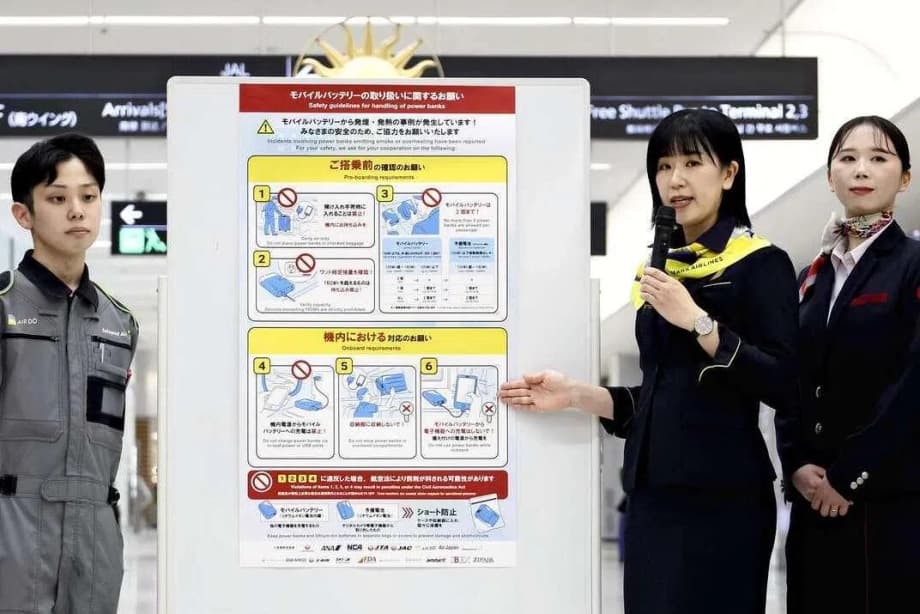
Japanese authorities have moved swiftly to implement public awareness campaigns ahead of the April 24 deadline. At Tokyo Haneda Airport, flight attendants and ground staff from the Scheduled Airlines Association of Japan distributed explanatory leaflets to travelers, clarifying the restrictions and requesting cooperation with the new safety protocols.
Airline check in counters now display prominent advisories regarding portable charger policies. Security screening processes have been adjusted to identify excessive quantities of power banks, with airport personnel authorized to confiscate devices exceeding the two unit limit or the 160 watt hour capacity restriction.
Legal enforcement extends beyond immediate confiscation. While first time offenders may receive warnings, repeated or serious violations can trigger prosecution under Japan’s Civil Aeronautics Law. The potential two year prison sentence and substantial financial penalties reflect the government’s determination to treat battery safety with the same gravity as other aviation security threats.
Passengers arriving in Japan on foreign carriers should note that the rules apply based on departure location rather than airline nationality. A flight operated by an American carrier departing Tokyo would be subject to Japanese regulations, while the same flight departing Los Angeles would follow FAA guidelines, though most major airlines are harmonizing their policies globally.
The Essentials
- Japan bans all use and charging of portable power banks on flights effective April 24, 2026, applicable to all flights departing from or arriving at Japanese airports including transit passengers
- Passengers limited to two power banks per person, each with maximum capacity of 160 watt hours; devices must be stored in carry on baggage within reach, not in overhead bins
- Violations can result in imprisonment up to two years or fines of one million yen (approximately $6,300 USD)
- Regulations follow International Civil Aviation Organization standards adopted March 2026 and align with similar restrictions implemented by South Korea, Singapore, Hong Kong, Taiwan, and major US and European carriers
- Pre charge devices before boarding, verify watt hour ratings on batteries, and prepare alternative entertainment for long flights without mid air charging capabilities