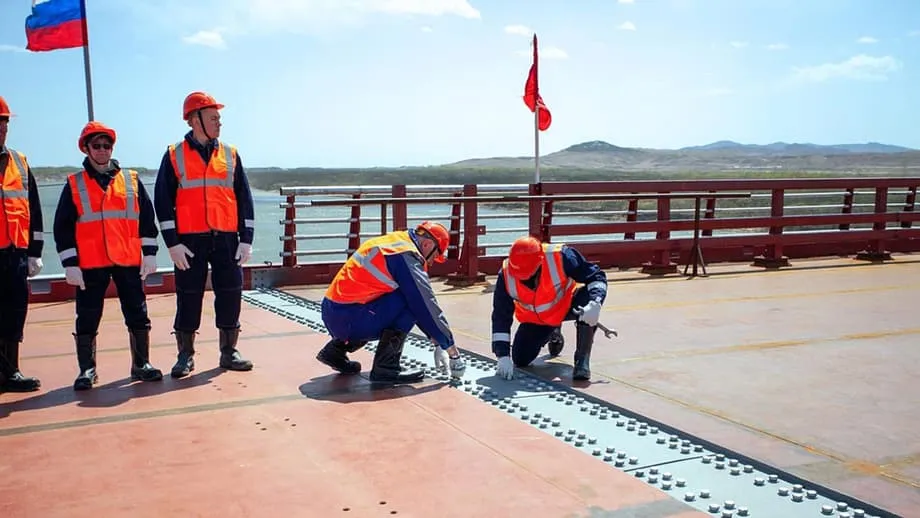
A New Crossing Takes Shape on the Tumen River
Russia and North Korea joined the two halves of their first dedicated road bridge on April 21, 2026, creating a physical connection across the Tumen River ahead of a planned opening to traffic on June 19. The Khasan-Tumangang bridge will have capacity for up to 300 vehicles and 2,850 people a day, according to Russia's Transportation Ministry.
Contents
- A New Crossing Takes Shape on the Tumen River
- What Has Been Built?
- How Construction Advanced So Quickly
- Customs Facilities Will Shape How Goods Move
- A Second Route Alongside Busy Railway Traffic
- Why the Bridge Matters to the Alliance
- Contractor Questions and Damage Around Khasan
- China's River Access Adds a Regional Complication
- Economic Hopes Extend Beyond the Border
- The Essentials
The ceremony on Tuesday celebrated the structural joining of the crossing, rather than its opening to drivers. Moscow described the occasion as a "landmark stage" in relations between the two countries, whose growing economic and military cooperation has developed under extensive international sanctions.
The bridge spans the river marking their border in Russia's Far East. Until now, their only permanent connection has been a railway bridge. A dedicated road crossing will give trucks and other vehicles a direct route between the neighboring countries, with substantially greater convenience and capacity for road traffic than the existing railway connection.
Russian Transport Minister Andrey Nikitin presided over the ceremony by video link. He described the project as a historic change in transport between the countries:
Direct road traffic will appear between the countries for the first time. The most important stages of construction have been completed in less than a year.
The project follows agreements reached during Russian President Vladimir Putin's visit to Pyongyang in June 2024. Its rapid construction reflects the priority both governments have given to a transport link that can carry trade, people and supplies alongside the existing railway. As of April 30, the scheduled opening remained June 19, with customs and other border infrastructure also forming part of the development.
What Has Been Built?
The bridge itself measures approximately 850 meters to 1 kilometer, depending on which parts of the structure are included in the measurement. The entire crossing, including its approach ramps, extends nearly 5 kilometers. Two traffic lanes have a combined width of seven meters, allowing standard vehicles to travel in both directions.
Russian authorities said construction required 5,000 tons of metal structures and more than 9,000 cubic meters of concrete. The project cost approximately 9 billion rubles, equivalent to roughly $111 million at the exchange rate cited for the project.
The crossing will connect with Russia's highway system and reduce the distance between Vladivostok and North Korea's border city of Rason to 320 kilometers. For road transport, the practical change is straightforward: vehicles will have a dedicated crossing between Russia and North Korea instead of relying on special arrangements at a railway bridge or routes through another country.
Construction formally began with a groundbreaking ceremony in April 2025, although preparatory work had started in November 2024. The structural joining therefore came about a year after the formal start, while the broader effort had already been under way for several months before that ceremony.
How Construction Advanced So Quickly
Satellite imagery tracked the narrowing gap between the bridge's two sides. Images from February 2026 showed approximately 210 meters still separating the bridge decks. By March 10, images with greater detail indicated that the sections had either connected or were separated by only a small gap. The April 21 ceremony formally celebrated their joining.
Workers also altered the river's flow while building the foundations. Accounts from January 2026 described temporary dams that directed the water through an opening just 40 meters wide as crews established the bridge footings, the foundations supporting the structure.
The Russian side employed 70 workers and 30 pieces of equipment in the construction operations. North Korea established a temporary aggregate plant near the site to support materials production. Aggregate consists of materials such as crushed stone and gravel used in construction.
The main dates show how the bridge developed alongside the countries' wider political relationship:
- June 2024: Putin visited Pyongyang, where the leaders reached agreements behind the bridge project and signed a strategic partnership treaty.
- November 2024: Preparatory work began.
- April 2025: A groundbreaking ceremony marked the formal start of construction.
- January 2026: Construction accounts described temporary dams channeling the river through an opening 40 meters wide.
- February 2026: Satellite imagery showed a gap of around 210 meters between the bridge decks.
- March 10, 2026: Images indicated that the decks had connected or nearly connected.
- April 21, 2026: Russia and North Korea celebrated the structural joining.
- June 19, 2026: The bridge is scheduled to open to traffic.
- December 31, 2026: The completion deadline set in the Russian contractor assignment falls later than the planned opening.
Customs Facilities Will Shape How Goods Move
North Korea is constructing a port of entry complex covering approximately five square kilometers. The development includes six buildings: a customs house, a warehouse, a facility for maintaining motor vehicles and several support buildings. A large surrounding parking area is designed to serve as a truck transfer facility.
The arrangement resembles North Korea's crossing with China between Wonjong-ni and Quanhe, approximately 20 kilometers to the northwest. At crossings of this kind, foreign trucks typically enter a controlled border area but cannot continue into the North Korean interior.
Goods instead change vehicles at border warehouses. North Korean trucks then carry them farther into the country. This gives Pyongyang control over foreign vehicle access while allowing cargo to pass across the border.
Russia is building a larger customs area and a new road corridor extending approximately 1.9 kilometers from the existing highway serving Khasan to the bridge. The route runs east around the Khasan railway facilities. A helicopter landing pad approximately 300 meters north of the Russian construction site suggests provision for officials and other priority passengers.
The bridge and the customs facilities perform different jobs. The bridge carries vehicles across the river; the border buildings provide places to inspect cargo, process travelers and transfer goods. Together, they will determine how the planned daily capacity translates into actual journeys and deliveries.
A Second Route Alongside Busy Railway Traffic
The new road bridge will supplement the Korea-Russia Friendship Bridge, a railway crossing commissioned in 1959 to replace a temporary wooden bridge. The older structure stands immediately downstream from the point where the borders of China, North Korea and Russia meet.
The Friendship Bridge has dual gauge tracks, meaning it accommodates both Russia's broad railway gauge and North Korea's standard gauge. Gauge is the distance between the rails. Planks can be placed between the tracks to allow limited vehicle crossings by special arrangement, but the bridge primarily serves trains and lacks the capacity and convenience of a dedicated road route.
The railway also carries a communications connection. In October 2017, a fiber optic cable running across the bridge gave North Korea an additional internet connection through Russia's TransTelekom, reducing its dependence on connectivity through China.
Railway use was suspended during the COVID-19 pandemic and resumed in November 2022. More recent activity indicates that the road bridge is being added to an already active transport corridor.
Satellite imagery from October 2025 showed freight trains moving between Khasan and Tumangang. The southern classification yard at Tumangang, where railway vehicles are sorted and assembled into trains, contained nine locomotives, 11 ore cars and 65 tank cars. The tank cars outnumbered the ore cars by almost six to one in that snapshot.
The continued railway activity points to a network with two forms of transport serving the border. Trains can continue carrying freight while the road crossing adds a direct route for vehicles and travelers.
Why the Bridge Matters to the Alliance
Russia's Foreign Ministry said the crossing's importance "goes far beyond a purely engineering task" and described it as an artery for "trade, economic and humanitarian exchanges" between the countries.
The project is taking shape as both governments face extensive international sanctions. Their closer relationship gives each a partner willing to expand trade and transport connections despite those restrictions.
Putin's June 2024 visit produced a "comprehensive strategic partnership treaty" containing mutual defense provisions. Such provisions set out commitments for the countries to assist each other in a military emergency. The bridge is a physical addition to a relationship that has also developed through security agreements and military cooperation.
Since Russia's invasion of Ukraine in 2022, Western intelligence agencies have repeatedly accused North Korea of supplying Russia with artillery shells, ballistic missiles and other munitions in exchange for economic assistance and technological support.
North Korea has also reportedly sent thousands of soldiers to fight alongside Russian forces in the Kursk region following a Ukrainian incursion. The road project has advanced during this expansion of military ties.
A direct vehicle route can speed the movement of goods and resources and provide another channel for potential military supplies. Its strategic value lies partly in giving the countries an additional way to move cargo, alongside the railway already connecting them.
Contractor Questions and Damage Around Khasan
Russian Prime Minister Mikhail Mishustin assigned the construction work to TonnelYuzhStroi, a company legally registered in Sochi, with a completion deadline of December 31, 2026. That deadline is later than the announced June 19 opening target.
Investigative reporting described TonnelYuzhStroi as a front for BTS-Most, a firm run by Chechen businessman Ruslan Baisarov, a confidant of regional head Ramzan Kadyrov. TonnelYuzhStroi officially employed only four people, had a history of financial losses and lacked a record of successful projects at the national level.
The contracting arrangement prompted concerns about opportunities for embezzlement in a project worth millions of dollars. At the same time, the strong Kremlin connections of BTS-Most were viewed as giving the work access to resources and political backing that could help secure completion on schedule.
Residents near the Russian settlement of Khasan complained about a more immediate cost. Heavy machinery and large trucks reportedly destroyed the main gravel road, making travel difficult for local drivers.
The complaints show how the construction timetable affected nearby communities. While the bridge received high political priority, residents described damage to the existing road they depended on for ordinary journeys.
China's River Access Adds a Regional Complication
China has long sought direct access to the Sea of Japan along the Tumen River. The location of the new crossing near the meeting point of the three countries' borders makes the project relevant to that ambition as well as to Russian and North Korean trade.
The existing railway bridge has low clearance, limiting navigation beneath it. The new road crossing will also impede China's navigation ambitions, adding another structure across the river route Beijing would need to use.
Russia and North Korea are therefore building a connection that brings them closer while potentially complicating a transport objective held by China. This creates a possible point of tension within an otherwise cooperative relationship among the three countries.
For Pyongyang, the road also offers an economic route that bypasses Chinese territory. Access to Russian markets and Pacific ports gives North Korea another external connection and reduces its dependence on China as a gateway for trade.
The benefit is both practical and political. A wider choice of transport routes can diversify North Korea's economic partnerships and reduce its vulnerability to pressure from Beijing, even as China remains part of the wider regional relationship.
Economic Hopes Extend Beyond the Border
South Korean officials have warned that support from Russia and China is helping revive North Korea's economy after decades of international isolation and sweeping sanctions. The new crossing gives that expanding support a permanent transport route.
Russia gains broader access to North Korean labor and resources, along with an eastern outlet for trade that can circumvent Western sanctions. North Korea gains a direct road connection to a partner offering economic assistance and technological support, without having to send that traffic through China.
Diplomatic activity around the time of the bridge announcement also showed cooperation extending into civilian affairs. During the week of the announcement, Russian Interior Minister Vladimir Kolokoltsev met North Korean officials in Pyongyang. Russian Health Minister Mikhail Murashko attended a hospital construction ceremony in Wonsan.
Those visits placed interior security, healthcare and civilian infrastructure alongside the military dimension of the partnership. The bridge belongs to that broader effort to make the relationship function through regular exchanges, buildings and transport links.
The next announced milestone is June 19, when road traffic is scheduled to begin. Structural joining has created the physical connection; the planned opening will bring the new crossing into use for vehicles and people, supported by the customs facilities being developed on both sides.
The Essentials
- Russia and North Korea celebrated the structural joining of the Khasan-Tumangang road bridge on April 21, 2026. Traffic is scheduled to begin on June 19.
- The bridge measures approximately 850 meters to 1 kilometer. With approach ramps, the crossing extends nearly 5 kilometers.
- The project cost approximately 9 billion rubles, or roughly $111 million, and is designed to handle 300 vehicles and 2,850 people daily.
- The crossing will supplement the Friendship Bridge railway link, commissioned in 1959, and reduce the Vladivostok-Rason road distance to 320 kilometers.
- New customs facilities will support cargo processing and transfers, including a North Korean complex covering approximately five square kilometers.
- The project follows agreements reached during Putin's June 2024 visit and accompanies closer military cooperation, reported weapons supplies and North Korean troop deployments to the Kursk region.
- Contractor arrangements raised concerns about embezzlement, while Khasan residents complained that construction traffic damaged their main gravel road.
- The crossing gives North Korea a route independent of Chinese territory while adding a complication to China's ambitions for navigation along the Tumen River.