Anime Takes a Central Role at Toho
Toho Co., Ltd. plans to raise its annual anime output from approximately 14 cours to 30 by 2032, with an interim target of 20 by February 2029. The Japanese entertainment conglomerate announced the expansion on April 14, 2026, during its financial results presentation for the fiscal year ending February 2026.
Contents
- Anime Takes a Central Role at Toho
- What 30 Cours Means in Practice
- The Milestones Through 2032
- Internal Studios and Outside Investments
- Why Publishers Matter to the Plan
- A Calendar Led by Returning Franchises
- Studio Kai Shows the Financial Pressure
- The Workforce Behind Every Episode
- A Growing Market With Fragile Producers
- Creative Quality and the AI Debate
- Growth Depends on More Than a Larger Slate
- The Bottom Line
For a company long associated with cinema and the Godzilla franchise, the announcement marks a substantial change in priorities. Toho described anime as its new corporate "pillar," moving it ahead of the film division in strategic importance and positioning it as the primary driver of its business.
Toho used the following phrase at its financial presentation to describe the next stage of anime production:
full blown mass production phase
The plan would more than double the company's current annual output. It also puts Toho's growth ambitions alongside a difficult reality for Japanese animation: studios are struggling financially, animators face demanding working conditions, and production teams are already stretched.
Toho wants the expansion to support a continuing flow of intellectual property, often shortened to IP. In this context, that means stories, characters and franchises that can earn money through successive anime seasons, global streaming, merchandise licensing and international distribution.
The strategy seeks to reduce dependence on established franchises such as Godzilla by building a system that can regularly develop new hits. It reflects a broader shift in entertainment consumption, with streaming platforms and serialized stories increasingly displacing traditional theatrical releases as the main sources of audience engagement and revenue. Toho's challenge is to turn that demand into sustained growth while securing the people and studios needed to make the programmes.
What 30 Cours Means in Practice
A cour is a broadcast block lasting roughly three months, usually containing about 12 episodes. It is a useful measure of production volume because an anime series may run for one cour, continue for several, or return after a break.
Toho currently produces approximately 14 cours annually, according to the industry analysis accompanying the announcement. Moving to 30 would represent an increase of about 114%. At roughly 12 episodes per cour, the final target translates into around 360 episodes a year.
That volume is equivalent to approximately seven different series airing simultaneously during any given broadcast season. It would require the company to sustain numerous productions across different genres and audiences, rather than rely on occasional animation projects alongside its film business.
Each cour draws on hundreds of animators, directors, writers, voice actors and specialists responsible for completing the sound and images. Increasing the number of broadcast blocks therefore requires much more than adding titles to a release calendar. It requires enough creative teams and production capacity to complete those titles on schedule.
The expansion is among the most ambitious efforts to increase output in Japanese animation and places Toho alongside major growth initiatives from competitors such as Toei Animation. Its proposed industrial approach puts greater weight on production volume and market presence than the traditional model of smaller studios developing individual projects over long periods.
The Milestones Through 2032
February 2029 is the first major checkpoint in Toho's plan. The company intends to reach 20 cours annually by then before increasing output to 30 by 2032. The roadmap describes a phased expansion over a seven year horizon.
The main milestones are:
- April 14, 2026: Toho announces its anime expansion strategy during the financial results presentation for the fiscal year ending February 2026.
- February 2029: Annual production is targeted to reach 20 cours, up from approximately 14.
- 2032: Annual production is targeted to reach 30 cours, equivalent to roughly 360 episodes.
The schedule allows an initial period of roughly three years to build capacity before a further increase toward the final target. Its timing also coincides with industry projections of continued anime market growth, particularly in North America, Southeast Asia and Latin America.
Internal Studios and Outside Investments
Toho is pursuing two routes to greater production capacity: strengthening studios within its own business and investing in outside partners. Its internal plans centre on TOHO animation STUDIO and Science SARU.
Science SARU, known for Devilman Crybaby and Keep Your Hands Off Eizouken!, is being developed into a larger production hub capable of handling more intellectual property. That represents a change from its earlier identity as a smaller operation shaped closely by its creators and their artistic approach.
The studio's forthcoming projects include a new Ghost in the Shell adaptation scheduled for July 2026, A Witch Life in Mongol, also scheduled for July 2026, and Dandadan Season 3, targeting a release in 2027. Together, those productions show its growing role in major franchises and commercially prominent series.
Toho has also acquired a stake in Studio Orange, the animation house known for Beastars and Trigun Stampede. Orange's computer generated animation methods give Toho access to another production approach while spreading its exposure across multiple companies.
The investment strategy matters because Toho acts as a production coordinator as well as developing its own studio capacity. Partner studios remain central to turning its plans into finished animation. A larger slate depends on those relationships as much as on the resources inside Toho itself.
Why Publishers Matter to the Plan
Toho sees its combined planning, distribution and marketing operations as a competitive advantage. Bringing those functions under one corporate umbrella, the company argues, helps it obtain stronger source material from publishers earlier in development.
Successful adaptations such as The Apothecary Diaries and Frieren: Beyond Journey End have strengthened its relationships with manga and light novel publishers. Manga are comics, while light novels are prose books that frequently provide stories for anime adaptations.
Those relationships can help Toho acquire promising properties before competitors have an opportunity to bid. The intended result is a continuing supply of stories that can support new seasons, films and licensed products.
Toho's growth model therefore extends beyond producing more episodes. It seeks to connect the selection of a story with its animation, promotion, distribution and subsequent commercial life. Streaming, merchandise and overseas audiences are intended to provide continuing revenue rather than leave the company dependent on domestic cinema releases.
A Calendar Led by Returning Franchises
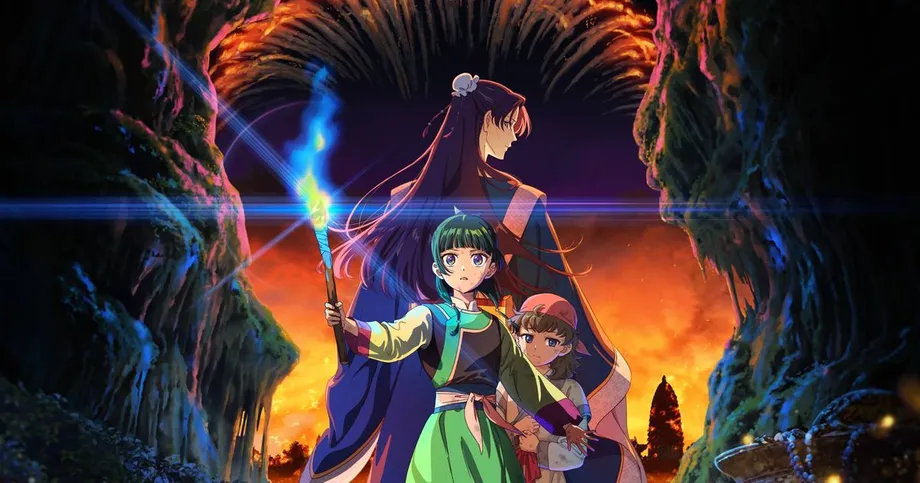
The Apothecary Diaries is one of the clearest examples of Toho's expanding franchise strategy. Season 3 is scheduled in two parts, beginning in October 2026 and April 2027, while a theatrical film is planned for December 2026.
Frieren: Beyond Journey End Season 3 is confirmed for October 2027 and will cover the Golden Land Arc. Haikyu!! The Movie: VS The Little Giant is also targeting 2027, adding another cinema release to a schedule that increasingly combines television and film projects.
Several other major properties have nearer release windows. Mushoku Tensei III: Jobless Reincarnation is scheduled for July 2026. Dr. STONE SCIENCE FUTURE Cour 3 is airing in April 2026, while Dorohedoro Season 2 is scheduled for streaming in the same month. Additional My Hero Academia episodes are due to begin in May 2026.
BEASTARS FINAL SEASON Part 2 has a March 2026 release slot. The Angel Next Door Spoils Me Rotten Season 2 and Snowball Earth are listed for April 2026, and Though I Am an Inept Villainess is scheduled for July 2026.
Projects further along the development pipeline include Spice and Wolf Season 2, a Godzilla anime series and the final arc of Kaiju No. 8. These are at various stages of production, without release dates specified in the announcement's accompanying account.
The calendar shows how Toho's production strategy is taking shape before the 2029 checkpoint. Multiple prominent franchises are receiving new instalments at the same time or within a short period. That density also creates competition for viewers within Toho's own portfolio, especially when several series arrive during an already crowded broadcast season.
Studio Kai Shows the Financial Pressure
Studio Kai declared insolvency earlier in April 2026, with debts exceeding 565 million yen, approximately $3.54 million. Its financial crisis came despite producing Sentenced to Be a Hero, which debuted in January 2026 and earned acclaim as one of the year's standout series.
The studio was founded in June 2019 and gained prominence after taking over production of Umamusume: Pretty Derby Season 2 from PA Works. Its recent difficulties show how a studio can attract praise for its animation while remaining financially vulnerable.
Following the reception of Sentenced to Be a Hero, Studio Kai attempted to build on that momentum with three more projects released within days of one another: The Ramparts of Ice, Snowball Earth and Mistress Kanan Is Devilishly Easy.
The clustered launches divided audience attention among the studio's own titles while those programmes also competed with the wider spring anime schedule. The release strategy was described as having backfired, leaving the studio in financial failure despite producing commercially successful content.
Studio Kai's experience brings the economics of increased output into focus. More productions can mean more opportunities to reach viewers, but they also bring simultaneous demands on money, staff and audience attention. Successful content and strong production quality can coexist with severe financial strain.
The company's collapse illustrates the concern that excessive output can reduce the attention and value available to individual properties. For Toho, whose schedule also includes Snowball Earth, the episode places the condition of partner studios directly alongside its own expansion plans.
The Workforce Behind Every Episode
Japanese animation studios faced a record number of closures and bankruptcies in 2025, according to industry reports. That financial instability sits alongside a chronic shortage of workers and longstanding concerns about working conditions.
Animators frequently work extended overtime for pay below the level needed to meet living costs in Tokyo, where many studios are concentrated. The industry's reliance on freelance animators paid for each drawing also creates unstable incomes and discourages new talent from entering the profession.
MAPPA, the studio behind major hits including Jujutsu Kaisen and Chainsaw Man, has faced severe criticism over staff burnout and production schedules described as unsustainable. Its experience illustrates the pressure that can accompany commercially prominent anime.
Toho's position as a production coordinator makes the availability of workers at partner studios particularly important. Each additional cour requires animation teams, including outsourced contributors, in an industry where many teams are already operating at capacity.
Studios are increasingly using joint production arrangements to spread financial responsibility across several companies. Industry observers describe these partnerships as a way to reduce the risk of insolvency as well as a means of creative collaboration.
A Growing Market With Fragile Producers
The global anime industry was put at $462 billion in 2025 in the industry estimate cited alongside Toho's plans. At the same time, the studios making the animation operate on margins described as so thin that a single production failure can lead to bankruptcy.
Toho's strategy rests on capturing more of the value generated by streaming, licensed merchandise and international audiences. The financial conditions at production studios show why rising demand and growing market value can exist alongside instability among the companies doing the creative work.
The proposed expansion assumes that the animation labour market can absorb more than twice Toho's current production demand within seven years. Chronic shortages, weak pay and demographic trends in the Japanese animation workforce make that assumption a central concern.
Strengthening internal studios and investing in partners provides a route toward greater capacity. The practical test will be whether enough people, time and financing are available to support the production calendar as it grows from approximately 14 cours to 20 and then 30.
Creative Quality and the AI Debate
Industry commentators have reacted skeptically to Toho's trajectory, focusing on market saturation and the danger of sacrificing creative quality for volume. Discussion forums and industry analysis have described the mass production approach as potentially destructive.
An industry analyst criticizing the strategy cited expected technological disruption and crowded markets, describing it as a:
terrible business move
Community concerns centre on the effect of an assembly line approach to animation. Anime's appeal has often depended on individual directors and animators developing distinctive visual styles. A system driven by output targets risks producing more uniform programmes aimed primarily at streaming platform algorithms rather than artistic expression.
Artificial intelligence has added another layer to the debate. Some industry watchers predict that animation tools assisted by AI could disrupt traditional production methods by 2029, potentially making parts of Toho's current infrastructure investment obsolete.
Toho has not announced plans to use AI in this expansion. The scale of its targets has nevertheless prompted expectations that some form of technological efficiency beyond traditional manual animation will be needed.
The creative concern reaches beyond production methods. Toho wants a repeatable system for generating hits and reducing dependence on older properties such as Godzilla. Entertainment successes often emerge unpredictably from distinctive creative ideas, making that ambition difficult to reconcile with a process organized chiefly around volume.
Growth Depends on More Than a Larger Slate
Toho's plan brings together a larger release calendar, stronger internal studios, investments in external partners and closer relationships with publishers. Its forthcoming projects demonstrate that the shift toward anime is already visible in production decisions.
The February 2029 target of 20 cours will be the first major measure of progress toward 30 by 2032. Meeting those milestones requires both the capacity to finish more animation and a commercial structure that can sustain the studios and workers producing it.
Studio Kai's insolvency, record studio failures in 2025 and criticism of demanding production schedules provide the immediate context for the expansion. Toho is seeking growth in an industry with global demand and recognizable franchises, but also a strained production base.
The central tension is between corporate growth and creative sustainability. Toho's planned network of studios and partners is intended to support a continuing stream of new properties. Its success will depend on whether that network can maintain distinctive work, manage simultaneous productions and earn lasting revenue from the resulting stories.
The Bottom Line
- Toho announced its anime expansion strategy on April 14, 2026, making anime its new corporate pillar ahead of film.
- Annual production is targeted to rise from approximately 14 cours to 20 by February 2029 and 30 by 2032, an increase of about 114%.
- Thirty cours would amount to roughly 360 episodes annually, or approximately seven series airing simultaneously in a broadcast season.
- Toho is strengthening TOHO animation STUDIO and Science SARU and has invested in Studio Orange.
- Major forthcoming projects include The Apothecary Diaries Season 3, Frieren: Beyond Journey End Season 3 and Haikyu!! The Movie: VS The Little Giant.
- Studio Kai declared insolvency earlier in April with debts exceeding 565 million yen despite producing acclaimed and commercially successful anime.
- Worker shortages, low pay, demanding schedules and record studio failures form the backdrop to the production targets.
- Toho aims to build continuing revenue through streaming, merchandise licensing and international expansion while developing new hits beyond legacy franchises.