A Sunday Market That Spills Across the City
Every Sunday, hundreds of thousands of shoppers gather along three and a half miles of streets in central Seoul, searching through a market that stretches across approximately 30 city blocks and countless side alleys. Around Sinseol-dong and Dongmyo, vintage military clothing, antique watches, old cigarette cartons and electronic gadgets compete for attention. Some of the electronics work. Others are a gamble.
Contents
- A Sunday Market That Spills Across the City
- How Survival Trading Became a Seoul Tradition
- Inside Sinseol-dong's More Orderly Market
- Dongmyo Has a Different Rhythm
- How Local Clothing Reached International Fashion
- The Sellers Behind the Stalls
- Buying Means Making Decisions Quickly
- Cash, Dust and Searches After Dark
- Why Street Trading Persists Beside the Indoor Market
- Decades of Change Remain Visible in the Goods
- What to Know
The gathering is one of the world's largest unofficial flea markets held outdoors. Permanent shops form part of it, but so do sellers spreading clothes, kitchenware and skincare products across sidewalks and traffic islands. The market operates throughout the year, regardless of the weather, with Sundays bringing the greatest number of vendors.
Locals and tourists move through this sprawling shopping district together. Some are looking for something useful at a low price. Others want a collectible, an unusual garment or an object whose value its seller may have overlooked. Piles of merchandise make rummaging part of the transaction: the shopper must find the item before deciding whether to buy it.
Authorities patrol in vans, broadcasting warnings through loudspeakers that unauthorized sellers must clear the streets. Yet the weekly gathering has grown beyond their capacity to enforce those demands fully. The resulting scene combines organized retail, informal livelihoods and the constant negotiation of space.
At its center is a contrast that shapes the entire experience. Seoul has a purpose-built indoor market with designated sections and small shops, while the surrounding streets sustain a much less orderly marketplace. Together, they trace a commercial history stretching from survival after the Korean War to today's enthusiasm for vintage fashion.
How Survival Trading Became a Seoul Tradition
The market's roots reach back to the aftermath of the Korean War in the 1950s, when poverty drove people to sell their belongings to survive. Trading that began as a way to meet immediate needs developed into an enduring culture of street vending.
Merchants repeatedly moved as redevelopment changed the capital. The market occupied streets along Cheonggyecheon Stream in Hwanghak-dong, then found a temporary home at the old Dongdaemun Stadium before moving to its present indoor location. Each move changed where people traded, without bringing every seller into the same space.
The Seoul Folk Flea Market opened in 2008 on the former site of Sungin Girls' Middle School on Cheonggyeo 8-ga Street. City government records put the construction cost at approximately 13 billion won, or $9.4 million. The building covers 54,422 square feet and houses 851 small shops across two floors.
Some vendors declined to move indoors during the relocations. Instead, they spread west toward Dongmyo Station and east along the stream. Those decisions helped create the extensive street market visitors encounter today.
The main stages of that history are:
- 1950s: People began selling personal belongings amid poverty after the Korean War.
- 1950s and 1960s: U.S. military surplus discarded by American bases became part of the trade.
- Later relocations: Merchants moved from Hwanghak-dong along Cheonggyecheon Stream to the old Dongdaemun Stadium.
- 2008: The present Seoul Folk Flea Market opened at the former school site.
- 2018: Designer Kiko Kostadinov drew attention to Dongmyo through Instagram stories.
- 2024: Kostadinov's subsequent collections with Prada and Asics reflected inspiration from the area's military clothing.
Merchants describe themselves as nomads. The market also carries the nickname Dokkaebi Market, or Goblin Market, because broken objects seem to be repaired as if by magic. Another name, Ant Market, refers to the tireless work of its vendors.
Inside Sinseol-dong's More Orderly Market
Sinseol-dong provides the more organized starting point. The Seoul Folk Flea Market stands at 21 Cheonho-daero 4-gil and is accessible from Sinseol-dong Station on subway Lines 1 and 2, using Exit 9 or 10.
The building divides merchandise into sections identified by color. Yellow marks sundry goods, orange vintage clothing, red the food court, purple hobbies, blue clothing and indigo another sundry goods section. Green covers antiques and a broad assortment described as all things.
Workshops add another layer to the shopping. Master craftsmen repair musical instruments, leather goods and motorbike accessories. At times, an impromptu violin performance accompanies the browsing, bringing the work of repair and the pleasure of music into the same space.
The indoor market opens from 10:00 AM to 7:00 PM and closes on the second and fourth Tuesday of each month. Its regular schedule makes it accessible beyond the weekend, although the surrounding street spectacle reaches its peak on Sundays.
Management has also created Youth 1st Street on the second floor, using vintage cafes and opportunities to take photographs in school uniforms to attract younger visitors. The effort brings a different kind of nostalgia indoors, even as the crowded streets remain the main attraction for many shoppers.
Dongmyo Has a Different Rhythm
West toward Dongmyo Station, the market becomes dustier, louder and more overwhelming. Visitors can reach this area on subway Lines 1 and 6 through Exit 3 or 4. Corners and intersections fill with merchandise, and shoppers must work their way through piles rather than browse neatly arranged displays.
Dongmyo takes its name from a shrine built in 1601 during the Joseon Dynasty to honor the Chinese military commander Guan Yu. Around that historic landmark, the modern bazaar draws fashion designers, vintage enthusiasts and people willing to spend time digging for something distinctive.
Military surplus and camouflage clothing are especially important to the area's identity. Older residents wearing these garments helped shape a style that younger visitors now search out. University students also hunt for objects connected to popular culture from the 1970s.
The practical differences between the two districts matter. Sinseol-dong offers an indoor building with identifiable sections and workshops. Dongmyo rewards patience with crowded alleys and loosely arranged stock, but its dusty clothing piles make a face mask useful while searching.
How Local Clothing Reached International Fashion
Bulgarian designer Kiko Kostadinov brought international attention to the streets in 2018, posting Instagram stories that called the area the best street in the world. His images captured older locals wearing military clothing in combinations that later inspired his 2024 collections with Prada and Asics.
The appeal rests partly in seeing clothing as people actually wore it. Garments carry real wear and age, rather than distress deliberately added to make something new look old. Unlike a curated vintage boutique, Dongmyo allows shoppers to encounter that style among the people and goods that produced it.
Park, a student aged 22 who was visiting to hunt for patterns, connected the camouflage trend to older residents wearing military clothing around Dongmyo and Dongdaemun. For younger shoppers, the market offers both clothes to buy and ideas to study.
The vintage trend now running through Seoul's youth culture originated here, and Korean television programs have also featured the market. Its fashion influence grows out of a place where practical garments, personal taste and decades of reuse meet.
Regular visitors build a social routine around the search. They form chat groups to share discoveries and arrange meals after shopping. Si Hwa Lee, who has visited on Sundays after church services for 10 years, described the attraction:
It is addicting and exciting to see what unexpected things you could find every week.
Lee said some shoppers are professional resellers who buy an object for $20 and discover it is worth $650 online. That is more than 32 times the purchase price, explaining why an inexpensive item can attract serious attention. Others seek unusual pieces of Hollywood history, including movie props discarded by celebrities who lacked other ways to dispose of them.
The Sellers Behind the Stalls
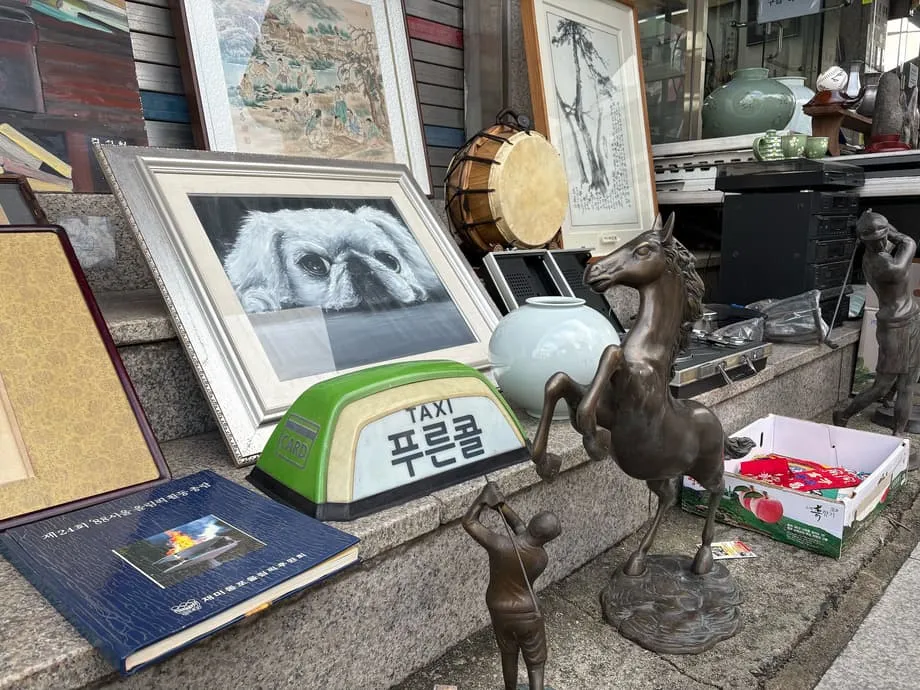
Changhoon Han runs a secondhand shop on the edges of Sinseol-dong. Watches, artwork, sculptures and taxi roof signs extend onto the sidewalk, though he takes care to keep them out of the road and avoid attracting the authorities. His shop sign reads, "We buy everything."
Han described a business sustained by changing interests, as one person's collection becomes stock for another buyer:
Once-avid collectors of all sorts have sold me their collections. Interest fades, items are sold and new collectors and trends take their place. It is a cycle.
Robert Kim draws customers to his small patches of leather by singing the Beatles' "Love Me Do." He has kept up the performance for six years, explaining that the COVID-19 pandemic encouraged him to live by the motto "you only live once."
Kim mainly chooses pop songs from the 1970s because his shoppers tend to be older. His music is both personal enjoyment and a way of catching the attention of people passing his goods.
Tae-sung Ha sells a particularly varied assortment, including disposable vapes, frying pans and axes six feet tall. His dealings with customers can be less tuneful. During a recent visit, a shopper threw a vape onto the ground, prompting Ha to intervene:
Hey, you do not throw others' belongings. Do not make me mad.
Courtesy can produce a different result. A woman bargaining for an egg frying pan secured a lower price simply by asking politely. In a market built around direct exchanges, the way a shopper approaches a seller becomes part of the sale.
Buying Means Making Decisions Quickly
A shopper examining a luxury brand watch spent 10 minutes asking questions, including whether it was genuine. The seller said he had no paperwork and offered it for far less than its retail price. The customer decided to return later.
Twenty minutes afterward, the shopper came back to find the seller putting the watch into a plastic bag for a competing buyer wearing a sly smile. The episode captures the pressure of a market where an interesting object may be the only one available at that stall.
The seller's lack of paperwork left the watch's authenticity uncertain. Buyers searching for branded goods must make decisions with whatever information the vendor can provide, while accepting that another customer may decide sooner.
Bargaining is expected, including over inexpensive purchases. Sales pitches can be theatrical: one hawker claims his goods bring pleasure in the bedroom, while another promises toned calf muscles. The persuasion is as varied as the merchandise.
Cash, Dust and Searches After Dark
Teenagers keep searching as evening falls, using smartphone flashlights to inspect mountains of watch dials and straps. Among thousands of pieces, they look for Louis Vuitton timepieces. A stall owner may loudly explain which watches are intended for men or women while the young customers giggle and continue looking.
Cash remains the predominant means of payment. Familiarity with Korean won denominations helps shoppers follow prices and negotiate directly, especially when moving between many small sellers.
A face mask can make rummaging through Dongmyo's dusty clothing piles more comfortable. Patience is equally useful, both for moving through crowded alleys and for sorting through merchandise that has little in common beyond sharing the same stretch of pavement.
Sundays offer the greatest concentration of sellers, although weekend activity extends beyond that day and the indoor market follows its own daily opening schedule. The market continues throughout the year and in all weather, so the experience is shaped by both the season and the particular goods brought out that week.
The range is unusually broad: vintage military gear, antique cigarette cartons, watches, kitchen utensils, artwork, leather scraps and possible movie props all circulate through the same commercial area. An item useful to one person may be a collectible to another, and a reseller may see a business opportunity where a casual visitor sees clutter.
Why Street Trading Persists Beside the Indoor Market
The Seoul Metropolitan Government spent billions of won on the indoor facility as part of efforts to move vendors out of the Cheonggyecheon Stream restoration zone. Nevertheless, sellers continue to occupy the edges of the stream each weekend.
City official Lee Byung-jin acknowledged complaints from residents about unauthorized vendors and said removing them was really difficult. Laws prohibit street vending in the refurbished stream area, while the market's popularity keeps drawing sellers and customers back.
Indoor stalls cost merchants approximately 50,000 to 60,000 won a month. Even with that relatively modest charge, many sellers prefer unauthorized outdoor positions because customers gather there. For those merchants, access to passing shoppers matters more than the order and shelter of an indoor stall.
The result is a continuing tension between the city's plans for public space and the trading habits that have developed over decades. Loudspeaker warnings, resident complaints and the formal market building all exist alongside a street economy that remains firmly embedded in the neighborhood.
Decades of Change Remain Visible in the Goods
Some vendors have spent 30 years in this commercial community and survived three major relocations. Their experience connects the present market to earlier versions of the same trade, even when the location, customers and most desirable objects have changed.
The stock has shifted from U.S. military surplus discarded by American bases in the 1950s and 1960s to antiques, LP records and today's demand for vintage fashion. Those changes reflect Korea's movement from scarcity after the war through industrial growth and into nostalgia in the digital age.
Objects carry that history in everyday forms. Military garments once valued for practical use become fashion references. Records become collectibles. Collections assembled over years return to circulation when their owners lose interest, making room for another generation of buyers.
Han's description of a cycle applies across the market: belongings change hands, tastes change and new collectors arrive. The indoor shops give part of that trade a permanent address. The Sunday streets preserve its restless character, with the next find waiting somewhere among the crowds, workshops and piles.
What to Know
- The Sunday market spans three and a half miles, approximately 30 blocks and numerous alleys around Sinseol-dong and Dongmyo.
- Hundreds of thousands of people visit on Sundays, when seller numbers peak. Street trading continues throughout the year regardless of weather.
- The Seoul Folk Flea Market opened in 2008 and houses 851 shops in a building covering 54,422 square feet.
- The indoor market is at 21 Cheonho-daero 4-gil, near Sinseol-dong Station, Lines 1 and 2, Exit 9 or 10.
- Indoor hours are 10:00 AM to 7:00 PM, with closures on the second and fourth Tuesday of each month.
- Dongmyo's outdoor market is accessible from Dongmyo Station, Lines 1 and 6, Exit 3 or 4.
- Cash, bargaining, patience and a face mask for dusty clothing piles are practical considerations for visitors.
- The market developed from trading after the Korean War and has moved repeatedly as Seoul redeveloped.
- Military clothing worn around Dongmyo helped inspire vintage trends and attracted international attention from designer Kiko Kostadinov.
- Unauthorized street vending continues despite enforcement efforts and the availability of indoor stalls.