
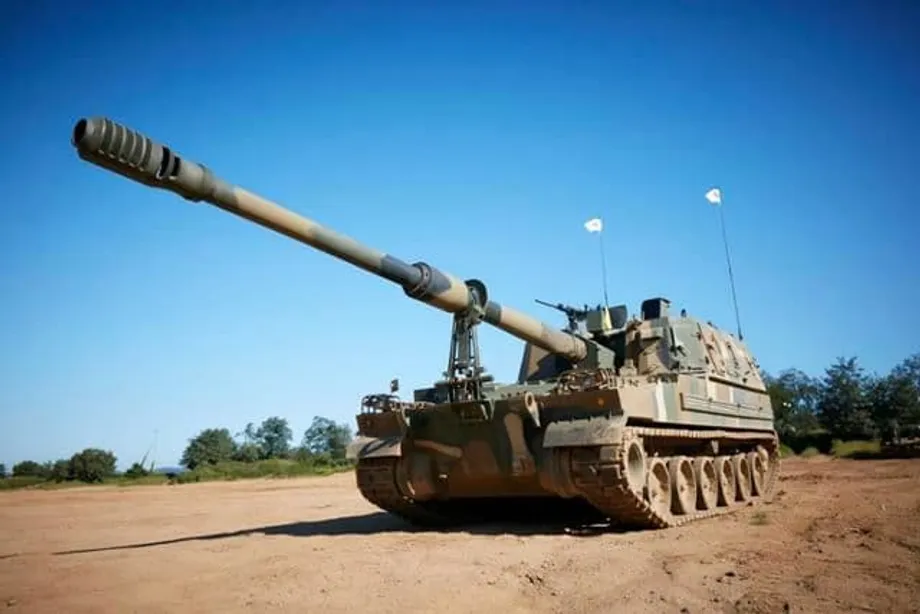
Artillery Partnership Sets the Stage for Wider Cooperation
India operates approximately 100 K9 Vajra T howitzers and plans to acquire another 100, placing a weapon developed in South Korea at the center of a defense partnership that is moving toward joint development of more advanced systems. Some of the guns have been deployed in northern Ladakh, where India faces China along a disputed Himalayan border.
Contents
- Artillery Partnership Sets the Stage for Wider Cooperation
- Why the K9 Vajra T Matters to India
- Border Clashes Shape the Demand for New Weapons
- What the Third Phase Would Involve
- Why Analysts Expect Sensitivity in Beijing
- Asian Defense Partnerships Are Becoming More Diverse
- South Korean Weapons Find Other Regional Customers
- Sharing Technology Requires Negotiation
- India Builds Several Partnerships at Once
- What to Know
South Korean President Lee Jae Myung and Indian Prime Minister Narendra Modi gave that partnership fresh political backing during their meeting in New Delhi in April 2026. The leaders announced an upgrade to economic cooperation covering shipbuilding, artificial intelligence and defense production. Lee expressed full support for India's Atmanirbhar Bharat initiative, which seeks to build domestic manufacturing capabilities and reduce dependence on foreign production.
Lee singled out the K9 Thunder howitzer as a model for future cooperation. Its Indian version, the K9 Vajra T, is manufactured in India through technology transfer from Seoul based Hanwha Aerospace. Technology transfer means sharing the knowledge needed to produce or adapt equipment, allowing a purchasing country to do more than receive finished weapons.
India and South Korea are now discussing air defense systems, antiaircraft guns and missile platforms. Indian officials describe the intended next stage as joint development and design, extending a relationship that has already moved from buying equipment toward making and adapting it together.
Analysts see strategic consequences for China, which remains involved in a border dispute with India. Their concern is that South Korean technology could strengthen India's military capabilities while connecting Seoul more closely to security partnerships that Beijing views with suspicion.
Why the K9 Vajra T Matters to India
The K9 Vajra T is a 155mm self propelled howitzer based on South Korea's K9 Thunder design. A howitzer is an artillery gun that can send shells toward distant targets along a high, curved path. A self propelled system carries the gun on its own vehicle, unlike towed artillery, which needs another vehicle to move it.
Indian production has involved adapting the South Korean design to the Indian Army's requirements in both desert and high altitude environments. Those adaptations make the K9 partnership more substantial than a simple purchase: the two countries have combined a foreign design with domestic manufacturing and changes for Indian operating conditions.
India's planned purchase of another 100 units would match the approximately 100 it already operates. The expansion would therefore roughly double the fleet, while continuing the manufacturing relationship that Lee presented as a template for further cooperation.
Ladakh gives the weapon a direct role in India's northern defenses. The systems deployed there add long range firepower along disputed borders and support military readiness amid continuing tensions with China and Pakistan.
In mountainous terrain, high angle artillery fire allows shells to clear ridges and descend into valleys. Self propelled howitzers provide an option for heavy firepower in all weather conditions when air support faces restrictions caused by weather or extreme altitude. Those conditions help explain why India has adapted the K9 for use beyond the desert environments for which its Indian configuration was initially suited.
Border Clashes Shape the Demand for New Weapons
The 2020 Galwan Valley clash sharpened India's attention to military readiness along its border with China. Indian and Chinese troops fought in hand to hand combat, producing the first casualties between the two sides in more than four decades. The deployment of artillery in Ladakh fits into India's effort to maintain the ability to respond along that frontier.
Tensions with Pakistan near disputed Kashmir escalated the following year, when both countries scrambled fighter jets and reportedly shot down each other's aircraft. The account also identifies a May 2024 conflict with Pakistan in which drones featured prominently, while analysts quoted about India's current defense needs refer to a clash with Pakistan last year.
The events and partnership milestones span several years:
- 2015: Indonesia joined South Korea's KF 21 fighter jet project, a partnership later affected by payment disputes and allegations involving technical data.
- 2020: Indian and Chinese troops clashed in the Galwan Valley, causing the first casualties between them in more than four decades.
- 2021: Tensions near disputed Kashmir escalated, with India and Pakistan scrambling fighter jets and reportedly shooting down each other's aircraft.
- May 2024: A conflict with Pakistan featured prominent use of drones.
- April 2026: Lee and Modi met in New Delhi and backed wider cooperation in defense production, shipbuilding and artificial intelligence.
India's requirements extend across land and air. Artillery strengthens its ability to support forces near disputed territory, while air defense is intended to deal with threats approaching from above. That combination helps explain the range of systems under discussion with South Korea.
What the Third Phase Would Involve
Periasamy Kumaran of India's Ministry of External Affairs outlined an intended "third phase" of defense industry cooperation during Lee's visit. The progression runs from direct acquisition, through increasing local production, to joint development, technology transfer and co design of the next generation of defense systems.
India and South Korea are discussing air defense systems, antiaircraft guns and missile platforms that could counter emerging aerial threats, including drones. Joint development would give India a role in shaping equipment from the design stage, while joint production would allow the countries to share manufacturing work.
Nishant Rajeev, a senior analyst at the S. Rajaratnam School of International Studies in Singapore, explained why India is interested in defenses that address several kinds of aerial attack.
As demonstrated by the conflict last year with Pakistan, India recognizes the need to develop a layered air defense system as well. India faces a multitude of threats from drones, cruise missiles and fighter aircraft. It is not clear what specific systems the two countries are looking to co develop or co produce, but it is definitely an area India will have a keen interest in.
A layered air defense system uses different weapons and detection equipment to address different threats. A drone, a cruise missile and a fighter aircraft can require different responses, so India is looking beyond a single type of defensive weapon. The specific systems to be jointly developed or produced have not been identified.
Rajeev sees the K9 arrangement as a likely template. It demonstrates that a South Korean system can be adapted for Indian terrain and manufactured domestically, giving the two countries a practical starting point for more demanding projects.
Why Analysts Expect Sensitivity in Beijing
China's border dispute with India makes the military side of the partnership especially sensitive. Analysts expect Beijing to consider both the additional strength of India's armed forces and the wider possibility that Seoul is becoming part of efforts to contain China.
Kang Jun-young, a professor of international relations at Hankuk University of Foreign Studies, described how Beijing is likely to assess the expanding relationship.
Beijing is highly likely to view defense and supply chain cooperation between South Korea and India very critically. This was because Seoul might be viewed as playing a substantial role in the US containment of China. In particular, as India is engaged in a border dispute with China, Beijing is inevitably sensitive to the fact that South Korea weapons systems could lead to an increase in India military power.
Jagannath Panda, head of the Stockholm Centre for South Asian and Indo Pacific Affairs, places the partnership within India's transition from importing arms to building industrial relationships. Panda also leads research on China's influence operations in the Indian Ocean region.
Panda argues that extending the K9 model to air defense guns and missile systems shows India increasingly values South Korea as a dependable technology partner. He describes the cooperation as "not merely commercial," connecting it to India's preparation for sustained competition with China on land and in the air, while maintaining readiness against Pakistan.
For Beijing, the concern described by these analysts therefore reaches beyond the number of guns India purchases. A manufacturing partnership can support further adaptation and production, giving the relationship a longer reach than an individual weapons delivery.
Asian Defense Partnerships Are Becoming More Diverse
India and South Korea are deepening cooperation amid wider changes in defense relationships across Asia. Both are middle powers seeking to preserve autonomy while larger powers compete for influence. Their partnership combines India's demand for military technology and domestic production with South Korea's growing defense industry.
The Atlantic Council has documented closer defense industrial cooperation among Russia, China, North Korea and Iran. Analysts describe their arrangement as the closest "defense industrial confederation of autocrats" in recent history, involving the sharing of sensitive technologies that threaten Western interests.
Research by the Lowy Institute on Southeast Asian defense partnerships points to another regional trend: countries are spreading their security relationships across several partners to reduce dependence on any one power. Australia, Japan, India and South Korea have increased their defense engagement with Southeast Asian countries through agreements, dialogues and combined military exercises since 2017.
India's work with South Korea fits that pattern of diversification. New Delhi gains another source of technology and industrial cooperation, while Seoul expands its relationships beyond its existing defense customers and development partners.
South Korean Weapons Find Other Regional Customers
LIG Defense & Aerospace recently secured a $94 million contract to export Haegung surface to air missile systems to Malaysia. The systems will be mounted on offshore patrol vessels built in Turkey. The deal was announced during the Defence Services Asia 2026 exhibition.
A surface to air missile is launched from land or a vessel to engage a target in the air. Malaysia's purchase gives South Korean air defense technology another role in the region, alongside the artillery cooperation already established with India.
Indonesia has also renewed its participation in South Korea's KF 21 fighter jet program. The Philippines has expressed interest in acquiring the advanced aircraft to deter incursions by China's air force.
The Malaysian contract, Indonesia's renewed participation and Philippine interest show the range of South Korea's regional defense activity. Its industry is pursuing naval air defense sales, aircraft development partnerships and potential fighter exports while discussing broader production arrangements with India.
Sharing Technology Requires Negotiation
South Korea's experience with Indonesia illustrates the difficulties that can accompany technology transfer. Jakarta joined the KF 21 project in 2015, but disputes over payments and alleged attempts to leak technical data created diplomatic friction.
The partnership was eventually restructured. Indonesia's financial contribution was reduced, and the scope of technology transfer was narrowed substantially. The arrangement shows how financial commitments and access to technical knowledge can become linked in negotiations over a shared weapons program.
Choi Gi-il, a professor in Sangji University's Department of Military Studies, explained why such negotiations depend on the wider relationship between the countries involved.
There is no fixed manual for this. Even if we have internal guidelines, they cannot simply be enforced on the other side. The counterpart will always push for more technology and concessions. This is inherently relational. It depends on diplomacy, bilateral relations and broader geopolitical factors.
For the KF 21, South Korea uses a "software and hardware" approach. It is willing to provide physical aircraft and basic documentation while retaining source codes for combat operations, electronic warfare programs and radar systems. Source code is the underlying set of computer instructions that determines how software works.
The K9 arrangement with India appears to have found a workable balance between domestic production and protection of core intellectual property, meaning the ownership of designs and technical knowledge. That model may guide future air defense cooperation as India seeks greater manufacturing autonomy and South Korea balances export revenue with security concerns.
India Builds Several Partnerships at Once
India's cooperation with South Korea is one part of a wider effort to diversify foreign direct investment and strategic relationships. New Delhi is also pursuing closer economic ties with Washington, Tokyo and European partners while seeking to strengthen its own industrial base.
A recent trade agreement with the United States aims to reduce bilateral tariffs and increase American exports to India. Disputes remain over access to India's agricultural market and its energy imports from Russia. Tariffs are taxes on goods brought in from another country, so reducing them can make those goods less expensive to sell.
India has sought South Korean investment in semiconductors, shipbuilding and clean energy, using dedicated startup funds and industrial corridors. Japanese investment continues to support infrastructure and high speed rail projects, while European partners are being courted for precision manufacturing and pharmaceutical ventures.
New Delhi also continues to purchase Russian crude oil despite Western sanctions, citing market prices and longstanding relationships. Its approach involves maintaining several relationships at once while pursuing domestic industrial upgrading through Make in India and Atmanirbhar Bharat.
Ian Hall, a professor of international relations at Griffith University in Australia, explained how South Korea fits India's military calculations.
India is certainly looking to improve military capabilities in multiple areas following the 2020 conflict with China and last year clash with Pakistan. South Korea would be a good partner, given the strength of its defense industry. If India can achieve a mutually satisfactory deal with South Korea, that could have a big long term impact on India capacity to deter threats from the north and west.
India's immediate foundation is the K9 manufacturing partnership. The next stage would apply that experience to other weapons, linking the search for stronger defenses with the goal of producing more military equipment at home.
What to Know
- Lee Jae Myung and Narendra Modi backed expanded cooperation in defense production, shipbuilding and artificial intelligence during their April 2026 meeting in New Delhi.
- India operates approximately 100 K9 Vajra T howitzers and plans to acquire another 100, roughly doubling the fleet.
- The K9 Vajra T is manufactured in India through technology transfer from Hanwha Aerospace and adapted for desert and high altitude conditions.
- The proposed third phase of cooperation covers joint development, technology transfer and co design, with air defense guns and missile platforms under discussion.
- Analysts expect Beijing to view the partnership sensitively because of China's border dispute with India and concerns about containment.
- South Korea's experience with the KF 21 program shows that access to technology depends on financial commitments, security protections and diplomatic negotiations.
- India is combining its South Korean partnership with relationships involving the United States, Japan, Europe and Russia while expanding domestic manufacturing.