A New Era in Ocean Exploration Begins in Shanghai
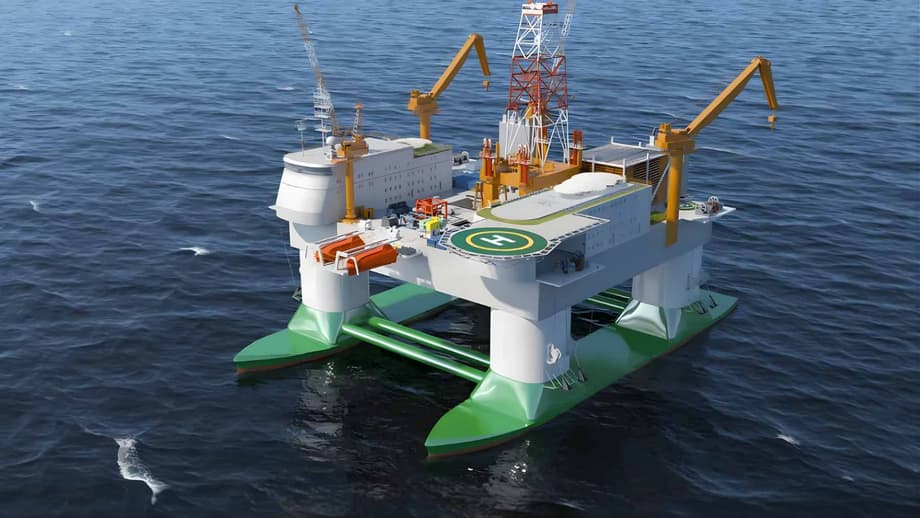
China has begun construction on a research platform that redefines the boundaries of ocean exploration. Dubbed the Open Sea Floating Island, this facility represents the world’s first ultra large deep sea floating research platform, officially launched in Shanghai as a major national science and technology infrastructure project. Developed by Shanghai Jiao Tong University, the platform merges the mobility of traditional research vessels with the stability of fixed offshore installations, creating a new category of scientific infrastructure designed to unlock mysteries at depths reaching 10,000 meters.
Standing roughly 30 stories high with a displacement of approximately 86,000 U.S. tons, the platform commands a deck area equivalent to two football fields. Its semi submersible twin hull configuration provides the physical foundation for extended missions, accommodating up to 238 researchers and support staff for roughly four months without resupply. This autonomy transforms the platform from a mere transport vessel into a self sustaining laboratory capable of conducting cross seasonal observations in remote oceanic regions.
The project addresses a specific gap in existing marine research capabilities. As explained by Xiao Longfei, the project’s chief engineer, China maintains various marine research facilities including deep sea test pools, research vessels, and submersibles. However, previous options forced scientists to choose between speed and stability. Conventional research ships can relocate quickly but struggle to maintain position in rough seas, while fixed oil rigs offer stability without mobility. The new platform integrates characteristics from both sectors, allowing rapid deployment to research sites followed by extended stationary operations.
Construction is scheduled for completion by 2030, positioning the facility to support a wide range of scientific and industrial applications. The university has established a dedicated institute for deep sea science and engineering to coordinate research activities, signaling long term institutional commitment to the project. When operational, the platform will serve as an open sea testing ground for technologies that cannot be adequately evaluated in near shore environments or laboratory simulations.
Engineering a Mobile City for the Sea
The engineering challenges overcome in designing this facility reflect decades of advances in offshore construction and naval architecture. The semi submersible twin hull design operates on principles similar to those used in offshore oil platforms, but with modifications that enable transit between research locations. Engineers developed a ballasting system that allows the platform to adjust its draft dynamically. To remain stable during operations, the hulls fill with water, positioning the structure lower in the water column to maximize wave resistance. When relocation becomes necessary, the system releases ballast water, allowing the platform to rise higher and maneuver like a conventional vessel.
This dual mode capability was tested extensively in Shanghai Jiao Tong University’s Deep Water Test Basin before construction began. Engineers subjected scale sized models to hurricane force winds and waves resembling tsunamis, validating the platform’s ability to withstand Level 17 typhoons with sustained winds reaching 250 kilometers per hour (approximately 155 miles per hour). The twin hull configuration distributes stress across the structure, reducing the pitching and rolling motions that typically disrupt scientific work during ocean storms.
At the center of the platform, a massive moon pool provides direct access to the water column. This opening, described as large enough to accommodate a fully grown blue whale, allows researchers to lower heavy equipment weighing up to 300 tonnes to depths of 6,000 meters. Such capacity enables testing of full scale deep sea mining systems, remotely operated vehicles, and other heavy marine equipment that would be impossible to deploy from conventional research vessels.
The facility comprises three integrated systems working in concert. The main platform serves as the primary research hub, while ship based laboratories provide additional mobile capabilities. Shore based support infrastructure completes the triangle, offering logistics, data processing, and personnel rotation services. This tripartite structure ensures that research activities can continue seamlessly regardless of whether teams are working offshore or on land.
Yang Jianmin, a researcher at Shanghai Jiao Tong University, emphasized that the platform’s mobility compares favorably to research vessels, enabling quick response to emerging scientific opportunities or changing weather conditions. Once on station, the ballasting system transforms the facility into a stable observation post capable of supporting precise scientific measurements over extended periods. This combination addresses what marine scientists have long considered a fundamental limitation in oceanographic research: the inability to study dynamic processes across time scales ranging from days to seasons while maintaining geographic position.
Probing the Depths for Climate Answers and Life Origins
The scientific missions envisioned for this platform span fundamental research and practical applications. Its rated operational depth of 10,000 meters places nearly the entire ocean floor within reach, including the deepest trenches except for the absolute deepest points of the Mariana Trench. This capability opens access to ecosystems that have remained largely unstudied due to technical limitations, including hadal zones where pressures exceed 1,000 atmospheres.
Six major research facilities will operate aboard the platform, covering marine disasters, meteorological observation, marine underwater physical environment studies, and other specialized fields. Chinese media reports indicate that researchers will investigate seasonal evolution patterns in marine ecosystems, potentially revealing how deep sea communities respond to climate variations. The platform will also support investigations into the origins and evolution of life, searching for extremophile organisms and geological formations that might offer clues about early Earth conditions.
Climate research represents a particularly urgent application. The Intergovernmental Panel on Climate Change notes that oceans have absorbed more than 90% of excess heat in the climate system and between 20% and 30% of human caused carbon dioxide emissions since the 1980s. Improved understanding of ocean atmosphere interactions could improve typhoon forecasting accuracy, providing coastal communities with earlier warnings and more precise storm track predictions. The platform’s ability to maintain position through severe weather events makes it ideally suited for studying the formation and behavior of tropical cyclones in their formative oceanic environments.
Beyond climate studies, the facility will test equipment for deep sea mining operations. As terrestrial mineral deposits become increasingly difficult to access, attention has turned to polymetallic nodules, cobalt rich crusts, and massive sulphide deposits found on the deep seabed. The platform offers a unique intermediate testing environment where mining systems can transition from controlled laboratory conditions to full commercial deployment. This testing capability is crucial for evaluating how mining equipment performs under actual oceanic pressures, temperatures, and sediment conditions.
However, this mining research occurs within a regulatory gray area. The International Seabed Authority continues developing exploitation regulations for deep sea mining, and commercial extraction remains unapproved while negotiations proceed. Environmental scientists caution that premature testing and deployment could damage ecosystems that have evolved over millions of years in stable, dark, and cold conditions. The floating platform’s capacity to support extended mining trials therefore carries both industrial promise and environmental risk.
The Strategic Dimensions of Seabed Mapping
The launch of this research platform coincides with heightened scrutiny of China’s oceanographic activities. A recent Reuters investigation documented more than five years of systematic seabed mapping by 42 Chinese research vessels across the Pacific, Indian, and Arctic oceans. The survey patterns observed in this investigation appeared consistent with comprehensive bathymetric data collection in strategically significant maritime areas.
Naval intelligence experts have noted that detailed seabed mapping serves dual purposes. While such data supports legitimate scientific research, including studies of marine ecosystems and geological formations, it also provides information essential for submarine navigation, concealment, and the potential placement of seabed sensors or weapons. In congressional testimony cited by Reuters, Rear Admiral Mike Brookes of the U.S. Office of Naval Intelligence explained that expanded surveying provides data that
enables submarine navigation, concealment, and positioning of seabed sensors or weapons.
The investigation highlighted specific missions by the research vessel Dong Fang Hong 3 near Taiwan and the U.S. territory of Guam during 2024 and 2025. These areas hold strategic significance for regional security, and detailed bathymetric knowledge would prove valuable for both commercial shipping and military operations. Beijing maintains that its ocean expeditions serve civilian goals, including mineral exploration, fisheries research, and climate studies. Some surveying activities do correspond to fishing ground analyses and mineral prospecting contract areas.
Yet concerns about civil military fusion persist. Engineering documentation for the new floating platform has drawn particular attention. According to reports from the South China Morning Post, peer reviewed project papers discussed nuclear blast protection for critical compartments and described metamaterial sandwich panels designed to absorb shock waves. Such specifications suggest resilience against explosive forces that exceed typical research requirements, hinting at potential military applications or contingency planning.
This overlap between scientific and strategic capabilities creates challenges for international research cooperation. Ocean science traditionally relies on data sharing and collaborative verification. When research infrastructure incorporates defensive capabilities designed for conflict scenarios, transparency becomes complicated by classification requirements. The floating platform’s stated civilian purposes may be genuine and important, but the inclusion of military hardened features raises questions about whether certain data or capabilities will remain restricted.
Deep Sea Mining and Environmental Stakes
The intersection of commercial interests and environmental protection presents another complex dimension. Deep sea mining represents a frontier industry with potentially significant environmental consequences. A 2025 review published in Frontiers in Marine Science summarized recurring concerns regarding direct habitat destruction, sediment plume dispersion, and underwater noise pollution associated with seabed extraction activities.
Sediment plumes pose particular risks. Mining operations that disturb the seabed can create clouds of fine particles that drift through the water column, potentially affecting ecosystems far from the extraction site. If these plumes reach the surface or mid water regions, they could impact fisheries that sustain coastal economies and provide protein for billions of people. Underwater noise from mining equipment may disrupt the communication and navigation of marine mammals, including whales and dolphins that rely on acoustic signals for mating, feeding, and migration.
The floating platform’s role in testing mining systems places it at the center of these environmental debates. By providing a venue for equipment trials in real ocean conditions, the facility could accelerate the timeline for commercial mining operations. This acceleration concerns conservation advocates who argue that regulators should establish comprehensive environmental safeguards before any commercial extraction begins. The International Seabed Authority’s draft exploitation regulations remain under negotiation, and major gaps in baseline data for many deep sea ecosystems complicate efforts to define acceptable impact thresholds.
Current scientific understanding suggests that deep sea ecosystems recover extremely slowly from disturbances, if they recover at all. Many species in these environments are endemic, meaning they exist nowhere else on Earth. The nodules targeted by mining companies often take millions of years to form, and the communities that live on them include long lived organisms that may be centuries old. Testing mining equipment in these pristine environments, even for research purposes, risks causing irreversible damage.
The platform’s research capabilities could theoretically help address these knowledge gaps by supporting baseline biodiversity surveys and environmental monitoring. However, such benefits depend on whether data collected remains accessible to the international scientific community or becomes proprietary to support commercial extraction. The choice between open science and industrial secrecy will determine whether the platform contributes to sustainable ocean management or merely enables resource extraction.
The Transparency Imperative for Global Ocean Science
China’s investment in this floating laboratory reflects broader trends in marine research capacity. The nation already operates the world’s largest fleet of civilian research vessels, and this new platform extends capabilities into previously inaccessible realms. While other countries maintain significant oceanographic programs, few possess comparable infrastructure for sustained deep sea operations combining heavy equipment testing and human habitation.
The scientific potential remains substantial. Despite covering approximately 70% of Earth’s surface, the oceans remain poorly mapped and understood. According to the National Oceanic and Atmospheric Administration, much of the sea floor lacks detailed modern mapping, and the deep sea floor constitutes a significant portion of the planet’s habitable space. Research platforms capable of extended deep sea presence could help close these knowledge gaps, contributing to climate modeling, biodiversity cataloging, and geological understanding.
However, the full scientific value of such infrastructure depends on transparency and collaboration. Oceanographic research traditionally functions through international cooperation, with shared data standards and open publication of findings. When research platforms incorporate capabilities with clear military applications, or when research supports extractive industries before environmental safeguards are established, the trust necessary for collaboration erodes.
For coastal communities facing increasingly severe storms and rising seas, improved ocean observation offers tangible benefits. Better typhoon forecasting, enabled by platforms that can ride out hurricanes while collecting data, can save lives and reduce economic damage. Understanding how oceans absorb carbon and heat helps scientists predict climate trajectories with greater accuracy. These benefits require that research findings flow freely across borders rather than remaining within national or corporate silos.
The floating island represents a remarkable engineering achievement with genuine potential to advance human knowledge. Whether it fulfills that potential or becomes merely another tool for resource extraction and strategic positioning depends on the choices China makes regarding transparency, data sharing, and environmental protection as the platform becomes operational over the coming decade.
What to Know
- China has launched construction on the world’s first ultra large deep sea floating research platform, nicknamed the Open Sea Floating Island, with completion scheduled for 2030.
- The semi submersible twin hull design allows the platform to travel like a ship and stabilize like an oil rig, withstanding typhoon force winds up to 250 km/h while supporting 238 residents for months.
- Capable of operating at full ocean depths of 10,000 meters (32,800 feet), the facility will test deep sea mining equipment, study marine ecosystems, and improve typhoon forecasting.
- Recent investigations have revealed extensive Chinese seabed mapping activities across the Pacific, Indian, and Arctic oceans, raising concerns about dual use applications for submarine navigation and undersea warfare.
- Engineering documents mention nuclear blast protection and metamaterial panels, highlighting potential military applications alongside civilian research goals.
- The platform emerges as international regulators at the International Seabed Authority continue developing rules for deep sea mining, with commercial extraction not yet approved.
- Environmental scientists caution that deep sea mining testing could damage fragile ecosystems through sediment plumes, habitat destruction, and underwater noise pollution.