Nearly 30,000 Hectares Lost Behind a Green Packaging Claim
Haleon, the British consumer healthcare company behind Panadol and Sensodyne, is moving to exclude Asia Symbol materials from its supply chain after an investigation traced timber from cleared Indonesian rainforests to the packaging producer. Plantations supplying the chain cleared nearly 30,000 hectares between 2016 and 2024, including habitat for critically endangered orangutans.
Contents
- Nearly 30,000 Hectares Lost Behind a Green Packaging Claim
- How Timber Reached Mills in China
- Promises and Forest Clearing Across a Decade
- Earlier Supplier Problems Continued
- Villagers Describe a Forest Becoming a Plantation
- Floods, Water Concerns and Unpaid Compensation
- Who Controls the Suppliers?
- Forestry Certification Extends Beyond a Company Name
- Green Finance Faces Scrutiny
- What Haleon and Asia Symbol Have Said
- Orangutan Habitat and Indonesia's Living Forests
- What to Know
The forest loss covered an area almost three times the size of Paris. Investigators followed the timber from plantations in Borneo through mills and shipments to China, where Asia Symbol markets carbon-neutral packaging. Haleon used that packaging for ibuprofen boxes sold in China.
Asia Symbol belongs to Royal Golden Eagle (RGE), a conglomerate headquartered in Singapore that committed to eliminating deforestation from its supply chain in 2015. RGE continues to say its supply chain is 100 percent deforestation free. The findings put that assurance under scrutiny, alongside the checks used by buyers, forestry certification bodies and banks providing finance tied to sustainability commitments.
Haleon said its own investigation found no direct evidence that material associated with deforestation entered its products. Nevertheless, it described the allegations as very concerning and instructed suppliers to exclude Asia Symbol and plantation companies associated with a risk of deforestation.
The joint investigation by AFP and The Gecko Project used satellite images, Indonesian government audit documents, trade records and ship tracking data. Together, those records connected forest clearing, timber deliveries and overseas shipments. The resulting picture reaches beyond packaging: residents describe lost farmland, disappearing wildlife and worsening floods, while campaigners question how companies linked to forest destruction continue to obtain green finance.
How Timber Reached Mills in China
Phoenix Resources International (PRI), a mill in Indonesia, began supplying Asia Symbol in January 2025. Government audit reports recorded timber arriving from 12 concessions, areas where companies hold rights to operate. Satellite analysis identified substantial deforestation in at least four of those concessions.
Industrial Forest Plantation (IFP), a major supplier, operates across more than 100,000 hectares in Central Kalimantan, an Indonesian province on Borneo and one of the planet's most biodiverse regions. Approximately 21,827 hectares of forest disappeared within its concession between 2016 and 2024. Clearing peaked at 6,790 hectares in 2022 alone.
Trade records from Import Genius and vessel tracking data showed that PRI sent more than 800,000 tons of wood chips to Asia Symbol facilities in Rizhao and Rugao during 2024. Those shipments were worth more than $70 million. Wood chips are pieces of timber that can be processed into pulp, the fibrous material used to make paper and cardboard.
The cargo vessel MV Sailboard provided another connection. In June 2025, it reached Rugao, China, from Tarakan in Borneo carrying pulp marked PRI. The arrival was celebrated with ceremonial cannons and official welcome committees beneath banners bearing the Asia Symbol logo.
The investigation also documented conditions inside the IFP concession. On one side of a road stood a diverse thicket of trees threaded with vines. On the other lay ashy brown mud scattered with branches. Felling was continuing during the visit, despite Asia Symbol's earlier pledge to stop using IFP wood indefinitely after violations identified in 2023.
Promises and Forest Clearing Across a Decade
RGE's commitment dates to 2015, but the investigation describes repeated problems involving suppliers over subsequent years. The timeline shows how corporate assurances, documented clearing and new trade relationships developed alongside one another.
- 2015: RGE committed to eliminating deforestation from its supply chain.
- 2016 to 2024: Plantations feeding the investigated supply chain cleared nearly 30,000 hectares of forest, including approximately 21,827 hectares inside the IFP concession.
- 2020: A Forest Stewardship Council analysis found that suppliers to APRIL, RGE's main pulp subsidiary, had destroyed 435,877 hectares of forest.
- 2022: Forest loss inside the IFP concession peaked at 6,790 hectares.
- July 2023: Asia Symbol acknowledged that PT Balikpapan Chip Lestari had sourced timber from plantations clearing rainforest in breach of its commitments.
- 2024: PRI shipped more than 800,000 tons of wood chips to Asia Symbol, while RGE secured a $1 billion loan tied to sustainability commitments.
- January 2025: PRI began supplying Asia Symbol through the mill relationship identified by the investigation.
- June 2025: MV Sailboard delivered PRI-marked pulp from Tarakan to Rugao.
- October 2025: New Forest Stewardship Council guidelines addressed mills under a corporate group's financial control.
- By April 23, 2026: Haleon had instructed suppliers to exclude Asia Symbol materials, and Asia Symbol had announced a review of PRI sourcing and an end to supplies from PT Balikpapan Chip Lestari.
Earlier Supplier Problems Continued
Asia Symbol acknowledged in July 2023 that PT Balikpapan Chip Lestari (BCL) had obtained wood from plantations clearing rainforest, contrary to commitments against deforestation. The company promised stronger due diligence and verification systems, meaning more checks on where timber originated and whether suppliers met its rules.
Satellite analysis and observations on the ground subsequently showed BCL continuing to source from PT Sendawar Adhi Karya and PT Bakayan Jaya Abadi. Those two companies cleared more than 5,565 hectares of rainforest in East Kalimantan between 2020 and 2024.
West Kalimantan presented another case. An investigation in 2024 documented PT Mayawana Persada clearing more than 33,000 hectares of rainforest in just three years. The clearing destroyed Bornean orangutan habitat and triggered disputes with local Dayak communities.
Corporate documents indicated links between Mayawana and RGE, although the conglomerate denied an association. Mayawana's ownership chain led through the British Virgin Islands and Samoa, jurisdictions where company structures can obscure the identities of the people who ultimately own or benefit from a business.
The Mayawana clearing and the forest loss attributed to APRIL suppliers concern other documented cases. Each adds to the scrutiny of RGE's group commitments and the reach of its supplier checks.
Villagers Describe a Forest Becoming a Plantation
Agau, the 69-year-old village secretary in Humbang Raya, described the transformation inside the IFP concession with tears in his eyes. Animals and birds had disappeared, he said, and residents who once depended on the forest for food and income had left to seek work elsewhere.
Fast-growing acacia and eucalyptus plantations replaced the area's varied forest. These are monocultures, meaning large areas planted with a narrow selection of trees instead of the many species found in a natural rainforest. For residents, the change affected what they could gather, grow and earn.
Agau said the community's survival remained tied to the forest:
Our lives, our livelihood here, depend on the forest that we have. That is our only hope.
WALHI Central Kalimantan, an environmental group, said plantation jobs mostly went to people from outside the area. Residents losing access to forest resources were consequently left with few alternatives for supporting themselves.
Floods, Water Concerns and Unpaid Compensation
Sei Gawing, about 30 kilometers from Humbang Raya, faces a different set of concerns. Residents fear drinking water from the nearby river because of plantation runoff, water flowing from plantation land into surrounding waterways.
Village head Dodie Kristiawan said flooding had become more frequent and severe after tree cover that absorbed rainfall disappeared. Floodwater now reaches people's homes, unlike before.
Indonesia's government acknowledged in 2025 that deforestation worsened floods and landslides in Sumatra that killed more than 1,000 people. Permits for forest clearing nevertheless continued to be issued elsewhere.
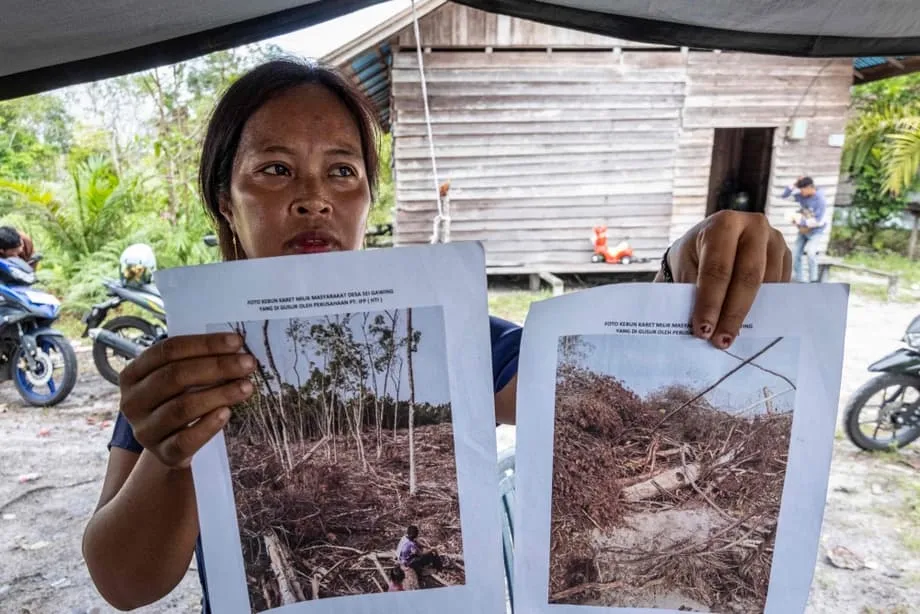
Ika Magdalena, a pregnant mother of three, said she lost her farmland when it was incorporated into the IFP concession. Promised compensation never arrived. She now runs a small snack stall to support herself and her family.
Magdalena described the damage to her crops and the absence of a response:
They have already damaged our crops, and they do not want to take responsibility. It breaks our hearts, but they just stay silent.
Her account connects the dispute over timber sourcing to daily household needs. Land that once produced food and income has become part of a plantation, while compensation and replacement livelihoods remain unresolved for residents such as Magdalena.
Who Controls the Suppliers?
RGE denies owning or controlling BCL and PRI. The investigation identified shared addresses, management personnel and exclusive supply relationships that suggested common control, making the boundaries between supplier companies and the conglomerate central to the dispute.
BCL president Lina Bustam previously served as an executive at PT Toba Pulp Lestari, described as an RGE-related party. Another BCL executive listed an address at RGE's pulp mill in Kerinci, Sumatra.
The Phoenix mill in North Kalimantan is formally owned by PT Phoenix Resources International. Its majority shareholder is a Malaysian company, itself owned by a company registered in the Cayman Islands. The mill was described as under construction, with expected processing capacity of 1.7 million metric tons annually.
These ownership chains make it harder to identify ultimate beneficial owners, the people who ultimately own or control a company, and to determine who is responsible for supplier practices. Auditors and certification bodies must assess relationships that extend beyond a company's publicly named subsidiaries.
Forestry Certification Extends Beyond a Company Name
The Forest Stewardship Council (FSC), a leading body certifying sustainable forestry, continues to suspend APRIL, RGE's main pulp subsidiary. The suspension followed an FSC analysis in 2020 finding that APRIL suppliers had destroyed 435,877 hectares of forest.
That analysis described the cleared land as likely containing areas of high conservation value and the loss as irreversible. High conservation value refers to places important for wildlife, ecosystems or communities, rather than simply the amount of timber they can produce.
RGE continues to seek FSC certification while the suspension remains in place. New FSC guidelines adopted in October 2025 treat mills under a group's financial control as part of that corporate group. The rules could bring mills within the assessment even where formal ownership structures appear separate, potentially placing RGE in breach of policies prohibiting destruction of areas of high conservation value.
RGE managing director Anderson Tanoto declared in 2024 that the entire supply chain was 100 percent deforestation free while the group secured a $1 billion loan tied to sustainability commitments. The investigation places that declaration alongside documented supplier clearing and the continuing FSC suspension.
Green Finance Faces Scrutiny
Mitsubishi UFJ Financial Group provided $222 million to RGE pulp operations between 2020 and July 2025. That included $95 million toward a syndicated loan in 2024. A syndicated loan is financing supplied by a group of lenders rather than a single bank.
The bank adopted a No Deforestation, No Peatland, No Exploitation policy for pulp and paper clients in 2023. The policy addresses forest clearing, damage to peatland and exploitation of people, but the bank had not disclosed clear commitments with deadlines for achieving a portfolio free of deforestation.
RGE has accessed billions of dollars in green credit from banks, including Mitsubishi UFJ Financial Group, through public commitments to eliminate deforestation. Loans tied to sustainability commitments connect financing to environmental or social targets, making the quality of those targets and the checks behind them important to lenders and borrowers.
Rainforest Action Network forest programme director Robin Averbeck said the findings indicated that RGE was "still very much in the business of deforestation".
Campaigners call the practice greenwashing: using sustainability pledges to persuade buyers and financiers that operations are environmentally responsible while destructive practices continue. Institutional investors increasingly want banks to examine entire corporate groups, because companies operating behind separate ownership structures can continue clearing forests while a parent company denies responsibility.
What Haleon and Asia Symbol Have Said
Haleon's response reaches beyond a single shipment. Its instruction asks suppliers to exclude material from Asia Symbol and plantation companies associated with deforestation risk, even though its internal investigation found no direct evidence of such material entering Haleon's supply chain.
The company explained its decision in a statement:
We have therefore asked our suppliers to ensure that any material supplied to Haleon is not sourced from Asia Symbol or plantation companies associated with risk of deforestation.
Asia Symbol said it had commenced a focused review of sourcing related to PRI and would immediately cease all supply from BCL. It also said the carbon-neutral products supplied for Haleon did not use PRI pulp.
Asia Symbol did not explain how it separates pulp from different sources in practice. No completion date was given for its PRI sourcing review. RGE maintained that its supply chain was 100 percent deforestation free despite allegations spanning several years and investigations.
The carbon-neutral label concerns the balance of carbon emissions associated with a product. Forest protection concerns where its raw materials come from and what happened to the land. The investigation brings both issues together: packaging sold with a climate claim sits within a supply network linked to the loss of forests, wildlife habitat and community resources.
Orangutan Habitat and Indonesia's Living Forests
Indonesia has some of the world's highest rates of tree cover loss. Its rainforests support 15 percent of all known species of flora and fauna, including elephants, tigers and more than 1,500 bird species. Clearing threatens that wildlife, climate stability and community safety.
Bornean orangutan numbers have declined by more than 50 percent, leaving an estimated 45,000 to 69,000 animals in the wild. The forest cleared along the investigated supply chain included habitat for this critically endangered species.
The Mahakam River region in East Kalimantan, affected by BCL sourcing, is also home to critically endangered Irrawaddy dolphins. The region served as habitat for Sumatran rhinos, which had previously been thought extinct in the wild there before being detected in recent years.
Agau's proposed response was straightforward: stop issuing permits to companies that clear forests. The Humbang Raya village secretary remained skeptical that planting replacement trees could make up for the destruction:
You plant one tree, a million are lost. It is not balanced.
Haleon's withdrawal, Asia Symbol's supplier review and the questions surrounding RGE's financing all turn on the same practical issue: whether buyers, banks and certification bodies can follow materials and responsibility through complex corporate chains. For the communities described in the investigation, the consequences are already visible in lost farmland, changed waterways and a forest that no longer provides what it once did.
What to Know
- Plantations feeding the investigated Asia Symbol supply chain cleared nearly 30,000 hectares of Indonesian forest between 2016 and 2024, including orangutan habitat.
- IFP accounted for approximately 21,827 hectares of forest loss, with 6,790 hectares cleared in 2022 alone.
- PRI sent more than 800,000 tons of wood chips worth over $70 million to Asia Symbol facilities in China during 2024.
- Haleon instructed suppliers to exclude Asia Symbol materials after finding no direct evidence that material linked to deforestation entered its own products.
- Asia Symbol announced a review of PRI sourcing and an immediate end to BCL supplies. RGE continued to assert that its supply chain was 100 percent deforestation free.
- Residents reported lost livelihoods, worsening floods, concerns about river water and compensation that never arrived.
- APRIL remained suspended by the FSC, while RGE's sustainability commitments and access to green finance faced renewed scrutiny.