Eastern municipalities face a new wave of smoke
A new mass of smoke from fires in Indonesia's West Papua region is expected to reach Timor-Leste before dawn or early on Friday, October 16, 2026, entering through Lautém, Baucau and Viqueque. The National Directorate of Meteorology and Geophysics (DNMG) warned on October 14 that winds could then carry the pollution inland, worsening air quality across the country beyond the conditions experienced in recent days.
Contents
- Eastern municipalities face a new wave of smoke
- When the pollution is expected to worsen
- Schools suspend classroom activities for three days
- Learning continues at home
- What Díli's air readings tell residents
- Why small particles create a large health risk
- Singapore records a sharp pollution spike
- Indonesia faces illness, evacuations and stubborn fires
- Firefighting expands as dry conditions persist
- Neighbouring countries seek cooperation and stronger action
- Key Points
The warning comes as the government suspends classroom activities from October 15 to 17. Monitoring stations in Díli recorded seven consecutive days of poor air quality between October 6 and 12, while recent Air Quality Index readings reported by the DNMG ranged from 165 to 174, within the unhealthy category.
Angelina Freitas, the DNMG official responsible for public forecasts, said conditions could worsen most sharply on Friday afternoon and into the early evening. Heavy smoke is expected to persist throughout Saturday, October 17, with visibility beginning to improve only on Sunday afternoon or early evening.
The DNMG described the expected intensity of Friday's conditions as 70% to 80%. The agency's explanation did not specify the measurement scale behind that percentage. Its practical warning was more direct: residents should prepare for heavier smoke, restrict outdoor physical activity, use N95 masks when going outside and keep doors and windows closed during periods of heavy pollution.
When the pollution is expected to worsen
Lautém, Baucau and Viqueque, all east of Díli, are forecast to receive the incoming smoke first. Freitas said winds could continue carrying particles into other parts of the territory, extending the health threat beyond the eastern municipalities.
The forecast and school measures set out the following sequence:
- October 6 to 12: Two monitoring stations recorded seven consecutive days of poor air quality in Díli.
- October 14: Authorities announced the school suspension and designated a preparation day for learning at home.
- October 15: The suspension of classroom activities begins.
- October 16: New smoke is expected before dawn or in the morning, with conditions worsening during the afternoon and early evening.
- October 17: Heavy smoke is expected to persist throughout the day, covering the final scheduled day of the school suspension.
- October 18: Visibility and air conditions may begin improving during the afternoon or early evening.
The DNMG will follow the smoke through satellite images and observation stations and update its guidance when conditions change. Sunday's expected improvement is a forecast, so families and schools will need to follow subsequent announcements.
Schools suspend classroom activities for three days
The Ministry of Education and Ministry of State Administration announced the suspension for October 15, 16 and 17. Domingos Lopes Lemos, secretary of state for secondary education, presented the decision at a press conference in Díli, linking it to the meteorological warnings.
The measure covers preschool, basic education, and general and vocational secondary education across public, private and cooperative institutions within the public education system. Private and international institutions outside that network were urged to adopt protective measures. Several schools had already reported students becoming ill or experiencing breathing difficulties before the suspension.
Escola Portuguesa de Díli separately announced that it would close on Thursday and Friday, cancelling classes, extracurricular activities and administrative services delivered in person. The closure therefore affects more than classroom lessons, including activities that would otherwise require students, families or staff to travel.
Initial government announcements gave no duration, while the detailed education arrangements specify October 15 to 17. A date for classes to resume has not been confirmed. Authorities are expected to assess conditions over the weekend before deciding whether the suspension needs to continue.
Learning continues at home
Schools were instructed to use October 14 to prepare guidance and assignments for students. During the suspension, they are expected to maintain learning through work completed at home and other support that does not require classroom attendance.
The government's stated purpose is to protect students, teachers and the wider school community from polluted air. Keeping children away from school also reduces the time they spend travelling through smoke or taking part in outdoor activities.
Parents have been advised to limit children's outdoor activity, close doors and windows when smoke increases, and arrange suitable respiratory protection when travel is necessary. The health advice applies throughout the closure, including hours that children would normally spend playing outside.
The timing places the entire suspension before the forecast improvement on Sunday. School preparations and household precautions are therefore operating together: education continues at home while families try to reduce exposure during the expected peak.
What Díli's air readings tell residents
Automatic monitoring stations at Presidente Nicolau Lobato International Airport in Comoro and the Ministry of Transport and Communications in Caicoli recorded Díli's prolonged spell of poor air. Measurements from two locations give authorities a firmer basis for tracking conditions than the appearance of the sky alone.
The Air Quality Index, or AQI, translates pollution measurements into a number and a health category. The DNMG's reported range of 165 to 174 falls within the unhealthy category, indicating a need to reduce exposure, particularly for people more vulnerable to polluted air.
Freitas described conditions at the time of her October 14 forecast as moderate and warned that the incoming smoke would make them worse. Air quality can change as smoke moves and winds shift, making the forecast important even after several days of unhealthy readings.
The DNMG attributes the incoming plume to West Papua fires and says winds associated with the Australian monsoon help transport smoke towards Timor. Local burning, including clearing agricultural land by fire, can also add pollution. Authorities have prohibited local waste burning to avoid adding more smoke during the emergency.
Why small particles create a large health risk
PM2.5 is a central concern in this haze episode. The term describes particles measuring 2.5 micrometres or less across. A micrometre is one millionth of a metre, making these particles small enough to travel deep into the lungs and, in some circumstances, enter the bloodstream.
Smoke exposure can cause coughing, irritation of the eyes and airways, and difficulty breathing. It can also worsen asthma and existing heart or lung conditions. The amount of pollution people breathe and the length of their exposure both affect the risk.
Freitas warned of respiratory illness, coughing, eye irritation and fever or a sensation of body heat. She urged particular care for pregnant women, children and older people, and advised residents to seek medical assistance when symptoms develop.
The DNMG recommends staying indoors where possible and avoiding outdoor exercise during heavy smoke. N95 masks provide filtration against fine particles when people need to go outside. Persistent coughing, breathing difficulty or symptoms that worsen should prompt medical attention, especially among people with existing respiratory or cardiovascular conditions.
Singapore records a sharp pollution spike
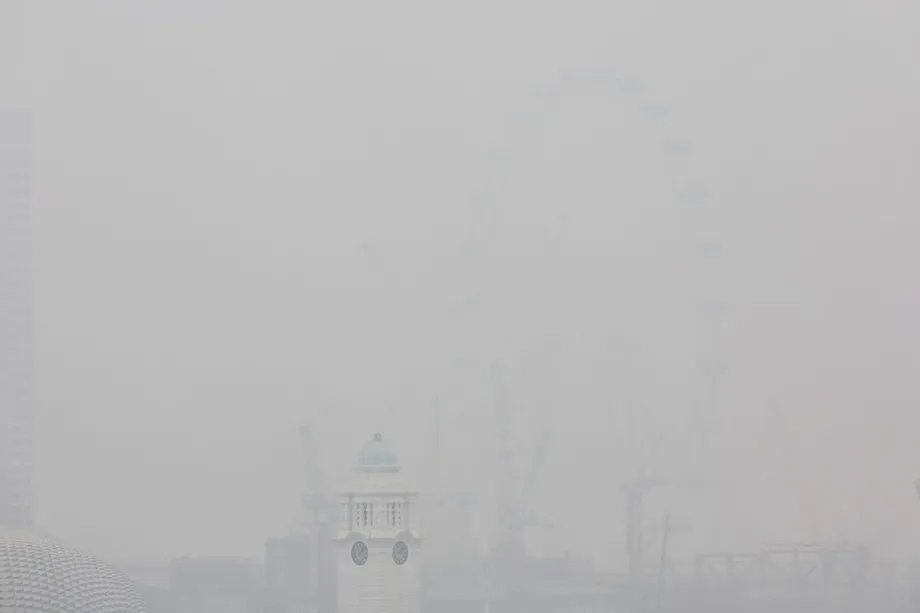
Singapore's western region recorded PM2.5 concentrations of 195 micrograms per cubic metre, rising to 284 at 2 p.m. and 288 at 3 p.m. on October 14. The National Environment Agency placed the peak in its very high band. A microgram is one millionth of a gram; the measurement describes the mass of particles in a cubic metre of air.
At 3 p.m., concentrations elsewhere in Singapore reached 218 in the central region, 208 in the east, 177 in the south and 140 in the north. The western reading of 288 was just over twice the northern reading of 140, showing how unevenly smoke can affect different parts of the same country.
Singapore's index readings over 24 hours ranged from 114 to 160, in the unhealthy category. Its Pollutant Standards Index, or PSI, describes conditions over a longer period than an hourly PM2.5 concentration. Residents therefore receive both information about short pollution spikes and a broader assessment of sustained exposure.
Some outdoor sports facilities and facilities without air conditioning in western Singapore temporarily closed. Authorities also reduced the financial burden of seeking care through subsidies for treatment related to haze, starting on Monday, and began providing N95 masks to eligible residents when pollution reached very unhealthy levels.
Singapore has prepared further measures, including mask distribution for vulnerable groups when the PSI exceeds 200 and possible school closures if forecasts reach the hazardous category above 300. Its western PM2.5 peak remains below the national record of 471 recorded during the October 2015 fires.
Indonesia faces illness, evacuations and stubborn fires
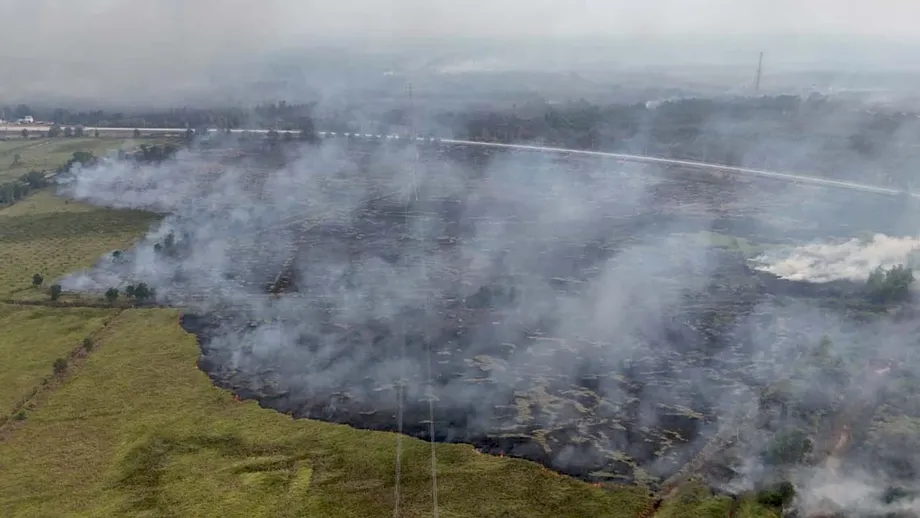
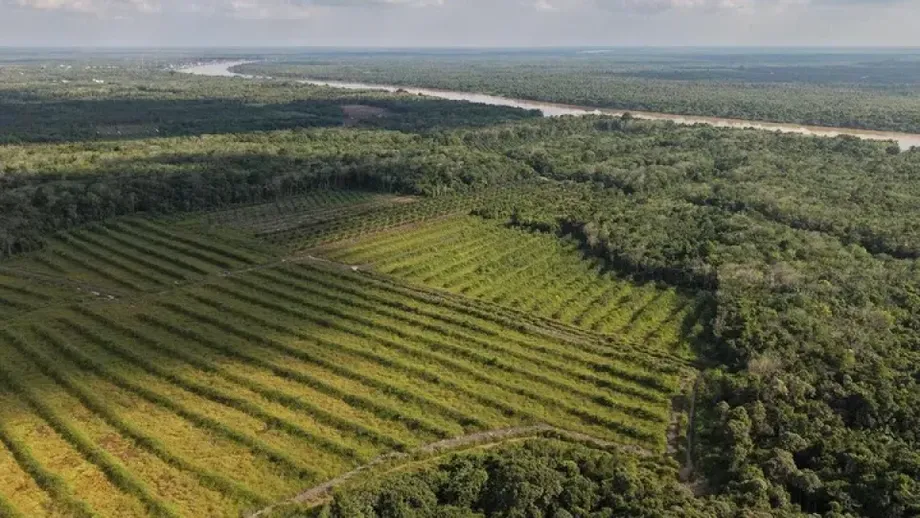
Indonesian authorities recorded more than 280,000 respiratory problems in regions affected by haze since August 18. Fires have burned hundreds of thousands of hectares of forests and plantations on Borneo and Sumatra, while fires in Papua have also contributed to the wider health emergency.
Hotspots have been reported in East Nusa Tenggara, the Indonesian province that includes the western part of Timor island. Timor-Leste's education statement referred broadly to pollution from fires in neighbouring regions or countries, while the DNMG identified West Papua as the origin of the new plume expected on Friday.
In Bangka Belitung province, a fire destroyed nearly 300 homes and forced nearly 1,000 people to flee, according to the local disaster agency. Residents initially tried to fight it with portable pumps, but fire continued smouldering in peat beneath the surface. A change in wind then drove flames towards their homes.
Peat consists of accumulated plant material in wet ground. When it dries and burns, fire can spread below the surface, making it harder to reach than flames above ground. Disaster mitigation agency spokesperson Berton Panjaitan described the difficulty of extinguishing these fires and said sustained rain was needed.
"We must recognize that the only way to resolve this is through sustained rainfall," he said.
Firefighting expands as dry conditions persist
Indonesia's wildfire season has been described as its most intense in 11 years, with dry weather associated with El Niño helping fires spread. El Niño is a climate pattern that can change rainfall across large regions, bringing drier conditions to parts of Indonesia.
Government figures put the deployment at 60,177 personnel across six provinces, especially Central Kalimantan and South Sumatra; Honi Havana, an official at the Coordinating Ministry for Political and Security Affairs, gave a national figure of more than 69,000. His figure compares with around 44,000 in mid September, an increase of more than 25,000 personnel.
The response includes firefighters, military personnel, police, forestry services, regional authorities and volunteers, alongside aircraft. President Prabowo Subianto ordered the government to mobilise maximum efforts. Havana described the national response at a Wednesday briefing.
"We are mobilizing all our resources and capabilities," he said.
Authorities are testing methods using special chemicals, while cloud seeding and dropping water from aircraft have had limited success. Cloud seeding aims to encourage rain from suitable clouds. Persistent fires beneath peat and continuing dry conditions make the task difficult even with more personnel and equipment.
Neighbouring countries seek cooperation and stronger action
Timor-Leste President José Ramos-Horta expressed solidarity with Indonesia and offered support for regional cooperation against what he described as a shared environmental challenge. He also urged residents to reduce outdoor activity, wear protective masks, drink water frequently and keep doors and windows closed.
Ramos-Horta warned that degraded air posed particular risks to children, older people, pregnant women and people with asthma or heart conditions. His message connected support for Indonesia's firefighting effort with immediate precautions for people in Timor-Leste.
Malaysia and Indonesia have begun discussions on cooperation, Malaysian Foreign Minister Mohamad Hasan said. Malaysia has also requested an ASEAN meeting, and Southeast Asian foreign ministers are expected to discuss haze at a meeting in November.
Malaysian lawmaker Syed Saddiq Syed Abdul Rahman called for a coordinated diplomatic protest and urged Malaysian and Singaporean banks to stop financing companies linked to land burning. His demand reflects a harder political response alongside the talks on practical cooperation.
Timor-Leste's immediate decisions concern classrooms, household exposure and changing winds. Across the region, governments also face the longer task of controlling the fires that keep producing smoke. The next checkpoints are the expected arrival on Friday, conditions through Saturday and the possibility of improvement late on Sunday.
Key Points
- Smoke from West Papua is forecast to enter Lautém, Baucau and Viqueque early on October 16 before potentially spreading across Timor-Leste.
- The DNMG expects conditions to worsen Friday afternoon and persist through Saturday, with possible improvement late on Sunday, October 18.
- Classroom activities are suspended from October 15 to 17, with assignments and learning support continuing at home.
- Díli recorded seven consecutive days of poor air quality from October 6 to 12; recent AQI readings ranged from 165 to 174.
- Residents are advised to avoid outdoor exercise, use N95 masks when outside and keep doors and windows closed during heavy smoke.
- Western Singapore's hourly PM2.5 concentration reached 288 micrograms per cubic metre on October 14.
- Indonesia recorded more than 280,000 respiratory problems in regions affected by haze since August 18 and expanded firefighting deployments.
- Timor-Leste has offered regional support, Malaysia and Indonesia have begun cooperation talks, and ASEAN ministers are expected to discuss haze in November.