A giant measured, not merely estimated
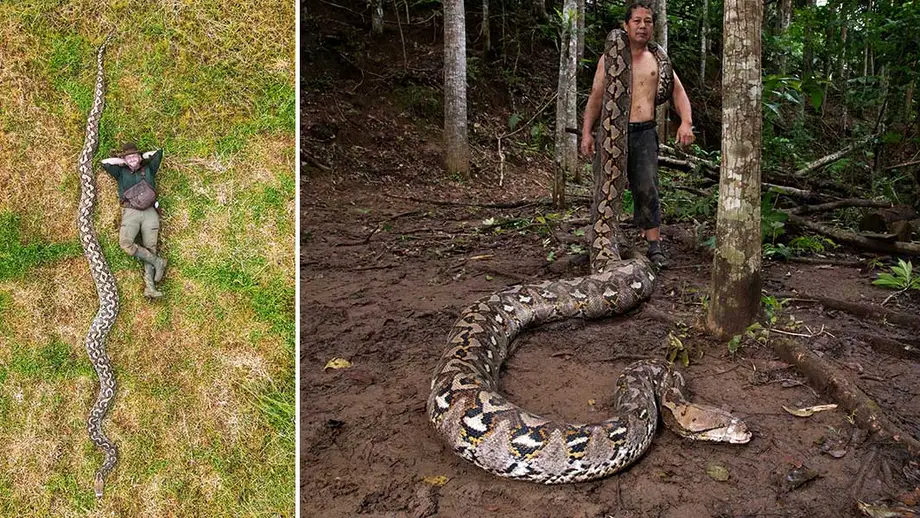
A female reticulated python discovered in Maros, South Sulawesi, in December 2025 has been recognized by Guinness World Records as the longest wild snake with a verified measurement. Named Ibu Baron, meaning "The Baroness," she measured 7.22 meters and weighed 96.5 kilograms when assessed on January 18, 2026.
Contents
- A giant measured, not merely estimated
- How the team established her size
- Why 7.9 meters is not the official record
- A rescue before a record
- What earlier giants can actually prove
- Longest does not mean heaviest
- Why encounters with people may be increasing
- Can recognition help keep giant snakes alive?
- Key Points
The assessment date matters. Although some reports place both the discovery and measurement in late 2025, Guinness World Records specifies that wildlife guide and licensed snake handler Diaz Nugraha and nature photographer Radu Frentiu assessed her the following January. Photographs and video documented the process, giving the record something many accounts of enormous snakes lack: evidence that can be checked.
Guinness announced the recognition in its February 2026 record announcement. The distinction is narrower than declaring Ibu Baron the biggest snake ever to exist. Larger wild snakes have been claimed, and a longer captive python has been measured. Her achievement rests on a documented length for an animal found in the wild.
Her survival is also central to the story. Local conservationist Budi Purwanto took her into his care rather than allowing her to be killed or sold. She now lives in a simple shelter on his property alongside other rescued snakes.
How the team established her size
Nugraha, a rescuer from Borneo, alerted Frentiu to the python. Frentiu, an explorer and natural history photographer who has lived in Bali for two decades, traveled with him to Sulawesi to document the animal.
On January 18, they used a surveyor's tape to follow the snake's natural curves from her head to the tip of her tail. The recorded length was 23 feet 8 inches, equivalent to 7.22 meters. Her weight, measured using scales for rice sacks, was about 213 pounds.
The snake appeared not to have eaten recently. That makes the weight different from a measurement taken immediately after a substantial meal, when the swallowed animal would contribute to the total. Reports suggest she could exceed 100 kilograms after feeding, but that is a possibility rather than a second recorded weight.
Frentiu described his reaction to seeing Ibu Baron, underscoring how unusual she was even for someone accustomed to large snakes.
"I had never seen a snake this big," says Frentiu.
The photographs and video were intended to make the assessment transparent. Guinness accepted the documented 7.22 meters, rather than replacing it with an estimate of how long the python might become under different measurement conditions.
Why 7.9 meters is not the official record
Ibu Baron was not anesthetized for the assessment. According to Guinness, full muscular relaxation under anesthesia could make her at least 10 percent longer, putting a possible measurement near 7.9 meters. Frentiu gives a potential increase of 10 to 15 percent.
Applying those percentages to 7.22 meters produces approximately 7.94 to 8.30 meters. These are calculations, not measurements. They cannot be treated as evidence that she actually reaches either length.
The team avoided anesthesia because of the risks and ethical concerns involved in sedating a healthy animal simply to establish a larger number. The decision left an uncertainty about her fully relaxed length while preserving a record based on what was observed.
This distinction separates three often confused figures: the measured length, an estimate based on muscle relaxation, and a historical claim without supporting physical evidence. Only the first establishes Ibu Baron's verified record.
A rescue before a record
Purwanto intervened after the python was found in December 2025, taking her from the people who initially encountered her. He constructed a modest shelter on his land for large snakes vulnerable to conflict with nearby residents. Ibu Baron shares that refuge with several other rescued snakes.
There is a small discrepancy in the conservationist's name: Guinness's species record page identifies him as Budi Purwanti, while other accounts use Budi Purwanto. Both describe the local conservationist who took responsibility for protecting Ibu Baron.
The shelter serves a practical purpose beyond preserving a record. Large pythons can threaten livestock and, very rarely, people. Moving an animal away from an immediate confrontation can reduce the danger to residents while preventing the snake from being killed.
Frentiu said returning Ibu Baron to the surrounding area would carry risks because large prey animals are scarce and human settlements are numerous. He explained why he considers a nearby release dangerous for her.
A python this big will probably be drawn toward a village," Frentiu explains. "And once that happens, it will almost certainly be killed.
No release date or permanent relocation plan has been announced. Her documented circumstances are those of a snake discovered in the wild and subsequently kept under protective care, not an animal still roaming freely.
What earlier giants can actually prove
Before Ibu Baron, the recent scientifically measured benchmark cited in reports was a female reticulated python found in East Kalimantan in August 1999. She measured 6.95 meters and reportedly swallowed a sun bear fitted with a tracking device.
Ibu Baron exceeds that measurement by 27 centimeters, or about 3.9 percent. The comparison shows why even a seemingly modest difference matters when both figures concern exceptionally large snakes with documented measurements.
The Guinness species record page also lists a 10 meter python reportedly killed in Celebes, now Sulawesi, in 1912. However, it explicitly notes the lack of supporting evidence for the claim associated with museum collector Harry C. Raven. That historical listing does not establish a verified measurement greater than Ibu Baron's.
A python found at a construction site in Penang, Malaysia, in 2016 presents another unresolved comparison. Reports give estimated lengths of 7.5 to 7.9 meters, while Guinness describes her as approximately 8 meters. She died before a formal measurement could settle the estimates.
The chronology shows how discovery, estimation and verification have produced different kinds of records:
- 1912: A python in Sulawesi was claimed to measure 10 meters, but supporting evidence is lacking.
- August 1999: A female in East Kalimantan was measured at 6.95 meters.
- October 12, 2011: Captive python Medusa was confirmed at 7.67 meters in Kansas City, Missouri.
- 2016: A large Penang python attracted estimates approaching 8 meters but died without a formal measurement.
- December 2025: Ibu Baron was discovered in Maros and taken into protective care.
- January 18, 2026: Nugraha and Frentiu recorded her length at 7.22 meters.
- February 2026: Guinness announced her recognition as the longest measured wild snake.
Longest does not mean heaviest
Reticulated pythons, scientifically named Malayopython reticulatus, typically measure between 3 and 6 meters. The largest individuals are generally females. At 7.22 meters, Ibu Baron is 1.22 meters beyond the upper end of that typical range.
She is nevertheless 45 centimeters shorter than Medusa, the captive reticulated python measured at 7.67 meters in 2011. Medusa weighed 158.8 kilograms at that assessment, compared with Ibu Baron's 96.5 kilograms. Their measurements belong to different record categories and were taken under different circumstances.
Guinness recognizes green anacondas as the heaviest snake species. Typical adult females measure 3 to 5 meters and weigh 30 to 70 kilograms, but exceptionally large individuals can approach 300 kilograms, especially during pregnancy or after a substantial meal.
Ibu Baron therefore outweighs the typical female anaconda range given by Guinness, without displacing the anaconda's species title. Length, individual weight and the maximum mass reported for a species answer different questions.
Why encounters with people may be increasing
Nugraha attributes more frequent encounters with giant pythons to shrinking habitat and declining natural prey, including wild pigs and anoas. He links some of that prey loss to poaching. These are his explanations for the encounters, rather than findings from a quantified population survey.
The concern is straightforward: a large predator with less habitat and fewer wild animals to eat may come into closer contact with farms and villages. Residents may then kill it to protect themselves or their livestock. Hunting for meat and illegal trade in exotic animals add separate pressures.
Reticulated pythons are not venomous. They subdue prey by constriction, wrapping their muscular bodies around an animal and applying pressure. Their diet includes mammals ranging from rodents to wild pigs and deer. Attacks on people are very rare, but documented fatalities mean local fears cannot simply be dismissed.
Guinness describes the species as widely distributed across Southeast Asia, with fairly stable numbers and no current broad assessment of risk. That does not rule out serious dangers for particular animals or local populations. A species can remain widespread while its largest individuals are killed whenever they approach settlements.
The record page also describes trade controls under the Convention on International Trade in Endangered Species, known as CITES. Such controls regulate international trade; they do not amount to a guarantee that an individual snake will be protected from local killing or habitat loss.
Can recognition help keep giant snakes alive?
Purwanto, Nugraha and Frentiu hope Ibu Baron's recognition will encourage stronger legal protection, habitat preservation and public education. Their immediate achievement is more concrete: an unusually large snake has survived long enough to be documented and sheltered.
Frentiu points to herpetological tourism, meaning wildlife tourism focused on reptiles and amphibians, as one possible incentive for communities to protect snakes. The idea is to create value around living animals rather than their sale or killing. No funded tourism program, visitor arrangements or revenue figures have been announced for Ibu Baron's shelter.
The possibility of larger snakes also remains open. Herpetologist John C. Murphy estimated in his 2019 book Giant Snakes: A Natural History that the likely maximum length of reticulated pythons is 8 to 9 meters. Nugraha considers a 9 meter python in Indonesia realistic, but no such animal has been verified here.
Frentiu distinguishes Ibu Baron's documented achievement from any claim that nature has produced nothing larger.
"I do not believe in the slightest that this is the largest wild snake. I got lucky," he says.
There is no scheduled further measurement or announced conservation decision. For now, the defensible figure remains 7.22 meters, and the central conservation result is that the animal behind it is alive.
Key Points
- Ibu Baron was discovered in Maros, South Sulawesi, in December 2025.
- Her January 18, 2026 assessment recorded a length of 7.22 meters and a weight of 96.5 kilograms.
- Guinness recognizes her as the longest wild snake with a verified measurement.
- Estimates of additional length under anesthesia were not tested and are not part of the record.
- She exceeds the cited 6.95 meter wild python benchmark from 1999 by 27 centimeters.
- Captive python Medusa was longer at 7.67 meters; green anacondas retain the heaviest species distinction.
- Ibu Baron remains in protective care alongside other rescued snakes, with no announced release date.