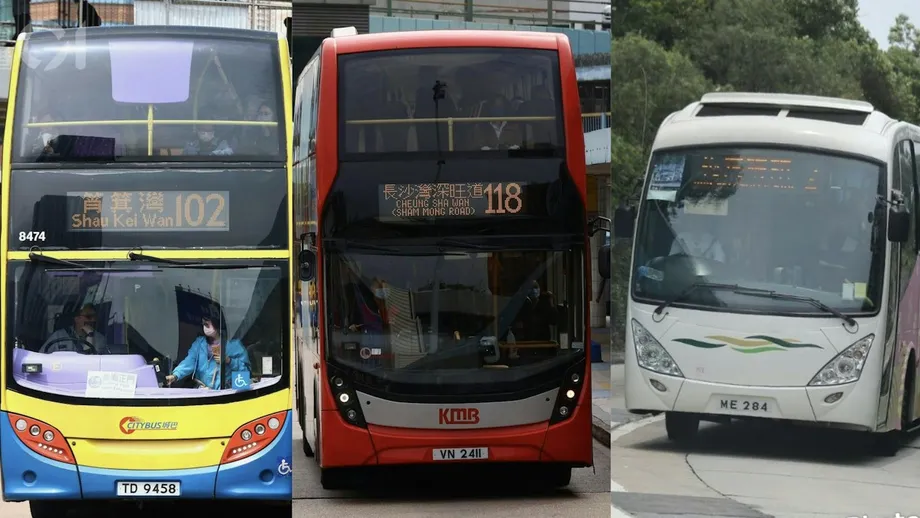
Four operators seek higher fares as financial pressure grows
Hong Kong's four franchised bus operators are seeking fare increases ranging from 8.1% to 17.7%, with Citybus requesting the largest rise, as sharply higher fuel costs squeeze profits despite a modest recovery in passenger journeys. The government is considering the applications and says it can reduce the requested increases or reject them.
Contents
- Four operators seek higher fares as financial pressure grows
- What the requested increases would mean
- Fuel prices rise faster than passenger demand
- Profit estimates point to a sharp deterioration
- Passenger numbers recover, but remain below earlier levels
- Earlier increases and the sequence of events
- Tunnel toll relief has uneven room to cushion fares
- Government weighs affordability, service and other income
- Key Points
Kowloon Motor Bus (KMB) is seeking 16%, Citybus 17.7%, Long Win Bus 8.1% and New Lantao Bus 9.8%. A Transport and Logistics Bureau paper submitted to the Legislative Council sets out a difficult combination for the industry: patronage remains below its level before the pandemic, operating and wage costs are rising, and operators must continue investing in buses and supporting facilities.
The financial pressure has intensified with the surge in diesel prices linked to conflict in the Middle East. Across the four operators, fuel purchase prices in March 2026 were about 75% to 134% higher than in January, while monthly fuel expenditure rose by about 85% to 132%.
Secretary for Transport and Logistics Mable Chan said the government would weigh service reliability and operators' financial sustainability alongside residents' ability to afford fares. The Legislative Council's Panel on Transport is due to discuss the applications on Friday, although the reports do not specify the calendar date.
The immediate decision is whether, and by how much, passengers should pay more. A related issue is how far fare increases and existing relief funds can support operators whose passenger numbers have improved without returning to their earlier levels.
What the requested increases would mean
The applications differ considerably. Citybus's proposed 17.7% increase is 9.6 percentage points above Long Win's 8.1% request. KMB's 16% application is also much larger than the 4.3% increase approved for it in 2024.
- KMB: a requested increase of 16%.
- Citybus: a requested increase of 17.7%.
- Long Win Bus: a requested increase of 8.1%.
- New Lantao Bus: a requested increase of 9.8%.
For illustration, applying those percentages directly to a HK$10 fare would add HK$1.60 for KMB, HK$1.77 for Citybus, HK$0.81 for Long Win and HK$0.98 for New Lantao Bus. These are calculations to show the scale of the requests, not announced route fares. No final fare schedules or implementation dates have been disclosed.
Reports differ on the initial applications. An earlier account described three operators seeking increases above 10%, while the detailed figures identify four operators and put both Long Win and New Lantao Bus below that threshold. Some accounts also refer to three companies while listing four operators. The named applications and their individual percentages provide the more precise picture.
Fuel prices rise faster than passenger demand
The bureau's paper identifies the surge in automotive diesel prices as a major source of financial pressure. Operators still rely mainly on diesel buses, leaving their operating costs exposed to disruption in fuel supply and higher purchase prices.
The March figures show two different measures. Fuel purchase prices rose by about 75% to 134% compared with January, meaning the price paid ranged from roughly 1.75 to 2.34 times its January level. Total fuel expenditure rose by about 85% to 132%, or roughly 1.85 to 2.32 times the January amount.
A fuel price measures what an operator pays for fuel; expenditure measures its total fuel bill. The latter can also change with the quantity bought or consumed. The figures therefore should not be treated as interchangeable, and the reported ranges do not identify which operator recorded each increase.
The detailed account also places August 2026 oil prices at almost twice their January level. The bureau expects prices could remain high while the course of the Middle East conflict is uncertain. It says fuel costs will form part of its assessment of the current applications, and subsequent oil price changes will be considered in future fare applications.
Profit estimates point to a sharp deterioration
Provisional estimates through June show substantial falls in profit after tax compared with the corresponding earlier period. KMB's profit was estimated to have fallen by about 55%, Citybus's by about 52%, Long Win's by about 31% and New Lantao Bus's by about 129%.
The more detailed breakdown identifies the Citybus figure as relating to its urban and New Territories franchise. Citybus also operates an airport and North Lantau franchise, so the figure should not automatically be read as a result covering every Citybus operation.
A decline greater than 100%, such as the 129% estimate for New Lantao Bus, can indicate a move from profit into loss when measured against a positive comparison period. The reports do not provide the underlying dollar amounts, however, so the size of the company's resulting loss cannot be calculated from that percentage alone.
The bureau's assessment also describes profits after tax across the franchises as generally falling by 20% to 30% in the first three months of 2026 compared with the same period in 2025. The larger falls in the estimates through June suggest that financial conditions worsened as the year progressed, although differences between operators remain substantial.
Some accounts use revenue or income language when describing the figures. The detailed financial measure is profit after tax, which is what remains after costs and tax, rather than the money collected from fares and other activities. A 55% fall in profit does not mean fare revenue fell by 55%.
Passenger numbers recover, but remain below earlier levels
Franchised buses carried an average of more than 3.7 million passenger journeys a day in both 2024 and 2025, up from about 3.67 million in 2023. That recovery has not brought the industry back to the average of about 3.92 million daily journeys recorded between 2010 and 2019.
The historical average is about 250,000 daily journeys above the 2023 figure. That puts 2023 patronage approximately 6.4% below the 2010 to 2019 average. Because the later figures are given only as more than 3.7 million, the precise remaining gap for 2024 and 2025 cannot be calculated.
These figures count passenger journeys, not distinct people. Someone taking a bus to work and another home contributes two journeys. The measure is useful for tracking demand, but it does not establish how many individual residents would face higher fares.
The bureau attributes the incomplete recovery partly to competition from other public transport and lasting changes in travel habits. Long Win has nevertheless benefited from more cross border activity and population growth associated with Tung Chung's expansion. Its financial performance began improving after its fare increase on June 18, 2023.
Earlier increases and the sequence of events
The current applications follow previous fare adjustments that helped improve operators' finances. In 2024, KMB requested 6.5% and received approval for 4.3%; Citybus sought 9.5% and received 7.5%; New Lantao Bus sought and received 6.5%. Those decisions show that approval need not match the percentage requested.
The current requests are higher than those approved increases for all three operators. KMB's application is 11.7 percentage points above its 2024 approved increase, Citybus's is 10.2 points higher, and New Lantao Bus's is 3.3 points higher. These comparisons describe separate adjustments, not a calculation of the cumulative change in individual fares.
- June 18, 2023: Long Win's previous fare increase took effect, after which its financial performance began improving.
- 2024: KMB, Citybus and New Lantao Bus received approval for increases of 4.3%, 7.5% and 6.5%, respectively.
- January to March 2026: fuel purchase prices and expenditure rose sharply across the four operators.
- April 2026: reports place the submission of the latest fare applications in this month.
- June 2026: provisional profit estimates showed substantial declines, and tunnel toll exemption fund balances were recorded.
- August 2026: oil prices were reported to remain close to twice their January level.
- Friday: the Legislative Council's transport panel is scheduled to discuss the applications, with no calendar date specified in the reports.
Reports say the government did not immediately process the April applications while it monitored the Middle East situation and fuel prices. No final approval date or date for new fares to take effect has been announced.
Tunnel toll relief has uneven room to cushion fares
The franchised bus tunnel toll exemption funds have been used in previous fare decisions to soften increases for passengers. Their remaining balances differ greatly, limiting how equally they could cushion the latest requests.
As of June 2026, KMB's fund held HK$174 million and was projected to run out in the first quarter of 2028. Long Win's balance was about HK$4.29 million, while New Lantao Bus's was just HK$18,300.
Citybus's urban and New Territories franchise had exhausted its fund through previous fare adjustments. Its airport and North Lantau franchise still held about HK$23.56 million. The larger remaining balance for that franchise was attributed to its not having applied for a fare increase.
KMB's balance was about 40.6 times Long Win's, based on HK$174 million and HK$4.29 million. Fund balances alone do not establish how much relief each passenger could receive, because the franchises differ in size, passenger demand and financial circumstances. KMB's projected exhaustion date also makes clear that the support is finite.
Government weighs affordability, service and other income
Chan said officials would closely examine operators' operating conditions, cost and revenue forecasts, longer term financial development and the effect on public services. The bureau says its assessment under the Franchised Bus Fare Adjustment Arrangement will balance financial sustainability against affordability and the impact on passengers.
The applications must be considered by the Chief Executive in Council. The Legislative Council panel discussion gives lawmakers an opportunity to examine them, but it is not itself approval of new fares. The government says requests it considers excessive can be reduced or refused.
Transport panel chairman Ben Chan urged the Executive Council to balance operators' continued viability with residents' ability to pay. He also proposed developing income beyond fares, including commercial use of space at bus depots and public transport interchanges.
That proposal offers a possible alternative source of revenue, but no projected income, approved development plan or timetable has been disclosed. It therefore cannot yet be counted as a quantified substitute for a fare increase.
Operators also face spending beyond their immediate diesel bills, including wages, replacement vehicles and investment in buses using new energy technologies and related facilities. The government's task is to assess those needs alongside the pressure on passengers. The requested percentages, provisional profits and remaining relief funds are now public, but the final approved increases, route fares and implementation dates remain undecided.
Key Points
- KMB seeks 16%, Citybus 17.7%, Long Win 8.1% and New Lantao Bus 9.8%.
- March 2026 fuel purchase prices were about 75% to 134% above January levels.
- Provisional profit estimates through June show declines ranging from about 31% to 129%.
- Daily passenger journeys exceeded 3.7 million in 2024 and 2025 but remained below the 2010 to 2019 average of about 3.92 million.
- Tunnel toll exemption fund balances vary widely, and Citybus's urban and New Territories fund is exhausted.
- The government can reduce or reject the applications. No final fare schedules or implementation dates have been announced.