The Sound of Displacement
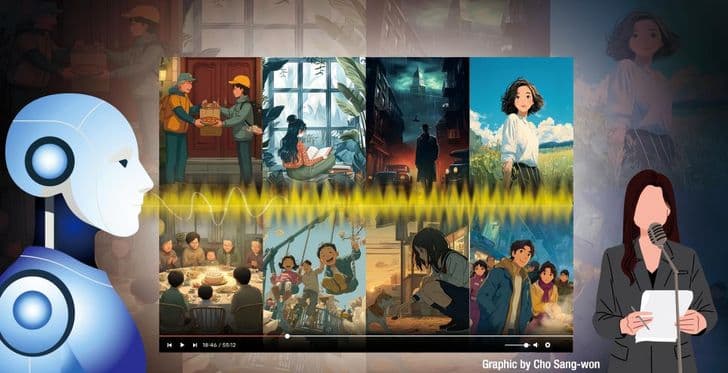
For years, the brisk, slightly metallic voice at the end of Korean television shopping segments served as background noise to millions of households. Today, that same sound signals a crisis for an entire profession. Voice actors across South Korea report that their average incomes have plummeted by half over the past two years, victims of artificial intelligence systems that can now generate convincing human speech from text alone.
- The Sound of Displacement
- Webtoon Artists Confront Unauthorized Training
- Language Professionals Face Market Polarization
- Entry-Level Positions Vanish Across the Economy
- Korea Enacts Landmark AI Regulations
- Education and Entertainment: AI as Collaborator
- Global Parallels and Emerging Resistance
- The Essentials
Choi Jae-ho, head of the Korea Voice Performance Association, traces the roots of this displacement to contracts signed years ago when global streaming platforms like Netflix first began investing heavily in Korean dubbing. At the time, the surge in demand appeared to be a boom for the industry. However, these agreements contained clauses allowing companies to process, reuse, and repurpose recorded voices for future technologies, long before the true capabilities of large language models were imagined.
Later, domestic technology firms began recording voice actors en masse to train synthetic voice models, offering lump sum payments that granted effectively unlimited, exclusive use of the performers’ vocal signatures. The consequences are now audible in corporate public relations videos, government promotional clips, and online advertisements that once employed human talent.
That used to be our work. Now they go into a system, download a voice they like and type in the script. That work is simply gone.
The association is now lobbying for AI-specific standard contracts and a new legal concept called a “voice publicity right,” which would treat every person’s voice as a protected commercial attribute. Actors want tools to challenge unlimited AI use based on old contracts and to ban training or cloning without explicit consent.
Webtoon Artists Confront Unauthorized Training
While voice actors fight AI in their ears, webtoon creators are fighting it in their files and feeds. The Korea Cartoonists’ Association reports that requests for simple illustrations and promotional comics have decreased sharply, with young assistants feeling the most immediate threat. Kwon Hyuk-joo, who leads the association, notes that the problem extends beyond lost work to a fundamental shift in market perception, where clients now assume that AI can handle tasks that once required human skill.
The debate gained public attention recently with “Mongletoon,” an AI-generated webtoon series from Chun Woo-won, grandson of former President Chun Doo-hwan. The series drew extensive debate over what constitutes authentic creation, highlighting how new tools enable anyone to produce webtoon-style content without years of drawing practice or production team support.
Kwon identifies large-scale, unauthorized training on scraped comics as the most serious issue facing the industry. Currently, there is no mechanism for artists to know which works were used to train which models, or to prevent their paid content from being ingested into datasets without compensation.
We need to make it obligatory to disclose what data AI uses. Transparency is the starting point for any institutional discussion.
To establish what he calls a minimum safety net, Kwon wants a preemptive system allowing authors to mark their work as off-limits before training occurs. He argues that an AI industry built without protecting creators cannot be sustainable, noting that Korea’s webtoons represent the world’s largest market and a key cultural export. If the creator ecosystem collapses, the industry itself cannot exist. While AI will certainly replace some parts of the work, Kwon maintains it cannot replace the essence of creation, suggesting creators may shift from pure producers to planners who guide AI tools.
Language Professionals Face Market Polarization
Translation and interpretation professionals are experiencing similar disruptions at the center of AI-replacement fears. At international events, organizers who once hired simultaneous interpreters now project automated captions generated by AI tools that promise good enough real-time translation at a fraction of the cost. Corporate meetings that previously brought in freelance interpreters are increasingly handled by smartphone applications.
The transformation extends to live theater, where Seoul producers are now testing AI-powered smart glasses that display translated dialogue on lenses in real time, synced to the action onstage. The technology, built by Korean startup Xpert Inc., currently supports four languages and aims to eliminate the need for human interpretation entirely in cultural venues.
Huh Ji-un, head of the Korean Association of Translators and Interpreters, reports that the squeeze is most visible in the middle of the market rather than at the top tier. While elite interpreters will likely survive, those offering basic services find it harder to secure work, creating a polarized market where only the highest-skilled professionals remain viable.
On the translation side, the impact is more advanced through the spread of post-editing work, where AI services produce first drafts that human experts then correct and refine. This workflow dominates technical documentation like manuals and user guides, reducing the creative component of the work to quality control.
Huh urges the government to build basic protections for freelancers, noting that many interpreters lack social insurance and corporate safety nets, leaving them particularly vulnerable to AI-driven market shifts. She also warns against state agencies selecting the cheapest bidders for court and parliamentary interpretation, arguing that this undermines citizens’ rights to understand proceedings while hollowing out the pipeline of skilled human experts.
Entry-Level Positions Vanish Across the Economy
The displacement extends far beyond creative industries into Korea’s broader labor market. According to the Software Policy and Research Institute, the share of Korean developers with less than three years of experience dropped from 26.9 percent in 2022 to 20.7 percent in 2024, the only experience bracket to see a decrease. Since ChatGPT’s launch in 2022, generative AI has triggered a quiet trend of corporate downsizing that targets exactly the routine tasks assigned to new employees.
A 23-year-old economics major named Ji-eun, working under a pseudonym, described spending two days creating an Excel spreadsheet for market research during an internship, only to watch her CEO generate superior results in five minutes using a subscription AI service. The experience left her questioning her value in a job market where AI handles data analysis, drafting documents, internet searches, and meeting minutes with increasing competence.
The Korea Labor Institute found that 58 percent of 500 surveyed office workers fear losing jobs to AI within ten years, with anxiety highest among those in their twenties. The Bank of Korea’s analysis shows that 211,000 fewer jobs were offered to young people between July 2022 and July 2025, with 208,000 of those losses in fields above the 50th percentile of AI exposure.
Manufacturing has not escaped the trend. At a firm producing multi-layer ceramic capacitors for semiconductors, AI introduction to quality inspection processes resulted in over 200 factory workers leaving a subcontractor over recent years. The company reduced machine management staffing from one person per five sorters to one person per fifteen.
Yoon-jin, a 34-year-old freelance video editor with eight years of experience, reports that rates for one-minute videos that once paid two to three million won and required weeks of work have collapsed because editors with one to two years of experience can now use AI to produce similar results to veterans with twenty years of experience.
Korea Enacts Landmark AI Regulations
Amid these disruptions, South Korea has introduced what officials call the world’s first comprehensive set of laws regulating artificial intelligence. The AI Basic Act, which took effect ahead of the European Union’s phased implementation through 2027, aims to position the country as a top-three AI powerhouse while building safety and trust.
The legislation requires companies to ensure human oversight in high-impact AI applications, including nuclear safety, drinking water production, transportation, healthcare, and financial services like credit evaluation. Firms must provide advance notice to users about high-impact or generative AI products, and clearly label AI-generated output that is difficult to distinguish from reality. Violations can result in fines up to 30 million won (approximately $20,400).
However, many startup founders express frustration that key details remain unsettled. Lim Jung-wook, co-head of South Korea’s Startup Alliance, notes resentment among founders about being first to navigate comprehensive regulation.
There’s a bit of resentment. Why do we have to be the first to do this?
President Lee Jae Myung has urged policymakers to ensure venture companies receive adequate support during the grace period, which allows at least one year before authorities impose administrative fines. The Ministry of Science and ICT is planning a guidance platform and dedicated support center, with potential extensions to the grace period if industry conditions warrant.
Notably, the current framework does not specifically address the unauthorized use of creative works for training data or establish the voice and image rights that performers are demanding, leaving significant gaps in worker protections even as the technology advances.
Education and Entertainment: AI as Collaborator
While creative workers battle displacement, other sectors view AI as a necessary evolution. South Korea is preparing to become the first nation to introduce AI digital textbooks nationwide, with rollout beginning in March 2025 for grades 3, 4, 7, and 10, covering subjects like English, math, and information technology. Full implementation across all schools is planned by 2028.
The government has allocated approximately 0.74 billion won for three years specifically for teacher training, aiming to transform educators from lecturers into mentors who guide project-based learning and critical thinking while AI handles routine instruction and personalized content delivery. Real-time data collection will allow continuous feedback, with strict privacy protections including data encryption and secure cloud storage.
The film industry presents a more complex picture. “King of Kings,” an animated film produced by Seoul-based Mofac Studios for just $25 million, grossed $60 million at the American box office, surpassing “Parasite” as South Korea’s most successful US release. The studio used AI-assisted production tools to automate visual design and rendering, allowing small teams to achieve results that once required hundreds of workers.
Yet prominent voices caution against unchecked adoption. Director Park Chan-wook, known for “Old Boy,” warned during the Busan International Film Festival that automation could take away many jobs and fundamentally change the aesthetics of film. The tension between efficiency and creative integrity remains unresolved as studios race to adopt tools that promise to halve production times.
Global Parallels and Emerging Resistance
The struggles of Korean workers mirror global trends in the creative industries. Netflix’s recent acquisition of InterPositive, an AI company founded by Ben Affleck, threatens thousands of visual effects jobs worldwide, including positions in South Korea. The technology automates color grading, relighting, and continuity fixes currently performed frame-by-frame by artists in India, South Korea, the Philippines, and Latin America.
According to industry surveys, 75 percent of entertainment executives were already using AI to remove, reduce, or consolidate jobs in 2023, with projections suggesting 118,500 positions could be lost in the US alone within three years. Unlike Hollywood, where unions are negotiating AI protections, post-production workers in Korea and elsewhere often lack equivalent representation.
In China, tech workers have coined the term “distilling” to describe the process of documenting their workflows to train AI agents that might replace them. A viral GitHub project called Colleague Skill, created as a spoof by Shanghai Artificial Intelligence Laboratory engineer Tianyi Zhou, struck a nerve by demonstrating how easily employers could capture personality traits and work habits to create digital replicas of employees.
The phenomenon has prompted countermeasures. Beijing-based AI product manager Koki Xu published an “anti-distillation” tool designed to sabotage the creation of workflow manuals, rewriting materials into generic language that produces less useful AI stand-ins. Her project drew over 5 million likes across platforms, highlighting growing resistance to the expectation that workers should train their replacements.
Back in Korea, voice actors, webtoon artists, and interpreters continue pushing for transparency requirements and consent-based frameworks. Their demands converge on a single principle: AI should augment human capability rather than exploit creative labor without recognition or compensation. Whether national policy can evolve quickly enough to protect these workers remains the critical question as the technology accelerates.
The Essentials
- Voice actors in Korea report average income drops of 50 percent over two years as AI-generated narration replaces human talent in advertising and broadcasting.
- Webtoon artists face unauthorized use of their work in training datasets, with industry leaders demanding mandatory transparency about AI training data and preemptive consent mechanisms.
- Interpreters and translators experience market polarization, with mid-tier professionals losing work to automated captioning and post-editing workflows while only elite practitioners remain secure.
- South Korea’s AI Basic Act, the world’s first comprehensive AI law, took effect in January 2026, imposing fines up to 30 million won for unlabeled generative AI content while offering companies a one-year grace period.
- Entry-level positions across software development, manufacturing, and office administration are disappearing fastest, with youth unemployment reaching 5.8 percent, the highest in four years.
- AI digital textbooks will roll out nationwide in Korean schools starting March 2025, transforming teachers into mentors while using AI for personalized instruction.
- Global VFX workers face similar threats from Netflix’s AI acquisitions, while Chinese tech workers experiment with both compliance and sabotage in response to demands they train their AI replacements.