
Seoul Turns Down the Brightness
Seoul introduced South Korea's first comprehensive brightness guidelines for outdoor digital billboards on April 1, 2026, after thousands of complaints about glare across several districts. A city survey of 52 major displays found daytime brightness ranging from 1,448 to 14,000 candelas per square meter. The new daytime ceiling is 7,000, half the highest level measured.
Contents
- Seoul Turns Down the Brightness
- What the New Limits Require
- A Media Gallery With Times Square Ambitions
- How Advertising Zones Changed the Streets
- Drivers Describe Sudden Bursts of Light
- Residents See Beauty and Clutter
- Different Cities Use Different Measures
- The Wider Growth of Artificial Light
- City Projects a 15% Electricity Saving
- The Bottom Line
Nighttime limits are much lower: between 350 and 500 candelas per square meter, depending on a screen's size and the hour. The previous legal ceiling was 1,500, meaning some large displays must now operate at one-third of that former limit or less. Motorists have described sudden bursts of light that interfere with driving through busy intersections.
The changes arrive as Seoul pursues a very different ambition: turning its historic center into an illuminated attraction that rivals New York's Times Square. Gwanghwamun Square is intended to become a global media gallery by 2033, with enormous screens wrapping buildings and showing vivid digital scenes. Officials now face the task of preserving that spectacle while responding to what they call "light chaos."
As of April 23, drivers and residents describe mixed results. Some say the glare has eased; others have noticed no change. People who enjoy the displays point to their visual appeal and the convenience they bring to pedestrians, while longtime residents complain that the historic plaza has become cluttered. The dispute reaches beyond advertising: it concerns how much brightness people should have to live and work beside.
What the New Limits Require
Seoul developed the guidelines after a three-month field survey conducted from January through March 2026. Officials examined 52 major digital displays and found wide differences in their brightness. The daytime cap of 7,000 candelas per square meter is intended to reduce excessive output while keeping advertisements readable.
A candela measures the intensity of light in a particular direction. Expressing brightness in candelas per square meter accounts for the surface area emitting that light. The scale used to explain the findings compares 7,000 candelas per square meter with the brightness of a heavily overcast day, while 14,000 approaches direct sunlight reflected from surfaces.
Nighttime operation follows two size categories, with a further reduction after midnight. Screens covering 225 square meters or less have a higher allowance than larger displays:
- Displays of 225 square meters or less: a maximum of 500 candelas per square meter from sunset until midnight, falling to 400 after midnight.
- Displays larger than 225 square meters: a maximum of 400 candelas per square meter from sunset until midnight, falling to 350 after midnight.
The larger screens face tighter limits because their broad illuminated surfaces are a particular concern for drivers. At 500 candelas per square meter, the highest new nighttime allowance is one-third of the previous 1,500 ceiling. The lowest allowance, 350, requires an even greater reduction from that ceiling.
Brightness is only part of the policy. Operators must minimize bright white backgrounds, make changes in luminosity gradual rather than abrupt, and eliminate repetitive flashing or intense strobe effects. These adjustments target the sudden changes that can tire viewers' eyes or catch motorists off guard.
Automatic brightness controls are also required in designated zones. These systems use sensors to measure surrounding light and adjust the screen's output as conditions change. The aim is to keep displays within the guidelines regardless of the weather or time of day, instead of leaving them at the same setting throughout the day and night.
A Media Gallery With Times Square Ambitions
Gwanghwamun Square, the symbolic heart of Seoul, is central to the city's plan for a more spectacular digital streetscape. District mayor Chung Moon-heon announced the revitalization project in 2025, describing a future in which the historic plaza would become an attraction for audiences around the world.
Chung explained the ambition in these words:
Gwanghwamun Square will be reborn as a new media gallery that people around the world can enjoy.
The project's slogan, "Beyond your imagination, beyond Times Square," directly positioned the square against Manhattan's famous illuminated intersection. The vision includes curved electronic screens wrapping entire buildings, with images ranging from waving K-pop stars to leaping dolphins presented in striking 3D.
One major installation at Gwanghwamun Square is the size of four basketball courts. Its 6K ultra-high resolution display extends across two building facades, creating an immersive effect as the image wraps around the structure. The scale makes the screen a visible part of the surrounding streetscape, rather than an advertisement confined to a small panel.
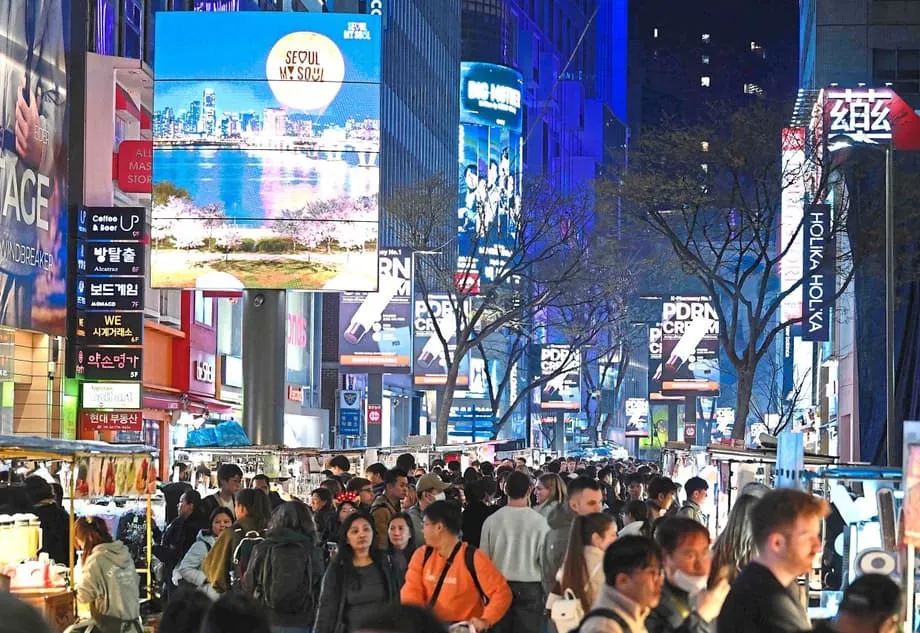
Gwanghwamun now has four such large digital screens. The busy shopping district of Myeongdong has three, while Gangnam, a district associated with South Korea's economic and cultural strength, has 17. Together, the installations show how widely the push for prominent digital advertising has spread through major commercial areas.
The 2033 goal remains the longer timeline behind the immediate brightness changes. Seoul is adjusting how the screens operate while continuing to pursue the media gallery concept. The competing demands are already visible: displays designed to attract attention must share space with drivers, offices and residents who cannot simply look away.
How Advertising Zones Changed the Streets
South Korea's central government created free advertising zones to establish urban landmarks and stimulate the outdoor advertising industry. Within these designated areas, billboard regulations are substantially relaxed, allowing larger installations and more experimental uses of display technology.
The first zone opened in 2016 at Coex in Gangnam District. Relaxed rules allowed experimental displays and higher brightness levels. Their success in generating attention on social media and drawing foot traffic helped bring the policy to Gwanghwamun and Myeongdong.
Some buildings in these zones now carry screens exceeding 1,200 square meters. Their reach extends into neighboring workplaces. One official noted that offices facing the displays had reported difficulty concentrating because of glare and changing colors, even during daylight hours.
The key dates show how the advertising expansion and the response to its brightness developed:
- 2010: Seoul enacted light pollution legislation, although complaints returned to their original levels within a few years as businesses found ways around restrictions.
- 2016: Coex in Gangnam became the first free advertising zone.
- 2025: Chung Moon-heon announced the Gwanghwamun Square revitalization project.
- January to March 2026: Officials surveyed 52 major digital displays.
- April 1, 2026: The new brightness guidelines took effect.
- 2033: Seoul's target year for establishing Gwanghwamun Square as a global media gallery.
Drivers Describe Sudden Bursts of Light
Nighttime motorists are central to the complaints that prompted the changes. Thousands have reported dangerous glare, including light that can temporarily blind drivers as they navigate some of Seoul's busiest intersections. Professional drivers spend hours moving through these illuminated corridors and encounter the screens repeatedly.
Kim Kyung-ho, a taxi driver aged 50, described the effect of large billboards suddenly becoming bright:
When those giant billboards suddenly light up, it's blinding. I know where they are now, but they used to catch me off guard.
Kim's account explains why the guidelines address transitions and flashing as well as maximum brightness. A driver familiar with a screen's location may anticipate it, but an abrupt change can still demand attention at a moment when the road needs it.
Park Ji-hoon, a tourist bus driver aged 56 with 25 years of experience, said conditions had improved:
The lights used to shine directly at me and really hurt my eyes. These days, it feels a bit better.
Kim Hye-joon, aged 30, also observed a slight easing of glare around Gwanghwamun. Kim underwent laser eye surgery and has long experienced sensitivity to light while driving. That experience adds another perspective to the early response: even a modest reduction can be noticeable to someone already troubled by bright lights.
Yoo Jong-dae, a night taxi driver in his late 60s, reported a different experience. Yoo works shifts lasting 12 hours, from 4 p.m. to 4 a.m., covering the evening and the hours after midnight when the stricter limits apply.
Yoo said the larger screens continued to interfere with driving:
I did not notice any change in billboard brightness since April. The glare at night is still considerable, especially from the larger ones, and gets in the way of driving.
The early responses range from some relief to continued discomfort. No results from a survey measuring brightness after April 1 were given, leaving the drivers' experiences as the account of how the changes feel on the road.
Residents See Beauty and Clutter
Gwanghwamun's digital transformation has also divided people who spend time in the square. For some, the vivid colors contribute to Seoul's modern identity and make the surrounding buildings more visually engaging. Others prefer the appearance of the plaza before giant screens became part of it.
Kim Hee-soo, an art student aged 23, described how the displays affect the wider scene:
The colours are so vivid that it feels like they are spreading out like waves. I didn't realise it before, but the glass facades of the buildings also feel vibrant.
Kim's appreciation helps explain why some residents resist the dimming initiative. The light is part of the attraction for them, extending beyond the screen itself to reflections on nearby glass facades.
Park, a shoe repairman aged 74 who has worked near Gwanghwamun Square for approximately 60 years, expressed nostalgia for the plaza before its digital transformation. He objected to the number of screens as well as their visual intensity:
Gwanghwamun Square was much better in the old days. It got too cluttered after those displays went up. One or two screens in a set place is fine, but now there are just too many. Too flashy.
Park initially did not notice the recent brightness reductions when asked about them. His response points to a concern that dimming alone leaves in place: the screens still occupy the same buildings and remain part of the square's appearance.
Lee Youn-kyu, a shipping industry worker aged 55, questioned whether Seoul's displays were genuinely problematic compared with those in other global cities. He argued that pedestrian convenience and visual appeal also deserved consideration:
We also can't ignore the overall convenience for pedestrians and the aesthetic value these lights add. I think it's important to find a good balance between all of these factors.
Oh Se-min, a retired construction company worker aged 68, said the displays did not personally bother him. He nevertheless placed driver safety first:
If drivers say they experience glare, then it should definitely be addressed to prevent accidents.
Different Cities Use Different Measures
Seoul is the first municipality in South Korea to establish comprehensive brightness standards of this kind. Internationally, it joins a small group of cities attempting to control the growing light from digital advertising through specific measurements and restrictions.
Shanghai applies a limit of 5 lux in certain areas and restricts blue light from digital billboards to 17% of the brightness allowed for green LEDs. Lux measures light arriving at a surface, while candelas per square meter describe the brightness of an emitting surface. The two figures therefore measure different aspects of illumination.
Shanghai's separate treatment of blue light reflects concerns about lighting rich in blue wavelengths disrupting human and animal circadian rhythms. Circadian rhythms are the daily cycles that help regulate sleeping and waking. The color of artificial light matters alongside its intensity.
London and New York rely on older nuisance rules rather than the preventive numerical approach described in Seoul and Shanghai. In London, electric light is legally treated as a nuisance rather than a pollutant. Residents must demonstrate harm, such as sleep loss or reduced property value, before authorities can intervene.
New York's light pollution ordinance applies only to properties owned by the state. Private developers consequently have considerable freedom to install bright LED facades with limited oversight. Seoul's approach places defined operating limits on screens, whereas nuisance rules put more responsibility on affected residents to demonstrate the problem.
Seoul's own experience shows the difficulty of keeping restrictions effective. Its 2010 light pollution legislation was followed by a return of complaints to their original levels within a few years, as businesses found ways to circumvent the rules. The new requirements for automatic controls address how screens operate through changing conditions, alongside the numerical caps.
The Wider Growth of Artificial Light
Electrically lit areas worldwide expand at an annual rate of 2.2%. Satellite data show that global light emissions increased by 49% between 1992 and 2017. Those figures place Seoul's billboard dispute within a wider increase in artificial illumination.
LED lighting rich in blue wavelengths is harder for satellites to detect, so the measured rise may underestimate the actual change. Global radiance, a measure of emitted light, may have increased by as much as 270% when that additional lighting is taken into account.
Seoul's policy focuses on specific displays rather than every source of urban light. Its requirements connect several concerns visible in the city: drivers reacting to glare, office workers struggling with bright color changes, and residents debating the appearance of public spaces. Shanghai's restrictions on blue light add another concern, the effect of illumination on daily biological rhythms.
City Projects a 15% Electricity Saving
Seoul officials project that limiting excessive brightness will reduce electricity consumption by the large digital installations by approximately 15%. The saving gives the policy an energy objective alongside its goals for road safety, visual comfort and advertising readability.
The timing also connects with national efforts to reduce energy use. Geopolitical tensions in the Middle East have prompted the South Korean government to seek broader reductions in consumption. Dimming large screens is one way the city expects to contribute to that effort.
Choi In-gyu, a local official involved in developing the policy, described the recommendations as a balance between readable advertisements, reduced visual fatigue and electricity savings:
These recommendations represent a reasonable improvement that adjusts brightness beyond what is necessary to consider the readability of advertisements and reduce visual fatigue for citizens, while also enhancing energy efficiency.
Seoul's immediate task is to make its expanding digital streetscape more comfortable without abandoning the attractions it has spent years encouraging. The April limits reduce permitted brightness and change how images appear, while Gwanghwamun's media gallery ambition continues toward 2033. Drivers' mixed responses show why the practical effect of those changes matters as much as the numbers assigned to each screen.
The Bottom Line
- Seoul's first comprehensive billboard brightness guidelines took effect on April 1, 2026, following a survey of 52 major displays.
- The daytime ceiling is 7,000 candelas per square meter. Nighttime limits range from 350 to 500, depending on display size and the hour.
- Operators must reduce bright white backgrounds, abrupt brightness changes and flashing, with automatic brightness controls required in designated zones.
- Thousands of complaints about glare helped prompt the policy. Some drivers report improvement, while others still find the larger screens difficult to drive past.
- Gwanghwamun has four large screens, Myeongdong has three and Gangnam has 17. Seoul aims to make Gwanghwamun a global media gallery by 2033.
- Officials project a 15% reduction in electricity consumption by the installations, while residents remain divided over their beauty, brightness and place in the historic square.