
A New Power Cycle Goes to Work in Guizhou
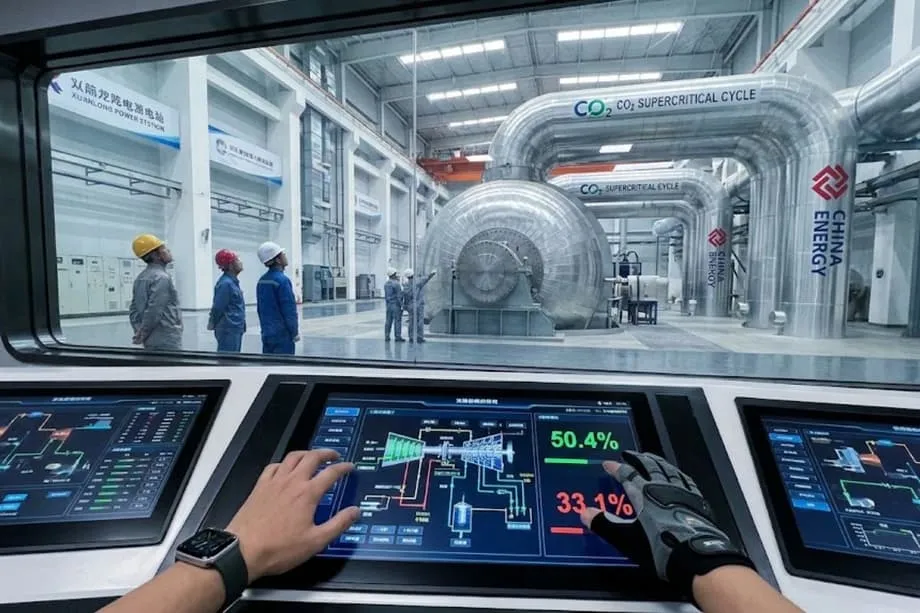
Two generating units with a combined capacity of 30 megawatts are turning waste heat from steelmaking into electricity in Liupanshui, in China's Guizhou Province. Chaotan One, described as the world's first commercial supercritical carbon dioxide power generator, connected to the grid on December 20, 2025, at the Shougang Shuicheng Iron and Steel facility.
Contents
- A New Power Cycle Goes to Work in Guizhou
- What Makes Supercritical Carbon Dioxide Useful?
- How Waste Heat Becomes a Source of Revenue
- Seventeen Years of Engineering Work
- How China and the United States Reached Different Stages
- Why Growing Electricity Demand Matters
- Can the Heat Exchangers Keep Their Performance?
- Seals and Steel Plant Contamination Add Pressure
- Molten Salt Storage Is the Next Announced Step
- Key Points
The installation uses two units rated at 15 megawatts each. Its stated annual output exceeds 70 million kilowatt-hours, with about 30 million yuan, or $4.26 million, in additional revenue for the steel operation. The energy comes from heat left over after sintering, a process that heats fine iron ore particles before they enter a blast furnace. That heat previously escaped into the atmosphere.
Chaotan One replaces steam as the fluid that carries heat through the power generation equipment. Instead, it circulates carbon dioxide under enough pressure and heat to give it properties useful for driving a turbine. The project brings a technology developed over 17 years into a working industrial setting, where electricity production, maintenance costs and reliability all matter.
Steam has been central to thermal power generation for nearly two centuries. The familiar process heats water, produces steam and uses that steam to spin a turbine. The Rankine cycle underlying this approach accounts for about 80 percent of global electricity production, according to the figures accompanying Chaotan One's launch.
The Chinese project introduces another way to use heat within existing industrial infrastructure. Its immediate opportunity lies in recovering energy that factories already produce but cannot always turn into electricity economically. Its longer test is whether the claimed efficiency gains survive years of demanding operation.
What Makes Supercritical Carbon Dioxide Useful?
Carbon dioxide becomes supercritical above about 31 degrees Celsius and a pressure of 73 atmospheres. The pressure is comparable to that found roughly 800 meters below the ocean surface. Beyond these conditions, the fluid has a density resembling that of a liquid while retaining flow properties resembling those of a gas.
Those properties allow a compact flow of carbon dioxide to carry energy through machinery. The explanation accompanying Chaotan One describes a fluid able to drive turbines with greater force and much less friction than steam. The system uses a Brayton cycle, an arrangement in which the working fluid is compressed, heated and expanded to produce power.
The comparison presented for the technology puts conventional Rankine cycle conversion at roughly 33 percent of heat energy, against theoretical efficiencies above 50 percent for a supercritical carbon dioxide Brayton cycle. The figure above 50 percent is a theoretical capability; the project's separate claims about improved waste heat recovery concern its comparison with conventional equipment.
Huang Yanping, chief scientist at the Nuclear Power Institute of China and lead designer of Chaotan One, described the thermodynamic advantage through a cycling analogy:
It is like a strong man riding a bicycle coated with lubricating oil, allowing him to pedal effortlessly over long distances.
The carbon dioxide circulates in a closed loop, meaning the equipment repeatedly uses the same working fluid instead of releasing it into the atmosphere during normal operation. Chaotan One's design is also described as eliminating the need for cooling systems based on water. The claimed absence of cooling water consumption would be valuable in dry areas where water availability restricts thermal power generation.
The equipment requires about half the floor space of an equivalent steam system, according to the project's stated comparison. Fewer auxiliary components and faster response are further claimed advantages. Together, those features offer a way to install generation equipment around existing industrial operations rather than build entirely new facilities.
How Waste Heat Becomes a Source of Revenue
Shougang Shuicheng's sintering process provides Chaotan One with an industrial heat source that was already available. Recovering that energy allows the plant to produce electricity from a stream previously treated as waste, adding a source of revenue without requiring the steel operation to be rebuilt.
Conventional steam recovery systems can struggle economically when heat sources are too cool or the installation is too small. Chaotan One targets this difficulty with medium temperature heat at small and medium scales, where the cost of recovering energy can outweigh the value of the electricity produced.
The project's stated comparison with conventional steam equipment for waste heat recovery is an 85 percent increase in generation efficiency and a 50 percent increase in net power output, alongside a 50 percent reduction in physical footprint. Net output is the electricity remaining after the generating system's own equipment has used the power it needs to operate.
The two performance percentages describe different measures. Efficiency concerns how effectively heat becomes electricity, while net output concerns how much usable electricity the installation delivers. Both matter to a steel plant deciding whether the recovered energy is worth the equipment and maintenance costs.
At the stated annual output of more than 70 million kilowatt-hours, the installation is expected to add roughly 30 million yuan a year to the steel operation's revenue. Its wider attraction is the possibility of repeating the approach at industrial sites where medium temperature heat has been too expensive to recover with conventional equipment.
The project also supports China's dual carbon goals by converting an industrial waste stream into electricity. Its claimed water savings address another constraint identified for industry in southwestern China, where water availability can limit expansion. Equipment that operates without cooling water could widen the range of locations suitable for waste heat recovery.
Seventeen Years of Engineering Work
The Nuclear Power Institute of China, part of China National Nuclear Corporation (CNNC), began its research program in 2009. Commercial operation in December 2025 followed a development effort described as lasting 17 years. The underlying concept dates to 1948, but turning it into industrial machinery required solutions to persistent engineering problems.
One essential component was the microchannel heat exchanger. Its passages measure roughly one millimeter in diameter, allowing heat to move efficiently into or out of carbon dioxide operating under very high pressure. Producing such narrow passages requires metal parts that can remain tightly bonded under demanding conditions.
The team used vacuum diffusion welding, which bonds metal plates under heat and pressure without melting them. Foreign suppliers had refused to export the technology, which was subject to strict commercial control restrictions. Huang's team then spent 829 days developing its own manufacturing process.
The work covered 218 welding parameters and 27 rounds of optimization. Failed samples filled half a warehouse. A successful bond came during the 49th process test on a cold winter morning in 2021, with stable green curves on laboratory monitoring screens confirming the result.
Sealing the rotating machinery presented another major problem. Carbon dioxide under high pressure can escape around rotating shafts, and the development account describes outside doubts about whether turbines operating at the megawatt scale could be sealed successfully. Foreign experts advised Huang against attempting units larger than 100 kilowatts and regarded the larger machines as effectively impossible.
The team examined several approaches before developing dry gas seals adapted to supercritical carbon dioxide. The resulting equipment was described as the world's first successful application of dry gas sealing at the megawatt scale in supercritical carbon dioxide turbomachinery. That advance helped move the project from a promising power cycle toward an operating generator.
How China and the United States Reached Different Stages
China's grid connection on December 20, 2025, came while the United States was continuing tests of similar technology. American work described through the Supercritical Transformational Electric Power program and Sandia National Laboratories had already demonstrated electricity delivery, but at a different stage of development.
Sandia delivered 10 kilowatts to the grid for 50 minutes in April 2022 using supercritical carbon dioxide. By October 2024, testing had advanced to 4 megawatts synchronized with the grid. Commercial targets in the United States remained focused on the mid-2030s.
The main dates show the distance between the original concept, component development and electricity generation:
- 1948: The concept behind supercritical carbon dioxide power generation was first proposed.
- 2009: The Nuclear Power Institute of China began its research program.
- 2017: The U.S. Department of Energy identified the technology as a strategic frontier.
- 2018: MIT Technology Review selected it among its 10 breakthrough technologies.
- 2021: The Chinese team achieved its decisive diffusion welding bond during the 49th process test.
- April 2022: Sandia delivered 10 kilowatts to the grid for 50 minutes.
- October 2024: U.S. testing reached 4 megawatts synchronized with the grid.
- December 20, 2025: Chaotan One connected to the grid in Guizhou.
The development paths reflect different approaches to managing technical uncertainty. American work has placed heavy weight on laboratory validation, corrosion testing, alloy qualification and understanding how materials behave over long periods before commercial deployment. Regulatory caution and extensive efforts to reduce risk have lengthened that timetable.
The Chinese approach is described domestically through the idea of crossing a river by feeling for stones: building equipment, learning from operation and making improvements as problems appear. That method supported earlier deployment while leaving questions about durability to be answered through continued use. The American approach seeks to settle more of those questions before commercial operation.
Why Growing Electricity Demand Matters
Artificial intelligence data centers and advanced manufacturing are increasing demand for electricity. The demand estimate cited alongside Chaotan One puts the increase in U.S. generating capacity needed to power AI facilities at 165 percent by 2030. Such projections make additional output from existing industrial sites an attractive prospect.
Chaotan One's relevance is its ability to use infrastructure and heat sources already present at a factory. Rather than depend entirely on new generating facilities, an industrial operator could add equipment that turns part of its discarded heat into usable power.
The opportunity is concentrated in heat streams that conventional systems struggle to use economically. Medium temperature sources and installations of modest size have been a longstanding difficulty for heat recovery. A smaller machine with better conversion performance could make those projects financially worthwhile.
Electricity demand also makes operating costs and dependable output more important. The same features that promise better performance, including compact heat exchangers and highly pressurized machinery, must remain effective during repeated heating, cooling and continuous industrial service.
Can the Heat Exchangers Keep Their Performance?
Michael Barnard, an analyst who has examined Chaotan One's technical risks, estimated a 40 to 70 percent probability of measurable performance degradation within two to five years. His assessment concerns several possible failure mechanisms in equipment operating at high temperatures and pressures of about 200 atmospheres.
The diffusion bonded heat exchangers are one concern. Their narrow channels depend on strong bonds between metal layers. Damage at those internal bonded surfaces can be extremely difficult to repair, potentially requiring replacement of an entire unit rather than a small component.
Carburization presents another risk. In this process, carbon enters a steel alloy and can make the material more brittle. Changes to the surfaces inside the channels can also increase roughness, making it harder for the working fluid to pass through.
Greater resistance to flow creates a larger pressure drop and reduces cycle efficiency. A gradual change inside the exchanger could therefore erode the claimed 85 percent efficiency advantage even while the installation continues producing electricity.
Barnard's probability range is an analyst's estimate of future degradation. Long term operating performance remains unconfirmed as of April 20, 2026. The coming years will provide the operating record needed to judge how much of the initial performance the equipment retains.
Seals and Steel Plant Contamination Add Pressure
Seal integrity is another concern because carbon dioxide under high pressure can escape through very small openings. The technical assessment compares the challenge with hydrogen sealing: small, mobile molecules must be contained around shafts and flanges exposed to repeated mechanical and temperature changes.
Historical experience cited for hydrogen refueling stations attributes approximately 50 percent of service interruptions to seal failures. That comparison illustrates why maintaining seals over years of continuous service deserves attention in supercritical carbon dioxide equipment.
Even a small leak can change the amount of working fluid circulating through the system. Compressors can then move away from their best operating conditions, while more electricity is consumed by equipment supporting the power cycle. Those additional internal demands reduce the useful power available to the plant.
The steelmaking environment creates a second, external challenge. Exhaust streams contain particles, metal oxides and sulfur compounds that can collect on heat transfer surfaces. The buildup reduces heat transfer in a way similar to limescale accumulating on equipment.
Barnard estimated a 60 to 85 percent probability of performance loss caused by fouling within two to five years in this industrial setting. Fouling could lower the temperature reaching the turbine even if the internal carbon dioxide circuit remains intact. Keeping the outside heat transfer surfaces effective is therefore as important as maintaining the pressurized loop.
Molten Salt Storage Is the Next Announced Step
CNNC has announced plans to combine supercritical carbon dioxide generation with molten salt energy storage, targeting demonstration operation by 2028. The project has been selected for China's fifth batch of major first-of-a-kind energy equipment.
Molten salts would hold energy as heat. When electricity demand rises, that stored heat could feed the carbon dioxide power cycle. The combination is intended to address the uneven output of renewable energy by separating the time energy is collected from the time electricity is generated.
Concentrated solar power offers another possible application. These facilities collect solar energy as high temperature heat, making them a potential match for a supercritical carbon dioxide Brayton cycle. The proposed benefit is better conversion performance than current solar thermal plants using steam.
Advanced nuclear designs are also potential users of the compact machinery, including small modular reactors and reactors cooled by gas at high temperatures. Huang's broader vision includes energy storage, waste heat recovery and industrial steam supply.
The common target is a thermal energy source that has been difficult to use efficiently at a medium scale. If Chaotan One retains its performance through years of service, its design could widen the market for distributed generation and industrial carbon reduction. The next announced milestone is the molten salt storage demonstration targeted for 2028.
Key Points
- Chaotan One connected to the grid on December 20, 2025, at the Shougang Shuicheng steel facility in Liupanshui, Guizhou.
- Two units rated at 15 megawatts each provide 30 megawatts of capacity, with stated annual generation exceeding 70 million kilowatt-hours.
- The project expects about 30 million yuan, or $4.26 million, in additional annual revenue from recovering sintering waste heat.
- Its stated advantages over conventional steam recovery equipment include 85 percent higher generation efficiency, 50 percent greater net output and half the footprint.
- Development began in 2009 and required advances in diffusion welding, microchannel heat exchangers and dry gas seals.
- The closed carbon dioxide loop is described as operating without cooling water, offering a potential benefit in dry regions.
- Material degradation, seal leakage and fouling are central risks to maintaining performance over several years.
- U.S. commercial targets remain focused on the mid-2030s, while CNNC targets a molten salt storage demonstration in 2028.