A Record Beneath the Sea
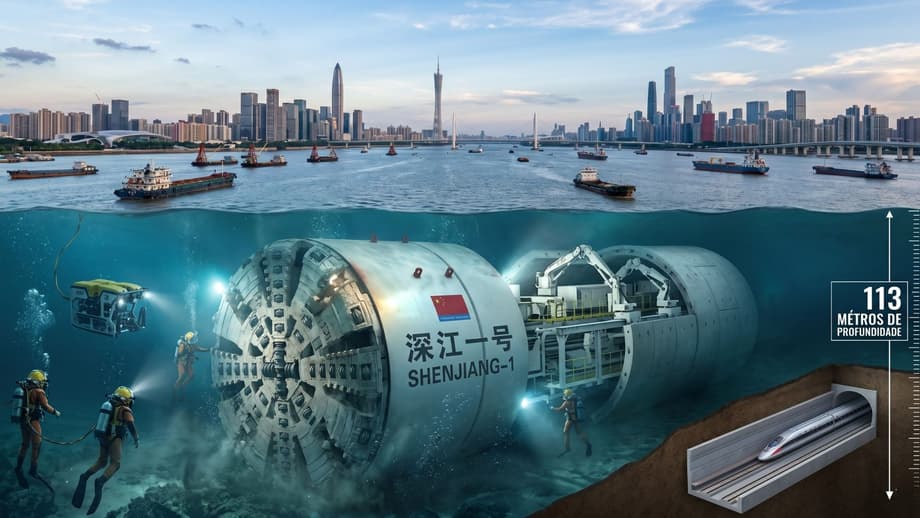
In April 2026, a massive Chinese tunnel boring machine operating beneath one of southern China’s busiest waterways reached a milestone that no similar project had ever achieved. The Shenjiang-1, a domestically developed excavation machine, pushed the Pearl River Estuary tunnel to a depth of 113 meters below the seabed, establishing a new world record for the deepest undersea high speed railway tunnel ever constructed. The achievement marks a critical advance in the 116 kilometer Shenzhen Jiangmen high speed railway, a project designed to bind together the eastern and western shores of the economically vital Guangdong Hong Kong Macao Greater Bay Area. When finished, the railway will cut travel time between Shenzhen and Jiangmen to less than one hour, and the stretch between Shenzhen’s Qianhai and Guangzhou’s Nansha will take roughly 30 minutes.
The tunnel itself stretches 13.69 kilometers beneath the estuary between Dongguan and Guangzhou, with approximately 11.05 kilometers passing directly under water. Engineers expect the excavation to reach an even greater maximum depth of 116 meters before the tunnel begins its ascent toward the opposite shore. At these depths, the project faces hydrostatic pressures approaching 11 bar, roughly equivalent to the crushing forces experienced by divers at extreme ocean depths. Under such conditions, human workers cannot safely access the excavation face, meaning the entire cutting operation must proceed through remote control and automated systems. The environment leaves no room for error, as any pressure failure could trigger sudden water ingress, soil instability, and catastrophic structural damage.
The Steel Dragon at Work
At the center of this engineering feat stands the Shenjiang-1, a slurry shield tunnel boring machine manufactured by the 14th Bureau of China Railway Group. The machine spans approximately 130 meters in length, weighs 3,800 tonnes, and features a cutterhead with a cutting diameter of roughly 13.42 meters, making it one of the largest diameter TBMs currently operating on any undersea railway project worldwide. Its cutterhead carries a decorative dancing lion motif reflecting the cultural heritage of Guangdong Province, though its function is purely industrial. The machine was designed and built entirely within China and carries full domestic intellectual property rights. Its overall design pressure rating of up to 12 bar allows it to operate against the extreme hydrostatic pressures that increase with every meter of depth.
Since beginning its journey in December 2021, the Shenjiang-1 has worked continuously for more than four years, advancing over four kilometers through some of the most hostile geological conditions ever encountered by a tunnel boring machine. The average progress rate of just two meters per day might seem slow to outside observers, but that pace reflects the extreme difficulty of the terrain rather than any lack of mechanical power. The machine must constantly adjust its rotation speed, mud pressure, and advancement rate as it moves through materials ranging from soft marine clay to intact granite with compressive strength exceeding 124 megapascals. Each meter requires careful calibration, as the geological layers shift without warning from soft sediment to hard crystalline rock.
Why Depth Changes Everything
The Pearl River Estuary presents one of the most complex geological profiles in southern China. The tunnel route crosses 13 distinct geological strata, five composite rock types, and six fault zones accumulated over millions of years. Each layer behaves differently when disturbed by a 3,800 tonne machine. Soft marine clay can flow and shift when the cutterhead passes through, while fine sand faces the risk of liquefaction under sustained vibration. Fractured rock may collapse into sudden blocks without warning, and hard granite rapidly wears down cutting tools that must bite through stone with compressive strength exceeding 124 megapascals. A 490 meter stretch of fault zones with uneven rock layers and particularly high water pressure posed especially severe risks during earlier phases of construction, requiring constant adjustments to keep the excavation face stable and to prevent ground settlement above the tunnel path.
Hydrostatic pressure increases by approximately one bar for every ten meters of depth. At the current record depth of 113 meters, the surrounding water and soil exert pressure nearing 11 bar on the tunnel structure. When the tunnel reaches its maximum 116 meter depth, the pressure will hit 1.06 megapascals. For context, that force concentrates the equivalent of more than 10 kilograms onto an area the size of a fingernail. Such pressures demand that every structural element withstand forces far beyond those faced by typical railway tunnels. No comparable engineering experience or design standards existed domestically before this project began, forcing teams to invent protocols as they advanced. The combination of high pressure and unpredictable geology explains why the Shenjiang-1 sometimes advances only two meters in a full day of continuous work, as operators verify stability at every stage before continuing.
Slurry, Concrete, and Millimetric Precision
To maintain stability in these conditions, construction crews rely on the slurry shield excavation method, a technique essential for deep underwater tunnels in saturated soils. The process uses bentonite, a type of absorbent clay, mixed into a thick paste capable of supporting the excavation face and preventing water and soil from surging into the tunnel. The Shenjiang-1 operates two interconnected slurry circuits that function as the machine’s circulatory system. The first delivers fresh bentonite slurry directly to the pressurized chamber behind the cutterhead, creating a protective barrier calibrated to balance exactly against the external water and soil pressure. If pressure drops too low, the front destabilizes and risks sudden collapse or flooding. If pressure rises too high, it can deform the surrounding soil and compromise the safety of the entire operation.
The second circuit transports the debris laden slurry back to the surface through a network of pipes. At the separation plant, workers filter out excavated rock and clay, then treat and recycle the bentonite for reuse in the tunnel. The volume of material removed equals roughly enough to fill a tanker truck every hour of continuous operation. Meanwhile, behind the excavation chamber, a robotic erector installs precast concrete lining segments with millimetric precision. Each ring of the tunnel consists of nine curved segments, each about two meters wide. These pieces must fit together perfectly to create a watertight structure rated for a 100 year service life while supporting tracks designed for high speed trains traveling at 250 kilometers per hour. Even minor misalignments accumulated across the full 13.69 kilometers could distort the track geometry, create vibrations, and threaten both passenger comfort and long term operational safety.
Tools That Repair Themselves
The unique combination of depth, pressure, and geological complexity forced Chinese engineers to develop solutions that go far beyond conventional tunneling equipment. The first major innovation allows the Shenjiang-1 to change worn cutting tools under extreme high pressure without sending human workers into the chamber. On traditional machines, this type of maintenance usually requires specialized divers and lengthy decompression protocols that halt progress for days. The second breakthrough involves an in situ disassembly system that allows crews to take apart the machine in confined spaces beneath the seabed, since not all points along the estuary provide suitable arrival shafts for standard machine removal. This capability matters because the geological conditions vary so wildly along the route that the machine might need to be extracted or modified at locations where conventional shaft construction is impossible or prohibitively expensive.
Additional advances include immediate settlement control in unstable soils, continuous monitoring of excavation parameters through embedded sensors, thermal management systems for the pressurized chamber, redundant communication networks operating at extreme depth, and emergency response protocols for sudden geological events like unexpected water inflows or pressure spikes. China Railway Construction Corporation has documented these technologies as replicable systems for future underwater projects. Rather than treating the Pearl River tunnel as a single isolated achievement, Chinese planners view it as an industrial laboratory for a new generation of undersea crossings that could eventually serve railway, road, and logistical corridors in other complex estuaries around the world. The knowledge gained from maintaining pressure balance at 113 meters will inform how future machines handle even deeper or longer subsea passages.
When Artificial Intelligence Meets Bedrock
While the Shenjiang-1 supplies the muscle, a suite of digital systems provides the brain. China Railway Tunnel Group deployed what it calls the Eight Intelligent Systems to manage construction of China’s deepest and highest water pressure railway tunnel. These systems cover intelligent tunneling, segment assembly, coordination, diagnostics, monitoring, component production, material management, and ventilation. A smart management platform integrates real time monitoring, collaborative management, auxiliary tunneling guidance, and big data analysis into a single operational picture. During the 2024 World Tunnel Congress in Shenzhen, international experts visited the site to observe how these systems function under actual extreme conditions.
The intelligent tunneling system uses neural networks, machine learning, and predictive algorithms to forecast geological behavior before the cutterhead encounters it. Edge feedback control allows the machine to adjust parameters automatically within fractions of a second, while emergency fuse control can shut down operations instantly if sensors detect abnormal pressure or temperature spikes. Hong Kairong, chief engineer of China Railway Tunnel Group, explained that the broader goal extends beyond this single project.
As we progress in intelligent tunnel construction research and development, our commitment is to bridge the data gap between construction and operation, thereby setting new standards in the field.
More recently, the project has served as a testing ground for China’s first vertical large model specifically developed for the tunnel and underground space sector. Released by the National Key Laboratory for Tunnel Boring Machines, this artificial intelligence system draws on data from 773 engineering projects and 120 billion construction records to make tunnel construction safer and more efficient. The model has already been applied to the Pearl River Estuary Tunnel, representing a step toward fully digital tunneling operations.
Shrinking the Bay Area
The Shenzhen Jiangmen railway is not merely an engineering exercise. It ranks as a priority project within China’s national strategy to integrate the Greater Bay Area, a region home to approximately 86 million people with a combined gross domestic product approaching two trillion dollars. The Pearl River estuary currently acts as a central geographical barrier that forces travelers between the eastern shore, where Shenzhen and Hong Kong sit, and the western shore, where Guangzhou, Jiangmen, and Zhongshan are located, to endure ferry crossings or road journeys lasting more than two hours. The new railway will reduce the journey between Shenzhen and Jiangmen to under one hour, while the run between Shenzhen Airport East and Nansha will take roughly half an hour.
The line will connect seven stations: Xili, Shenzhen Airport East, Binhai Bay, Nansha, Zhongshan North, Henglan, and Jiangmen. Two of these, Xili and Shenzhen Airport East, will operate as underground stations. The latter covers a construction area of 487,500 square meters and will allow passengers to transfer between high speed rail, subway, and air travel within five minutes. Four stations will run as elevated structures, while Jiangmen will serve as a station at ground level. The route forms a critical missing link in the eastern coastal section of China’s Eight Vertical and Eight Horizontal national high speed rail network, a grid designed to connect major population centers across the world’s most populous country.
The reduction in travel time is expected to alter the economic geography of the region. Workers residing in Jiangmen or Zhongshan will gain practical access to employment centers in Shenzhen, while manufacturers will find it easier to link production chains and free trade zones on both sides of the estuary. Every minute saved in transportation within a region this dense translates directly into productivity gains and expanded labor markets. The tunnel will influence decisions about where companies build factories, where families purchase homes, and how one of China’s most productive regions distributes growth across its cities during the coming decades.
The Final Push to 2028
Construction of the Shenzhen Jiangmen railway began in earnest during 2024, with a projected completion date of 2028. The Pearl River Estuary Tunnel represents the most technically demanding single element of the entire corridor, and its progress effectively determines the timeline for the whole route. While the Shenjiang-1 has already passed the 113 meter mark, the deepest point of 116 meters still lies ahead before the machine begins its upward curve toward the western shore. After more than four years of continuous operation, the TBM has proven that Chinese designed equipment can operate reliably under conditions that no railway tunnel has previously attempted.
The project has already generated substantial intellectual property beyond the tunnel itself. The project team has filed five invention patents and seven utility model patents, alongside 17 published technical papers that provide guidance for future projects in similar geological conditions. These contributions extend from mechanical innovations to smart construction technologies, including advanced geological forecasting tools and automated welding robots that maintain quality under harsh underground conditions. The documentation and data gathered at 113 meters below the seabed will serve as reference material for planners considering underwater crossings in other complex estuaries, both within China and potentially abroad.
When the railway opens, it will join more than 45,000 kilometers of high speed rail lines already operating across China, the largest such network on Earth. Yet the Pearl River Estuary Tunnel stands apart even within that vast system. It pushes the industrial limits of tunneling under high pressure and validates a new generation of domestically developed machinery, artificial intelligence tools, and construction methods. For the millions of residents in the Greater Bay Area, the tunnel means faster commutes and stronger economic bonds. For the global engineering community, it sets a new benchmark for what underwater railway construction can achieve.
The Bottom Line
- The Pearl River Estuary tunnel reached a world record depth of 113 meters below the seabed in April 2026, making it the deepest undersea high speed railway tunnel ever built.
- The domestically developed Shenjiang-1 tunnel boring machine excavated more than 4 kilometers over four years through 13 geological strata, five rock types, and six fault zones.
- Hydrostatic pressure at maximum depth will reach 1.06 megapascals, requiring remote controlled slurry shield technology and precast concrete lining built to last 100 years.
- Eight Intelligent Systems using machine learning and neural networks guide the excavation, alongside China’s first vertical large model for tunnel construction.
- The 116 kilometer Shenzhen Jiangmen railway will cut travel time between the two cities to under one hour when it opens in 2028, strengthening the Guangdong Hong Kong Macao Greater Bay Area economy.