A Breakthrough Beneath the Waves
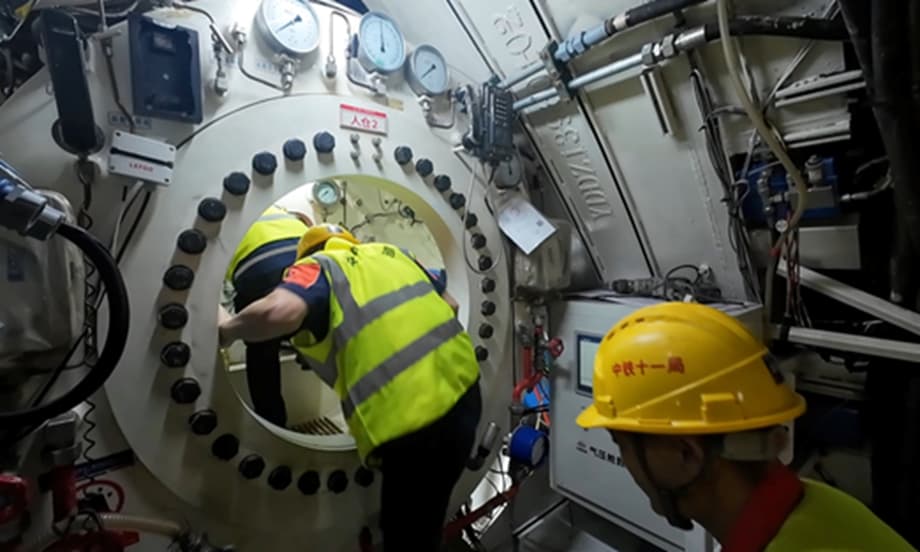
China has deployed a first of its kind ternary mixed gas shield tunneling system to support construction of the Jintang undersea tunnel, a 16.18 kilometer rail link that will become the longest undersea high speed railway passage on Earth. The domestically developed technology allows workers to operate safely at pressures that exceed traditional limits by a wide margin, marking a major advance in subterranean engineering. The system entered active service on the Zhoushan side section of the tunnel, where crews face some of the most demanding conditions ever encountered in rail construction. By blending helium, nitrogen, and oxygen in precise ratios, the equipment sustains human life and alertness in an environment where water and soil pressures reach levels normally associated with deep ocean exploration rather than tunnel boring.
Inside the Longest Undersea High Speed Rail Tunnel
The Jintang tunnel will connect Ningbo and Zhoushan across a busy waterway in the eastern Chinese province of Zhejiang. When complete, the 16.18 kilometer corridor will hold the global record for the longest undersea high speed rail tunnel, far surpassing existing subsea rail links in length and complexity. The project forms a critical segment of a larger transportation network designed to bind the mainland more closely with Zhoushan, an archipelago city whose geographic isolation has long posed logistical challenges for commuters and freight alike.
Construction teams on the Zhoushan side are responsible for a 6,270 meter shield tunneling section, a distance that requires months of continuous boring through varying geology beneath the seabed. Shield machines, often called tunnel boring machines or TBMs, carve out circular passages while simultaneously installing support structures to prevent collapse. These mechanical giants rely on rotating cutter heads to grind through rock and sediment, but the cutting tools wear down and must be inspected or replaced regularly. Performing this maintenance inside a pressurized chamber deep below the waterline is among the most dangerous jobs in civil engineering.
Why Traditional Methods Hit a Wall
Ultra high pressure chamber operations represent one of the most severe challenges in the shield tunneling industry. For decades, crews have relied on compressed air systems to keep water out of the excavation chamber while workers enter to service the cutter head. Conventional compressed air techniques carry a recognized safety pressure limit of 0.5 megapascals. Beyond this threshold, the risk of decompression sickness and other physiological dangers rises sharply, making human entry prohibitively hazardous.
The Jintang tunnel, however, defies those old boundaries. Its deepest section sits 78 meters below sea level, where the combined water and soil pressure climbs to 0.85 megapascals. To visualize that force, imagine roughly 30 kilograms of weight pressing down on an area no larger than a one yuan coin. That concentration of pressure would be impossible for workers to endure using standard compressed air protocols. The project demanded a fundamentally different approach to life support and pressure management.
Borrowing from the Deep Ocean
Faced with this extreme barrier, the construction team looked not to conventional mining technology but to deep ocean diving. Saturation diving and mixed gas breathing systems have long allowed commercial divers to work at ocean depths where simple compressed air would be lethal. The same physiological rules apply whether a worker is repairing infrastructure on an offshore oil platform or replacing worn components on a tunnel cutter head hundreds of meters underground. Engineers adapted these maritime principles to create a helium nitrogen oxygen ternary mixed gas system specifically tailored for tunnel construction.
Helium serves as the game changing ingredient. Unlike nitrogen, which makes up the bulk of ordinary air, helium possesses low density and diffuses rapidly through tissues. Under extreme pressure, normal breathing gas causes nitrogen to dissolve into the bloodstream in dangerous quantities, leading to narcosis, a condition sometimes called rapture of the deep that clouds judgment and slows reaction times. A confused worker hundreds of meters underground is a danger to himself and his colleagues. Oxygen itself becomes toxic when breathed at high partial pressures for extended periods. Helium sidesteps both problems, providing a safer medium that keeps workers mentally sharp and physiologically stable while they labor in conditions that mirror the deep ocean floor.
The adaptation of diving technology to tunneling reflects a growing trend in infrastructure engineering, where solutions increasingly cross disciplinary boundaries. What works for offshore oil rig divers can, with careful modification, protect railway construction crews hundreds of meters underground. This convergence of marine science and civil engineering may define the next generation of subterranean projects in coastal regions around the globe.
How the Ternary Mixed Gas System Functions
The new equipment is not merely a set of gas cylinders on a cart. It integrates two major modules, one for gas mixing and one for gas supply, supported by 113 specialized submodules that include gas distribution hubs, supply hubs, and individual breathing apparatus. This modular architecture allows precise control over the gas mixture delivered to each worker inside the pressurized chamber.
The system can support operations across a pressure range from 0.5 to 1 megapascal. That upper limit exceeds even the 0.85 megapascal maximum found in the Jintang tunnel, providing a safety margin for even more challenging projects in the future. Gas blending algorithms adjust the ratios of helium, nitrogen, and oxygen in real time to match the ambient pressure at the cutter face, ensuring that workers receive an optimal breathing mixture regardless of how deep the tunnel runs.
Each component must withstand corrosive saltwater environments, constant vibration from the boring machine, and the mechanical stresses of hyperbaric conditions. Engineers designed redundant safety systems so that a failure in any single submodule does not compromise the life support of the entire crew. Remote monitoring allows surface teams to track gas flow rates, pressure levels, and individual worker vital signs without entering the chamber themselves.
Protecting Workers in Extreme Conditions
Safety remains the central concern whenever humans enter a pressurized excavation chamber. Nitrogen narcosis presents one of the most insidious threats in high pressure environments. The inert gas dissolves into neural tissues under pressure, producing symptoms similar to alcohol intoxication. A worker suffering from narcosis might feel euphoric or disoriented, turning routine maintenance into a lethal gamble. Helium does not produce this narcotic effect, which is why deep ocean divers and now tunnel workers rely on it.
Oxygen toxicity presents another danger. While oxygen is essential for life, breathing it at elevated partial pressures for prolonged periods can damage the lungs and central nervous system. By diluting oxygen with helium and carefully controlling the fraction of the mixture, the ternary system prevents toxic buildup while still delivering enough gas to sustain vigorous physical labor.
Decompression protocols also require careful management. When workers finish a shift, they must ascend through a series of pressure stages to allow dissolved gases to leave the body gradually. Rapid decompression causes bubbles to form in the blood, triggering decompression sickness, a painful and potentially fatal condition. The mixed gas system supports controlled decompression schedules tailored to the specific gas load accumulated during each shift.
What This Means for Global Infrastructure
The successful deployment of this Chinese ternary mixed gas shield tunneling system carries lessons for infrastructure projects worldwide. Coastal cities from Tokyo to New York face growing pressure to expand transit networks beneath waterways, yet many potential routes encounter geologic conditions similar to those beneath the Ningbo Zhoushan corridor. The ability to work safely at pressures up to 1 megapascal opens previously impossible routes, allowing engineers to consider deeper, more direct alignments that reduce travel times and environmental disruption.
Domestically, the innovation reinforces the leading role of Chinese engineers in large scale tunneling. The country already operates some of the most ambitious subterranean transit systems on Earth, and this technology removes a key bottleneck that has constrained undersea rail development. Other sectors may also benefit. Underground mining, subsea cable installation, and scientific drilling projects all involve hyperbaric environments where mixed gas life support could prove valuable.
For the Jintang tunnel specifically, the system ensures that the 6,270 meter Zhoushan section can proceed on schedule without sacrificing worker safety for progress. Once complete, the tunnel will slash journey times between the mainland and the archipelago, supporting economic integration and tourism across Zhejiang Province.
The Bottom Line
- China has activated its first domestically developed ternary mixed gas shield tunneling system at the Jintang undersea tunnel project in Zhejiang Province.
- The 16.18 kilometer tunnel will become the longest undersea high speed rail tunnel on Earth, connecting Ningbo and Zhoushan.
- Traditional compressed air methods are limited to 0.5 megapascals, but the deepest section of the Jintang tunnel reaches 0.85 megapascals at 78 meters below sea level.
- The new system mixes helium, nitrogen, and oxygen to create safer breathing conditions and prevent nitrogen narcosis and oxygen toxicity during ultra high pressure operations.
- Engineers adapted deep ocean diving technologies to develop the system, which supports operations between 0.5 and 1 megapascal through 113 integrated submodules.