A May Deadline Puts Piracy at the Centre of Trade Tensions
Vietnam has ordered a nationwide crackdown on copyright violations from May 7 to May 30, 2026, after the United States named it the only Priority Foreign Country in the Office of the United States Trade Representative's 2026 Special 301 Report. Several illegal streaming services had announced closures by 2:00 pm on May 7, while ministries face targets to increase copyright enforcement and customs action by at least 20 percent compared with May 2025.
Contents
- A May Deadline Puts Piracy at the Centre of Trade Tensions
- Why Washington Applied Its Strongest Copyright Label
- Who Must Act Under Official Dispatch No. 38?
- Streaming Platforms and Anime Communities Close
- The Servers Behind Multiple Piracy Websites
- Music Piracy Reaches Beyond Film Streaming
- Customs and Border Forces Target Counterfeit Goods
- Illegal Streaming Also Carries Security Risks
- The Financial Stakes Behind the Trade Dispute
- Key Points
Deputy Prime Minister Ho Quoc Dung signed Official Dispatch No. 38 on May 5 on behalf of Prime Minister Le Minh Hung. The order brings police, customs officers, cultural authorities, border forces and local governments into a coordinated operation against pirated entertainment and counterfeit goods. A full report on the campaign is due on May 31.
Washington's designation is its most severe classification for trading partners considered to provide inadequate intellectual property protection. It is the first time in 13 years that the United States Trade Representative, known as USTR, has singled out a country for that status. Intellectual property covers rights over creations such as films, songs and software, as well as protected brands.
For Hanoi, the pressure reaches beyond websites offering free entertainment. A Priority Foreign Country designation starts a process under which USTR must decide within 30 days whether to launch an investigation under Section 301 of the Trade Act of 1974. That process can lead to tariffs or sanctions, adding another point of tension while Vietnam and the United States negotiate a trade agreement.
By May 12, the campaign had already affected film platforms, anime translation communities and services supporting online distribution. Its wider goals include protecting legitimate businesses, disrupting counterfeit trade and addressing security risks associated with illegal streaming.
Why Washington Applied Its Strongest Copyright Label
USTR said Vietnam was responsible for intellectual property related acts, policies and practices that it considered among the most damaging to American products. Its 2026 Special 301 Report described a lengthy effort to obtain changes: the United States proposed an IP Work Plan in 2020 and submitted a revised proposal in 2023.
Vietnam failed to make meaningful progress, according to USTR. The agency said the shortcomings had caused substantial damage to industries that depend on intellectual property, both within Vietnam and abroad. Naming Vietnam a Priority Foreign Country brings those complaints into a process that can produce formal trade action.
Section 301 is a provision of US trade law used to investigate practices by trading partners and consider a response. The immediate requirement is a decision on whether to investigate within 30 days of the designation. Tariffs and sanctions are possible later consequences of that process.
Pham Thu Hang, spokesperson for Vietnam's Ministry of Foreign Affairs, called for an objective and balanced US assessment. She pointed to efforts to strengthen the legal framework, raise public awareness and cooperate with the World Intellectual Property Organization. Firm action against violations, she said, remains a consistent policy intended to create a healthy business environment.
The warning arrives after a succession of US tariff changes. The Trump administration imposed duties of 46 percent on Vietnamese imports in 2025, reduced them to 20 percent in July and then to 10 percent in February 2026. Washington has indicated that it intends to restore higher rates through other legal mechanisms. The copyright designation gives it another route to consider trade penalties.
Who Must Act Under Official Dispatch No. 38?
Official Dispatch No. 38 orders ministers, agencies and local authorities to intensify enforcement under a principle of strict handling, with no exceptions and no safe zones. The Ministry of Public Security is responsible for leading investigations and prosecutions of serious copyright cases.
The Ministry of Culture, Sports and Tourism must increase online inspections covering software, films, music, television and video games. Its numerical target is to handle at least 20 percent more cases in May 2026 than in May 2025. That makes last year's enforcement activity the benchmark for this month's campaign.
The Ministry of Finance must suspend customs procedures for imports showing clear evidence of counterfeiting. It has a parallel target: at least 20 percent more suspended shipments than in May 2025. These are separate measures, one counting copyright cases and the other counting customs suspensions.
The Ministry of Industry and Trade and provincial authorities must direct market surveillance forces to inspect counterfeit goods and trademark violations. The Ministry of Science and Technology must provide expert opinions to support cases involving industrial property, including protected brands and other commercial rights.
The Supreme People's Procuracy and Supreme People's Court were instructed to accelerate prosecution and trials in major cases to strengthen deterrence. Provincial and municipal leaders must create task forces involving several agencies, with local chairpeople personally heading them.
Ministries and localities must send daily rapid reports on serious cases to the Ministry of Science and Technology. The ministry will compile weekly reports for government leaders. After the May 7 to May 30 operation, agencies are expected to keep reviewing and applying measures regularly and against specific targets.
The sequence links earlier US demands with the current enforcement timetable:
- 2020: The United States proposed an IP Work Plan to Vietnam.
- 2023: Washington submitted a revised proposal.
- May 5, 2026: Ho Quoc Dung signed Official Dispatch No. 38 on behalf of Le Minh Hung.
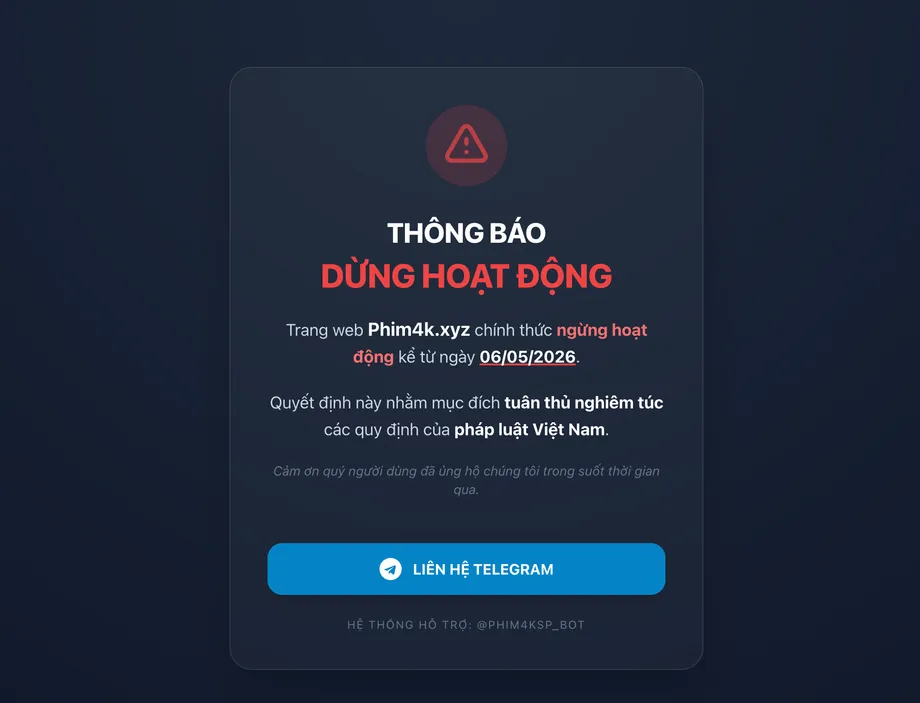
- May 6: Phim4k.xyz said its operations officially ceased.
- May 7: The nationwide campaign began; several platforms had announced closures by 2:00 pm.
- May 30: The intensive campaign is scheduled to end.
- May 31: The full campaign report must be submitted.
Streaming Platforms and Anime Communities Close
Phim4k.xyz, a widely known illegal streaming platform, was among the services announcing its closure. Its notice gave May 6 as the date it ceased operating, one day before the nationwide campaign began.
The platform explained its decision in a farewell message:
Phim4k.xyz officially ceases operations from May 6, 2026. This decision is to strictly comply with Vietnamese law. Thank you for your support.
Thia Phim displayed a service unavailable message and said it had closed at the request of authorities. It also advertised the sale of its source code, the software used to run the service. Co TV and a range of smaller platforms were also affected. The speed of the closures drew attention in a market where blocked domains are often quickly replaced with mirror sites or alternative addresses.
Mon Fansub and Doraemon Fansub Vietnam, communities distributing unauthorized Japanese animation with Vietnamese subtitles, announced that their platforms would close, including DoraWatch. Fansubbing means adding subtitles made by fans, but these communities were distributing animation without authorization from the rights holders.
Doraemon Fansub Vietnam said its operating model no longer met legal standards. It pledged to delete all databases and servers within 48 hours and immediately cancelled ongoing translation and editing projects. Its farewell message encouraged viewers to support official distribution channels, protect creators' rights and contribute to a healthier digital environment.
Vietnamese internet users expressed both disappointment and support. Some regretted losing free access to shows they had watched for years. Others backed enforcement: one user said pirated streaming was never something to be proud of, while another said following the law was the right thing to do.
A recurring request across forums was for official platforms to buy broadcasting rights for popular series. For those viewers, the closures sharpened a practical concern: whether the programmes they wanted would become available through legal services.
The Servers Behind Multiple Piracy Websites
Vietnam's role in online piracy extends beyond individual websites. USTR's report and industry accounts describe the country as a major base for piracy services attracting audiences around the world, including infrastructure supporting networks such as MyFlixerz and Fmovies.
MegaCloud, VidCloud and RapidCloud are examples of Platform as a Service, or PaaS, backends used by piracy platforms. In this setting, a backend is the service behind the visible website that supplies the video. One media server can provide streams to dozens of affiliated sites at the same time.
A failure at that shared server can therefore interrupt many differently named websites at once. When a backend goes offline or loses connectivity, the sites relying on it can lose their streams and display errors. Users recently reported widespread Cloudflare errors across multiple platforms, a pattern consistent with disruption to shared infrastructure.
HiAnime shut down earlier in 2026. The sudden disappearance of 9anime and related sites that continued under names such as AniWatch occurred just days before USTR published its findings. That timing prompted speculation that operators were closing services in anticipation of government action. Alternative anime services, including AnimeKai, also reportedly went offline.
The Motion Picture Association, or MPA, and its antipiracy coalition, the Alliance for Creativity and Entertainment, or ACE, have previously taken part in dismantling piracy services. Those efforts included the Anime Play streaming app. Vietnam's present operation brings local enforcement into closer alignment with international efforts to disrupt the services and servers supporting unauthorized distribution.
Music Piracy Reaches Beyond Film Streaming
The International Federation of the Phonographic Industry's 2023 Music Consumer Study found that 66 percent of Vietnamese respondents aged 16 to 44 regularly consumed pirated music. The global average was 29 percent. Vietnam's figure was 37 percentage points higher and more than twice the global rate.
Stream ripping was the most common method. It involves using a service to download audio from a streaming platform such as YouTube without authorization. The study found that 63 percent of respondents used stream ripping services such as Y2Mate and SnapTube.
Prime Minister Le Minh Hung explicitly instructed the Ministry of Public Security to dismantle websites distributing pirated music, films, mobile games and television programmes, including content in English. The Ministry of Culture, Sports and Tourism must also inspect copyright compliance among online businesses supplying music and other digital entertainment.
Industry representatives said earlier enforcement tools had been insufficient to eliminate piracy networks entirely. That concern persists despite IFPI's success in shutting down Y2mate.com and 11 similar websites in Vietnam in 2025.
Victoria Oakley, IFPI's chief executive, described that operation as an unprecedented success for the music industry in Vietnam. She said the organization intended to build on it by addressing other infringing services operated from the region.
Viettel, VNPT and FPT Telecom have welcomed the tougher approach. A Viettel representative said infringement involving films and football broadcasts had persisted for years. VNPT said stronger enforcement would protect legitimate pay television providers that had suffered financial losses from illegal streaming. FPT Telecom described the renewed attention to intellectual property enforcement as a much needed development for the industry.
Customs and Border Forces Target Counterfeit Goods
The Ministry of Finance has ordered customs authorities to intensify inspections of imports and exports, suspending clearance when there is clear evidence of counterfeiting. These checks extend the operation from online entertainment to goods moving through physical supply chains.
The Ministry of National Defense must deploy the Border Guard and Coast Guard in coordination with the Ministry of Public Security to intercept counterfeit goods at land borders and at sea. Market surveillance teams will also inspect goods and trademark violations inside the country.
Copyright and counterfeiting involve different kinds of protected rights, but the campaign places both under the same coordinated enforcement effort. Unauthorized distribution of a film concerns rights over a creative work; counterfeit goods involve products that misuse protected branding or other rights. The dispatch assigns specialist agencies to investigate each area while requiring them to report through a common government structure.
Illegal Streaming Also Carries Security Risks
Research cited by the English Premier League and conducted by cybersecurity expert Professor Paul Watters found that piracy websites in Vietnam were nearly 10 times more likely to contain malware than legitimate platforms. Malware is harmful software that can interfere with devices or compromise information.
The research indicated that nearly 72 percent of piracy websites contained malicious code, scams or other deceptive activities. It also classified 95 percent of advertisements displayed on those sites as harmful. Those figures describe threats encountered alongside the films or sporting events viewers were trying to watch.
Professor Watters connected the services to infrastructure used for wider criminal activity:
Our research shows they are connected to digital infrastructure commonly used by cybercriminals for fraud, extortion and other illegal activities.
Watters also warned that illegal streaming devices can secretly become part of proxy networks. A proxy routes internet traffic through another connection. In this situation, a user's home connection can become a point through which criminal activity elsewhere is routed.
Security warnings also cover piracy applications that steal personal data or exploit internet connections for illegal activity. Users can face fraud, criminal misuse of their connections or exposure to investigations linked to that traffic. The security findings give the campaign a consumer protection dimension alongside its focus on the rights of creators and legitimate distributors.
The Financial Stakes Behind the Trade Dispute
Media Partners Asia estimated that online piracy caused losses of $348 million in Vietnam in 2022 and projected losses of $456 million by 2027. The projected increase is $108 million, or about 31 percent of the 2022 estimate. The figures describe estimated losses and a forecast, with the later amount depending on how conditions develop.
Those losses affect domestic and international businesses investing in Vietnam's expanding digital economy. Legitimate providers pay for broadcasting and distribution rights, while unauthorized services offer the same material without those permissions. Telecom and media companies backing the campaign see stronger enforcement as protection for that investment.
Trade figures add to Hanoi's exposure. US data released in March showed that Vietnam recorded a $19 billion trade surplus with the United States in January, the largest surplus among US trading partners that month. Vietnam's surplus had exceeded China's since the second quarter of 2025. For the full year of 2025, Vietnam's surplus with the United States reached $178 billion.
The United States is Vietnam's largest export market, while China is its main supplier. That trading pattern has put Hanoi under pressure from Washington over the gap between US purchases from Vietnam and Vietnamese purchases from the United States.
Vietnam and the United States have been negotiating a trade agreement for months without reaching a deal. The wide trade gap and disagreements over tariffs remain obstacles. The Priority Foreign Country designation adds the risk of further barriers tied specifically to intellectual property enforcement.
Hanoi's rapid mobilization appears intended to demonstrate good faith and reduce the risk of a Section 301 investigation and possible punitive tariffs. As of May 12, no US decision on such an investigation or final trade agreement had been announced. The next concrete domestic deadlines are the campaign's end on May 30 and the government report due on May 31, followed by continued enforcement measures.
Key Points
- Vietnam's nationwide campaign runs from May 7 to May 30, 2026, following its designation as the only Priority Foreign Country in USTR's 2026 Special 301 Report.
- Official Dispatch No. 38 assigns police, ministries, customs, border forces and local task forces responsibilities for copyright and counterfeit enforcement.
- The culture ministry must handle at least 20 percent more copyright cases than in May 2025; customs must increase qualifying shipment suspensions by at least 20 percent.
- Phim4k.xyz, Thia Phim, Co TV and anime communities were among the services affected by closures.
- The campaign covers films, music, television, mobile games, software and counterfeit goods, with attention to infrastructure serving international piracy networks.
- IFPI's 2023 study found regular music piracy among 66 percent of Vietnamese respondents aged 16 to 44, compared with 29 percent globally.
- Security research cited by the English Premier League found malicious code, scams or deceptive activity on nearly 72 percent of piracy websites examined.
- A full campaign report is due on May 31, while Washington must decide within 30 days of its designation whether to begin a Section 301 investigation.