A Hardening Stance in Brussels
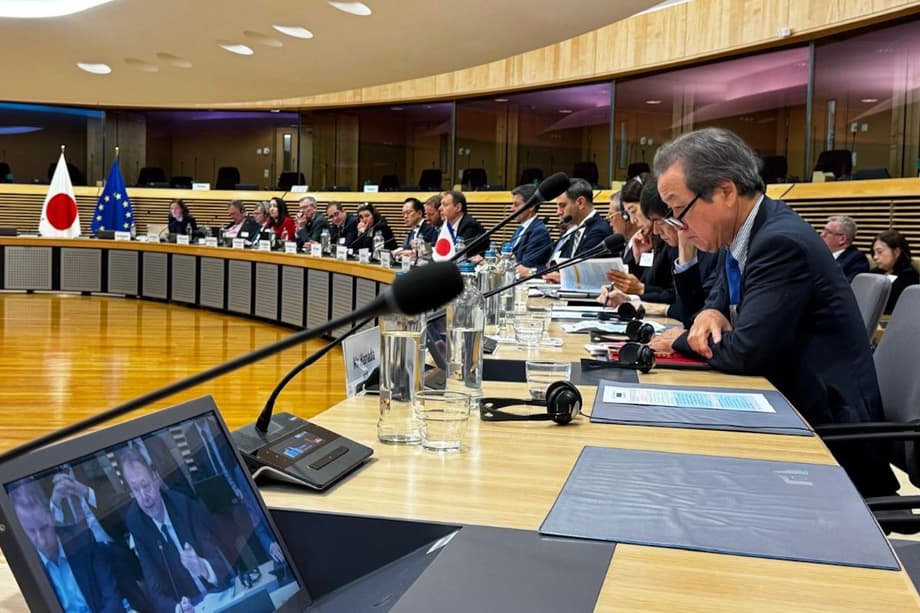
When European Commission Executive Vice-President Stephane Sejourne and Trade Commissioner Maros Sefcovic sat down with Japanese Trade Minister Ryosei Akazawa and State Minister for Foreign Affairs Iwao Horii in Brussels in early May, the conversation was framed by a sense of urgency that would have been unthinkable a decade ago. The seventh High-Level Economic Dialogue between the European Union and Japan underscored a profound shift in how both powers view global commerce. Supply chains, once celebrated as engines of efficiency, are now scrutinized as potential vectors of geopolitical coercion.
The meeting served as a checkpoint for the Japan-EU Competitiveness Alliance, an initiative unveiled during a bilateral summit in July 2025. Both sides took stock of progress and mapped future collaboration across critical minerals, batteries, defense industries, hydrogen, offshore wind, and semiconductor supply chains. Although diplomatic protocol meant Beijing was not named in every sentence, the subtext was unmistakable. The dialogue focused squarely on mitigating risks created by excessive concentration in processing and refining capacity controlled by a single dominant power.
Japanese officials came to Brussels with a specific concern. Akazawa raised alarms over the European Industrial Accelerator Act, a bill proposed in March that could favor products manufactured inside the EU. Tokyo worried that such preferences might inadvertently undermine the very industrial cooperation both sides are trying to build. The exchange illustrated that even aligned partners must navigate competing domestic interests when forging a common front.
The Brussels talks built upon a conversation that began weeks earlier at the World Economic Forum in Davos. In January, Akazawa and Sejourne had already reaffirmed their commitment to accelerate public and private sector collaboration on critical minerals, promising financial support for joint ventures. By May, that promise had migrated from the snowy corridors of Switzerland to the formal chambers of the European Commission, hardened by months of fresh Chinese export controls and mounting anxiety over supply disruptions in rare earths and battery materials.
How a Trade Pact Became a Security Pact
The partnership resting beneath the Brussels dialogue was not originally designed for economic warfare. The 2018 Economic Partnership Agreement and Strategic Partnership Agreement largely focused on slashing tariffs and aligning regulatory standards. Since the EPA entered into force in 2019, trade in goods has climbed by roughly 11% and services trade has surged 42%. Yet these commercial frameworks lacked mechanisms to address export bans, investment screening, or coordinated crisis response.
Tokyo reached an inflection point first. The 2010 maritime dispute with Beijing, which triggered a sudden Chinese embargo on rare earth exports, taught Japan a harsh lesson. At the time, more than 90% of Japanese rare earth supply flowed from China. Though diversification has narrowed that figure to around 60%, the memory of strategic strangulation lingers. In response, Japan passed the Economic Security Promotion Act in 2022, creating a legal framework to safeguard critical technologies and stockpile essential materials.
Europe moved more slowly. The EU published its first comprehensive Economic Security Strategy in June 2023, spurred by the Russian invasion of Ukraine and supply chain fractures exposed during the pandemic. The strategy identified derisking, or reducing excessive single-country dependence, as a central goal. However, implementation has been complicated by internal divisions within the bloc. German automotive and chemical giants continue to deepen research and production ties with China, while some member states, such as Hungary, actively court Chinese direct investment. This fragmentation means that Brussels often struggles to convert strategic consensus into unified action.
A newer layer of cooperation, the EU-Japan Digital Partnership launched in 2022, has injected forward looking energy into the relationship. That accord targets artificial intelligence, quantum computing, and semiconductor supply chain security. One of its flagship projects, an Arctic submarine cable linking Europe and Japan, is designed to bypass politically sensitive routes and harden digital resilience against potential disruption. Still, analysts note that the existing patchwork of agreements lacks a dedicated institutional framework for coordinating responses to economic coercion or pooling procurement in strategic minerals. The Brussels dialogue represented another step toward filling that void.
Critical Minerals at the Center
At the heart of the EU-Japan alignment lies a shared vulnerability: control over the minerals that power modern economies. China dominates refining and processing for rare earths, graphite, gallium, germanium, and lithium compounds. These inputs are irreplaceable in semiconductors, electric vehicle batteries, wind turbines, robotics, aerospace components, and advanced defense systems. Beijing has demonstrated a growing willingness to use this dominance as political and economic pressure, fundamentally altering how Tokyo and Brussels calculate risk.
The European Critical Raw Materials Act, adopted in 2023 and enacted in 2024, provides the legal backbone for European efforts to break free from concentrated supply. During the Brussels HLED, officials highlighted progress on strategic projects linked to the CRMA and vowed to back additional joint mineral ventures. Japan complements this effort with decades of expertise in advanced materials processing, battery chemistry, and precision manufacturing. The EU brings financial scale, regulatory harmonization across 27 national markets, and immense purchasing power. Together, they aim to build parallel industrial ecosystems capable of competing with the vertically integrated dominance of China.
Their cooperation stretches from extraction to recycling. Simply diversifying mining operations is insufficient if midstream refining, cathode production, and rare earth separation remain concentrated in Chinese entities. Both sides recognize that true resilience requires dominance across the entire value chain, including next generation manufacturing and recycling of products at the end of their service life. The ambition is nothing less than the creation of an alternative global infrastructure for strategic industry.
However, the two powers also share a growing alarm over Chinese industrial overcapacity. Subsidized Chinese production has flooded global markets with steel, solar panels, batteries, and electric vehicles, compressing prices to levels that many competitors cannot match. While this has accelerated certain aspects of the green transition, officials in Tokyo and Brussels fear it could hollow out domestic industrial bases before alternative supply networks reach commercial scale.
Private Sector Pressure Mounts
Government officials in Brussels and Tokyo are not acting in a vacuum. Private sector leaders have been amplifying the same warnings. At an EU-Japan Business Round Table held in Brussels, nearly 100 corporate executives issued a blunt call for deeper collaboration in an era of sharp geopolitical and economic transformation. The executives stressed the need to strengthen supply chains for rare earth elements and semiconductors while preventing the weaponization of raw materials and technology.
In a joint declaration following the round table, the corporate executives described the current moment as one of acute danger for global commerce. The business leaders, representing major firms from both jurisdictions, warned against export barriers and pressed governments to identify critical technologies that could serve as counterpressure against coercive trade practices. They described Japan and the EU as natural advocates for robust multilateralism.
“We call for deeper collaboration between Japan and the EU in an era of unprecedented geopolitical and economic transformation,”
the group stated, adding that both sides should draw upon their technological leadership to push back against the weaponization of goods and services. Yet the executives also acknowledged a stark reality: both economies remain deeply intertwined with China as a major exporter of critical minerals and consumer goods, as well as an indispensable market for their own industries.
The round table also revealed the strains rippling through commercial relations. Since diplomatic friction escalated over remarks by Japanese Prime Minister Sanae Takaichi regarding Taiwan, Chinese export controls targeting Japan have intensified. Companies find themselves caught between government calls for derisking and commercial imperatives that still rely on competitively priced Chinese inputs. This tension underscores why the Brussels dialogue matters not only to ministries but to boardrooms across both continents.
The corporate statement noted that by aligning across trade, economic security, and industrial competitiveness, both partners could navigate challenges of protectionism and regulatory complexity without abandoning shared values. Such endorsements lend political momentum to officials pushing for faster implementation of mineral stockpiles and joint processing facilities.
Washington Adds Its Weight
The EU-Japan effort is increasingly nested within a broader Western strategy. In February, the United States announced strategic partnerships with both the European Union and Japan on critical minerals, alongside an action plan with Mexico. The trilateral framework envisions price floors for strategic commodities, coordinated stockpiles, and aligned standards for mining, processing, and trading. Washington and Brussels committed to draft a memorandum of understanding on supply chain security within 30 days, while Tokyo and Washington continued coordination on mineral investments.
The United States Trade Representative framed the initiative as a signal that the largest open market economies are committed to developing a new paradigm for preferential trade in critical minerals. The Trump administration has simultaneously moved to build a domestic stockpile, acquiring equity stakes in firms such as MP Materials, USA Rare Earth, and North American lithium suppliers. A Defense Department agreement with MP Materials already includes an offtake guarantee and a price floor intended to shield domestic producers from Chinese market manipulation.
For Brussels and Tokyo, the inclusion of Washington offers both opportunities and complications. American partnerships bring capital, technological reach, and geopolitical muscle. Yet they also introduce new variables, including unpredictable tariff policies and the insistence of Washington on rapid decoupling timelines that may outpace European or Japanese industrial readiness. Navigating this three-way coordination will require deft diplomacy to avoid misaligned incentives.
The Hard Math of Decoupling
For all the rhetorical momentum, the practical obstacles to displacing Chinese dominance remain formidable. China commands vast portions of global refining and processing capacity for rare earths and battery materials accumulated through decades of state subsidy, aggressive industrial targeting, and patient scaling. Europe possesses minimal domestic refining capability, and Japan, despite its technological sophistication, still imports the majority of these inputs from Chinese suppliers. Severing these ties is not merely a policy choice; it is an industrial rewiring project measured in decades and hundreds of billions of dollars.
The cost calculus is already becoming visible. European efforts to bar Chinese suppliers from critical infrastructure, including solar inverters and telecommunications gear, have triggered warnings of staggering replacement expenses. One recent assessment estimated that ripping out and replacing Chinese hardware across strategic sectors could cost the bloc hundreds of billions over the next five years, with additional losses from delayed digitalization, service interruptions, and employment adjustments. Small and medium enterprises, along with ordinary consumers, would likely bear the sharpest price increases.
Clean technology illustrates the bind most acutely. European and Japanese firms continue to depend on competitively priced Chinese solar panels, battery components, and refining equipment to meet their own climate targets. Restricting these imports risks driving up domestic costs and slowing the green transition precisely when both jurisdictions have committed to aggressive net zero timelines. Alternative supply chains, meanwhile, often face environmental objections, technological immaturity, and higher labor costs that make them commercially uncompetitive without sustained government subsidy.
Akazawa himself has acknowledged the tension. During his January talks in Davos, he shared concerns about non-market policies with European counterparts, yet Japanese industry remains heavily enmeshed in the same supply networks. The dilemma is shared: politicians and executives must simultaneously derisk from overconcentration while preserving access to the inputs that keep factories running and transition targets within reach. This paradox suggests that EU-Japan coordination may improve resilience at the margins but is unlikely to fundamentally erode the entrenched industrial position of China in the near future.
Ultimately, the race is not simply for minerals but for time. Both Europe and Japan need to build alternative industrial ecosystems before Chinese overcapacity and export controls permanently reshape the competitive landscape against them. The Brussels dialogue advanced that clock by a few ticks, but the finish line remains distant and expensive.
Key Points
- The European Union and Japan held their seventh High-Level Economic Dialogue in Brussels in early May, sharpening cooperation on economic security and supply chain resilience.
- Both sides are deepening coordination under the EU-Japan Competitiveness Alliance, focusing on critical minerals, batteries, hydrogen, semiconductors, and defense industries.
- Japan brings advanced materials and battery expertise, while the EU offers financing power and market scale, aiming to challenge Chinese dominance in midstream processing and refining.
- Business leaders from both regions urged stronger public and private collaboration and warned against export barriers and the weaponization of critical technologies.
- The United States has joined the effort through strategic mineral partnerships with the EU and Japan, including plans for coordinated stockpiles and price floors.
- Despite ambitious plans, both Europe and Japan remain heavily dependent on Chinese supply chains, and diversification faces high costs, technical gaps, and commercial realities that could slow progress for years.