50,000 Gather as Japan Debates Its Military Future
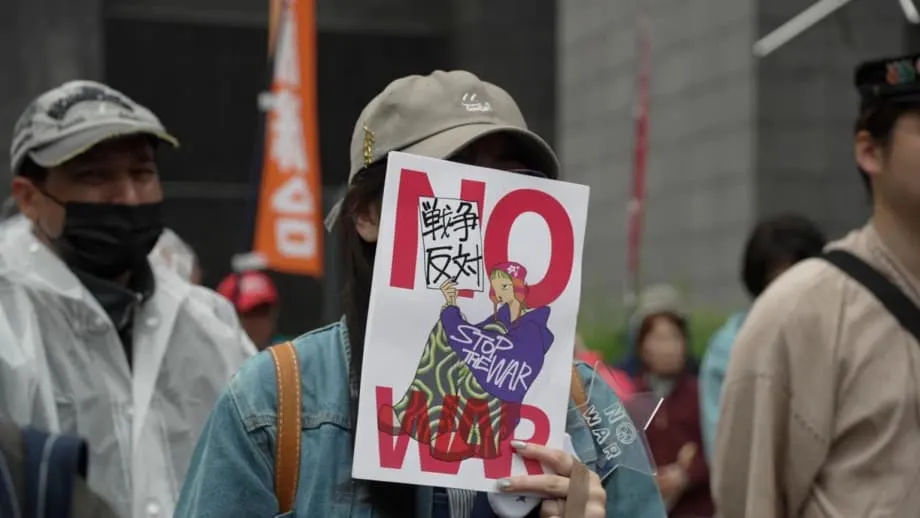
An estimated 50,000 people gathered at Tokyo's Rinkai Disaster Prevention Park on May 3, 2026, Constitution Memorial Day, in what was described as Japan's largest anti-war demonstration in decades. The gathering challenged Prime Minister Sanae Takaichi's plans to expand the country's military role, less than two weeks after her government lifted longstanding restrictions on exporting lethal weapons.
Contents
- 50,000 Gather as Japan Debates Its Military Future
- What Changed With the Arms Export Decision?
- Why Article 9 Matters
- Younger Protesters Bring Music and Light Sticks
- How the Protests and Policy Changes Unfolded
- Peace Campaigners Fear a Wider Military Role
- China, Taiwan and the Pressure From Washington
- Polls Show Different Views on Different Changes
- The Anxiety Described as Takaichi Blues
- The Essentials
Rain soaked placards and flags as protesters gathered in Tokyo. One sign carried a simple message in bold Japanese kanji characters: "No War". Demonstrations also took place in cities including Osaka and Fukuoka, bringing a national argument about security, peace and constitutional change onto the streets.
Takaichi, who took office in October 2025, has made military expansion and constitutional revision central priorities. Her government's April 21 decision on arms exports sharpened opposition among people who fear Japan is moving away from the pacifist commitments that have shaped its identity for nearly 80 years.
Article 9 of the constitution sits at the centre of that argument. It renounces war and prohibits maintaining armed forces, yet Japan already operates substantial Self-Defense Forces through constitutional interpretation. Takaichi's Liberal Democratic Party, or LDP, wants to address the gap between the constitution's wording and that military reality.
Japan's public demonstrations are usually relatively restrained, reflecting a strong cultural emphasis on social harmony. The size of the May 3 gathering, alongside the arrival of younger participants, points to anxiety extending beyond a routine disagreement over government policy. Protesters are contesting how Japan should protect itself and what limits should apply to its use of military power.
What Changed With the Arms Export Decision?
Takaichi's government announced on April 21 that it was lifting the decades-old ban on exporting lethal weapons, described as a restriction lasting 78 years. The decision opens the way for sales to 17 countries with which Japan maintains defence agreements, including the United States and the United Kingdom.
Previous rules limited exports to five categories: search and rescue, transportation, warning, surveillance and minesweeping. The new framework permits exports of finished lethal weapons, including warships, missiles and other arms, subject to screening.
Recipient countries must pledge to use the weapons consistently with the United Nations Charter. The ban on sales to countries involved in active conflict remains in place, although authorities said exceptions could be permitted "in special circumstances". That exception is part of the concern among opponents of the policy.
Chief Cabinet Secretary Minoru Kihara defended the change, explaining the government's stated purpose:
safeguard Japan's security and further contribute to the peace and stability of the region.
Takaichi argued on X that cooperation with other countries had become essential to Japan's protection:
in an increasingly severe security environment, no single country can now protect its own peace and security alone.
The prime minister also said the change preserved Japan's commitment to peace:
absolutely no change in our commitment to upholding the path and fundamental principles we have followed as a peace-loving nation for over 80 years since the war.
Critics remain deeply sceptical of those assurances. Their concern links the export decision to Takaichi's wider constitutional agenda: Japan would be able to supply more types of weapons abroad while debating changes to the legal limits governing its own forces.
Why Article 9 Matters
Japan's constitution took effect on May 3, 1947, after being drafted under the supervision of General Douglas MacArthur's occupation forces following World War II. It has never been amended. Constitution Memorial Day in 2026 marked 79 years since it came into force.
Article 9's first paragraph renounces "war as a sovereign right of the nation and the threat or use of force as means of settling international disputes". Its second paragraph declares that "land, sea, and air forces, as well as other war potential, will never be maintained. The right of belligerency of the state will not be recognised."
Japan has nevertheless built substantial Self-Defense Forces, or SDF, through interpretations of those provisions. The current debate centres on formally recognising those forces in the constitution. The LDP has long sought changes to resolve what it sees as contradictions between the text and Japan's existing military institutions.
Takaichi called for "advanced discussions" on constitutional revision during an official visit to Vietnam. Explaining her position, she said the constitution:
should periodically be updated to reflect the demands of the times.
A constitutional amendment requires approval by a two-thirds majority in each house of the National Diet, Japan's parliament, followed by a simple majority in a national referendum. Parliament therefore cannot complete the change on its own: voters must also approve it.
Article 9 carries a meaning beyond its legal wording for many Japanese, particularly hibakusha, the survivors of the atomic bombings, and their descendants. Approximately 200,000 people died in Hiroshima and Nagasaki by the end of 1945. For these families, the constitution's rejection of war represents a moral commitment rooted in that experience.
Jiro Hamasumi, a hibakusha speaking at the 2026 review conference of the Nuclear Non-Proliferation Treaty, connected the atomic bombings directly to war:
Nuclear weapons were used because we went to war. No more war, no more hibakusha.
Younger Protesters Bring Music and Light Sticks
People in their twenties and thirties have become a visible part of demonstrations traditionally associated with older generations who remember World War II. Their participation has brought elements of South Korea's protest culture into Japan's peace movement.
K-pop played continuously at rallies outside the National Diet Building on April 8 and April 19. Participants waved light sticks, also called penlights, while chanting "Protect the Constitution" and "Quit, quit, (Sanae) Takaichi government" to songs including KARA's "Mister" and aespa's "Whiplash". The atmosphere resembled a concert as well as a political gathering.
Osaka Station echoed with the Korean lyrics of Girls' Generation's "Into the New World" on April 26. The song became symbolic of youth protests in South Korea after the 2016 occupation at Ewha Womans University. Its use in Osaka connected the Japanese demonstrations to that tradition of civic participation.
Posts on X encouraged people to bring light sticks and join casually, much as they might support a favourite idol. A self-employed man in his thirties who attended the April 8 rally near the Diet described how that approach helped younger people take part:
In Japan, there's usually a high barrier to participation for people in their 20s and 30s, but many came out voluntarily with light sticks.
A woman in her twenties said the presence of participants drawing or knitting made it easier for others to join without feeling pressure. These activities offered ways to be present without needing to lead chants or belong to a political organisation.
Playful banners carried fictional group names inspired by Korean civic movements: "Union of People Who Just Add to the Crowd", "Alliance of People Who Struggle in Crowds", and "Association of Low-Stamina People Against War". Their message was that ordinary people could contribute simply by showing up.
How the Protests and Policy Changes Unfolded
Takaichi's security agenda and the demonstrations developed across several months. The sequence brings together her arrival in office, mounting regional tensions and the gatherings leading up to Constitution Memorial Day.
- October 2025: Sanae Takaichi became prime minister.
- November 2025: Takaichi said a Chinese attack on Taiwan could constitute a "survival-threatening situation" for Japan, a legal formulation that could permit SDF deployment.
- March 2026: Japan deployed upgraded Type-12 missiles with a range of approximately 1,000 kilometres. President Donald Trump also reportedly requested Japanese maritime forces for the Strait of Hormuz, which Takaichi declined, citing Article 9.
- April 8 and April 19: Protesters gathered outside the National Diet Building with K-pop music and light sticks.
- April 17: The Japanese destroyer JS Ikazuchi passed through the Taiwan Strait.
- April 21: The government announced the easing of restrictions on lethal weapons exports.
- April 26: Protesters at Osaka Station used Girls' Generation's "Into the New World".
- May 3: An estimated 50,000 people gathered at Tokyo's Rinkai Disaster Prevention Park on Constitution Memorial Day.
By May 8, opposition to the export decision had become intertwined with resistance to constitutional revision. The demonstrations brought together concerns about specific government decisions and fears about the country's future military role.
Peace Campaigners Fear a Wider Military Role
An 87-year-old participant at the May 3 rally in Osaka described the constitution as something to preserve for younger generations:
I want to cherish the constitution like I do my own child, and pass it on to the next generation.
Akari Maezono, 30, held brightly painted paper lanterns calling for peace. She objected to the way the changes were being pursued:
I'm angry that these changes could be made without properly listening to us, the public.
An older man nearby carried a bright red banner linking Article 9 to Japan's avoidance of involvement in conflict:
The Japanese constitution, Article 9 in particular, must be protected at all costs. It kept Japan from being drawn into past conflicts like the US-Iran war.
Hiroko Maekawa, a Tokyo ward councillor, voiced concern that the LDP wanted to turn the SDF into a conventional military and tie Japan more closely to American military policy:
Under Takaichi, Japan is following America like a dog follows its owner. The LDP wants to turn the self-defence forces into a traditional military, because they know the constitution, as it is, prevents them from doing that.
These objections focus on the possibility of Japan moving from a primarily defensive role towards active participation in conflicts abroad. Takaichi's government presents stronger military cooperation as a way to protect peace; protesters fear the same changes could draw the country into war.
China, Taiwan and the Pressure From Washington
Takaichi's supporters argue that Japan faces a changed security environment, with an assertive China, an unpredictable North Korea and an aggressive Russia. The United States, Japan's closest ally, has repeatedly encouraged Tokyo to take a more active security role.
Trump's reported request in March 2026 for Japanese maritime forces in the Strait of Hormuz brought that pressure into focus. Takaichi declined, citing Article 9 constraints. The episode illustrated the operational limits that conservatives want to remove.
China has expressed "serious concern" about what it calls Japan's "reckless militarisation", saying it will remain "highly vigilant and resolutely opposed". Relations became more tense after Takaichi's November 2025 statement about a possible Chinese attack on Taiwan.
The phrase "survival-threatening situation" matters because it is a legal formulation that could allow deployment of the SDF. Takaichi's use of it connected a possible conflict over Taiwan to decisions about Japan's own security response.
Japan's upgraded Type-12 land-to-ship missiles, deployed in March 2026, have a range of approximately 1,000 kilometres. That gives Japan standoff capability, meaning it can strike from a considerable distance, with a reach extending to mainland China. Beijing is also concerned about plans to deploy missiles on Yonaguni, Japan's westernmost island, only 110 kilometres from Taiwan.
The JS Ikazuchi's passage through the Taiwan Strait on April 17 added to the tensions. It coincided with the anniversary of the treaty that ceded Taiwan to Japan. Chinese officials responded by launching combat-readiness patrols in the East China Sea.
The US embassy in Tokyo, meanwhile, posted a message on its official X account praising the constitution's principles of "popular sovereignty, respect for fundamental human rights, and pacifism". Its statement also highlighted the document's longevity:
this constitution, highly praised by Gen MacArthur in his memoirs, has continued to serve as the foundation of Japanese society for 79 years since its enactment, without ever having been amended.
The embassy's message offered a subtle expression of support for the existing constitutional framework while Washington continued to encourage Japan to assume greater regional security responsibilities.
Polls Show Different Views on Different Changes
Public opinion is divided, and the answer depends partly on which proposal people are asked to consider. A poll by the conservative Yomiuri Shimbun found 57% support for constitutional revision, while a poll by the liberal Asahi Shimbun put support at 47%, a gap of 10 percentage points.
An NHK survey in March found that around half of Japanese opposed the arms export changes, compared with 32% who supported them. Opinion on weapons exports therefore presents a different picture from the broader question of constitutional revision.
Opposition is strongest when people are asked about changing Article 9's first paragraph, which renounces war: 80% oppose such a change. Views on modifying the second paragraph, concerning military forces, are more evenly divided. The two paragraphs address related but different issues, one rejecting war and the other setting out limits on military institutions.
A convenience store cashier in Tokyo expressed impatience with demonstrators, saying, "They're always here," before adding, "Time for a new Japan." The remarks reflected support for moving beyond the existing arrangements.
Masako, a 29-year-old Tokyo resident attending a rally against arms exports, expressed the opposing view:
I'm angry that, even though Japan has been a peaceful nation for the past 80 years, a small group of people did something that outright denies that.
The Anxiety Described as Takaichi Blues
The phrase "Takaichi blues" has emerged to describe anxiety among citizens troubled by the government's direction. Their concerns extend from military policy to how constitutional changes could affect the relationship between individuals and the state.
Writer Masahiko Shimada, 65, criticised the prime minister's priorities:
Takaichi seems to have nothing but constitutional revision and preparations for war on her mind. There is not a single element that would improve people's lives.
Essayist Keiko Kojima, 53, pointed to the LDP's 2012 draft constitutional revision, which replaced "individual" with "person" in Article 13. She argued that the change could recast citizens from respected individuals into "human resources belonging to the state".
Gohta Hashimoto, a 22-year-old university student, said the US-led war on Iran had pushed younger Japanese to speak out. He described a change in his own understanding of political participation:
I always thought of politics as something for older people, but that feels like turning over my future to someone else,
Hashimoto also explained why the constitution had become a personal concern:
Until now I'd never thought of the constitution as something young people needed to fight for.
His comments connect the younger protesters' music, light sticks and informal banners to the central issue of the demonstrations. For these participants, constitutional policy has become a decision about their own future, rather than a debate to leave to older generations.
The Essentials
- An estimated 50,000 people gathered in Tokyo on May 3, 2026, in Japan's largest anti-war demonstrations in decades, with protests also taking place in Osaka and Fukuoka.
- Takaichi's government lifted longstanding restrictions on lethal weapons exports on April 21, opening sales to 17 countries with defence agreements, including the US and UK.
- Exports remain subject to screening and recipient commitments under the United Nations Charter. Restrictions on countries in active conflict include possible exceptions for "special circumstances".
- Takaichi, in office since October 2025, is pursuing constitutional revision focused on Article 9 and formal recognition of the Self-Defense Forces.
- Younger protesters are using K-pop, light sticks and informal group banners inspired by South Korean civic movements.
- Tensions with China involve Taiwan, missiles with a range of approximately 1,000 kilometres, proposed deployments on Yonaguni and the JS Ikazuchi's April 17 passage through the Taiwan Strait.
- Polls put support for constitutional revision at 47% and 57%, while 80% oppose changing Article 9's first paragraph renouncing war.
- Any constitutional amendment requires a two-thirds majority in both houses of the Diet and a simple majority in a national referendum.