Before Dawn, a Business Built Around RM5
At 3am in Kampung Datuk Keramat, Kuala Lumpur, Zainab Dali starts cooking for people who need a meal costing no more than RM5. By 5.30am, the 55 year old former hotel chef is delivering fried rice, spaghetti aglio e olio, macaroni and kuih to a vending machine at Ampang Park MRT station, a short walk from the Petronas Twin Towers.
Contents
- Before Dawn, a Business Built Around RM5
- Thousands Have Left Menu Rahmah
- Why Some Operators Are Staying
- Household Budgets Meet Rising Kitchen Costs
- The Women Cooking From Public Housing
- Cramped Kitchens and Long Working Days
- Singapore Ties Budget Meals to Rental Terms
- Indonesia and Thailand Face Different Pressures
- Cheap Food Still Needs to Be Nourishing
- Support Exists, but the Bills Keep Coming
- The Bottom Line
Every item sells for RM3 to RM5. Government support pays for her machine and rental space, but her contract, which runs for two years, expires at the end of May 2026. As of May 12, her immediate concern is whether the business can survive the charges that might follow.
Zainab participates in the Economy Ministry's People Income Initiative, which helps people sell affordable food through vending machines with a ceiling price of RM5. The programme seeks to raise earnings among the bottom 40 percent of households, commonly called the B40 group. After three years, she says food margins are vanishing.
Zainab, who searches for supermarket discounts to control her ingredient bill, explained how the pressure has changed her meals:
"Before, I could include whole chicken pieces. Now, I use fillets as they are cheaper. You have to be smart. I usually look for supermarket offers," she explained.
Her monthly revenue is around RM10,000, with a reported profit of RM7,000 to RM8,000. Bottled water sales account for much of the cushion against thin food margins, while the government currently covers the machine and space. Her experience captures the central challenge: a cheap meal for the customer still needs a workable business behind it.
Thousands Have Left Menu Rahmah
Malaysia's wider affordable meal effort has lost much of its original participation. Menu Rahmah, meaning compassionate menu, began in January 2023 as a lifeline for people on low incomes. Around 15,000 food outlets initially signed up, ranging from local Indian Muslim restaurants, known as mamak eateries, to major chains.
By October 2025, Deputy Domestic Trade and Cost of Living Minister Fuziah Salleh said only 3,141 operators remained active. Compared with the launch figure, that represents a fall of about 79 percent, or roughly four out of every five participants.
The programme also lost its earliest champion when Salahuddin Ayub, then the minister responsible, died in July 2023, less than six months after the rollout began. Without its principal architect, the initiative struggled to maintain momentum as business costs climbed.
The main dates show how the effort developed and where the next immediate pressure falls:
- January 2023: Menu Rahmah launched, attracting around 15,000 outlets.
- July 2023: Salahuddin Ayub died, removing the programme's leading champion.
- October 2025: Fuziah Salleh put the number of active operators at 3,141.
- April 2026: Prime Minister Anwar Ibrahim announced access to discounted ingredients through selected supermarket partners.
- Early May 2026: Customer Norlisa Ayub discovered the affordable food outlet Kesum through social media.
- End of May 2026: Zainab's vending machine contract is due to expire.
Why Some Operators Are Staying
Mydin Mohamed Holdings continues to serve a RM5 meal containing rice, chicken or fish, vegetables and iced tea. Its managing director, Ameer Ali Mydin, says the company remains committed despite pressure on costs.
Ameer described the meals as part of the retailer's support for the community:
"There are no changes to our objective of serving RM5 meals, even with cost pressures. This is about helping the community, especially the B40 group," said Datuk Ameer.
KFC also continues to sell a RM5 set consisting of one piece of chicken, a bun and bottled water. Smaller businesses have less room to absorb rising expenses, making the same price commitment harder to sustain.
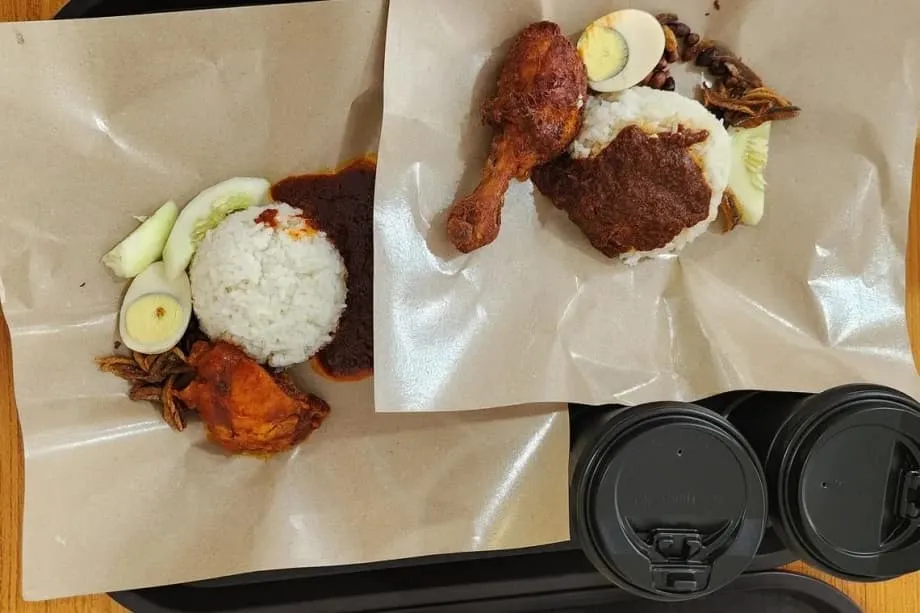
Kesum, a social enterprise founded by former economy minister Rafizi Ramli, sells nasi lemak with spiced fried chicken for RM4.90 and fried noodles for as little as RM3.90. Supervisor and cook Izzan Ilham said the outlet serves 200 to 300 customers a day. Demand has grown since Hari Raya Aidilfitri in March, reflecting the pressure on household budgets.
Izzan said price is the main consideration for customers, even when they also appreciate the food:
"It is not about whether the food is nice or not, the price is the main thing. Customers tell us the food is nice. The profit is very small, but we can still survive," he said.
Household Budgets Meet Rising Kitchen Costs
Khazanah Research Institute has warned that global crises, including pandemics, wars and disruptions to energy supplies, have exposed structural weaknesses in Malaysia's economy. Higher energy and logistics costs reach both businesses and households. People on lower incomes face particular strain because wages have stagnated for years.
Central bank data cited in the institute's report showed that real wages for the bottom 50 percent of households grew by only around RM56 annually between 2010 and 2019. Real wages describe earnings after allowing for changes in prices. The bottom 70 percent of households now struggle to keep pace with living costs.
A simple meal outside the home can easily cost RM20 or more. A roadside burger starts at RM5, while mixed rice at a stall can reach RM10 to RM15. Against those prices, a full meal at RM5 offers relief to customers but leaves vendors with little space to pass on higher expenses.
Malaysia spends billions of ringgit each month on fuel subsidies to keep petrol prices stable. Those subsidies are themselves under pressure. With quotas reduced and the government urging conservation, the cost of transporting ingredients from farms to kitchens continues to climb. Traders relying on daily deliveries feel those increases directly.
Norlisa Ayub, a 34 year old homemaker who also runs a home baking business, found Kesum through a social media post in early May. Its prices attracted her immediately. She has seen some of her own ingredient costs double.
Norlisa described what the increases mean for a small food business:
"The food is good and affordable. It is hard to find prices like this any more. Cocoa powder used to be RM20 plus per kg, now it is RM40. Butter went up from around RM10 to RM16.90," she said.
Din Ali, a 40 year old lorry driver, expressed the frustration of workers looking for food they can afford:
"People want cheap and tasty food. The economy now is not good, we cannot control it. Even nasi lemak sold by the roadside is RM7 now," he said.
The Women Cooking From Public Housing
Women from B40 communities living in Public Housing Projects, known as PPR flats, sustain many neighbourhood food businesses. They form a large part of the micro enterprise workforce. Micro enterprises account for 70.1 percent of Malaysia's micro, small and medium enterprise landscape.
Many women work from flats measuring just 600 to 700 square feet, where the family home also becomes a production space. Their food helps sustain communities on low incomes, even as their economic contribution receives little recognition.
Department of Statistics Malaysia figures show that the average household has 1.8 income earners. For B40 families, additional earnings from self employment have become a critical buffer against inflation rather than an optional supplement.
Small operators often buy ingredients in small quantities, paying more for each unit than a business purchasing in bulk. Some earn margins of only fifty sen per item. Unlike large retailers, they have limited ability to negotiate discounts or absorb sudden increases.
Bank Negara Malaysia's financial stability reviews identify thin documentation, uneven cash flows and a lack of collateral as barriers to credit for micro enterprises. Collateral is an asset a lender can claim if a borrower cannot repay. Many women in PPR communities combine household and business money and use each day's takings to buy the next day's ingredients.
Without clear financial records or a stable cash position, many remain ineligible for financing programmes such as TEKUN, DanaNita MARA or BSN Micro i. The businesses most in need of a cushion can therefore struggle to obtain one.
Cramped Kitchens and Long Working Days
PPR kitchens may also serve as children's study areas and spaces for laundry. Sharing a small room between food preparation and family needs slows production and creates food safety risks. Several housing blocks have introduced shared kitchens, but their reach remains limited.
Community leaders say training programmes rarely produce lasting progress on their own. A single workshop on digital sales or bookkeeping cannot resolve the practical difficulties of a household sharing one smartphone or relying on an unstable internet connection.
PEDi and MDEC eUsahawan provide foundations for developing business skills. Participants say they also need continuing mentorship and simple tools suited to very small operations, rather than systems designed for more formal small and medium enterprises.
Workdays frequently run for 14 to 18 hours, without paid leave or childcare support. Exhaustion adds to the financial pressure. Since the pandemic, more households have begun selling similar products, including nasi lemak, kuih and frozen snacks, within the same small neighbourhoods.
More sellers competing for customers with limited spending power pushes prices down. Without daily sales records and clear tracking of costs, some women discover only after months of work that hidden expenses have consumed almost all their earnings. Motivation alone cannot overcome a business environment that leaves little room for rest, investment or mistakes.
Singapore Ties Budget Meals to Rental Terms
Singapore has taken a different approach to affordable food. Its Housing and Development Board requires all leased coffee shops to offer budget meals by 2026, typically costing S$3 to S$3.50.
The requirement is tied to rental renewals, with a rental discount for one year to ease the transition. Malaysia's programme relies on voluntary participation. Malaysian retail executives argue that this preserves goodwill, while compulsory participation could create resentment or encourage operators to cut corners.
Singapore's model links an obligation to a form of support: operators must provide budget meals, while receiving temporary help with rent. Stallholders still object that rising labour and ingredient costs can make low prices economically unworkable without outside assistance.
Both approaches face the same practical problem. Someone must meet the gap between what an affordable meal costs to produce and what a customer can pay. Zainab's concern about future machine and rental fees shows how quickly that balance can change when support has an expiry date.
Indonesia and Thailand Face Different Pressures
Indonesia's President Prabowo Subianto has launched a free meals programme costing about US$20 billion annually. It aims to feed more than 80 million people, mostly schoolchildren, and consumes roughly 11 percent of central government spending.
Civil groups have challenged the budget law in the constitutional court, arguing that it lacks transparency and adequate safeguards for public finances. Major credit agencies have shifted Indonesia's outlook to negative, citing concerns about fiscal priorities. An outlook signals the direction in which an agency believes a country's credit assessment may move.
Thailand's Prime Minister Anutin Charnvirakul has faced fuel shortages and price increases linked to conflict in the Middle East. Economists have trimmed growth forecasts as exports and tourism suffer.
Malaysia's RM5 meals, Indonesia's free meals and Thailand's fuel pressures involve different policies and budgets. Together, they show how energy disruptions and supply chain shocks are placing pressure on social support across Southeast Asia.
Cheap Food Still Needs to Be Nourishing
Menu Rahmah's nutritional quality has also come under scrutiny. Many meals centre on deep fried chicken or fish, partly because frying extends shelf life and allows unsold items to be repurposed the following day. Fresh vegetables and whole grains are often scarce.
Critics have called for a stronger framework based on Health Ministry dietary guidelines, covering food quality, portion sizes, hygiene and nutritional balance for different age groups. Proposals include menu guides for participating eateries and spot checks involving local government and health departments.
Opposition lawmaker Halimah Ali suggested in a controversial parliamentary speech that low quality cheap food might expose consumers to lasting health risks. She later apologised for the remarks.
Dr Zainul Ariffin Omar, a medical expert and adviser to the Malaysian Public Health Organization, said meals at established retailers such as Mydin are sufficiently balanced. He warned, however, that fast food chains participating in the programme may use it to promote less healthy choices.
Dr Zainul said customers should retain expectations about the food they receive:
"Customers must be aware that paying low prices does not mean they should accept low quality," he said.
Kesum's kitchen team tries to maintain taste despite its low prices. Across the industry, however, vendors who barely cover their ingredient costs can find that adding fresh produce becomes a luxury rather than a routine part of the meal.
Proposals to reduce costs also include encouraging customers to bring food containers, cutting spending on disposable plastic packaging and reducing waste. Tax deductions for small businesses adopting environmentally friendly practices have been suggested as a way to ease financial pressure while supporting national sustainability targets.
Support Exists, but the Bills Keep Coming
The government's Payung Rahmah umbrella includes cash aid, discounted broadband packages, basic donations and the People Income Initiative. In April, Prime Minister Anwar Ibrahim announced that Menu Rahmah operators would be able to purchase chicken, onions, rice and other raw materials at special discounted rates through selected supermarket partners.
Rahmah Cash Donations distributed almost RM8 billion to 8.7 million recipients in 2023, covering nearly 60 percent of the adult population. The People Income Initiative has reached 4,100 households so far. For participants such as Zainab, however, contracts have limits, and future market rents could consume thin profits.
Advocates say support remains patchy. Policy proposals seek a better balance between protecting customers and protecting the livelihoods of the people feeding them. They include more accessible micro financing, wider partnerships with nongovernmental organisations to reach peripheral communities, and digital channels through which local food quality can be monitored.
Turning temporary projects into lasting services would also require coordination with local government, regular spot checks, and formal links with health and education departments. Those connections are intended to keep meals affordable, safe and nourishing, while giving vendors a workable operating environment.
Zainab's immediate decision is more personal. The fees she will face after her contract ends, and whether she can meet them, remain uncertain. She said she hopes to keep serving commuters, office workers and nearby residents:
"If the rent and machine fees increase, I am not sure I can continue. For me, it is more like charity. I do not make a big profit, just enough to survive. People still depend on it, so I will try to continue for as long as I can," she said.
Din, the lorry driver who eats at Kesum, wants affordable meals available in more places. His request reflects demand that exceeds the current supply:
"I think Kesum should open up in other places. The food is good. It is a nice looking place, and it is air conditioned, too," said Din Ali.
For customers, the RM5 meal is a way to stretch a daily budget. For vendors, keeping it available depends on ingredient prices, rental terms, access to finance and support that lasts beyond a temporary contract. At Ampang Park, those decisions will shape whether Zainab can keep filling the machine before dawn.
The Bottom Line
- Menu Rahmah participation fell from around 15,000 outlets at launch in January 2023 to 3,141 active operators by October 2025.
- Zainab Dali sells food for RM3 to RM5, but government support for her vending machine and rental space faces a contract deadline at the end of May 2026.
- Rising ingredient, energy and transport costs squeeze small vendors while households struggle to afford everyday meals.
- Women running food businesses from PPR flats face limited financing, cramped kitchens, competition and working days lasting 14 to 18 hours.
- Singapore links budget meals to rental conditions, while Indonesia's much larger free meals programme faces scrutiny over public spending.
- Discounted ingredients, cash assistance, accessible financing and checks on nutrition and hygiene are central to efforts to keep affordable food available.