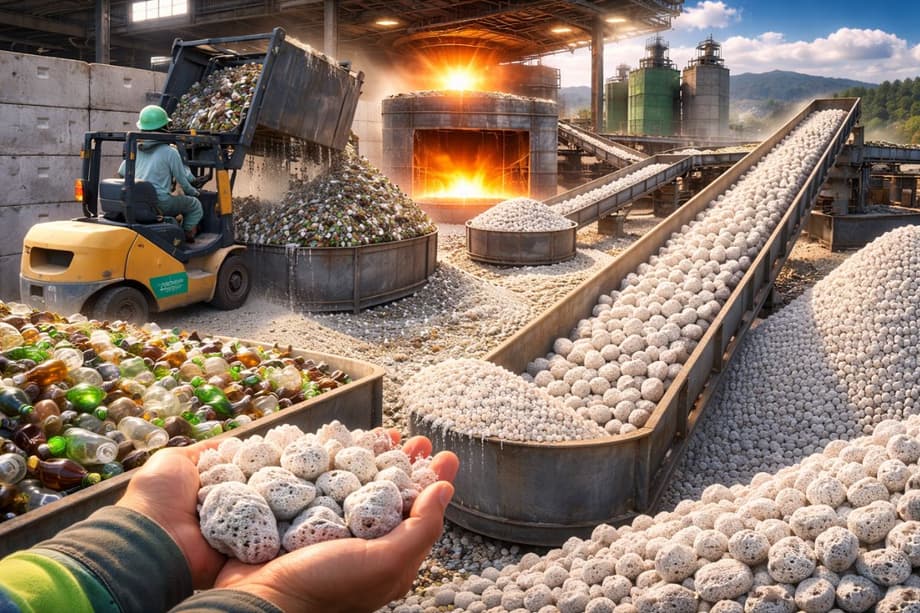
A New Life for Discarded Glass
Japan generates approximately one million tons of glass bottles annually. While clear containers readily enter conventional recycling streams, colored glass bottles often face rejection by standard processing facilities. These discarded vessels historically met their end in landfills, representing both an environmental burden and a wasted resource. In Hiroshima Prefecture, Cocco Co., Ltd. operates a facility that redirects this waste stream toward an innovative second act. The company transforms rejected glass into Super Sol, a lightweight foamed material that serves industries ranging from civil engineering to environmental remediation.
Super Sol represents a departure from traditional glass recycling. Rather than attempting to return waste bottles to the packaging cycle, the process converts glass into an entirely new substance with distinct physical properties. The resulting material resembles artificial pumice, featuring a porous structure that provides unique advantages in construction, agriculture, and water treatment applications.
The challenge of colored glass waste has plagued recycling systems globally. Melting different colors together produces inconsistent, low quality cullet that manufacturers reject. In Japan, this limitation affects a substantial portion of the annual million ton glass output. Cocco Co., Ltd. addresses this gap by accepting glass that lacks viable recycling alternatives, including specifically difficult to process colored bottles. The facility also processes glass from aging solar panels, addressing an emerging waste stream as renewable energy infrastructure reaches the end of its service life. This dual approach creates value from materials that would otherwise require permanent disposal, demonstrating how industrial innovation can resolve waste management deadlocks.
The environmental implications extend beyond simple waste reduction. By converting glass into a construction aggregate weighing one fifth to one sixth as much as standard soil, the process reduces transportation emissions and structural loads on buildings and embankments. The material also contributes to water purification efforts, with recent research demonstrating its capacity to remove phosphate contaminants from wastewater. These applications position Super Sol not merely as a recycled product, but as a functional material that solves specific technical challenges across multiple sectors.
The Science of Transformation
The production of Super Sol involves precise thermal and mechanical processing. Operations begin with the collection of discarded glass bottles and solar panel glass. The raw material undergoes initial drying using residual heat from the production furnace, an energy efficient step that prepares the glass for subsequent grinding. Workers then remove impurities, including plastic caps, paper labels, and adhesive residues, both before and after the crushing stage. This cleaning ensures uniformity in the final product.
The crushing phase reduces bottles to fine particles measuring approximately 200 microns, utilizing ceramic spheres to achieve consistent granularity. Screening processes maintain standards for the resulting glass powder. Technicians then blend this powder with proprietary additives before feeding the mixture into a burning line. Here, temperatures ranging from 800 degrees Celsius to 900 degrees Celsius cause the material to expand, creating the lightweight, foamy structure that defines Super Sol. This sintering process, similar to the natural formation of volcanic pumice, traps gas bubbles within the glass matrix, producing irregular particles ranging from 2 to 75 millimeters in diameter.
The resulting material exhibits specific gravities and water absorption rates tailored to different applications. Unlike conventional aggregates, Super Sol contains countless microscopic holes formed during the expansion phase. These pores create the material’s characteristic combination of lightness and structural integrity. The final product carries an Eco Mark certification in Japan, confirming its status as an environmentally friendly material composed of natural soil components. Its mineral based, inorganic nature ensures physical and chemical stability without corrosion risks.
Engineering and Environmental Applications
Civil engineering projects represent the primary market for Super Sol. The material serves as lightweight fill for embankments and backfill, where its reduced density minimizes loads on retaining walls and foundations. Engineers can blend it with crushed stone to achieve specific unit weights between 4 and 11 kilonewtons per cubic meter, allowing precise control over structural properties. Its drainage capabilities make it valuable for greening projects and agricultural applications, where it improves soil aeration while retaining water.
Beyond construction, recent scientific research has revealed promising environmental applications. A study published in a peer reviewed scientific journal investigated the use of iron lanthanum loaded foam glass derived from Super Sol for phosphate removal from wastewater. Researchers modified the material by loading it with 0.1 percent iron and 1 percent lanthanum, then calcining it at 350 degrees Celsius. The resulting adsorbent demonstrated a maximum phosphate adsorption capacity of 1.3 milligrams per gram and effectively removed 99.2 percent of phosphate from domestic wastewater after 24 hours.
This application addresses critical water quality challenges. Excessive phosphorus discharge from municipal and agricultural sources causes eutrophication, leading to harmful algal blooms and aquatic ecosystem degradation. The foam glass adsorbent offers a low cost solution for localized wastewater treatment in rural areas and developing regions lacking advanced sewage infrastructure. The study noted that the material performs particularly well at low phosphate concentrations typical of domestic wastewater, with an equilibrium constant higher than previously developed adsorbents.
Additional applications include use as safety gravel, inorganic soil amendments for horticulture, and hydroculture growing media. The material’s workability allows installation in confined spaces and uneven terrain without requiring specialized curing periods or advanced construction techniques. Workers can install it through simple leveling and compaction procedures, reducing labor costs and project timelines.
Regulatory Recognition and Standardization
The widespread adoption of Super Sol across Japan reflects extensive regulatory validation. The material holds certifications from numerous prefectural governments, including Hiroshima, Okinawa, Hokkaido, Iwate, Ibaraki, Gifu, Shiga, Okayama, and Fukuoka. These certifications recognize Super Sol as an authorized recycled material for public works projects, ensuring that government contractors can specify the product for infrastructure development.
In 2005, the technology entered the New Technology Information System (NETIS), a database maintained by Japan’s Ministry of Land, Infrastructure, Transport and Tourism that catalogues innovative construction technologies. This registration facilitates adoption in public infrastructure projects by providing technical verification. The material also meets the JIS Z 7313 standard established in 2019 for glass foam recycling materials, creating industry wide quality benchmarks.
The Eco Mark certification provides consumers with assurance that Super Sol reduces environmental burdens associated with daily life. Various regional systems, such as Okinawa’s Yuikuru authorization and Shiga Prefecture’s Biwakuru Eco Ship certification, specifically recognize the material’s contribution to regional recycling economies. These designations often prioritize the use of certified recycled products in government procurement, creating stable markets for the material.
From Local Innovation to Industrial Network
The technology behind Super Sol originated with Trim Co., Ltd., which began investigating glass recycling opportunities in 1995. The company developed a proprietary cullet machine in 1996 and received its first patent for glass processing technology. Production of Super Sol commenced in 1999 at a facility in Okinawa, following technology assessments by Japan’s Public Works Research Center.
The Hiroshima plant operated by Cocco Co., Ltd. opened in 2010, representing the company’s expansion from its Okinawan origins to Japan’s main islands. Since then, the network has grown to include manufacturing plants in Fukuoka, Hokkaido, Shizuoka, Gifu, Akita, Aomori, Ibaraki, Hyogo, Shiga, Okayama, Iwate, Yamagata, Gunma, Kochi, Miyazaki, Kyoto, Yamanashi, Wakayama, and Fukushima prefectures. In 2014, the company established its first overseas production facility in Taiwan, marking the technology’s international debut.
This expansion reflects both the scalability of the manufacturing process and the consistent demand for sustainable construction materials. The Glass Foam Materials Cooperative Association, formed in 2016 and certified as a public demand qualified association in 2020, coordinates industry standards and promotes market development. In 2021, Trim Co., Ltd. received the Minister of Economy, Trade and Industry Award in the Industrial Standardization Business Awards, recognizing the company’s contribution to establishing the JIS standard for glass foam materials.
Addressing Tomorrow’s Waste Today
As Japan expands its renewable energy infrastructure, the disposal of aging solar panels presents an emerging waste management challenge. Cocco Co., Ltd. has adapted its process to accept solar panel glass, separating aluminum frames for metal recycling while processing the glass through the Super Sol production line. This integration addresses a waste stream projected to grow substantially as early photovoltaic installations reach the end of their operational lives.
The process for solar panel glass requires additional preparation steps. Small steel spheres blast the glass surfaces to remove laminates and other coatings before processing. The recovered aluminum enters conventional metal recycling streams, while the glass undergoes the same crushing, screening, and sintering process used for bottle glass. This dual stream approach maximizes resource recovery from complex electronic waste.
Municipal programs in various regions are developing similar initiatives to manage photovoltaic waste as renewable energy adoption accelerates globally. These programs highlight the growing recognition that renewable energy technologies require end of life management strategies to maintain their environmental credibility. By incorporating solar glass into Super Sol production, the Hiroshima facility demonstrates how circular economy principles can adapt to evolving waste streams while creating valuable industrial inputs.
Key Points
- Cocco Co., Ltd. in Hiroshima Prefecture transforms non recyclable colored glass bottles and solar panel waste into Super Sol, a lightweight foamed material
- The manufacturing process involves crushing glass to 200 microns, mixing with additives, and sintering at 800 to 900 degrees Celsius to create an expanded, porous structure
- Super Sol serves as a lightweight aggregate in civil engineering, a soil amendment in agriculture and landscaping, and an adsorbent for phosphate removal in water treatment
- Research demonstrates that modified Super Sol can remove 99.2 percent of phosphate from domestic wastewater, offering a solution for eutrophication control
- The material holds certifications from multiple Japanese prefectures and meets the JIS Z 7313 standard for glass foam recycling materials
- Trim Co., Ltd., the technology developer, operates over 20 production facilities across Japan and one in Taiwan
- The process diverts approximately one sixth the weight of traditional soil from landfills while providing functional benefits in construction and environmental remediation