Village Signs Become the Latest Battleground
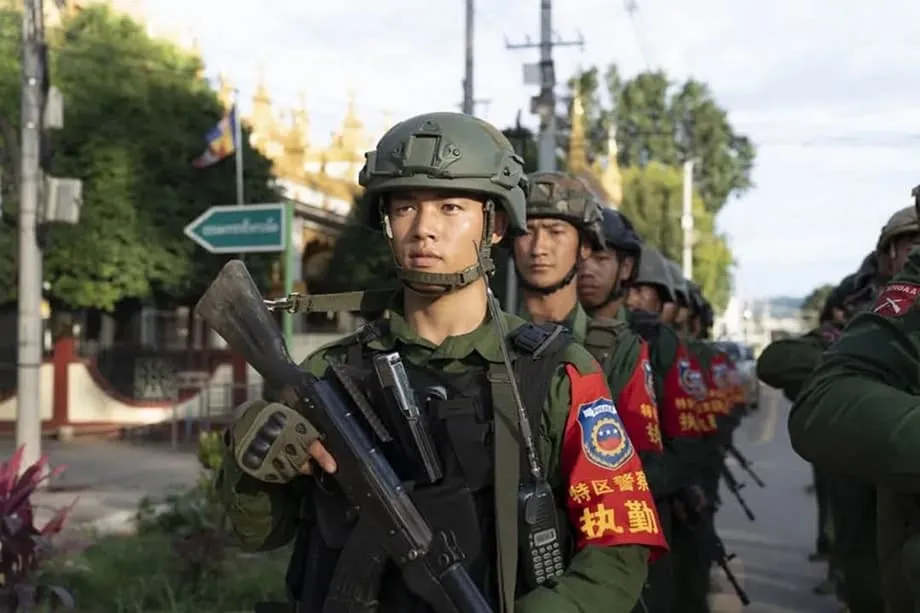
More than a dozen villages in Myanmar's Kutkai Township have had their Ta'ang language signs whitewashed and replaced with signs in Chinese and Burmese, residents say, as the Myanmar National Democratic Alliance Army (MNDAA) extends its authority over the town it seized in March 2026.
Contents
- Village Signs Become the Latest Battleground
- Restrictions Reach Flags, Administration and Schools
- Former Allies Fight Over Kutkai
- A Ta'ang Appeal After the Takeover
- Hsenwi Shows a Wider Cultural Shift
- Commerce and Identity Documents Change Daily Life
- China Presses for Truces but Stays Silent on Culture
- Trade Routes Give the MNDAA Strategic Weight
- Civil Society Demands Restoration and an Apology
- The Essentials
The changes reach beyond the names displayed at village entrances. In early April, MNDAA officials summoned elders from more than 17 communities with Ta'ang majorities and prohibited the display of the Ta'ang national flag and the use of Ta'ang in official business. More than 300 schools administered by the Ta'ang Land Education Council have reportedly had their operations suspended, while the armed group is preparing to introduce compulsory Chinese language instruction in village classrooms.
Residents describe the removal of their language and flag symbols as an erasure of ethnic identity. The signs carried both Ta'ang text and distinctive Ta'ang flag logos that had marked the settlements for generations. Their replacement has made a struggle over territory visible in everyday community life.
A Ta'ang resident of Kutkai, speaking anonymously because of fears of retaliation, described the changes as being imposed without village approval:
The MNDAA are forcing us to use Chinese without even consulting village committees. They act like they own the villages now. It is painful to see our traditions erased, but we have no power to resist.
Kutkai lies in the mountains of northern Shan State, along the Mandalay-Muse highway, also known as AH14. The road is one of Myanmar's most important trade routes, connecting the country's interior with China's Yunnan Province. Control of the township brings influence over valuable border commerce as well as authority over the people living beside the highway.
Restrictions Reach Flags, Administration and Schools
MNDAA troops have carried out the sign replacements over the past several weeks. The new signs retain Burmese alongside Chinese but remove Ta'ang, changing which languages residents see represented in their own villages.
The early April meeting with village elders widened that pressure. By restricting the Ta'ang flag and official use of the language, the MNDAA moved from altering public signs to setting rules for how communities could represent themselves and conduct local affairs.
The reported suspension of more than 300 schools adds a separate concern for families. Those schools were administered by the Ta'ang Land Education Council, making education another area in which the armed group's new authority is displacing Ta'ang institutions.
Compulsory Chinese lessons are reportedly being prepared, but no date for their introduction was given. For a community that has struggled to preserve its language, the prospect of Chinese instruction replacing indigenous curricula threatens the connection between younger generations and their cultural roots.
Former Allies Fight Over Kutkai
The MNDAA and the Ta'ang National Liberation Army (TNLA) previously fought together within the Three Brotherhood Alliance. Their joint Operation 1027 began in late 2023 and captured 23 towns and more than 400 military bases from Myanmar's military junta within two months.
The TNLA captured Kutkai during that operation in January 2024 and initially administered it. TNLA forces controlled the western part of town, while MNDAA forces maintained positions east of the main Union Highway. Over the following two years, disputes over administration and resources steadily damaged their relationship.
In mid-February 2026, TNLA troops removed CCTV cameras installed by the MNDAA along the highway and stormed an MNDAA office. By late February, both groups had deployed hundreds of fighters around important villages. MNDAA forces dug trenches and prepared forward positions, while the TNLA put its troops on full defensive readiness.
The MNDAA attacked in March, expelled the TNLA from Kutkai and took complete control. The capture turned a dispute between former military partners into a change of government for the town's residents, followed by restrictions on Ta'ang symbols, language and education.
The main stages of that shift were:
- Late 2023: The Three Brotherhood Alliance launched Operation 1027 against the junta.
- January 2024: The TNLA captured Kutkai and began administering the town, with MNDAA positions remaining on the eastern side of the highway.
- Mid-February 2026: TNLA troops removed MNDAA cameras and stormed an MNDAA office.
- Late February 2026: Both groups deployed hundreds of fighters around villages near the town.
- March 2026: The MNDAA seized Kutkai and expelled the TNLA.
- Early April 2026: MNDAA officials summoned elders from more than 17 Ta'ang majority communities and imposed restrictions on flags and official language use.
A Ta'ang Appeal After the Takeover
TNLA spokeswoman Lway Yyay Oo appealed to the MNDAA after the capture to respect Ta'ang communities, their identity and their culture. She also called for TNLA troops to have freedom of movement in Ta'ang areas.
The appeal has largely gone unheeded as the MNDAA strengthens its administration. The removal of signs and restrictions on schools show how the contest has spread beyond military positions to the institutions through which residents maintain their identity.
The March attack came one day after Chinese special envoy Deng Xijun met junta foreign minister Than Swe in Naypyitaw to discuss border cooperation. China, which had previously pressured both armed groups to stop offensives against the junta, remained silent as the MNDAA captured the town with its Ta'ang majority.
For residents, the immediate result is a loss of influence over decisions inside their villages. The anonymous Kutkai resident's account and the objections raised by Ta'ang civil society both point to the absence of consultation with village committees.
Hsenwi Shows a Wider Cultural Shift
Similar changes have already taken place in Hsenwi, a historic Shan town captured during Operation 1027. Now known by the Chinese name Mupang (木邦), Hsenwi has been under MNDAA administration since April 2025. Residents say the town has become unrecognizable.
Hsenwi was once a cultural heartland of the Shan saophas, the region's hereditary feudal rulers. Its historic Haw, or palace, remains a symbol of that aristocratic heritage. Chinese inscriptions now appear even at the palace entrance.
The MNDAA has banned signs written only in Shan or English and requires businesses to display Chinese as the primary language. Local businesses have faced pressure to add Chinese text, making the language rules part of ordinary commercial life as well as public administration.
Sai Wansai, a Shan political analyst, described the changes to Shan News by comparing them with earlier pressure on ethnic communities to adopt a Burman identity:
If Burmanization meant forcing non-Burmans to adopt a Burman identity, Sinicization reshapes non-Chinese people into a Chinese identity. In Hsenwi today, the MNDAA is pushing Shan people toward Chinese assimilation.
Burmanization refers here to the pressure imposed over decades by Myanmar's central government on ethnic communities to adopt Burman culture. Sinicization describes the adoption or imposition of Chinese cultural practices and identity. For communities that resisted the first process, the changes in northern Shan State bring a new source of pressure from the border.
Commerce and Identity Documents Change Daily Life
Chinese entrepreneurs have moved into Hsenwi and opened grocery stores, hardware shops and restaurants. Vehicles with Chinese license plates have become a daily sight, while the Chinese yuan is increasingly replacing Myanmar kyats in everyday transactions.
Chinese investors reportedly rent houses and farmland at inflated prices, often with MNDAA assistance. Alongside the compulsory signs, those changes are reshaping the town's commercial environment and the conditions under which local residents operate businesses or use property.
The MNDAA has also started issuing Special Region (1) local identification cards and household registration documents. Residents are charged between 20,000 and 25,000 kyats for each card. The documents allow travel into China through border gates.
Many residents nevertheless fear that the same registration system could expose them to arrest in areas controlled by the junta, where the documents lack recognition. Others worry that registration could make them targets for forced recruitment.
Language requirements, currency use and identity documents give the armed group's authority a presence in daily activities: opening a shop, paying for goods, registering a household or crossing the border. In Kutkai, the restrictions on village symbols and schools are extending that administrative reach into Ta'ang community life.
China Presses for Truces but Stays Silent on Culture
Beijing has repeatedly intervened to stop ethnic armed groups from continuing offensives against Myanmar's junta. In late 2024 and early 2025, China blocked fuel, food and internet supplies to TNLA territory and brokered talks that compelled the group to sign a truce with the regime.
That intervention helped save the junta from collapse after it lost its Northeastern Command in Lashio and dozens of towns during Operation 1027. China's ability to restrict essential supplies gave it direct influence over the choices available to armed groups near the border.
Chinese Foreign Minister Wang Yi has visited Myanmar three times since the 2021 coup, most recently in April 2026. Those visits confer diplomatic legitimacy on the regime while much of the international community continues to maintain sanctions and isolation.
Beijing has maintained silence over the MNDAA's cultural policies in Ta'ang and Shan territories. Its calls for "border stability" have brought pressure to stop fighting the junta, without objections to the replacement of indigenous languages and symbols by Chinese characters and cultural markers.
The contrast matters for communities under MNDAA control. China has shown that it can intervene forcefully in military affairs, while residents confronting restrictions on their language and identity have received no comparable public support from Beijing.
Trade Routes Give the MNDAA Strategic Weight
The MNDAA now controls nearly all major trade corridors connecting northern Shan State with Yunnan, including the Chinshwehaw route captured during Operation 1027. Its control of Hsenwi, Kunlong and Kutkai places it at important points along China's commercial connections through Myanmar.
China is accelerating construction of the Dali-Ruili railway, which is intended eventually to connect with a planned Muse-Mandalay railway. The connection would form part of the China-Myanmar Economic Corridor (CMEC), giving Beijing direct access over land to the Indian Ocean.
The 1,700-kilometer route would allow China to bypass the contested Strait of Malacca. For Beijing, these links offer a strategic reason to care about the security and administration of northern Shan State's transport corridors.
The MNDAA's position at those junctions makes it a gatekeeper for China's Belt and Road Initiative ambitions in Myanmar. Its economic influence appears to give the group considerable freedom to pursue its cultural and administrative agenda without Chinese criticism.
Kutkai's location helps explain why former allies fought to control it. The same town that contains Ta'ang villages and schools also sits on a route important to border trade and China's wider transport plans. Residents are experiencing the cultural consequences of a struggle with both military and economic stakes.
Civil Society Demands Restoration and an Apology
The Ta'ang Civil Society Network (TCSN), which represents six organizations, has condemned the MNDAA's actions as a violation of international human rights law. Its objections focus on the forced changes and the absence of consultation or community consent.
Mai Karng Hao, spokesman for the TCSN, told The Irrawaddy that the restrictions threaten cultural identity and peaceful coexistence among ethnic groups:
They are essentially destroying the cultural identity of an entire people. This breaches human rights and international norms. It also undermines the federal principle of peaceful coexistence among diverse ethnic groups and will only fuel further conflict. They must restore the original Ta'ang signs and symbols, and they owe the villagers an apology.
The federal principle invoked by Mai Karng Hao concerns how different ethnic communities can coexist while retaining their identities. The network's demand is specific: restore the Ta'ang signs and symbols and apologize to the villagers affected.
The suspension of Ta'ang education is particularly painful for a community that has long worked to preserve its language against Burmanization. Residents who resisted pressure to adopt Burman culture now face cultural domination by a Chinese speaking armed group backed by a powerful neighboring state.
The Shan State Progress Party/Shan State Army (SSPP/SSA), another major ethnic organization, has also condemned what it called "narrow nationalism and expansionism" by the MNDAA. Opposition to the group's expansion nevertheless appears fragmented.
The TNLA has been weakened by military setbacks and diplomatic isolation following its recent decision to congratulate junta chief Min Aung Hlaing on his presidency. Its loss of Kutkai leaves Ta'ang communities facing new restrictions while the organizations objecting to those measures struggle to present a united response.
The Essentials
- The MNDAA seized Kutkai from its former ally, the TNLA, in March 2026 after disputes over territory, administration and resources.
- Residents say Ta'ang text and flag symbols have been removed from signs in more than a dozen villages and replaced with Chinese and Burmese.
- Officials summoned elders from more than 17 communities in early April and restricted Ta'ang flags and official language use.
- More than 300 Ta'ang administered schools have reportedly been suspended, with compulsory Chinese instruction being prepared.
- Hsenwi has experienced Chinese signage requirements, growing use of the yuan and new MNDAA identity documents costing 20,000 to 25,000 kyats per card.
- China has pressured armed groups into truces with the junta while remaining silent on the MNDAA's cultural policies.
- The MNDAA controls important trade routes connected to China's plans for access through Myanmar to the Indian Ocean.
- Ta'ang civil society groups are demanding restoration of village signs and symbols and an apology to residents.