A 20 minute call ends years of silence
Aung San Suu Kyi spoke to her son Kim Aris for 20 minutes on October 22, 2026, their first direct conversation in more than five years, as Myanmar's military authorities allowed another rare glimpse of the detained former leader. Aris took the call at Myanmar's embassy in London's Mayfair district, while his 81-year-old mother remained under detention in Naypyidaw.
Contents
- A 20 minute call ends years of silence
- Family news, with limits on the conversation
- What Aris learned about her health and detention
- From the coup to renewed outside contact
- Two books and a sealed royal message
- Why the contact carries political weight
- An 18 year sentence and a wider prisoner campaign
- What the family wants next
- Key Points
Myanmar's presidential spokesperson said the telephone conversation began at 2:30 p.m. Myanmar time, or 0800 GMT, and released photographs of mother and son speaking into telephones. Aris said Britain's Foreign Office had alerted him to go to the embassy.
Aris, 49, said Suu Kyi sounded "fairly healthy" and told him she was in good health. Their conversation focused on family, beginning with her concern for him and other relatives. They avoided sensitive subjects because they expected the call to be recorded.
For Aris, who had spent years receiving only occasional indirect updates about his mother, hearing her voice brought relief. In his statement, published on Facebook on October 22, he thanked the people who had campaigned for contact and described what the moment meant to him.
Hearing her voice again means more to me than words can express.
Suu Kyi has been detained since the military overthrew her elected government on February 1, 2021. The call followed an August meeting with a Red Cross representative and the delivery of books and correspondence from Britain's King Charles III on October 19. Aris welcomed the contact while continuing to demand regular private conversations, independent medical care and unconditional release.
Family news, with limits on the conversation
Aris said his mother's first question concerned his health and the rest of the family. He was able to ask about her condition and living arrangements, and to reassure her that efforts to secure her freedom were continuing.
His public statement initially gave few details about the exchange. In subsequent comments, he described a conversation shaped by the expectation that authorities would listen to it. Aris explained why they stayed with personal subjects.
Essentially we just discussed family matters.
We knew the phone call would be recorded, so we didn't talk about anything sensitive.
Aris said he was allowed to take the call alone at the embassy. His concern about recording explains why privacy remains central to his demands: being able to speak without another person in the room still leaves a family choosing its words carefully if it expects someone to hear the conversation.
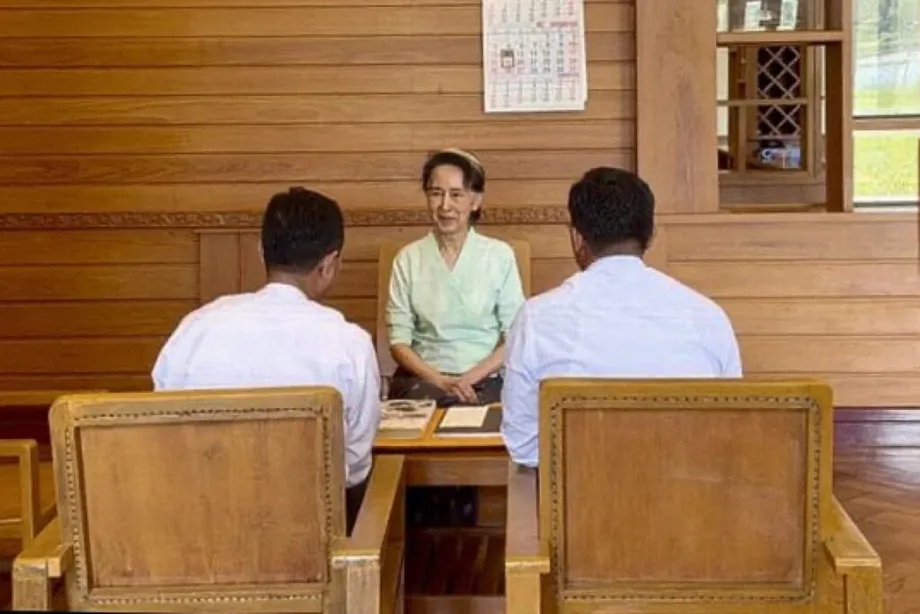
Myanmar's authorities described the exchange as a "consular telephone conversation." Photographs released by the presidential spokesperson showed Suu Kyi seated beneath a calendar displaying Thursday's date. Aris also published images that appeared to show him outside the embassy.
What Aris learned about her health and detention
Suu Kyi told Aris she was in good health, and he described her voice as strong. He also said she had tendonitis affecting her right hand. Tendonitis is irritation or swelling in the tissue that connects muscle to bone and can make movement painful.
Aris said his mother was largely on her own in a house in Naypyidaw, with police stationed around it. She could go into a garden that he described as essentially scrubland. Authorities say she was transferred from prison to house arrest in April, with the transfer reported as taking place on April 30.
Her precise address remains undisclosed, and independent verification of the transfer and her medical condition remains unavailable. Earlier concerns about her health included reports of heart problems. Aris continued to express concern about her wellbeing after the call and requested access to independent medical care.
Suu Kyi's age adds urgency to that request. Aris said she was able to tell him she was well, while acknowledging the difficulties of growing older in detention. A doctor able to examine her independently would give the family a more detailed assessment and identify any treatment she needs.
From the coup to renewed outside contact
Suu Kyi's isolation began with the February 2021 military takeover, when soldiers removed her government and arrested civilian leaders. Her family went more than five years without speaking directly to her, even as she faced successive prosecutions and a lengthy prison term.
The publicly known developments leading to Thursday's call span several months:
- February 1, 2021: The military overthrew the elected government and detained Suu Kyi and President Win Myint.
- April 2026: Coup leader Min Aung Hlaing became president following military controlled elections that excluded Suu Kyi's party. Authorities reduced her remaining sentence to 18 years and said she was moved to house arrest.
- April 17: Win Myint was released in a Myanmar New Year amnesty but remained under strict surveillance.
- August 3: Suu Kyi met Arnaud de Baecque, the International Committee of the Red Cross representative in Myanmar.
- September 7: Aris launched his renewed Free Her campaign.
- October 19: Authorities released photographs of officials delivering books and correspondence from King Charles.
- October 22: Suu Kyi and Aris spoke by telephone for 20 minutes.
The August meeting was her first publicised encounter with a representative of an independent international organisation since her arrest. Thursday's call gave Aris direct contact of his own, following those earlier openings.
Two books and a sealed royal message
Myanmar's authorities said home ministry officials delivered two books about soil, a sealed envelope and a sealed diplomatic communication from King Charles on October 19. Photographs showed Suu Kyi seated across a small table from two officials in a room with wooden wall panels.
The books were The Land Gardeners: Soil to Table, by Bridget Elworthy and Henrietta Courtauld, and Soil: The World at Our Feet, a catalogue accompanying an exhibition at London's Somerset House. Both concern soil and its role in sustaining food and life.
Buckingham Palace declined to comment on the announcement or the contents of the sealed communication. Myanmar's authorities referred to Suu Kyi as a "special female prisoner," wording they had not previously used publicly.
Burma Campaign UK, an advocacy group, criticised the British government's approach on October 22. It accused Britain of "incrementally softening its approach towards the Burmese military regime" and said delivering the books through the authorities had handed the military a "propaganda opportunity."
The royal package and the telephone call have brought personal benefits to Suu Kyi and her family. Their public presentation has also given Myanmar's rulers images of apparently accommodating treatment to circulate as they seek wider diplomatic acceptance.
Why the contact carries political weight
Min Aung Hlaing, the military chief who ousted Suu Kyi, became president in April after an election criticised by democracy watchdogs as a staged process to consolidate military power. Since then, he has received invitations for diplomatic visits, including to countries in the Association of Southeast Asian Nations, or ASEAN.
Suu Kyi's detention has long complicated Myanmar's relations with the regional organisation. Allowing contact with a royal household, a humanitarian representative and her son gives foreign governments visible developments to consider as they decide how to engage with the authorities.
Morgan Michaels, a research fellow at the International Institute for Strategic Studies, said the authorities were using Suu Kyi "to extract concessions from members of the international community." He explained why limited gestures might receive a favourable response abroad.
But many within ASEAN and beyond want to see her release," he said. "These types of gestures are likely to be very well received even if they are insincere or tactical in nature.
Suu Kyi biographer Mon Mon Myat also called for release without conditions and objected to the political use of her detention. She described the detention as unlawful.
The regime must stop using Daw Aung San Suu Kyi as a bargaining chip," she said. "This is an unlawful detention. They must release her unconditionally.
An 18 year sentence and a wider prisoner campaign
Suu Kyi is serving a remaining sentence of 18 years on charges including incitement, corruption, election fraud and violating a state secrets law. She denies the charges. Her supporters and human rights groups regard the prosecutions as politically motivated and intended to keep the military in control.
The former state counsellor, who served as Myanmar's de facto leader from 2016 until the coup, had already spent a total of 15 years under house arrest between 1989 and 2010. She received the Nobel Peace Prize in 1991 for her nonviolent campaign for democracy.
Aris has tied his mother's case to the detention of thousands of other people. His Free Her campaign sought her release alongside 15,088 other political prisoners. That figure was cited in coverage of the campaign; the Assistance Association for Political Prisoners, an advocacy organisation, maintains daily updates on arrests associated with opposition to the coup.
Win Myint's circumstances provide another example of restrictions continuing after release from prison. Although freed in the April 17 amnesty, the former president remained under strict surveillance.
Myanmar's crisis extends far beyond its detained leaders. Protests against the coup developed into armed resistance and civil war, with millions of people displaced. For families separated by detention, the immediate demands remain concrete: knowing where relatives are, obtaining medical care, speaking privately and securing their return home.
What the family wants next
Aris called for regular, direct and private family contact, independent medical access, and the immediate, unconditional release of his mother and all other political prisoners. No schedule for another call or date for her release was announced.
He urged Britain and other governments dealing with Myanmar's military authorities to judge progress by "freedom, human rights and accountability, not publicity or diplomatic appearances." His concern is that access to his mother could become part of negotiations over recognition, sanctions or political advantage.
In his statement, Aris explained the limits of what Thursday's conversation had changed for the family.
Your voices helped me hear my mother again. Please do not let the world mistake that moment for her freedom. One conversation is not regular family access. Family access is not freedom.
Aris thanked supporters for helping make the call possible and asked them to continue pressing for release. After years of silence, he could finally hear his mother's voice and ask about her daily life. She remained in custody when their 20 minutes ended.
Key Points
- Suu Kyi and Kim Aris spoke on October 22, 2026, their first direct conversation in more than five years.
- The call lasted 20 minutes, with Aris speaking from Myanmar's embassy in London.
- Aris said she sounded fairly healthy but had tendonitis affecting her right hand.
- Authorities say she is under house arrest in Naypyidaw, serving a remaining sentence of 18 years.
- The call followed an August Red Cross meeting and the October 19 delivery of books and correspondence from King Charles.
- Aris wants regular private contact, independent medical care and unconditional release for his mother and all political prisoners.