
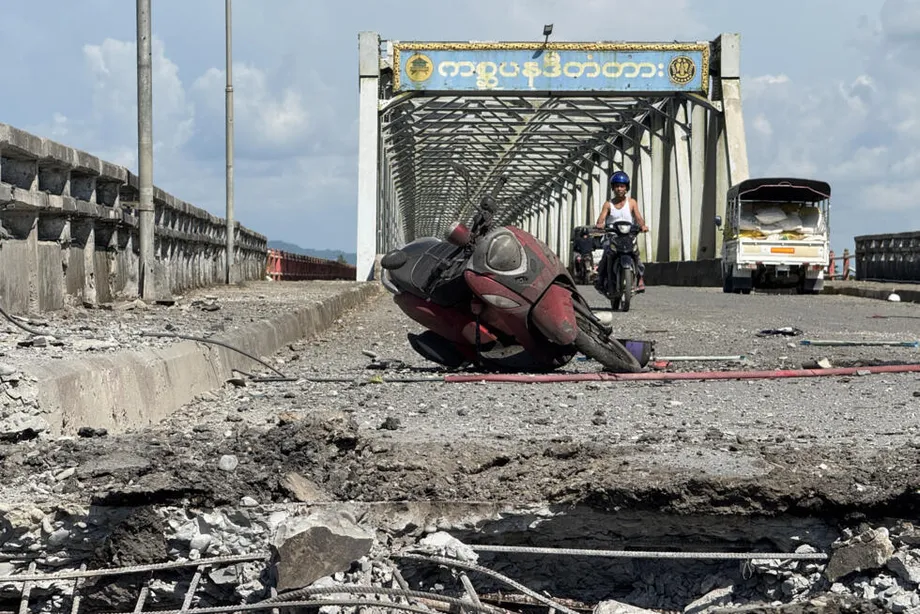
A crowded market, a damaged bridge and 50 dead
The September 28, 2026, bombing of Kyauktaw's India Market and the nearby Kissapanadi Bridge killed at least 50 people and injured at least 58, according to the Arakan Army and aid worker Wai Hun Aung. Rescuers recovered more bodies the following day. Women and children were among the victims of an attack that struck a busy commercial area beside the Kaladan River in Myanmar's Rakhine State.
Contents
- A crowded market, a damaged bridge and 50 dead
- What witnesses and casualty records show
- Attacks continued after September 28
- The growing civilian toll in Rakhine
- Four vessels behind nine confirmed deliveries
- How the shipping trail was concealed
- Iran connections are indicators, not proof of origin
- Territorial losses and pressure for talks
- What investigators still need to establish
- Key Points
Fortify Rights, in its October 2 statement on Kyauktaw, said ethnic Rakhine and Rohingya residents were among those killed or wounded. Its examination of casualty lists, photographs and videos identified at least two apparent bomb craters, one in the market and another on the bridge. The organization said the bombing caused a large fire that burned many victims alive.
The attack has brought two connected developments into focus: the military's continued ability to strike territory it no longer controls, and an aviation fuel supply chain that has expanded despite international sanctions. Amnesty International recorded at least 109,604 metric tonnes of aviation fuel imports in 2025, a 69 percent increase from 2024 and the largest annual amount since the February 2021 coup.
The fuel investigation does not identify the shipment that supplied the aircraft involved in Kyauktaw. It does, however, show how imports continued during what Amnesty described as the deadliest year for military aerial attacks since the coup. Investigators are now seeking evidence that could connect the Kyauktaw bombing to particular aircraft, bases, weapons, pilots and commanders.
What witnesses and casualty records show
Accounts place the bombing around midday, when traders, shoppers, transport workers and people passing through the market were exposed. Fortify Rights said the timing appeared to coincide with the busiest shopping hours. Among the victims was a woman nine months pregnant whose unborn baby was also killed. The Arakan Army's confirmed casualty list described in the initial account included a child aged four.
A 28-year-old eyewitness, whose name Fortify Rights did not publish, described hearing several bombs before discovering that relatives had died. The witness told the organization:
Half an hour later, I saw smoke coming from nearby places, and people screaming. I realized there were many casualties. Later, I found out several of my relatives were killed as well. It is heartbreaking to see my relatives and neighbors get killed by the Myanmar military.
The main casualty accounts agree on at least 50 deaths. Their injury figures differ in precision rather than showing a clear contradiction: the Arakan Army and Wai Hun Aung gave at least 58 injuries, while Fortify Rights reported more than 50. The death toll reached 50 on September 29 after additional bodies were recovered.
Arakan Army spokesperson Khine Thu Kha accused the military of deliberately attacking populated civilian areas and said the group would retaliate against those involved. A Myanmar government spokesperson did not respond to a request for comment on the bombing. The military has previously said it "exercises maximum restraint to avoid civilian harm", but that earlier assertion is not a specific explanation of the Kyauktaw attack.
Attacks continued after September 28
Kyauktaw was not the only location hit that day. Fortify Rights reported airstrikes in Ponnagyun, Minbya and Thandwe townships that killed or wounded at least 100 people. Further attacks followed while rescuers, families and investigators were still establishing what had happened at the market.
The sequence of reported events shows how quickly the violence spread beyond the initial bombing:
- September 28: Aircraft struck India Market and the Kissapanadi Bridge area in Kyauktaw. Airstrikes were also reported in three other townships.
- September 29: The Kyauktaw death toll rose to 50 after rescuers found more bodies.
- September 30: The Independent Investigative Mechanism for Myanmar requested evidence about Kyauktaw. Attacks on Kyaukseik and Kutaung villages reportedly killed one civilian and injured three.
- September 30 to October 1: The Arakan Army reported further attacks across five townships, with civilian casualties and damage to a monastery and homes.
- October 4: The United League of Arakan and Arakan Army said an attack on Byala displacement camp in Ponnagyun killed six civilians and injured 10.
- October 5: Further attacks reportedly hit another displacement camp, a temporary public welfare clinic and Aungphyupyin Village.
The United League of Arakan and Arakan Army gave a combined toll of eight civilians killed and 11 injured for October 4 and 5. That total includes the Byala casualties, rather than being an additional eight deaths. An 18-year-old trainee nurse and a displaced woman were among those reported killed in the later attacks.
The growing civilian toll in Rakhine
A compiled record of Rakhine airstrikes documented at least 667 civilians killed and 1,302 injured between April 2024 and September 30, 2026. Those figures include 133 children killed and 194 injured, as well as 61 elderly people killed and 121 injured. Children accounted for about one fifth of the recorded civilian deaths, based on 133 out of 667.
An earlier version of the tally, ending on September 12, recorded 602 deaths and 1,211 injuries. The updated record therefore contains 65 more deaths and 91 more injuries. That difference reflects the expanded record and its later cutoff; it should not automatically be treated as a complete count of casualties occurring only between those dates.
Access restrictions, disrupted communications and difficulties verifying incidents mean these are minimum documented figures. The October displacement camp attacks fall outside the September 30 cutoff. A separate monitoring count recorded at least 222 military airstrikes in Rakhine between March 31 and August 31, also excluding the September and October attacks.
Earlier incidents illustrate the damage beyond Kyauktaw. A January 2025 attack on Kyauk Ni Maw in Ramree Township reportedly killed 26 people, injured 27 and destroyed 398 houses. A September 2025 attack on Thayet Ta Pin School killed 20 students, young people and other civilians and injured 21. A December 2025 bombing of Mrauk-U Public Hospital was recorded as killing 33 civilians and injuring 77. Another account described that hospital toll more broadly as at least 30 deaths.
National figures attributed to the United Nations human rights office recorded 982 civilians killed by military airstrikes in 2025, including 232 children, compared with 641 civilian deaths in 2024. That represents an increase of 341 deaths, or approximately 53 percent. These national totals cover a different period and geography from the Rakhine records and should not be added to them.
Four vessels behind nine confirmed deliveries
Amnesty International's January 2026 aviation fuel investigation confirmed at least nine deliveries by four vessels between mid 2024 and the end of 2025. Its findings combined trade records, shipping data, satellite imagery and Myanmar Port Authority information.
The 109,604 metric tonnes recorded for 2025 is a minimum annual import figure, not a stated total for just those nine shipments. Amnesty Regional Research Director Montse Ferrer said the growth in fuel imports coincided with rising civilian deaths. She described the findings this way:
Five years after the coup, our analysis shows that the Myanmar junta continues to evade sanctions and find new ways to import the jet fuel it uses to bomb its own civilians – with 2025 being the deadliest year on record for aerial attacks since the junta takeover in 2021,
The four vessels identified in the investigation were:
- HUITONG 78, now BARAAWE 1, IMO 9646479: Delivered one shipment on July 12, 2024, after at least nine earlier deliveries in 2023 and 2024.
- YONG SHENG 56, now LS MERCURY, IMO 9657507: Delivered one shipment on July 30 and 31, 2024.
- REEF, formerly BALTIC HORIZON, IMO 9263382: Delivered shipments in October 2024, July 2025 and October 2025.
- NOBLE, formerly ASTRA, IMO 9162928: Delivered four shipments between January and June 2025.
The IMO numbers are permanent vessel identifiers, useful for following ships through changes in name. HUITONG 78 and YONG SHENG 56 were identified as carrying Chinese flags, while REEF and NOBLE carried Guinea's flag. A vessel's flag identifies its registration jurisdiction, not necessarily the origin of its cargo.
How the shipping trail was concealed
Amnesty described a shift toward vessels that interrupt or manipulate their Automatic Identification System, known as AIS. The system broadcasts a ship's identity and position. Switching it off creates gaps in the public tracking record; transmitting false positions, often called spoofing, can make a vessel appear to be somewhere else.
For REEF, satellite imagery placed the ship at Bandar Abbas in Iran in September 2025 with high confidence. Its AIS record instead indicated positions near Kuwait and the United Arab Emirates, including unusual rectangular movements more than 750 kilometres from Bandar Abbas. Amnesty said those patterns were inconsistent with normal navigation and indicated manipulation.
NOBLE was also located by satellite at Bandar Abbas before its June 2025 delivery to Myanmar. Other journeys involved the offshore anchorage near Fujairah in the United Arab Emirates, where ships can transfer petroleum cargoes between vessels without loading at a conventional terminal. These transfers can make it harder to trace cargo ownership and origin.
Ferrer explained that Amnesty identified the cargo as aviation fuel by comparing port records, satellite images of unloading locations and Myanmar's continued military aviation activity. She said all four vessels unloaded at Myan Oil Terminal in Thilawa, near Yangon, formerly operated as the Puma Energy terminal. She also said the terminal was controlled by companies connected to the military.
The investigation traced a change that began before these deliveries. A November 2022 investigation identified companies in Singapore and Thailand within the aviation fuel supply chain. After sanctions targeting parts of that chain in 2023, later investigations found fuel being bought and resold repeatedly, including through storage in Vietnam, making its origin harder to identify.
Iran connections are indicators, not proof of origin
Amnesty did not confirm the suppliers or country of origin of the aviation fuel. That limit matters because evidence placing a tanker in an Iranian port does not, by itself, establish where every cargo aboard it was produced or who sold it.
The organization nevertheless identified several indicators of an Iranian connection. REEF and NOBLE had documented histories of transporting sanctioned Iranian fuel, according to the United States Office of Foreign Assets Control. Both were seen at Bandar Abbas, and commodity intelligence company Kpler assessed their Myanmar shipments as originating in Iran using shipping, satellite, customs and other information.
Ferrer distinguished these findings from evidence of a new political alliance between Iran and Myanmar. Her assessment was that entities already exposed to sanctions, along with traders and networks willing to operate in less transparent markets, could share commercial interests. The investigation supports scrutiny of those networks, but does not establish an Iranian government decision to supply the Kyauktaw operation.
Sanctions have therefore affected how fuel reaches Myanmar without stopping imports. The annual volume rose by 69 percent in 2025 even as the routes became harder to follow. That does not prove every imported tonne was used by military aircraft, but it challenges the idea that restrictions on selected suppliers have been enough to prevent the military from obtaining fuel.
Territorial losses and pressure for talks
Fortify Rights said the military had lost control of 14 of Rakhine's 17 townships to the Arakan Army. Aircraft still allow it to strike areas beyond its effective ground control, including infrastructure needed for trade, medical care and everyday travel.
Airstrikes have also continued alongside invitations to peace talks. The Arakan Army said more than 130 civilians were killed by airstrikes and heavy artillery in areas it controlled between April 21 and September 30, 2026, while the military government was extending those invitations. That figure covers different weapons and dates from the wider airstrike tally, so it should not be combined with it.
Security analyst Sai Kyi Zin Soe described military, political and economic pressure intended to push the Arakan Army toward negotiations. That is an assessment of the military's strategy, not a confirmed account of the orders behind the market bombing. Fighting continued around Sittwe, Kyaukpyu and Manaung, while the Arakan Army, Kachin Independence Army and Karen National Union remained major groups outside the talks.
Thar Tun Hla, chairman of the Arakan National Party, said attacks on civilians undermined the confidence needed for negotiations. He stated:
The peace process requires trust,
A contrasting position came from Thien Tun Oo, executive director of the Thayninga Institute for Strategic Studies, which supports the military. He argued that groups continuing armed operations would face military responses. That position does not remove the legal requirement to protect civilians, regardless of whether negotiations are taking place.
What investigators still need to establish
In a September 30 statement, the Independent Investigative Mechanism for Myanmar requested photographs, videos and testimony about the Kyauktaw casualties and damage. It also sought information identifying the aircraft, operating airbase, weapons, pilots and personnel who gave or carried out orders. Witnesses were urged to prioritize their safety and make contact only when safe.
Fortify Rights said the apparent deliberate bombing of a crowded market could constitute a war crime. International humanitarian law requires forces to distinguish civilians and civilian buildings from military targets. Even an attack on a legitimate military target is prohibited if the expected civilian harm would be excessive compared with the anticipated military advantage. A bridge's military relevance, if established, would not make every nearby person or shop a lawful target.
The legal status of prisoners also needs separate attention. A distinct record documented 187 prisoners of war and other detainees killed and at least 122 injured in Rakhine airstrikes from 2024 through September 2026. It included 116 prisoners killed and 32 injured in an attack on a detention facility in Ann Township on March 8, 2026. These figures should remain separate from civilian totals. Captured fighters no longer participating in hostilities are protected under the laws of war.
Fortify Rights named General Ye Win Oo as commander in chief since March 2026, succeeding Min Aung Hlaing. Determining responsibility for Kyauktaw requires evidence about the actual command chain and decisions, rather than an assumption based solely on a person's title. The same distinction applies to pilots, fuel suppliers, ship operators, insurers and financial intermediaries: their potential legal responsibilities are not identical.
Rohingya casualties add to concerns surrounding Myanmar's obligations under the International Court of Justice's provisional measures in The Gambia v. Myanmar, the genocide case filed in 2019. Fortify Rights said a judgment might come in the following months, but gave no fixed date. Neither a judgment date nor a timetable for concluding the Kyauktaw investigation has been established in the cited statements.
Regional parliamentarians have renewed demands to stop supplies of weapons, aviation fuel and equipment usable for civilian or military purposes. The immediate unresolved issues are more specific: who ordered the bombing, which aircraft carried it out, what weapons were used, and which supply routes continue to sustain the air campaign.
Key Points
- The September 28, 2026, Kyauktaw bombing killed at least 50 people and injured at least 58.
- Fortify Rights identified apparent bomb craters in the market and on Kissapanadi Bridge and said the attack could constitute a war crime.
- A regional casualty record documented 667 civilians killed and 1,302 injured in airstrikes through September 30, excluding later October attacks.
- Myanmar imported at least 109,604 metric tonnes of aviation fuel in 2025, up 69 percent from 2024.
- Amnesty confirmed nine deliveries by four vessels, but could not confirm the fuel suppliers or origin.
- United Nations investigators are seeking evidence identifying aircraft, weapons, pilots and those responsible for orders.