
A legal change for families of 5,285 missing people
Nepal has issued a disaster ordinance intended to let families seek legal recognition of deaths after 45 days, rather than rely on the general 12 year presumption for missing people. The change follows weeks of appeals from communities devastated by the August 26, 2026, Bhotekoshi and Trishuli floods, with revised figures putting the number still missing at 5,285.
Contents
- A legal change for families of 5,285 missing people
- Funeral rites have not unlocked financial help
- What the existing law actually permits
- How local appeals became an ordinance
- Registration involves more than one law
- What families could receive
- Identification remains a separate task
- Ending rescue operations has divided families
- Recovery costs and unresolved decisions
- Key Points
For families in Rasuwa, Nuwakot and other affected districts, a death certificate can determine whether they receive bereavement payments, claim insurance, access pensions or transfer property. Some have already performed Hindu funeral rites using symbolic bodies made from sacred kusha grass. Ward offices nevertheless said they lacked authority to register deaths without identified bodies or another accepted legal basis.
The latest account places the ordinance's issuance on October 10 and attributes confirmation to Krishna Bahadur Shahi, spokesperson for the President's Office. Another report dates the presidential announcement to October 9. Both describe a change aimed at shortening the waiting period to about 45 days, but they do not establish that every missing person has already been declared dead or that certificates have been issued.
The reform also needs to be understood alongside an existing court procedure. Section 40(4) of the National Civil Code, 2017, already allows a judicial declaration of death in disaster or accident cases without necessarily waiting 12 years. The immediate problem has been obtaining recognition through a process that grieving, displaced families and local officials describe as too cumbersome for a disaster of this scale.
The ordinance therefore addresses an administrative barrier as well as a waiting period. Its practical effect will depend on how registration offices apply it, what evidence they require and how they handle families who still want their relatives treated as missing.
Funeral rites have not unlocked financial help
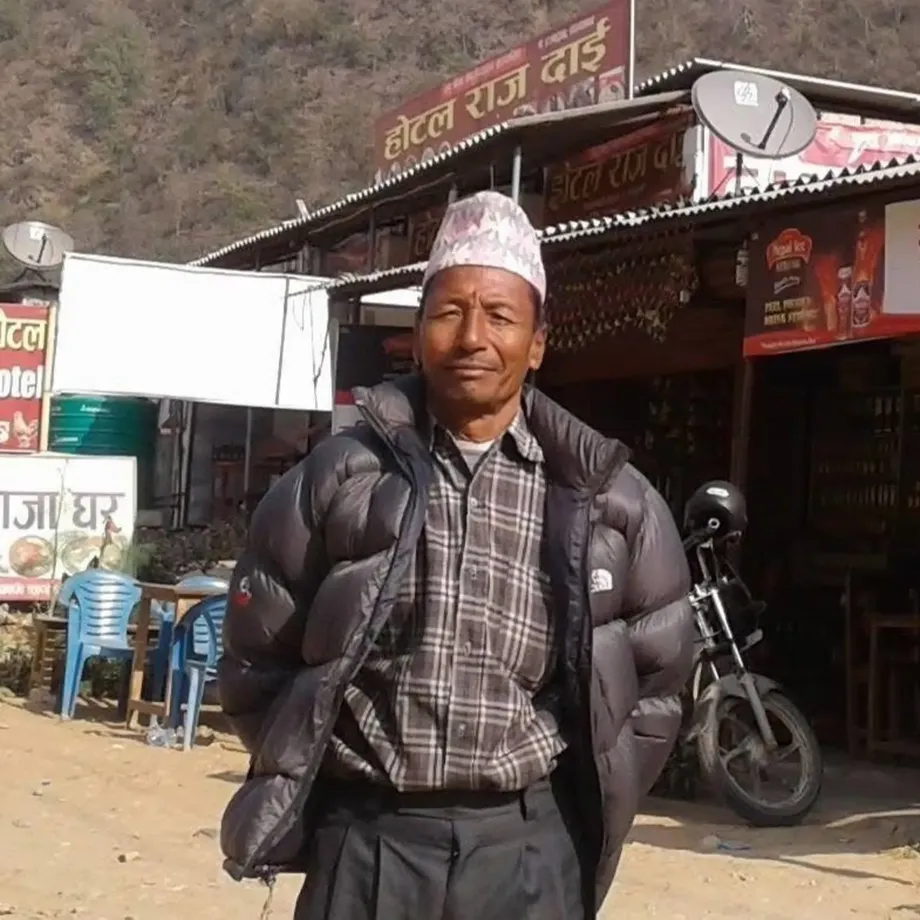
Purna Ghale, a survivor from Khalte in Rasuwa, reported losing his home and having numerous relatives missing, including his father, eldest son, daughter in law, younger brother, two granddaughters and three sons in law. Without recovered bodies and death certificates, he said he could not obtain relief or afford the funeral ceremonies he wanted to perform.
Ghale explained why the rites mattered to him:
At least I want to perform the rites according to our faith and traditions. Perhaps their souls would find peace.
Using kusha grass allows families to carry out religious ceremonies when a body cannot be recovered. It does not, by itself, establish a death for civil registration. That distinction has left some families able to mourn according to their faith but unable to settle the financial and legal affairs of the missing.
Sabitri Tamang of Angitar in Nuwakot described a different obstacle: she wanted to perform the rites but could not afford them. Her ward office told her financial assistance could not be provided without a death certificate because the case involved legal complications.
Tamang described the divide between families who could pay for ceremonies and those who could not:
Those who had something left to them have already completed the rites. We have nothing.
What the existing law actually permits
Section 40 of the National Civil Code establishes a general presumption of death after 12 years of continuous absence or lack of information, unless there is evidence that the person is alive. It also contains exceptions. Treating the 12 year period as an unavoidable wait for every flood victim would therefore be misleading.
Under Section 40(4), a concerned person can ask a court to declare someone dead when that person has disappeared without information or there are grounds to believe they died in a disaster or accident. The court examines evidence concerning the date, place, circumstances and basis of the presumed death. Rule 60 of the Civil Procedure Rules, 2018, sets out the application procedure.
Senior advocate Raju Khadka explained that relatives can apply to the district court with evidence connecting the missing person to the incident. Useful records may include police reports, eyewitness accounts, travel records, CCTV footage and phone records. What counts as sufficient evidence depends on the circumstances of each case.
A judicial declaration can then support death registration at the relevant ward office and subsequent property or inheritance procedures. If the person returns alive, the declaration can be annulled. Any consequences of property transfers or other transactions must then be addressed under the relevant laws.
Reports differ in their explanation of the disaster provisions. Constitutional law expert Bipin Adhikari described Section 40 as lacking a provision for disasters like this flood. Other legal explanations, consistent with the account of Section 40(4), identify an existing judicial route for disaster and accident cases. The distinction is between having a court remedy and having a straightforward registration mechanism that local offices can use across thousands of cases.
For families who have lost homes, documents and potential witnesses, collecting evidence and pursuing individual court applications can itself be a substantial burden. Local officials have argued that the government should help families establish their relatives' status instead of leaving each household to navigate that process alone.
How local appeals became an ordinance
Local governments in Rasuwa and Nuwakot wrote to the Home Ministry on September 9, asking for an alternative mechanism to confirm deaths and process registrations. Authorities in Dhading, Gorkha and other affected districts also raised the issue. Their appeals described difficulties with insurance claims and official recognition of people who remained missing.
Uttargaya Rural Municipality chair Madhav Prasad Aryal said representatives took the issue to Prime Minister Balendra Shah, the home minister and other ministers. They sought either a Cabinet decision or an immediate legal amendment. Home Ministry spokesperson Ananda Kafle subsequently said the letters had been received and the legal issues were under discussion.
The sequence of reported developments shows how the government's response moved from discussion to legal action:
- August 26, 2026: The floods struck Rasuwa, Nuwakot and surrounding areas.
- September 9: Local governments in Rasuwa and Nuwakot sent their request to the Home Ministry.
- October 5: The government ended the 40 day search and rescue operation and announced a shift toward recovery and reconstruction.
- October 6: Law Ministry officials discussed accelerated amendments at a parliamentary special committee meeting.
- October 7: The Cabinet recommendation for a disaster ordinance was reported, with a proposed waiting period of about 45 days.
- October 9 or 10: Reports place the presidential announcement or issuance of the ordinance on these different dates.
Government spokesperson Sasmit Pokharel described the proposed change when the Cabinet recommendation was announced:
The change is quite significant. The 12-year period is being reduced to around 45 days.
The latest account says the ordinance amends several Nepal laws related to disaster management, 2083 BS, and will enter implementation. Separate proposed ordinances concerning land and forests remained under presidential consideration.
Registration involves more than one law
The Ministry of Law, Justice and Parliamentary Affairs identified the Disaster Risk Reduction and Management Act and the National Identity Card and Registration Act as priorities for amendment. Joint Secretary Subhash Kumar Bhattarai said the ministry was coordinating with the Home Ministry to address the legal status and death registration of disaster victims.
Bhattarai told the parliamentary committee that work on the changes had begun:
Existing legal provisions are currently inadequate for declaring and registering the deaths of missing citizens, so the process to amend the relevant Acts has begun in coordination with the Home Ministry.
Law Minister Sobita Gautam also said her ministry was discussing death declarations and registration with the National Disaster Risk Reduction and Management Authority. She identified the Civil Code and registration legislation as relevant parts of the legal framework.
Those discussions reflect two separate steps: establishing that a person is legally dead and entering that death into the civil registration system. A shorter waiting period must be accompanied by a usable process for ward offices if families are to obtain certificates.
Officials have also raised cases in which victims disappeared outside their home districts or entire families went missing. Nuwakot Chief District Officer Shambhu Prasad Regmi said it was unclear whose information should be treated as authoritative when no immediate family member remained to report the disappearance. These questions will still require administrative answers even after the waiting period changes.
What families could receive
The reported relief policy provides Rs200,000 for the first flood death in a family and Rs100,000 for each additional death in that family. Funeral assistance is reported at up to Rs25,000. One account gives the first payment as approximately Rs200,005, differing slightly from the Rs200,000 figure stated elsewhere.
Using the Rs200,000 and Rs100,000 figures, a family with five recognised deaths would qualify for Rs600,000 in bereavement compensation before any separately applicable funeral support. That calculation illustrates why registration matters, but it does not establish any individual family's eligibility or payment status.
The amounts also differ from earlier disaster assistance. Ghale recalled that after the 2015 earthquake, the government provided Rs40,000 per victim for funeral rites and a further Rs100,000 in relief. Those are his account of past payments, not the present flood policy.
Death registration also affects pensions, social security, insurance, official recognition of widowhood, and ownership of movable and immovable property. Families of missing army and police personnel face similar difficulties with pensions and insurance. One report warns that insurance claims can become difficult if they are not filed within a year, although policy terms and applicable requirements may vary.
Identification remains a separate task
The reported casualty figures changed over the weeks after the floods. An earlier account listed 1,397 recovered bodies and 5,130 people unaccounted for. A September 18 account attributed figures of 1,403 recovered bodies and 105 returned to families to the National Disaster Risk Reduction and Management Authority.
Later figures put the missing total at 5,285. One account attributed at least 1,455 deaths to the authority, while another described 1,455 bodies as recovered. A subsequent report said 112 bodies had been identified and returned to families. These figures cover different reporting points and sometimes use different categories, so they should not be treated as interchangeable.
Police had collected 3,139 DNA samples in one reported count: 1,286 from bodies and remains, and 1,853 from relatives of missing people. DNA identification compares genetic material from remains with relatives' samples to help establish identity. Taking a sample is not the same as completing a match.
Japan's International Cooperation Agency provided extraction kits capable of processing up to 480 samples to the Nepal Police Central Forensic Science Laboratory. Japanese Ambassador Maeda Toru handed them to Science, Technology and Innovation Minister Mahabir Pun at the Nepal Police Academy in Maharajgunj. The assistance followed requests from Nepal's Foreign Ministry and the laboratory.
Legal recognition can allow a family to settle urgent affairs without a recovered body. Forensic identification serves a different purpose: establishing whose remains have been found and, where possible, returning them to relatives.
Ending rescue operations has divided families
The government ended the main search and rescue operation on October 5, shifting attention toward rehabilitation and reconstruction. National Emergency Operation Center head Phanindra Poudel described a transition into search and reconstruction, indicating that the end of rescue did not necessarily mean every effort to locate remains would stop.
Families had held protests and vigils demanding stronger searches. Earlier rescues sustained hope: two Nepalese workers were found in a Trishuli hydropower project tunnel on September 4, followed by a Chinese man two days later.
Usha Khatri, who was searching for her husband in towns along the river and checking photographs of recovered bodies, opposed declaring him dead without stronger evidence:
Either they have to give up the body or show some solid proof that my husband is gone and only then can they declare him dead.
Nirajan Poudel, who lost five family members, expressed a different position:
After so many days and weeks there is little or no hope of finding anyone alive. We are sure that none of our family members survived and we are just looking for a closure.
The missing also include foreign nationals. Nine South Korean employees were being sought at the Upper Trishuli 1 construction site in Rasuwa. Corporate searches were expected to scale back around Dashain because of limited staffing, while some excavation using heavy machinery could continue. The ordinance does not resolve every family's need for a body, identification or a fuller account of what happened.
Recovery costs and unresolved decisions
Nepal's reported damage assessment counted 7,570 private buildings damaged or destroyed, affecting nearly 33,000 people. Bidur Municipality estimated damage to more than 3,000 buildings. Thousands of displaced residents were living in 37 holding centres, where drinking water, sanitation and disease risks added to immediate needs.
The government estimated rebuilding costs at Rs723 billion. Other accounts expressed recovery and reconstruction costs as approximately $4.77 billion or up to £3.6 billion. These are estimates presented in different currencies, not separate bills to be added together.
The October parliamentary discussions also addressed safer reconstruction, legal and financial support for families of missing people, protection for children who lost relatives, and more reliable flood warnings. Lawmakers urged assessment of multiple risks before rebuilding roads, bridges and other infrastructure, with alternatives to construction along riverbanks where possible.
Past disasters offer a precedent for government action. After the August 2, 2014, Jure landslide in Sindhupalchok, 145 people were reported missing and only 33 bodies were recovered. The government subsequently declared the remaining missing people dead. Around 198 people were also reported missing after the 2015 earthquake.
The immediate unresolved issue is implementation of the new ordinance. The reports do not specify a complete application checklist, who will verify every case, whether recognition requires a family request, or how cross district and foreign national cases will be handled. They also give no firm date by which ward offices must begin issuing certificates. Shortening the waiting period is a concrete change, but families will need registration decisions before it becomes financial assistance or settled legal rights.
Key Points
- Nepal issued a disaster ordinance reported to reduce the waiting period for death declarations to 45 days.
- Revised figures put 5,285 people still missing after the August 26, 2026, floods.
- Section 40(4) already provides a court route for disaster and accident cases without an automatic 12 year wait.
- Death certificates are needed for reported bereavement payments, insurance claims, pensions and property procedures.
- DNA identification continues separately from legal recognition of death.
- Reports differ on whether the presidential announcement or issuance occurred on October 9 or October 10.
- Detailed registration requirements and a firm implementation timetable have not been established in the reports.