
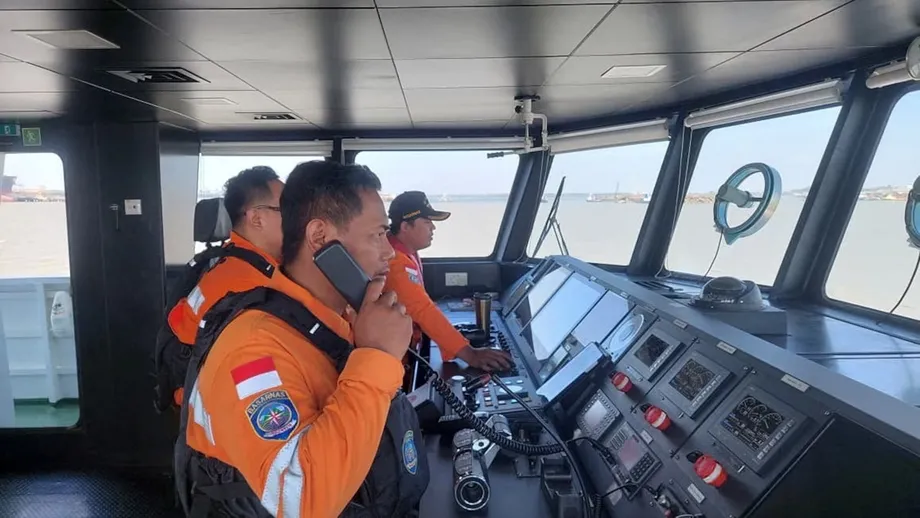
Recovery of the wreck becomes central to the search
Indonesia's Virgo Transport 8 ferry disaster has left 82 people dead and 53 still missing, with rescuers awaiting the recovery of the wreck before they can resume searching inside it. The latest dated rescue update, on October 7, 2026, recorded 108 survivors among the 243 passengers and crew aboard the ferry when it capsized in the Java Sea on September 13.
Contents
- Recovery of the wreck becomes central to the search
- How the disaster and search unfolded
- Survivors describe darkness and little warning
- A large rescue effort and families waiting ashore
- Why the casualty figures changed
- Divers recovered victims but faced growing risks
- Salvage is planned, but its start is not confirmed
- Police examine the captain and company roles
- What is known about the vessel and its condition
- Key Points
Police have detained the captain and three representatives of the operator, PT Virgo Karya Shipping, over alleged negligence and involvement in the disaster. Their detention was announced in an October 8 statement, as the company worked toward a salvage operation planned for October. No completed salvage operation or final finding on the cause has been announced.
The ferry was sailing from Surabaya, East Java, to Banjarmasin, South Kalimantan, on the Indonesian part of Borneo. Early accounts described severe weather, a sudden tilt and passengers escaping in darkness. The initial toll of six dead and about 129 missing has changed through weeks of searches, body recoveries and identification work.
Underwater searches were suspended on October 3 after 21 days of operations. Rescue officials cited dangers inside the unstable wreck and the deteriorating condition of human remains. Searches continued on the surface and along coastlines across South, Central and West Kalimantan.
I Putu Sudayana, head of the Banjarmasin Class A Search and Rescue Office, described the obstacle facing teams trying to reach those still inside the vessel.
"Diving efforts have been suspended, we are still waiting for the ship to be recovered," he said.
The distinction matters for families: suspending dives did not end the search, but it left access to the ferry's interior dependent on a separate operation involving the owner, insurers and a salvage contractor.
How the disaster and search unfolded
The ferry left Surabaya on September 12 and was expected in Banjarmasin the next afternoon. Reports differ on its departure time: maritime monitoring information placed it at 10:33 a.m. Western Indonesian Time, a later account gave 6:52 a.m., and survivor Faisal recalled leaving around 10 a.m. Those accounts have not been reconciled.
Authorities placed the loss of contact near Masalembo at about 2 a.m. Central Indonesian Time on September 13. Another early account described the last reported position as approximately 150 kilometers south of Banjarmasin and said authorities received the initial distress report at 4:10 a.m. Survivor estimates put the onset of the capsize earlier, between about 12:15 a.m. and 1 a.m.
- September 12: Virgo Transport 8 departed Surabaya for Banjarmasin.
- September 13: The ferry capsized in the Java Sea. Initial updates recorded six deaths and more than 100 survivors.
- September 24: Basarnas reported 108 survivors, 42 deaths and 93 people still unaccounted for.
- September 25: Police detained captain Arief Yunianto.
- October 2: The reported toll reached 80 dead, with 108 survivors and 55 missing.
- October 3: Basarnas suspended underwater searches after 21 days; the operator announced plans for salvage in October.
- October 4: Police detained three company representatives.
- October 6 and 7: Rescue updates recorded 82 dead, 108 survivors and 53 missing.
- October 8: Police publicly detailed the four suspects and the legal provisions being applied.
The dates show how the operation changed from rescuing people at sea to recovering and identifying victims, while a criminal investigation developed alongside it.
Survivors describe darkness and little warning
Several survivors described the ferry tilting rapidly while many passengers were asleep. Faisal, 26, who was travelling to work on a palm oil plantation in Central Kalimantan, recalled an ashtray falling, chairs toppling and a loud noise from the lower left side of the vessel before the tilt became more severe.
Faisal said the crisis developed around 12:15 a.m. Central Indonesian Time. He grabbed a life jacket and stayed on the raised side of the ferry as people tried to reach boats in the water. He said 11 of his 16 friends had been rescued and five remained missing when he spoke on September 15.
Agus, a truck driver from Palangkaraya, said another driver alerted him while he was in the sleeping quarters. Describing what he heard before escaping toward a lifeboat, he said:
"When I woke up, there was no announcement. I only heard from my friends that the ship was tilting," he said.
Truck driver Ari also said he heard no alarm. Crew member Akmal recalled hearing the ship's horn only once, without an earlier warning. Wearing a life jacket, Akmal said he spent 10 hours at sea with four others holding onto a 12 kilogram LPG cylinder before a coal tugboat rescued them.
These accounts describe passengers' experiences, not a settled explanation of the accident. Basarnas chief Mohammad Syafii said survivor testimony would inform the National Transportation Safety Committee, known as KNKT, which is responsible for investigating the cause and developing safety recommendations. Basarnas distinguished that work from its own responsibility to find and evacuate victims.
A large rescue effort and families waiting ashore
The initial search involved about 280 personnel, ships, a helicopter and a joint task force including Basarnas, the navy and maritime police. A subsequent update described five aircraft and 17 vessels, including navy warships. Other vessels in the Java Sea were asked to report signs of passengers.
Syafii said the search area had been divided into six sectors, with teams first concentrating on people floating at sea. Divers and underwater drones were also planned for the area around the located wreck.
Explaining the early search priorities, Syafii said:
"We will maximise the search operation in six sectors that we have divided by prioritising the search for floating victims," he said.
Basarnas video showed people being rescued from orange life rafts and receiving first aid aboard another vessel. Ahmad Supandi, a freight driver, survived after being rescued by MV Haida. His wife, Misnah, cried when she learned he was safe.
Other families had no such confirmation. Rusmilawati went to the Banjarmasin port seeking information about eight relatives returning from visits to the tombs of Islamic scholars in Java. They had flown there and chosen the ferry for the return journey. At Surabaya's Tanjung Perak Port, Fredy sought news of his younger sibling, Stevie Manuhua, a crew member who entertained passengers as a keyboard player.
Why the casualty figures changed
The latest figures account for all 243 people on the manifest: 108 survived, 82 died and 53 remain missing. The missing represent about 22 percent of those aboard. The manifest was described in early updates as listing 213 passengers and 30 crew members, although some later accounts used the word passengers for the entire group.
Early reports differed. One recorded six deaths, 107 people rescued and 130 missing. The initial Basarnas update cited in the first account recorded six deaths, 108 evacuated and about 129 missing. Both sets total 243, but they differ by one survivor and one missing person.
A September 14 Basarnas update at 3:30 p.m. Central Indonesian Time gave another count: 109 survivors, six dead and 128 missing. It said 86 people had reached Trisakti Port, one had reached Syamsudin Noor Air Force Base and 28 were still being evacuated. Later updates consistently returned to 108 survivors. No explanation for the difference was given.
Recovery and identification also involve different counts. By October 6, the South Kalimantan police Disaster Victim Identification team had received 80 body bags, identified 65 and was awaiting DNA matching for 15. Those figures describe the identification workload and should not be treated as interchangeable with the rescue agency's death toll of 82.
Two victims found in Seruyan waters, Suroso, 40, from Pamekasan, and Soni Marta Andika, 44, from Banyuwangi, were identified through medical characteristics and personal belongings matched against information from their families. Their bodies were returned for burial. Other remains required DNA comparisons, which can establish identity when visual recognition or belongings are insufficient.
Divers recovered victims but faced growing risks
On September 24, the twelfth day of searches, Basarnas reported that 150 people had been found: 108 alive and 42 dead. Operations director First Admiral Yudhi Bramantyo said that, against the manifest of 243, about 93 people might still be inside the vessel. That was an assessment of where missing victims could be, not confirmation that all 93 were in the wreck.
Three diving sorties recovered 14 victims that day: seven on the first sortie, one at 12:13 p.m. and six at 3:05 p.m. Dauphin helicopters 3601 and 3604 evacuated them, supported by Panther HS 1311 aboard the naval vessel KRI Sultan Iskandar Muda.
By the end of the underwater phase, Basarnas said divers had recovered 50 bodies. Teams generally made four or five dives a day, with five members per team. Inside the vessel, debris could shift or collapse, sediment reduced visibility, and sharp objects and oil created additional hazards. Officials said working time at depth was limited to less than 20 minutes per scuba dive.
Reports differ on the wreck's depth. One placed it at 24 meters, while another said it had moved from 21 to 29 meters after shifting about 450 meters. An account of diving conditions also referred to 27 meters. Those measurements were not reconciled, but officials consistently described a changing, unstable position.
Basarnas also warned that attempts to remove remains could cause further deterioration. By early October, the agency judged continued underwater recovery ineffective under the prevailing conditions. Searches then concentrated on the surface and coastline, although officials reported no new finds during a three day period.
Salvage is planned, but its start is not confirmed
PT Virgo Karya Shipping said it planned to raise the wreck in October after discussions with international Protection and Indemnity insurers. P&I insurance commonly covers a shipowner's liabilities, including certain claims and wreck removal costs. In this case, insurer coordination and the appointment of a contractor were part of the preparations.
Company spokesperson Simson Fransiscus Rihi said on October 3 that the plan had approval from the Ministry of Transportation, Basarnas, and the Harbor Master and Port Authority. He said a contractor had been selected, although another account described the choice as narrowed down. Both accounts said the contract had not yet been signed and administrative work remained.
Rihi described the proposed operation as an obligation of the operator:
"This is part of our responsibility," he said.
Heri Purwanto, head of the Class I Banjarmasin Harbor Master and Port Authority Office, said the transport minister had ordered the company to raise the ferry immediately. Rescue officials cited Law Number 17 of 2008 on Shipping, which requires owners to remove wrecks or sunken cargo when they interfere with navigation safety.
Raising or stabilizing the ferry would serve a separate recovery purpose: giving teams safer access to spaces that divers could no longer search. Families waiting at Trisakti Port also called for the wreck to be raised. No precise start date, signed contractor agreement or completion timetable had been confirmed in the October updates.
Police examine the captain and company roles
The four detained suspects are captain Arief Yunianto, identified by police as AY, and three company representatives: LBA, an agent; RH, the operations manager; and YR, general manager of the Surabaya branch. All were being held at a South Kalimantan police detention facility.
Police detained the captain on September 25 and the company representatives on October 4. The stated detention periods ran through October 14 for the captain and October 23 for the other three. These are custody dates, not announced trial dates.
Brigadier General Trunoyudo Wisnu Andiko, head of the National Police Public Information Bureau, said investigators were examining alleged negligence, complicity and assistance. Explaining the scope of the inquiry, he said:
"Our investigation is not limited to those directly involved in operating the vessel. Investigators have also examined the company's role in the case," Andiko noted.
Investigators are applying Article 302(3) of Law Number 17 of 2008 on Shipping, Article 474(3) of the Criminal Code, and Articles 20 and 21 of Law Number 1 of 2023 concerning participation and assistance. Suspect status does not establish guilt. The allegations must still be tested through the legal process, and no court ruling was announced.
The criminal investigation and KNKT safety inquiry have distinct purposes. Police examine possible offenses and responsibility, while the transport safety investigation seeks to establish how the accident happened and what measures could prevent a similar disaster.
What is known about the vessel and its condition
Virgo Transport 8 was a vessel on which vehicles could be driven aboard and off, commonly called a roll on/roll off ferry. It measured approximately 119 meters long and 21 meters wide, was built in 1987 and was owned by PT Virgo Karya Shipping. A later account said it carried 89 vehicles alongside the 243 passengers and crew.
Transport Minister Dudy Purwagandhi said the ferry's capacity was 500 people and that it was not overloaded. The 243 aboard amounted to about 49 percent of that stated capacity. A headcount below capacity, however, does not resolve questions about vehicle loading, stability, weather conditions or emergency procedures.
The captain reportedly told rescuers that waves struck the starboard side, meaning the right side when facing forward, before the ferry tilted and capsized. Transport officials initially said they were examining natural, technical and human factors. No final causal finding was announced.
The disaster occurred in a country of more than 17,000 islands, where ferries can cost up to 75 percent less than air travel. Reports cited at least 601 sea accidents by August and a separate government figure of 111 ship accidents between 2020 and 2026. Without matching definitions and coverage, those figures cannot be compared as a single measure of accident frequency.
Other recent incidents included a ferry fire off Madura Island that killed five people and the July sinking of KM Nurul Salsa west of Polassi Island, where 58 survived, three were found dead and 14 remained missing. For Virgo Transport 8, the unresolved tasks are specific: locate 53 people, complete identification work, recover the wreck and establish what caused the capsize.
Key Points
- Virgo Transport 8 capsized on September 13, 2026, while sailing from Surabaya to Banjarmasin.
- The October 7 rescue update recorded 82 deaths, 108 survivors and 53 missing among 243 people aboard.
- Underwater searches stopped on October 3 because of recovery conditions and risks inside the wreck.
- Surface searches continued across South, Central and West Kalimantan.
- The operator planned salvage for October, but no exact start or completion date was confirmed.
- Police detained the captain and three company representatives over alleged offenses; no finding of guilt was announced.
- The cause remained under investigation, with survivor testimony intended to inform KNKT's safety inquiry.