
Arrest did not prevent an attack on his home
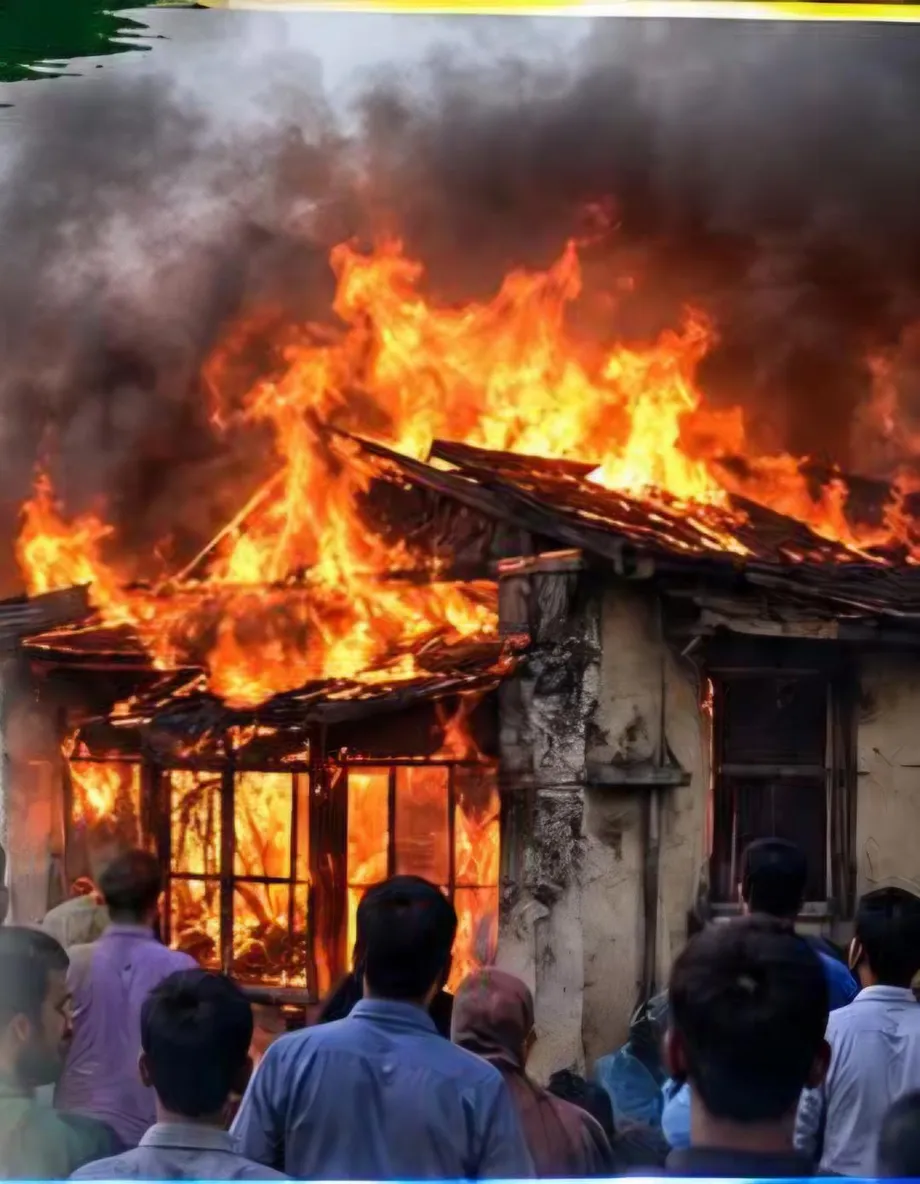
A mob burned the home and adjoining clinic of Kamran Gill Masih in Gharial Kalan village near Narang Mandi, in Pakistan's Sheikhupura district, after he was accused of sharing blasphemous content online. Christian rights groups say more than 35 Christian families fled amid threats of further attacks. Police reported no deaths or injuries.
Contents
- Arrest did not prevent an attack on his home
- How the violence unfolded
- What investigators allege about the video
- Conflicting accounts of the charges
- The separate case against the attackers
- Families fled, despite a police denial
- Police protection and the threat to a church
- HRFP calls for protection and fair proceedings
- A village attack with wider precedents
- Key Points
Masih, a 40 year old father of three who operated a traditional medical clinic with a small pharmacy, had already been arrested before the fire. Accounts place his arrest or transfer to a protected location at about 9:30 p.m. on October 8. The attack followed on Friday, October 9. Human Rights Focus Pakistan (HRFP) dates the complaint against him to October 9, 2026.
Police say they opened separate criminal cases against Masih and people accused of attacking his property. Five alleged attackers were reported in custody by a district police spokesperson, while Punjab Assembly member Ejaz Alam Augustine gave a higher figure of more than 15. The difference has not been resolved.
The central concern extends beyond the destruction of one family's property. Witnesses described threats against other Christian households, and a provincial legislator said the crowd moved toward a local church before police intervened. Police later described the situation as under control, but disputed residents' accounts that families had fled.
HRFP has called for protection for Masih, his relatives and the wider community, alongside separate investigations into the accusation and the violence. The allegation against Masih has not been established in court. His arrest does not establish guilt, and the accusation provides no lawful justification for attacking his family, property or neighbors.
How the violence unfolded
The sequence described by witnesses and police places the attack after officers had taken Masih away. Some families began leaving when news of his arrest circulated. Others escaped during the violence or after threats that the crowd would return following Friday prayers.
Accounts differ on the precise time the attack began. One witness described violence on Friday morning, while a student from the village placed the emergency departure of her family around midday. Both accounts describe residents leaving urgently because they feared further attacks.
- October 8: Masih was arrested and taken to a protected location. Accounts place his arrest or transfer at about 9:30 p.m.
- October 9: A crowd gathered, and his home and clinic were ransacked and burned. Police registered a separate case concerning the attack.
- October 9: Police reinforcements and provincial representatives responded, while Christian families sought shelter elsewhere.
- The following Saturday: Punjab Assembly member Emmanuel Athar Julius said some families had returned, although others remained with relatives.
An eyewitness identified by the protective pseudonym Asif said members of Masih's family, including his mother and sister, were inside when the crowd began throwing stones. He said they escaped through a back door before the building was set alight.
Asif also described threats that the crowd would return after Friday prayers and target other Christian families if they remained. That account helps explain why households beyond Masih's immediate relatives left, despite not being accused of any offense.
What investigators allege about the video
The accusation concerns a video allegedly shared through social media. Police described a post that spread locally, while other accounts referred to circulation in WhatsApp groups. A reported complaint described an eight minute, 17 second video shared on Masih's Facebook account, allegedly originating from an account named John Shaqi one day earlier.
These descriptions do not establish who created the recording, who controlled the accounts involved or precisely how it circulated. They also leave unresolved whether the Facebook and WhatsApp references concern the same act of sharing or different stages of distribution.
Raees Ahmed is identified as the complainant, but accounts differ on his role. HRFP described him as a local resident; other accounts identified him as a police sub inspector who received information while on patrol. The complaint attributed to him describes collecting a video and screenshots as evidence.
In the reported complaint, Ahmed explained how he said the recording was preserved:
I downloaded the video from my mobile phone using an application, transferred it onto a USB in the presence of witnesses, prepared a sealed parcel, and took it into police possession. Screenshots were also taken into police possession via phone,
That statement describes a claimed evidence collection process, not a judicial finding about the recording's authenticity or Masih's responsibility. Establishing the origin of the material, its integrity and its connection to the accused remains part of the investigation.
Conflicting accounts of the charges
The statutory provisions reportedly invoked against Masih vary substantially. HRFP lists Sections 295-A, 298 and 298-A of the Pakistan Penal Code, together with provisions described as Section 16 of the Maintenance of Public Order law and Section 29-D of the Telegraph Act. HRFP itself says the precise references and their application require verification against the FIR and legal records.
A Sheikhupura District Police spokesperson was separately quoted as saying Masih was booked under Section 295-C. That provision concerns derogatory remarks about the Prophet Muhammad and carries the possibility of a death sentence. It is not interchangeable with Section 295-A, which concerns deliberate and malicious acts intended to outrage religious feelings.
Another account of the complaint lists Penal Code Sections 160, 290, 295, 298, 298-A and 504, alongside the Telegraph Act and Sections 11, 20 and 26 of the Prevention of Electronic Crimes Act, commonly called PECA.
Punjab Minority Affairs Minister Sardar Ramesh Singh Arora gave a different list: Penal Code Sections 295, 298, 298-A and 504-A, Section 29 of the Telegraph Act and Section 16 of the Maintenance of Public Order law.
A First Information Report, or FIR, records information that initiates a police investigation. It is not a conviction. Here, the differences between 295, 295-A and 295-C, and between the other statutory references, cannot be treated as minor wording variations. They affect what conduct is alleged and the possible penalties.
The police spokesperson said the FIRs could not be shared at that stage because of security concerns and the sensitivity of the case. Until the records can be checked, the exact charges against Masih should be treated as unresolved rather than assembled into one definitive list.
The separate case against the attackers
Police accounts of the arson case describe officers arriving to find approximately 30 to 35 people at the scene. The reported FIR alleges that the crowd broke the clinic's lock, entered, damaged property and set the premises on fire. Rescue 1122 was reportedly working to extinguish the blaze.
The complaint describes suspects carrying sticks, stones, petrol bottles and matches, as well as a person allegedly inciting the crowd. It also refers to 20 to 25 unidentified suspects. These are allegations recorded during the investigation, not findings of guilt against individual people.
Several accounts list Penal Code Sections 436, 427, 147, 149 and 153-A, together with Sections 6 and 7 of the antiterrorism law. Broadly, these provisions concern fire damage, property damage, rioting, responsibility within an unlawful assembly and hostility between groups. Arora's account instead listed Sections 427-A, 436, 147, 149 and 153, alongside antiterrorism provisions.
The arrest totals also differ. The district police spokesperson said five named suspects were in custody. Augustine, a Christian member of the Punjab Assembly, said police had arrested more than 15 protesters who set the property on fire. No confirmed breakdown explains whether these figures cover different times or categories of detention.
Police said investigators were using video footage, mobile phone location data and witness statements to identify additional suspects, with teams conducting raids. No trial date, court outcome or final accounting of arrests was reported.
Families fled, despite a police denial
Christian rights groups put the number of families who fled at more than 35. Residents described moving to relatives' homes in nearby villages. Julius, a member of the Punjab Assembly who visited the area, also confirmed that multiple Christian families left urgently because they feared for their lives.
The district police spokesperson disputed reports of relocation, saying the district peace committee and Christian legislators arrived promptly and helped settle tensions. That account conflicts directly with residents' descriptions and Julius's confirmation of departures.
A college student identified by the pseudonym Rosie Gill described her father coming home and telling the family to collect essential belongings and leave immediately. Because everyone could not fit on his motorcycle, the family split up and arranged to meet outside the village before seeking refuge with an uncle.
She also described a Muslim neighbor offering the family shelter. They thanked her but left because they were too frightened to stay. Her account points to both the fear created by the attack and support offered by individual neighbors.
Another resident, a government employee identified by a protective pseudonym, said he took his wife and children to his parents' home, about 15 to 20 minutes away. Although told that conditions had returned to normal, he intended to wait another two or three days before going back.
Julius said some families returned on Saturday. No verified count establishes how many households remained away, what assistance they received or whether all felt safe returning.
Police protection and the threat to a church
Julius said the crowd moved toward a local church after attacking Masih's property, but police intervened before a further major incident occurred. He also said officers had moved Masih to an undisclosed location and that his family was in protective police custody.
Other accounts describe family members fleeing the house or village. The timing of those departures and any subsequent placement in protective custody has not been fully established.
Falbous Christopher, a Punjab Assembly minority representative and chair of its human rights and minority affairs standing committee, contacted community leaders, urged calm and called for action against those responsible. District police chief Bilal Zafar Sheikh was named as leading a police contingent to the scene.
An official at the district police chief's office said a large deployment was protecting Christian residents and their homes. Those measures reportedly prevented damage to other Christian properties, but they followed the destruction of Masih's home and livelihood. Protecting the accused person did not, by itself, protect the community from retaliation.
HRFP calls for protection and fair proceedings
Naveed Walter, president of Human Rights Focus Pakistan, called on the government, police and local administration to protect Masih, his family and other Christian residents. He rejected the idea that an accusation could authorize punishment by a crowd.
No allegation can justify mob violence, arson, intimidation, or collective punishment. Every person, regardless of religion or belief, has the right to life, security, dignity, and a fair trial. Allegations of blasphemy must never become a pretext for attacking individuals, destroying property, or terrorizing religious minorities,
Walter said determining guilt belongs to the courts. HRFP requested legal representation and fair proceedings for Masih, accountability for the violence, assistance to displaced families and measures to prevent inflammatory material from encouraging further attacks.
The organization said its fact finding team was gathering information, verifying evidence and assessing immediate protection needs. Its work covers people facing threats, intimidation and displacement, not just the man accused of sharing the video.
Those requests address two separate responsibilities: investigating the allegation through lawful procedures and protecting people from violence regardless of how that investigation develops.
A village attack with wider precedents
Residents described Gharial Kalan as a village of roughly 4,000 to 5,000 people, with Muslim and Christian households living among one another rather than in separate neighborhoods. A relative of Masih said the communities had historically maintained cordial relations and described this violence as unprecedented locally.
The attack nevertheless resembles earlier incidents in which a religious accusation against one person exposed a wider Christian community to danger. In August 2023, mobs burned churches and homes in Jaranwala, in Faisalabad district. In 2013, a crowd attacked Christian homes in Lahore's Joseph Colony following a blasphemy accusation.
Other reported incidents show different outcomes. On July 3, more than two dozen Christian families left Jhulan village in Gujranwala Division after accusations concerning social media videos by a pastor living in the United States. Human rights advocate Joseph Nayyar credited police and local Muslim residents with negotiations that helped prevent violence.
On July 9 in Karachi's Baldia Town, activist Asif Bastian described a crowd gathering after an envelope allegedly containing a burned Quran page and photographs of a Christian man and his mother was delivered to a shop. Approximately 10 to 15 Christian families on the affected street were reportedly trapped in their homes before additional police and paramilitary Rangers restored order.
For Gharial Kalan, the immediate unresolved issues are concrete: the verified charges against Masih, the number and status of alleged attackers in custody, the extent of property losses and the number of families still displaced. No hearing date, return deadline or compensation commitment was reported. Assurances of calm do not settle those questions or establish that every threatened household can safely return.
Key Points
- Kamran Gill Masih's home and clinic were burned after a blasphemy accusation, although police had already arrested him.
- Rights groups say more than 35 Christian families fled. Police disputed relocation reports, while residents and a provincial legislator confirmed departures.
- Police reported no deaths or injuries and said officers were deployed to protect the community.
- Accounts differ on the charges against Masih and on whether five or more than 15 alleged attackers were arrested.
- Police opened separate cases concerning the alleged social media content and the mob attack.
- HRFP called for fair proceedings, protection for threatened residents, assistance to displaced families and accountability for the violence.