
Recovery money faces a return order after years of limited spending
A Seoul court has ordered two organizations representing communities affected by the 2007 Taean oil spill to return about 285.2 billion won to the Community Chest of Korea, after finding that their regional development projects had stalled while salaries and other operating expenses absorbed most of the money they spent.
Contents
- Recovery money faces a return order after years of limited spending
- Why the repayment totals differ
- From the 2007 spill to the 2018 allocations
- Two organizations serving different coastal communities
- What the spending figures reveal
- Audits exposed problems before the lawsuit
- The court focused on whether projects could be delivered
- An appeal follows an unsuccessful mediation attempt
- Residents seek a new management structure
- Key Points
The October 1, 2026, ruling by Seoul Central District Court's Civil Division 31, led by presiding Judge Nam In-su, partly upheld the charity's claim against the West Coast Association Foundation and the Hebei Social Cooperative. The cooperative has announced its intention to appeal.
The detailed account of the judgment puts the cooperative's repayment at 185,074,448,715 won, plus damages for late payment. The foundation must pay 1,552,250,529 won plus late payment damages, and return another 98.6 billion won subject to approval from the minister of oceans and fisheries. Together, those principal amounts total 285,226,699,244 won.
The central finding was not that the entire fund had disappeared. Rather, the court concluded that the organizations were failing to carry out the public benefit projects for which the money had been allocated. At the end of 2021, the foundation had spent only 4.4% of its allocation and the cooperative about 7.8%. Most of that spending supported the organizations themselves.
The distinction matters for affected residents: a large balance remaining in bank accounts does not establish that an organization can deliver the promised assistance. The ruling addresses whether the fund's management and project plans could achieve its purpose, while leaving further legal and administrative steps before all the money can be recovered.
Why the repayment totals differ
Reports describe the combined return order as roughly 280 billion won, 285 billion won or 283.674 billion won. The detailed payment terms help explain part of that variation. The 283.674 billion won figure combines the cooperative's rounded repayment of 185.074 billion won with the foundation's 98.6 billion won in basic assets, but omits the additional 1.552 billion won payment ordered against the foundation.
Basic assets are assets formally set aside as part of a foundation's permanent financial base. In this case, the court found that the foundation could not dispose of that portion without authorization from its supervising ministry.
The foundation was therefore ordered to apply for permission to dispose of the 98.6 billion won and for approval to amend its articles so that the money would no longer be classified as basic assets. Payment of that portion depends on those approvals. This qualification explains why the judgment was a partial victory for the charity even though the court accepted its main reasons for recovering the funds.
Most accounts put the foundation's total repayment at about 100.1 billion won. One English account instead gives approximately 110 billion won, a figure that does not match the detailed order. The reported amounts are principal sums; the eventual financial liability also includes the late payment damages specified by the court.
From the 2007 spill to the 2018 allocations
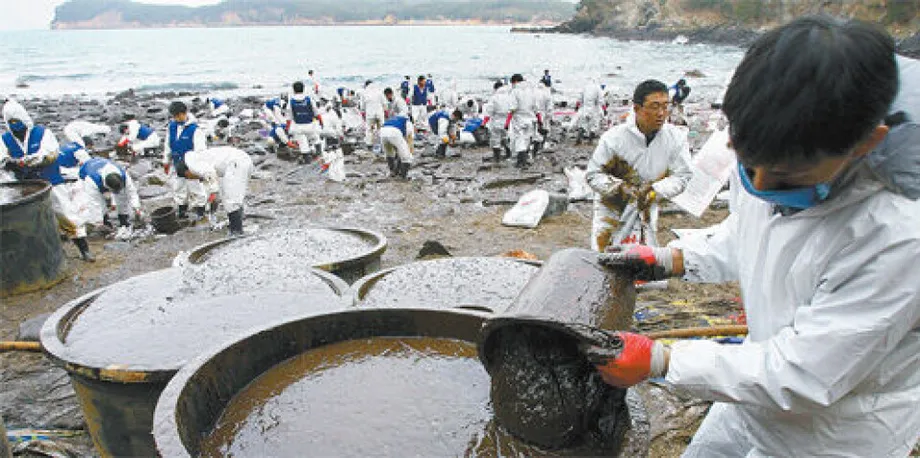
The disaster began on December 7, 2007, when a crane vessel collided with the tanker Hebei Spirit off Taean County in South Chungcheong Province. Most accounts give the oil release as 12,547 kiloliters, equivalent to 12.547 million liters. Another gives 10,900 tons. Those are measurements of volume and mass respectively, and cannot be compared directly without information about the oil's density.
Descriptions of the vessels also differ. Most identify the crane vessel with Samsung Heavy Industries and describe the tanker as Chinese flagged. Another identifies the tanker as registered in Hong Kong and the crane vessel as Samsung No. 1 associated with Samsung C&T. These differences do not alter the issue decided in the fund recovery lawsuit.
The dominant account of the funding agreement is that Samsung Heavy Industries agreed in February 2016 with 11 groups representing affected residents to contribute 290 billion won through the Community Chest of Korea. A separate account describes an earlier November 2013 commitment of 360 billion won. The reports do not establish how that earlier figure relates to the later agreement.
The detailed account of the subsequent donation gives approximately 306.7 billion won as the total designated contribution in 2018. About 104.2 billion won went to the foundation and 202.4 billion won to the cooperative. Those rounded allocations add up to 306.6 billion won, slightly below the reported rounded total.
Some reports describe the 2016 agreement as the donation itself, while the more detailed account places the designated contribution and distribution in 2018. Accounts also differ on whether the organizations were established in 2016 or 2018. They agree that both received their allocations in November 2018.
Two organizations serving different coastal communities
The Hebei Social Cooperative was formed by groups from Taean, Seosan, Seocheon and Dangjin. The West Coast Association Foundation brought together groups from Boryeong, Sinan, Yeonggwang, Hongseong, Gunsan, Buan and Muan. The fund therefore served communities across several coastal areas, rather than Taean alone.
The money was intended to support residents' welfare, community recovery and regional economic activity. It was not simply a budget for immediate oil removal, despite descriptions of the dispute that frame it as missing cleanup money. The allocations reached the organizations almost 11 years after the spill.
The cooperative says it has continued projects including care facility operations and shellfish seed releases. It also says approximately 180 billion won in cash assets has been spread across several financial institutions. These statements are its account of its activities and financial position, not a finding that the court accepted its management as adequate.
The geographic reach of the two organizations also matters to proposals for replacement management. A plan centered on Taean would still need to address the interests of residents in the other communities for which the money was allocated.
What the spending figures reveal
By the end of 2021, the foundation had spent 4.6 billion won out of its approximately 104.2 billion won allocation. Of that expenditure, 3 billion won went to salaries and other institutional operating costs. Using those rounded figures, operating expenses accounted for about 65% of spending, leaving 1.6 billion won for other expenditure.
The cooperative had spent 15.8 billion won out of approximately 202.4 billion won. Most accounts put its operating expenses at 9.4 billion won, or about 59% of its expenditure. Another gives 9.8 billion won. Reports also round its expenditure rate differently, to either 7.7% or 7.8%.
Across both organizations, the commonly reported 2021 figures show 20.4 billion won spent, including 12.4 billion won on operating costs. That means about 61% of recorded spending went toward maintaining the institutions. This is a share of expenditure, not a claim that 61% of the entire donated fund was consumed.
Later figures show more spending but the same imbalance. Ministry of Oceans and Fisheries data obtained by lawmaker Lim Ho-seon put the cooperative's expenditure at 22.6 billion won by the end of 2022, or 11.2% of its allocation. Operating expenses were 12.9 billion won, compared with 9.7 billion won in project spending.
Compared with the end of 2021, the cooperative's cumulative expenditure had risen by 6.8 billion won. Yet operating costs still exceeded project spending by 3.2 billion won. The combined expenditure of both organizations was reported as 28.8 billion won out of 306.7 billion won, or approximately 9.4%, although the report rounded the rate to 9.5%.
Audits exposed problems before the lawsuit
Community objections emerged around 2021. A Boryeong residents' investigation committee challenged the foundation's directors' salaries and recruitment procedures, called for its dissolution and sought the resignation of its leadership. In 2022, it asked the Ministry of Oceans and Fisheries to investigate whether projects were being pursued without sufficient input from affected residents.
The ministry conducted document checks and field inquiries, although an inspection was interrupted when the foundation did not cooperate. Audits and investigations identified improper travel expenses, unnecessary borrowing and delays in establishing the cooperative's general assembly of delegates.
The Board of Audit and Inspection carried out a field audit of the cooperative in 2022. It identified problems in the project delivery structure and a failure to take effective corrective action, and called for a plan that would allow projects to be completed within their allotted period.
One account of earlier audit findings describes 237.33 million won in personnel payments made over nine months to six officials whose terms had expired, as well as 51 million won in improperly paid meeting allowances. Recovery measures were taken over those payments.
Separately, the foundation's chair and secretary general were reported to have been indicted on charges including embezzlement under the Act on the Aggravated Punishment of Specific Economic Crimes. An indictment is an accusation, not a conviction. That criminal case is distinct from the civil decision requiring the return of the allocated money.
The court focused on whether projects could be delivered
The charity notified both organizations in August 2023 that it would recover their remaining allocations. When they contested that decision, it pursued civil litigation. The reported contractual grounds were Article 6, paragraph 2, items 6 and 7 of the allocation agreement, covering stopped projects or an inability to achieve their purpose, and serious problems with project delivery or budget execution.
The donation application dated November 5, 2018, also stated that Samsung Heavy Industries agreed to allow unspent money to be converted into general charitable donations under the Community Chest's internal rules. The ruling should not, however, be read as an announcement of a new distribution plan. No final replacement program is identified.
Seoul Central District Court's Civil Division 31 explained that the foundation's operation appeared to prioritize personnel expenses over completing its intended work:
Rather than completing its intended projects within the project period, the Foundation appears to have operated by using income generated from the allocated funds, such as interest, to cover expenses including personnel costs.
The same court described the cooperative's internal conflicts as an obstacle to effective decision making and project delivery:
Internal divisions rendered the Cooperative's general assembly of delegates unable to function, and serious conflicts both between its headquarters and branches and within the headquarters itself made it impossible to properly carry out the projects.
The court also found the project plans inadequate for the scale of the funds. Its reasoning concerned the organizations' ability to achieve the contractual purpose, rather than requiring a finding that all their money had been stolen.
An appeal follows an unsuccessful mediation attempt
Cooperative chair Guk Eung-bok announced an intention to appeal and denied that the cooperative had embezzled or diverted the fund. He argued that the money had been secured through years of effort by affected residents and said the organization would address the problems for which it had been criticized.
The cooperative attributed some delays to the litigation. The court instead found that its internal condition was the fundamental cause of the stalled work. Reports describe failures to convene a project selection committee, a lack of concrete execution plans and discussion of splitting branches as evidence of those difficulties.
Before judgment, the court proposed mediation involving appointed directors and amendments to the cooperative's articles. The cooperative said its internal procedures, including a delegates' assembly, made rapid acceptance difficult. Mediation ended unsuccessfully on July 23.
The principal dates show how the dispute developed:
- December 7, 2007: The oil spill occurred off Taean.
- February 2016: Samsung Heavy Industries reached the reported 290 billion won agreement with 11 residents' groups.
- November 2018: The two organizations received their allocations.
- 2021 and 2022: Community complaints and official audits examined management and spending.
- August 2023: The Community Chest notified the organizations of recovery.
- December 2023: The civil claim was filed, according to one account.
- July 23, 2026: Mediation failed.
- October 1, 2026: The court issued its ruling.
- October 6, 2026: A former Taean council chair proposed public management of the returned money.
The cooperative has two weeks from service of the judgment to submit an appeal. No service date or appeal hearing date is given. Its announcement therefore establishes an intention to appeal, rather than confirming that an appeal has already been filed.
Residents seek a new management structure
Former Taean County Council chair Kim Jin-kwon proposed a public fund committee at an October 6 press conference. His proposal would bring together the Community Chest, Taean County, the county council, South Chungcheong Province, the Ministry of Oceans and Fisheries, affected residents and specialists.
The committee would discuss preservation of the returned principal and interest, priorities for public benefit projects, resident participation, external audits and disclosure standards. Kim said he would consider a roughly 160 kilometer walk from Taean to the Community Chest if formal discussions failed or were delayed. He also recalled undertaking a walk to Seoul and repeated prostrations in 2012 while seeking Samsung's contribution.
A separate account identifies Park Soo-hyun as South Chungcheong governor and reports that he supported resident control while expressing willingness for provincial intervention and mediation. The same account says the province lacks direct authority to spend the fund. An expression of willingness to intervene is therefore not an approved transfer of financial control.
The immediate unresolved issues are whether the cooperative files its appeal, whether the ministry authorizes disposal of the foundation's basic assets, when money is actually recovered and what arrangement will replace the disputed management. None of the reported proposals constitutes a final spending decision. Residents attending the ruling expressed concern that further proceedings would prolong the wait for assistance.
Key Points
- The detailed return order totals about 285.23 billion won in principal, with late payment damages also ordered.
- The foundation's 98.6 billion won in basic assets requires ministerial approval before repayment.
- At the end of 2021, the organizations had spent only 4.4% and about 7.8% of their allocations.
- Operating costs accounted for approximately 61% of their combined recorded spending that year.
- The court found inadequate project plans and internal governance problems justified recovery.
- The cooperative plans to appeal, but no appeal hearing date is identified.
- A public management committee has been proposed; no replacement distribution plan has been finalized.