
Warnings of a sagging ceiling precede injuries to 38 people
A ceiling collapse that injured 38 people at a sales event in Daegu has exposed two gaps in local safety oversight: a building completed in 1994 was outside mandatory periodic inspection requirements, and the district office did not know the event was taking place. A resident has also alleged that ceiling supports were visibly deteriorating as early as 2019 or 2020.
Contents
- Warnings of a sagging ceiling precede injuries to 38 people
- What fell was the suspended ceiling, not the concrete structure
- A resident describes deterioration years earlier
- A month of sales activity went unreported
- Furniture helped limit injuries during the escape
- A small building outside mandatory periodic checks
- Police examine video, connections and repair records
- The sequence from rental to investigation
- Safety inspections and a dispute over presidential response
- Key Points
The accident happened at about 10:16 a.m. on October 10 on the second floor of a four story building in Gwaneum-dong, Buk-gu. All 66 people present escaped outside. Attendees were predominantly older adults, with accounts describing people in their 60s through 80s.
By the following morning, police had established that 18 people had received hospital treatment and five were hospitalized. No serious or life threatening injuries were reported. The 38 injured people represented about 58% of everyone inside, calculated from the reported attendance of 66.
Investigators believe the collapse began above a stage on the left side of the room when viewed from the entrance, before other ceiling sections fell in sequence. An indoor camera installed by the sales company recorded the accident.
The central question is whether age, faulty construction, excessive weight or failed connections caused the ceiling to fall. Residents' descriptions of earlier damage could become important to the investigation, but they have not yet been established as the cause. Police are examining installation and repair histories, the recovered debris and video evidence before deciding whether anyone should face criminal proceedings.
What fell was the suspended ceiling, not the concrete structure
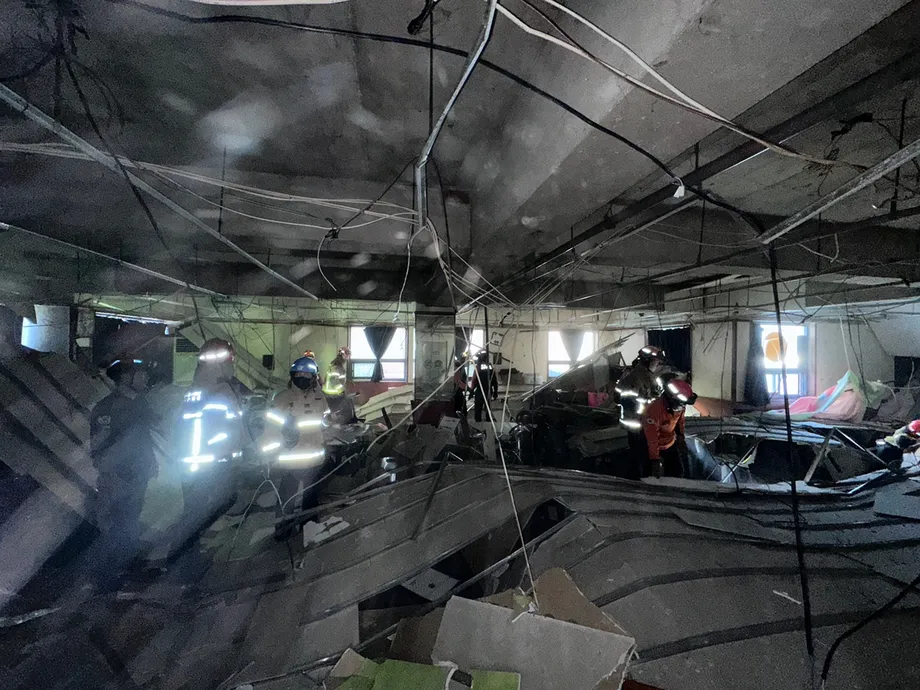
The damaged installation was a suspended ceiling, a surface fitted beneath the building's original ceiling to conceal pipes, wiring and other equipment. Reports describe ceiling panels and their steel support framework falling together. They do not describe the building's concrete structural frame collapsing.
Police identified three layers of finishing material: ceiling tiles known locally as tex, gypsum board and paper based plywood. After those finishes detached, exposed concrete was visible above the room, while boards and metal components lay across the floor and furniture.
That distinction matters for understanding the investigation. A suspended ceiling depends on hangers, frames, clips and other connections to keep its weight securely attached overhead. Investigators must determine which part failed first and whether the installation's condition or construction contributed.
Officers are investigating possible detachment of fixing clips. An administrative official also raised the possibility that aging support wires broke. Neither explanation has been confirmed. One early account described steel clips coming loose near the section farthest from the entrance, while subsequent police accounts focused on the recorded starting point above the stage without declaring a final mechanism.
Park Myeong-ho, head of the Daegu Metropolitan Police Agency's forensic investigation section, said the examination would distinguish between the weight of the materials, structural defects and deterioration. Identifying where the collapse began is therefore only the first step toward establishing why it happened.
A resident describes deterioration years earlier
A 51 year old resident identified by the surname Kim described earlier warning signs at the scene on October 11. The second floor had previously operated as a billiard hall for roughly a decade, and Kim said customers had noticed that parts of the ceiling were sagging.
According to Kim, cables supporting the ceiling were already deteriorating and hanging down in 2019 or 2020. Customers reportedly expressed concern about the bent ceiling and asked whether it needed repairs.
Kim alleged that the billiard hall operator sought repairs involving lightweight steel framing, but the owner resisted because of the cost. Painting and other temporary work were allegedly used to conceal worn areas before the business closed. These are a resident's allegations, not findings announced by police.
Residents believe prolonged vacancy may have meant the ceiling went without repairs, although that remains an assumption requiring maintenance records or other evidence. A billiard hall sign was still attached to the second floor after the accident.
The accounts differ on the precise history of the premises. Several describe a sales event there in March of the previous year followed by about one year and seven months of vacancy. Another places the billiard hall's closure in that March, while residents describe a longer period of little use. Police are checking when the ceiling was installed and what repairs followed, facts needed to resolve those differing descriptions.
A month of sales activity went unreported
The company, identified only as A, rented the second floor from October 3 until November 3. It used the former billiard hall to sell electric blankets, kitchenware and other household goods, attracting attendees with free items including tissues, detergent and eggs.
Buk-gu authorities said the company had not filed a sales business notification with the district office. Officials also said they were unaware that the event was operating before the accident. The same company reportedly held a similar event at the premises for about a month in March of the previous year.
Reports describe comparable temporary sales operations elsewhere in Daegu and across South Korea. Information about such events can circulate through senior centers and welfare facilities, with free goods used to encourage attendance. That description does not establish how each person at this particular event was recruited.
The short rental period and lack of notification help explain why the venue was not visible to local administrators. They do not, by themselves, establish what caused the ceiling to fail or prove that the operator knew it was unsafe. Those issues depend on the investigation into the premises, its management and any safety checks before the event.
Furniture helped limit injuries during the escape
People inside described ceiling sections falling one after another as attendees hurried toward the exit. An attendee in their 70s, identified only as A, gave this account of the moment the materials started falling:
Dozens of elderly people were inside the building when the ceiling finishing materials started pouring down over our heads one after another.
Some falling materials caught on desks and chairs. Hwang Chil-seok, head of incident command at Daegu Gangbuk Fire Station, explained how the furniture helped prevent more serious injuries:
Fortunately, there were desks and chairs under the ceiling tiles, so thanks to that empty space, there were no severe injuries among the casualties.
A nearby laundry operator, identified by the surname Park and described as being in their 50s, said the narrow staircase made evacuation dangerous and recalled seeing an older person bleeding from a head injury. Other accounts describe abrasions sustained during the escape and injuries from falling material.
Fire authorities dispatched 18 vehicles and 55 personnel for rescue and searches. Police and firefighters checked for additional casualties and restricted access around the scene.
Reports differ on the number initially transported to hospital. Most give nine, while one gives 12. An early account also described nine people receiving hospital care, whereas police follow up with injured attendees established that 18 had received treatment by October 11. Those figures describe different measures or reporting stages and should not be treated as interchangeable.
A small building outside mandatory periodic checks
The building received approval for use in 1994 and has a total floor area of 892 square meters. The first two floors were used commercially, while the owner occupied the upper two floors. A food mart on the ground floor had stopped trading at the end of September and was reportedly awaiting removal work.
Buk-gu said the property was not subject to mandatory periodic safety inspections under the applicable building rules. Reports also state that no independent safety inspection had been carried out, although the complete inspection and maintenance history remains part of what investigators need to establish.
The inspection framework described in the reporting covers certain buildings according to size and use, including some collectively owned buildings of at least 3,000 square meters and specified buildings used by large numbers of people. The accident property was less than one third of that floor area, but size is not the only criterion in the rules.
Article 15 of South Korea's Building Management Act allows local authorities to inspect certain small buildings, including qualifying properties more than 30 years past approval for use, where safety weaknesses or disaster risks are judged to exist. Local ordinances help determine the buildings covered. Reports describe this as a discretionary power rather than an automatic inspection duty for every older property.
The practical gap in this case is specific: an aging space outside routine mandatory checks was brought back into use for an event attended by 66 people without the district knowing. Exemption from periodic inspection is not a finding that the ceiling was safe, nor does it settle whether the owner or operator met their responsibilities.
Police examine video, connections and repair records
Daegu police formed a dedicated investigation team of 33 officers led by the head of the metropolitan investigation unit. The team includes officers responsible for serious accident investigations and forensic work.
A joint examination began at about 9 a.m. on October 11, involving the National Forensic Service, Daegu city officials, Buk-gu officials and police forensic personnel. Around 10 representatives participated. Accounts differ on its duration: an initial report said about one hour, while later reports described approximately two hours.
Investigators recovered an indoor camera installed by the sales company and secured surveillance footage from other floors and outside the building. Comparing those recordings with the debris can help reconstruct the sequence and distinguish the first failure from damage caused by the subsequent collapse.
Police are checking construction quality, the condition of supports and fastening components, installation dates, repair work and maintenance. They are considering whether company or building representatives could face allegations of causing injury through occupational negligence. That means investigators would need to establish a failure to exercise required care connected to the injuries, rather than infer guilt from the accident alone.
No suspect had been formally booked at the reporting stage described on October 11. Detailed forensic results were expected to take about two weeks, but no exact publication date was announced.
The sequence from rental to investigation
The reported dates connect the earlier safety concerns, the venue's return to use and the response after the collapse. They also show which parts of the sequence remain disputed or incomplete.
- 1994: The four story, 892 square meter building was approved for use.
- 2019 to 2020: Resident Kim alleges that support cables were deteriorating and sections of ceiling were sagging.
- March of the previous year: The company reportedly held a month of sales events at the same premises.
- October 3: The current rental and household goods sales operation began.
- October 10, about 10:16 a.m.: Ceiling materials collapsed during the event; 66 people escaped and 38 were injured.
- October 11, about 9 a.m.: Police and other agencies began the joint forensic examination.
- About two weeks after the examination: Detailed forensic findings were expected, without a fixed release date.
The claimed gap of roughly one year and seven months between sales events does not establish that no maintenance occurred during that period. Records and testimony will be needed to determine what happened while the room was vacant.
Safety inspections and a dispute over presidential response
Buk-gu planned to inspect ceiling installations on the building's other floors during the week of the October 11 reports. District chief Lee Geun-su said officials would cooperate with police and fire authorities on safety measures and act once the accident circumstances and compliance with safety requirements were established.
Daegu Mayor Choo Kyung-ho visited the scene and announced inspections of aging facilities across the city. Municipal officials discussed the scope and timing of checks with district and county authorities. No completed citywide results or firm schedule were announced in the accounts of the response.
The Korean Red Cross opened a disaster psychological recovery support center nearby. By the morning of October 11, 20 residents had received counseling, extending assistance beyond treatment of physical injuries.
The accident also became the subject of a political dispute. In an October 11 statement, the presidential office said President Lee Jae-myung had visited Taereung golf course with family the previous day and received news of the collapse there. It said he spoke directly with acting National Police Agency commissioner Kim Jong-cheol about casualties and injury severity, then directed agencies to prioritize rescue and a prompt, safe response.
People Power Party lawmaker Joo Jin-woo demanded a detailed account of the president's actions. He claimed Lee left the golf course at 4:49 p.m. and said he held photographs and video of security vehicles. Joo also cited an initial rescue operation ending at 10:40 a.m. and a presidential statement issued at 12:30 p.m. These are his claims; the time of a public statement does not establish when instructions were first given.
The presidential office objected to using a private holiday schedule in political arguments. Democratic Party spokesperson Cho Gye-won, while saying the party had no settled position, suggested golf could relate to prospective diplomacy with US President Donald Trump. Possible golf diplomacy around a December summit was discussed as a justification, not announced as a confirmed engagement. The precise time of Lee's call and instructions was not given.
Key Points
- The October 10 collapse injured 38 of the 66 people attending a household goods sales event in Daegu.
- Eighteen people received hospital treatment and five were hospitalized; no serious injuries were reported.
- Suspended ceiling materials and supports fell, not the building's concrete structural frame.
- A resident alleges visible deterioration in 2019 or 2020, but the cause has not been established.
- The sales event was unreported to Buk-gu, and the building was outside mandatory periodic inspection requirements.
- A 33 officer team is investigating construction, aging components, maintenance and possible negligence.
- Detailed forensic findings were expected in about two weeks, while authorities planned further safety inspections.