
A vast investment meets a dispute over who benefits
Google's planned $15 billion artificial intelligence hub in Visakhapatnam spans more than 600 acres across three sites, with over 260 acres being cleared at Tarluvada alone. The investment is scheduled for 2026 to 2030, and some facilities are expected to begin operating in 2028. For farmers losing their land, however, the immediate change is the disappearance of an income source that supported their families.
Contents
- A vast investment meets a dispute over who benefits
- Compensation does not replace a family livelihood
- The job forecasts measure different things
- Water shortages shape the cooling decision
- Replenishment and drinking water programs need local measures
- Electricity promises extend beyond the server buildings
- The court has not settled the environmental challenge
- The public subsidy package carries unresolved differences
- Cables and community programs widen the investment's reach
- The next milestones are construction, court review and operation
- Key Points
The project has also reached the Andhra Pradesh High Court, which has allowed construction to continue at the developer's own risk and cost while a petition challenging its permissions remains under consideration. That is permission to proceed during litigation, not a final judicial endorsement of the project.
Google's October 2025 announcement describes its largest investment in India to date: a hub combining computing infrastructure, international communications cables and new energy infrastructure. Partners include AdaniConneX and Airtel. The facilities will house servers that run AI systems and other digital services, bringing substantial demands for electricity alongside the promised computing capacity.
Andhra Pradesh sees the development as an anchor for technology businesses and employment. Residents and campaigners question whether those gains will reach communities surrendering farmland or already facing water shortages. The central dispute is therefore about more than the size of the investment. It concerns how permanent jobs, public concessions and resource commitments compare with the losses and risks borne locally.
Compensation does not replace a family livelihood
In Tarluvada, farmer Bali Narasingha Rao said he received 17 lakh rupees, reported as about $25,000, for one acre. He described the land as the basis of his livelihood:
"Our land is gone, and that land was our livelihood," he said.
Farmer Chandala Sadamma received more than $82,000 for two acres of mango and cashew trees. The 50 year old said seeing the cleared plot brought a sense of loss despite the compensation:
I feel like crying.
Those payments concern different plots and cannot establish a standard compensation rate. They do show why a cash settlement and the loss of productive land are separate questions. The state government says new housing is also being built and handed over to people who lived on the project site.
Engineering student Bali Charan Teja had expected to inherit his family's farmland, which has now been sold. He doubts the project will offer much employment to villagers. Farmer Bali Sanyasa Rao similarly describes land as his family's livelihood and security for its children.
Changes extend beyond the acquired plots. E. Ashok Kumar, Visakhapatnam head of the Confederation of Real Estate Developers' Associations of India, says land prices have risen by more than 45% since the city's development plans were unveiled. That increase may benefit property owners, but it does not establish that displaced farmers can buy comparable land or replace their former earnings.
The job forecasts measure different things
Employment estimates vary substantially. One state estimate puts potential indirect employment in related technology industries at up to 150,000, with about 4,000 construction jobs annually. Another government account gives 188,000 direct and indirect jobs. No reconciliation of those totals has been reported, and their differing categories prevent a straightforward comparison.
Google projects approximately $688 million in annual local economic activity. Alexander Smith, its head of infrastructure and energy for Asia Pacific, says a typical development employs about 4,200 construction workers annually over three to five years, followed by hundreds of specialist roles at facilities designed to operate for at least 20 years. Annual construction employment should not be added across years and presented as that many distinct permanent jobs.
Smith also says each job inside a Google data centre supports nine additional jobs in the surrounding community. That is a company estimate of a wider economic effect, not a promise of nine direct Google hires or a guarantee that those positions will go to displaced residents.
Gutta Rohith of the Human Rights Forum argues that the project does not meet the need for broad employment:
We need mass employment and labour-intensive industries, not high-capital industries.
Visakhapatnam MP Sribharat Mathukumilli takes the opposite view, arguing that data centres are necessary for India and could attract banks, financial technology businesses and AI startups. Software developer and entrepreneur Sudeep Pillarisetty hopes the investment will create engineering and data science opportunities, including support for startups developing Indian AI models. Those possible gains depend on businesses growing around the hub, rather than on the operating workforce alone.
Water shortages shape the cooling decision
Residents describe water supplies already strained by a weak monsoon, drought, a receding reservoir and falling groundwater levels. V. Jyothi welcomes the prospect of employment but worries about additional pressure on water. Shopkeeper Gubbala Ramanamma also says shortages are an existing problem, not simply a concern about a future facility.
Reported city figures put supply at about 410 million litres a day against estimated demand of 480 million litres. If those estimates are accurate and comparable, the shortfall is 70 million litres daily, or roughly 15% of demand. The figures are not an independently verified water budget for Google's project, but they help explain the calls for greater scrutiny.
Google says its assessment identified pressure on the local watershed, the area through which water drains into connected rivers, reservoirs and groundwater systems. Smith says that finding shaped the decision to use advanced air cooling rather than water cooling. Google says water consumption will consequently be limited mainly to kitchens and restrooms.
That distinction matters: avoiding water cooling addresses a major potential source of direct consumption. It does not, by itself, establish the project's complete water demand during construction or operation. A quantified campus water budget has not been disclosed in the accounts describing these commitments.
Andhra Pradesh Technology Minister Nara Lokesh has stated that residential demand will take priority:
The water needs of our people will always come first.
Environmental campaigner E.A.S. Sarma, a former senior official in the power and finance ministries, is calling for an independent water audit. Such an audit would allow the promises about household supply and cooling technology to be assessed against actual consumption and the wider city's needs.
Replenishment and drinking water programs need local measures
Google says it is committed to replenishing 120% of the freshwater consumed across its operations by 2030, including consumption for needs other than cooling. The commitment is expressed across its operations, not as a published guarantee that every litre used in Visakhapatnam will be replaced in the same watershed at the same time.
Water replenishment generally means supporting activities that restore or protect water resources. It should not be read as an automatic replacement for municipal supply during a drought. The location, timing and measurable results of those activities matter when judging their benefit to nearby residents.
In its official community impact update, Google says it has partnered with Sponge Collaborative on watershed management, ecosystem restoration and drinking water systems. Planned facilities include reverse osmosis plants, which filter dissolved contaminants, and water dispensing stations described as Water ATMs.
The update acknowledges hydrological stress and coastal sensitivities near the campuses. It does not provide a complete numerical account of expected consumption, replenishment volumes or the delivery dates for each drinking water project. Those details would help distinguish the hub's own resource requirements from the benefits promised through separate community programs.
Electricity promises extend beyond the server buildings
The hub is described as a one gigawatt project, although Google does not disclose detailed power capacity figures for individual sites. A gigawatt equals 1,000 megawatts. Capacity describes the scale of electrical demand or infrastructure, rather than the amount of electricity consumed over a year.
Adani's partnership announcement, dated October 14, 2025, says the investment includes new transmission lines, clean energy generation and energy storage in Andhra Pradesh. AdaniConneX is a joint venture owned equally by Adani Enterprises and EdgeConneX.
Smith says Google fully funds the power infrastructure upgrades it requires and plans additional clean energy projects in Visakhapatnam. He also sets a condition on the company's choice of location:
If there is insufficient power in a location, or if operating a data centre would mean taking power away from a community, Google will either find ways to develop more power, or it will not build there.
The generation mix, delivery schedule and backup arrangements serving the hub have not been fully disclosed. State plans for six nuclear plants of 1.2 gigawatts each would total 7.2 gigawatts, but those proposals should not be treated as power already available or as confirmed dedicated supply for Google.
At an October 10, 2026 discussion in Hyderabad, retired scientist K. Babu Rao raised concerns about backup generators, emissions, heat and noise. Environmentalist Sagar Dhara proposed an environmental assessment led by residents. Their statements express concerns about data centres; they do not establish the equipment configuration or measured emissions of the Visakhapatnam hub. Google separately says sound at the facility boundary will remain below 55 decibels.
The court has not settled the environmental challenge
The High Court proceedings add detail to an earlier account that an August court challenge failed to stop construction. On October 5, 2026, Chief Justice Lisa Gill and Justice Challa Gunaranjan posted a petition challenging the clearances to October 6. The bench said environmental conditions could not be relaxed and directed both sides to submit relevant documents, including responses to opposing claims.
A subsequent reported order allowed Vizag Hyperscale Data Center Park Ltd, an Adani Infra owned development company, to continue at its own risk and cost. The developer cannot rely on money spent while the case is pending as a reason to protect the project from an adverse final decision.
The petition was filed by environmental activist Bolisetty Satyanarayana. His counsel, Virag Gupta, challenged the use of a Category B/B2 classification and cited the site's reported distance of 0.86 kilometres from Kambalakonda Wildlife Sanctuary.
Under India's environmental clearance framework, Category A projects are assessed centrally, while Category B projects are generally handled by state authorities. B2 projects typically do not require a detailed environmental impact assessment. The petitioner questions whether the classification adequately captures the consequences of operating a large data centre. The state defends its assessment under the Building and Construction category, based on built area.
The reported proximity to the sanctuary is a reason raised for closer scrutiny, not proof of ecological damage. No independently confirmed harm to the sanctuary is established in the reports. Another court account identifies Alphabet subsidiary Raiden Infotech Pvt. Ltd. in the clearance challenge, while the continuation order concerns the Adani development vehicle. The corporate roles should not be treated as interchangeable.
The litigation also concerns 160 acres belonging to Simhachalam Devasthanam. The petitioner challenges the arrangement; the state says the land was leased through the Andhra Pradesh Industrial Infrastructure Corporation, not transferred, and generates about 26 crore rupees annually for the temple.
The public subsidy package carries unresolved differences
Detailed reporting on the incentives describes a 25% land price discount on 480 acres, a 25% discount on industrial water, an electricity duty exemption, a one rupee electricity tariff discount and reimbursement of State Goods and Services Tax during construction, capped at 2,245 crore rupees.
That account puts electricity concessions at about 15 years and water concessions at 10 years. Other reporting describes reduced water and electricity tariffs for 10 years. The difference in electricity duration has not been reconciled.
The same incentives account describes an 87,520 crore rupee, or $10 billion, data centre investment, while Google's official announcement gives $15 billion for the broader hub, including energy and connectivity infrastructure. These may reflect different scopes, but no explicit reconciliation is given. Similarly, the 480 acres covered by the reported land discount should not automatically be equated with the more than 600 acres across all three sites.
The reported tax reimbursement cap is about 2.6% of the stated 87,520 crore rupee investment. It is a ceiling, not proof that the full amount will be paid. Karnataka IT Minister Priyank Kharge has questioned Andhra Pradesh's ability to afford the concessions. Comparisons with Karnataka include its reported 10% land subsidy outside Bengaluru Urban, capped at 10 acres, illustrating differences in both subsidy rates and eligible land.
Community organizer Deeksha Vanguru argues that public resources should first address needs such as schools and hospitals. State supporters maintain that the concessions will yield lasting economic value. A full assessment would require actual subsidy costs and public revenues, not investment and employment forecasts alone.
Cables and community programs widen the investment's reach
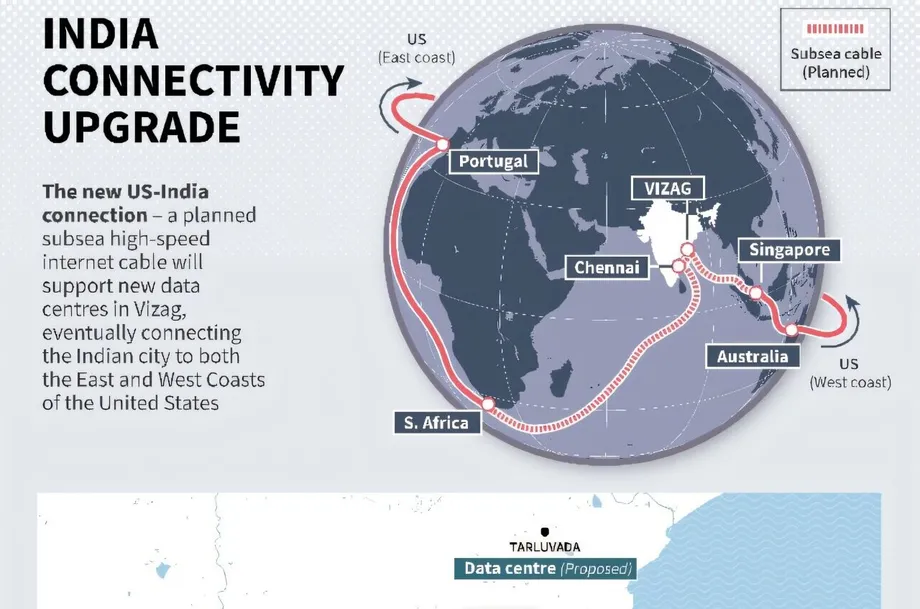
Google's official plans include a new international subsea gateway in Visakhapatnam, adding cable routes to complement existing landings around Mumbai and Chennai. Reports describe three cables being laid near the coast, while Google's announcements refer more broadly to multiple international cables. Smith says connections toward South Africa and Australia could make Andhra Pradesh India's third major subsea hub.
Separate routes can improve network resilience by reducing dependence on a single cable corridor. That connectivity is a concrete element of the investment beyond the data centre buildings. Google also cites a commissioned Access Partnership analysis projecting at least $15 billion in American gross domestic product over 2026 to 2030. That forecast measures activity in the United States and must not be presented as income for Visakhapatnam residents.
Locally, Google says its Sambhav Foundation partnership aims to provide navigation and weather tools and training to more than 1,000 fishers. Its NARI Shakti program targets support for more than 10,000 women building small businesses. Training partnerships aim to reach over 1,000 local workers and more than 1,200 students and educators, while the Google Udaan India Fund will support community projects through grants.
These are program targets, not completed employment outcomes. Google also proposes an AI Corridor with local procurement. Meanwhile, an $11 billion AI data centre investment by Reliance Industries, Brookfield and Digital Realty shows why campaigners are seeking a pause on new approvals across Andhra Pradesh until independent environmental and social assessments are published. Their concern extends to the combined demands of several developments.
The next milestones are construction, court review and operation
The project combines a fixed investment period with unresolved legal and resource questions. Its principal reported milestones are:
- October 14, 2025: Google and Adani announced the partnership and the planned 2026 to 2030 investment.
- April groundbreaking: construction was formally launched, with state support and community programs outlined.
- August court challenge: an earlier attempt to stop work did not halt construction.
- October 5, 2026: the High Court listed the clearance challenge for October 6 and required relevant documents from both sides.
- Subsequent court order: work was allowed to continue at the developer's own risk and cost.
- 2028: some facilities are expected to begin operating.
- 2030: the announced investment period ends, and Google's water replenishment target falls due.
No final judgment or next confirmed hearing date is identified in the reported proceedings. The unresolved measures include the campus water budget, its electricity supply mix, final subsidy expenditure and the share of lasting employment reaching nearby communities. Those figures will determine how the investment's promises compare with its local costs.
Key Points
- Google plans a $15 billion AI hub investment in Visakhapatnam over 2026 to 2030.
- The development spans more than 600 acres, with some facilities expected to operate in 2028.
- Farmers say compensation has not resolved the loss of livelihoods and family security.
- Google says air cooling will limit water use and that it will fund required power infrastructure upgrades.
- Large employment forecasts include indirect jobs; permanent facility roles are expected to number in the hundreds.
- Construction can continue at the developer's own risk while the environmental petition remains pending.
- Water demand, power supply details and the final cost of public concessions remain unresolved.