
Johor incident triggers registration halt and fresh recall
Malaysia's Road Transport Department (JPJ) has suspended Vehicle Type Approval for potentially affected Chery Omoda 5 models and variants, halting new registrations while it investigates a rear axle detachment in Johor Bahru. Chery Auto Malaysia's recall statement, dated 11 October 2026, covers affected vehicles in the C and H variants and promises inspections and necessary component replacement free of charge.
Contents
- Johor incident triggers registration halt and fresh recall
- What the suspension means for owners and buyers
- Chery offers inspections and replacement at no cost
- How owners can check their vehicle
- JPJ will examine factories, suppliers and weld inspections
- What happened during the 2024 campaign
- Inspection progress does not establish this car's history
- Why the suspension design matters
- The sequence and the decisions still pending
- Key Points
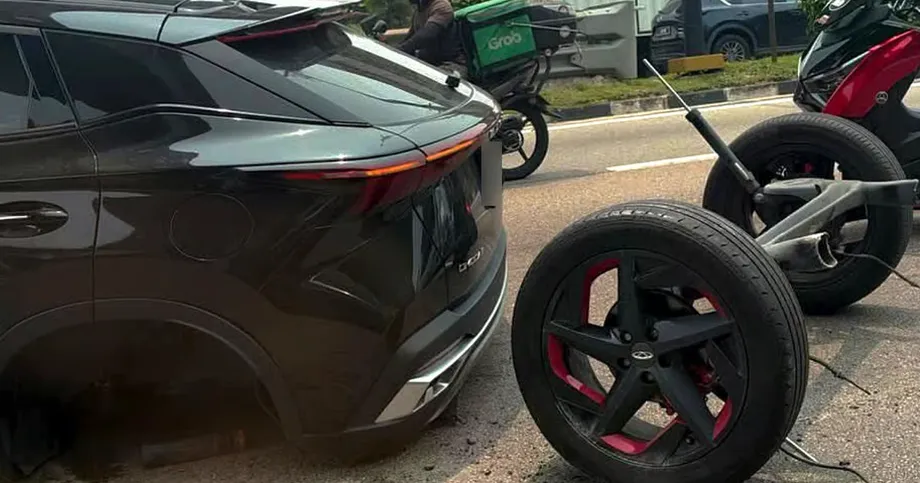
The incident occurred on 6 October on Jalan Pandan near AEON Mall Tebrau City. Photographs and video showed a black Omoda 5, registration JWL 2862, stranded with its rear suspension assembly and both rear wheels separated from the vehicle. No injuries were reported.
The failure follows an April 2024 incident that led to a recall of 600 Omoda 5 vehicles. Chery attributed that earlier defect to improperly calibrated welding equipment at an overseas component supplier. Whether the latest vehicle belonged to that recall, underwent an inspection or suffered the same defect has not been established.
JPJ director general Aedy Fadly Ramli said the department would examine the production and assembly process and relevant axle suppliers. Approval will remain suspended until corrective and preventive measures are completed and JPJ provides technical confirmation that the safety risks have been addressed.
What the suspension means for owners and buyers
Vehicle Type Approval, commonly shortened to VTA, is the approval governing a vehicle model's technical compliance before registration. Suspending it stops new registrations within the affected scope while the regulator investigates. Aedy said the action would target models and variants potentially involved, rather than automatically extend to every vehicle carrying a related Chery name.
The registration restriction and the recall serve different purposes. The restriction prevents further affected vehicles from being registered. The recall brings vehicles already with customers into the inspection and repair process. The announcement does not state that all existing Omoda 5 registrations have been cancelled.
Aedy described the conditions for restoring approval in JPJ's statement:
The suspension will only be lifted once all corrective and preventive measures have been fully implemented and RTD has confirmed that all safety risks have been adequately addressed.
No date has been announced for lifting the suspension. Completing the investigation alone will not meet the stated conditions: Chery must also carry out the required remedies, and JPJ must confirm that those measures address the risks.
Chery offers inspections and replacement at no cost
In its official recall statement, Chery Auto Malaysia said it had been working closely with JPJ since the incident was first reported. The company identified affected Omoda 5 C and H variants but did not publish a total number of vehicles covered by the new campaign.
Chery Auto Malaysia set out the inspection and repair commitment in that statement:
Customers will receive comprehensive vehicle inspections and any necessary follow-up actions including replacement of the component is free of charge.
The wording does not promise automatic replacement for every vehicle inspected. It provides for replacement where necessary, with the inspection determining the required action. Chery also encouraged any Omoda 5 owner seeking reassurance to visit an authorised service centre.
Some initial reports said Chery had not yet addressed the latest incident. Its subsequent statement on 11 October confirms that a recall campaign is beginning, although it does not provide a technical explanation for the detachment.
How owners can check their vehicle
Owners can use the Vehicle Identification Number (VIN) to check eligibility through Chery's website, on its Product Update page. The VIN identifies an individual vehicle, allowing the manufacturer to connect it with production records and the components fitted during assembly.
Reported VIN locations include a label visible through the front windscreen at the top left of the instrument cluster, a label on the hood, a stamping beneath the driver's seat and a marking at the back door. Owners should use their own vehicle's number rather than assume that a matching model or variant confirms recall eligibility.
For questions about the current campaign, Chery gives the Careline number 03-9388 0888. That is the number in its October 2026 statement; reports about the 2024 campaign carried a different contact number. Owners can also approach an authorised service centre for assistance.
JPJ will examine factories, suppliers and weld inspections
JPJ has instructed Chery to identify potentially affected vehicles using part numbers, production batches, VINs and other relevant technical information. That approach should connect individual cars to particular components and manufacturing periods, rather than rely solely on the model name.
The technical audit will cover the Omoda 5 production and assembly lines and relevant axle component suppliers. Its scope includes Good Manufacturing Practice, quality control systems, procedures for inspecting welded joints and the safety of the components used.
Good Manufacturing Practice refers to controlled production procedures intended to make manufacturing consistent and traceable. In this investigation, the issue is whether the processes that produce, inspect and assemble axle components can reliably detect a defect before a vehicle reaches a customer.
Aedy said JPJ required all vehicles identified as posing a risk to be recalled for inspection and appropriate correction. He also said manufacturers were responsible for ensuring that every vehicle marketed met the prescribed safety standards and technical requirements. The audit therefore extends beyond repairing the car involved in the incident to examining how potentially unsafe parts could enter production.
What happened during the 2024 campaign
The earlier rear axle failure occurred on 28 April 2024 while an Omoda 5 was moving slowly in traffic. Chery announced a precautionary recall of 600 vehicles on 30 April. JPJ summoned the company to investigate and provide further information, then issued a recall notice effective 3 May.
At a technical briefing in May 2024, Chery Auto Malaysia vice president Lee Wen Hsiang attributed the defect to an equipment calibration problem at an overseas supplier. An automated welding tip had been replaced during maintenance, but improper recalibration resulted in incomplete weld penetration on affected rear axle beams.
Weld penetration describes how deeply a weld joins the metal parts. An incomplete weld may leave a joint without the intended strength. That explanation belongs to the 2024 investigation and has not been confirmed as the cause of the October 2026 failure.
Chery said 60 vehicles had received affected components manufactured on 15 August 2023. The wider 600 vehicle campaign covered rear axles produced from 14 to 17 August. The identified group of 60 was therefore 10% of the inspection population, showing that the precautionary campaign extended beyond the specific production day linked to the known defect.
Inspection progress does not establish this car's history
By 24 May 2024, Chery said it had contacted all 600 targeted customers and inspected 92% of the vehicles. Applied to the campaign total, that percentage represents approximately 552 inspections, with approximately 48 still outstanding at that point. It does not establish the campaign's final completion rate.
There is no verified confirmation that JWL 2862 was among those 600 vehicles, whether it was inspected or whether it was manufactured outside the earlier component window. Its production date and service history are also unverified.
The photographs establish the scale of the separation but cannot identify where it began. Investigators still need to determine whether the initial failure occurred at a mounting point, within the transverse beam or at another component connection. Images also show damage to the rear passenger door on the right side, but its connection to the detachment is unclear.
Those gaps prevent a firm conclusion that the earlier repair programme failed, that an uninspected vehicle was involved or that a separate defect exists. Each possibility requires vehicle records and physical examination, rather than a visual comparison of the two incidents.
Why the suspension design matters
The recall concerns the Omoda 5 before its facelift. Malaysian versions described in the earlier campaign use a 1.5 litre turbocharged engine, front wheel drive, a continuously variable transmission and torsion beam rear suspension. A torsion beam connects the rear wheels through a transverse structure that twists as the suspension moves.
The replacement model, called Chery 05, and the electric Omoda E5 use a different rear arrangement with multiple links controlling wheel movement. The reported Chery 05 launch was in September before the latest incident. The original Omoda 5 launched in July 2023.
All three models are locally assembled at Inokom's plant in Kulim, Kedah. Sharing an assembly location does not establish that they share the component under investigation. Their different suspension arrangements mean the Omoda 5 recall should not automatically be applied to the Chery 05 or Omoda E5. Eligibility must follow the campaign's technical scope and vehicle records.
The sequence and the decisions still pending
The two incidents have produced separate recall actions, with the latest also bringing a suspension of approval and new registrations. The main dates are:
- July 2023: The Omoda 5 launches in Malaysia.
- 28 April 2024: An Omoda 5 suffers a rear axle failure while moving in traffic.
- 30 April 2024: Chery announces a precautionary recall of 600 vehicles.
- 3 May 2024: JPJ's recall notice takes effect.
- 24 May 2024: Chery reports that 92% of the targeted vehicles have been inspected.
- 6 October 2026: Another Omoda 5 suffers rear suspension separation in Johor Bahru.
- 11 October 2026: Chery issues its new recall statement as JPJ's approval suspension is reported.
The new campaign's vehicle count, affected production dates and confirmed failure mechanism have not been announced. There is also no published deadline for completing the audit, finishing the recall or restoring approval. The next decisive steps are identifying the affected vehicles, establishing the cause, carrying out repairs and securing JPJ's technical confirmation.
Key Points
- JPJ has suspended approval and halted new registrations within the potentially affected Omoda 5 scope.
- The 6 October Johor Bahru incident involved vehicle JWL 2862. No injuries were reported.
- Chery's new recall covers affected C and H variants, with inspections and necessary replacement free of charge.
- Owners can check eligibility by VIN and contact Chery at 03-9388 0888.
- The 2024 campaign covered 600 vehicles, but the latest vehicle's connection to that campaign is unverified.
- Approval will return only after corrective and preventive action and JPJ confirmation that safety risks have been addressed.