
A new weapon reaches a key test milestone
South Korea says it has successfully flight-tested its first domestically developed hypersonic glide vehicle, a weapon designed to travel at more than five times the speed of sound while changing course in flight. President Lee Jae Myung watched the test, which officials described as a step toward a new conventional deterrent for the Korean Peninsula.
Contents
The vehicle rose to a planned altitude on a booster rocket, separated from it, then descended and maneuvered both vertically and horizontally before striking its designated target. The test was conducted by South Korea's Agency for Defense Development. Officials did not publicly identify the location, though a report said the launch took place from a barge at a test facility in Taean, south of Seoul.
The test demonstrated that the vehicle completed a planned flight under hypersonic conditions. It did not establish that the weapon is ready for operational use. South Korean officials said the system remains under development and described the launch as a test of core technologies, including heat protection, guidance and control, and low-altitude maneuvering.
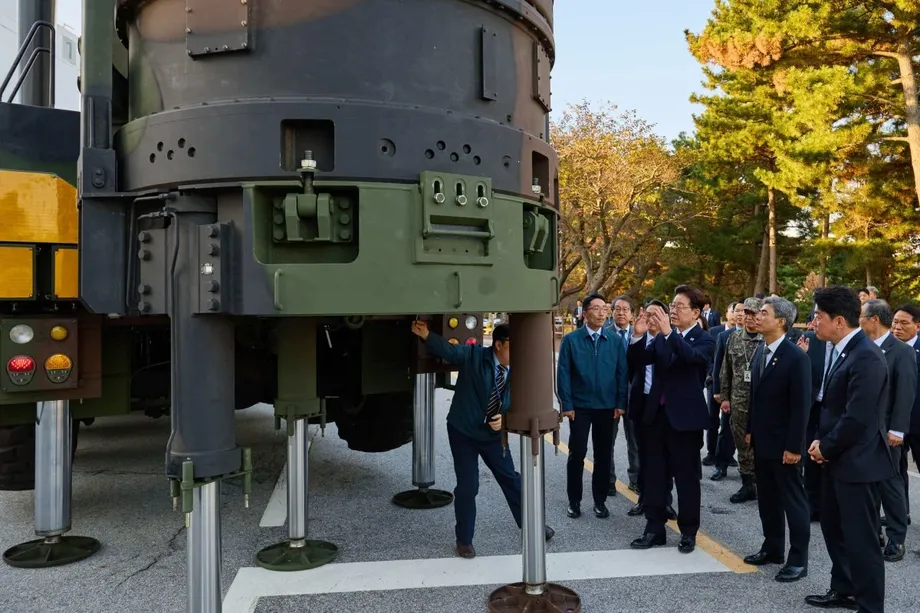
Lee called for continued work toward development and deployment, saying the country must protect its security through its own strength. After watching the test, he also inspected the Hyunmoo-5, a powerful South Korean ballistic missile designed to strike hardened and underground targets.
What makes a glide vehicle different?
Hypersonic refers to speeds of at least Mach 5, or five times the speed of sound. Speed alone does not distinguish these weapons from every other missile. The defining feature of a hypersonic glide vehicle is its flight profile: a rocket booster carries it to high altitude, then the vehicle separates and glides toward its target while retaining the ability to maneuver.
That differs from a conventional ballistic missile, which follows a more predictable arc after launch. A glider can travel at lower altitudes and change direction, potentially complicating detection, tracking and interception. Those characteristics are the basis for South Korea's claim that the weapon could strike targets by surprise. They do not make it impossible to detect or stop: performance depends on the weapon's actual flight, sensors, warning time and the defenses available to the target.
South Korea said Thursday's trial was intended to test whether the vehicle could withstand the intense heat of hypersonic flight, follow guidance commands and make irregular maneuvers at low altitude. These are demanding engineering problems. At very high speeds, friction with the atmosphere heats the vehicle's surface, while rapid maneuvering requires control systems to remain reliable under severe conditions.
The announced target strike is a meaningful development milestone, but a single test cannot show how consistently the system would perform across different conditions. Further trials, integration with operational forces and decisions about production would be needed before it could be treated as a fielded weapon.
A test amid rising tensions
The launch took place against a backdrop of renewed friction between the two Koreas. North Korea conducted its own hypersonic missile test in the days before South Korea's trial. Pyongyang said its missile flew more than 1,000 kilometers and used artificial intelligence to support its flight, while South Korean and Japanese estimates were shorter. Japan said the missile landed outside its exclusive economic zone, in waters near the country.
The differences in reported distance became part of the dispute. Kim Yo Jong, the North Korean leader's sister, argued that differing estimates showed Seoul and Tokyo could not track the missile accurately enough to intercept it. South Korea and the United States said the missile could be detected and intercepted with the allies' existing defense systems. Public claims by either side do not, on their own, establish how a real interception would perform.
Border incidents have added to the strain. Three South Korean soldiers were injured in land mine explosions near the heavily armed inter-Korean border. South Korea's military and the U.S.-led United Nations Command concluded that mines planted by North Korean troops caused the blasts. Pyongyang denied responsibility, and tensions rose as Seoul considered responses. The test was widely viewed in South Korea as part of a broader show of resolve, although the presidential office did not directly describe it as retaliation for the incident.
North Korea has expanded its weapons testing as leader Kim Jong Un advances the country's nuclear and missile programs. Diplomatic efforts with Washington have also stalled since talks broke down in 2019. Pyongyang has called for the United States to end what it describes as a hostile policy and to drop denuclearization as a condition for negotiations.
Lee's message on self-reliant defense
Lee's appearance at the test gave the event unusual political visibility. His office said national security should be secured through South Korea's own strength and pledged government support for advanced weapons development. The president has also called for stronger conventional forces while pursuing a greater South Korean role in the alliance with the United States.
South Korea and the United States maintain a combined defense structure, but wartime operational control of South Korean forces remains with the U.S.-led Combined Forces Command. Seoul regained peacetime operational control in 1994 and is working toward a conditions-based transfer of wartime authority. Lee has pledged to complete that transfer during his term, which ends in 2030.
South Korean military officials have identified high-yield missiles and medium-altitude reconnaissance aircraft among capabilities needed to support a South Korean-led defense posture. A hypersonic weapon could add another means of striking time-sensitive or heavily defended targets, alongside the country's existing ballistic and cruise missiles. The test therefore connects a specific weapons program to Seoul's wider effort to build capabilities it considers necessary for greater operational independence.
That effort does not mean the U.S. alliance is being abandoned. South Korea continues to rely on cooperation with Washington for deterrence and defense, even as Lee has advocated reducing dependence in some areas. The balance between national capability and alliance coordination is a central part of the country's security policy.
Deterrence and the risk of escalation
South Korean officials describe the glide vehicle as a deterrent: a capability intended to discourage an adversary from attacking by making the potential cost of aggression higher. A weapon able to maneuver quickly toward important targets could complicate an opponent's planning. Its value would depend on whether it can be produced, deployed, controlled and used reliably, not just on its speed.
New strike capabilities can also intensify regional competition. North Korea may treat South Korea's program as evidence of a growing threat, just as Seoul views Pyongyang's missile tests as a reason to strengthen defenses. That dynamic can encourage further testing and investment on both sides. The situation is particularly sensitive because the two Koreas remain technically at war, with the 1953 armistice stopping large-scale fighting without replacing it with a peace treaty.
Officials have not released details such as the test's precise range, the vehicle's dimensions or its intended deployment schedule. Without those figures, it is not possible to assess the system's eventual reach or operational role. The public account establishes that the test vehicle separated, maneuvered and hit a target, while leaving important questions about the program's maturity unanswered.
What comes next for the program?
South Korea's statements point to further refinement before the glide vehicle becomes a dependable strategic asset. Development would likely require repeated trials to confirm that its heat-resistant materials and guidance systems work consistently, as well as work to connect the weapon to the military's command and targeting systems. Officials have not announced a timeline for deployment.
The test is also part of a wider modernization effort that includes the Hyunmoo-5 and plans for other advanced systems. Lee's inspection of that missile alongside the HGV trial underscored the government's focus on conventional strike power, even as the North Korean threat includes nuclear weapons. South Korea presents these weapons as tools for deterrence, while their role in a crisis would depend on decisions by political and military leaders.
For now, the successful flight is best understood as a technical milestone rather than proof of a fully operational weapon. It shows that South Korea has demonstrated key elements of a domestically developed hypersonic glide system at a time of heightened tension, while the schedule, capabilities and future deployment of the program remain undisclosed.
Key Points
- South Korea's first domestically developed hypersonic glide vehicle completed a test flight and hit its designated target.
- The vehicle separated from a booster, then maneuvered vertically and horizontally at hypersonic speed.
- Officials said the test examined heat protection, guidance, control and low-altitude maneuvering.
- The weapon remains under development; no operational deployment date was announced.
- The launch followed a North Korean hypersonic missile test and came amid heightened border tensions.
- President Lee linked the program to stronger conventional defense capabilities and greater self-reliance.