

Human judgment remains central as courts consider AI
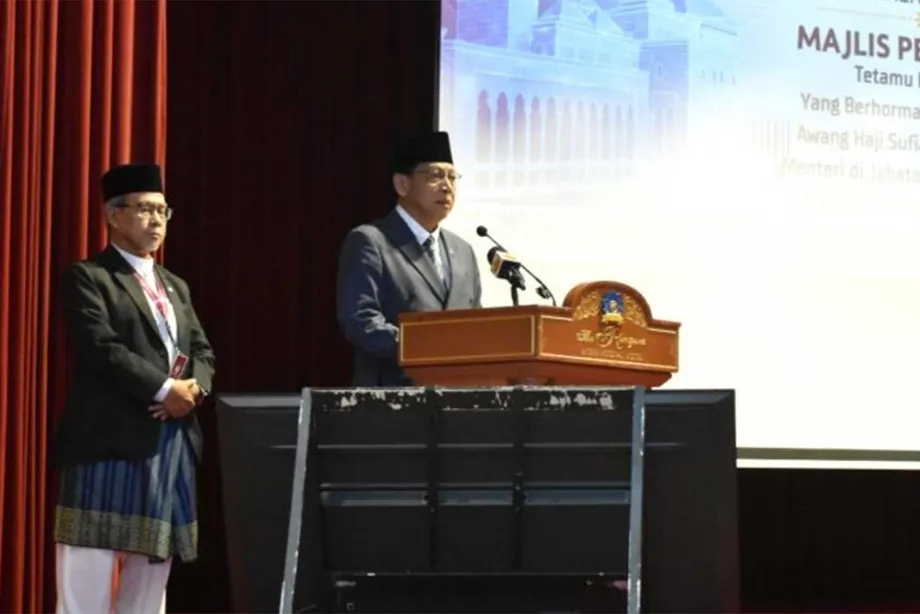
Artificial intelligence could help Brunei’s Syariah Courts manage cases, research legal questions and deliver services faster, but judges must retain authority over every decision, Minister at the Prime Minister’s Office (Security and Law) Dato Seri Setia Awang Haji Sufian bin Haji Sabtu said at a regional legal conference in Gadong.
Contents
- Human judgment remains central as courts consider AI
- What can AI contribute to court work?
- Why accuracy and privacy are major concerns
- Brunei’s policies set a starting point
- Legal rules may need to keep pace
- Regional cooperation and training on the agenda
- Public confidence depends on accountable use
- Key Points
Speaking at the opening of the fourth Nusantara Syariah Judicial and Legal Conference 2026, the minister said AI should be treated as an assistive tool, not a substitute for human judgment. Outputs such as case summaries, legal references, translations and draft documents must be checked and verified by responsible court personnel before use, particularly when people’s rights are at stake.
Responsibility for court decisions, he said, must remain with people. Judicial assessment, ijtihad and final rulings belong to judges. Ijtihad refers to reasoned interpretation by qualified scholars or judges when applying Islamic legal principles to questions that require considered judgment.
The conference, hosted in Brunei for the first time at The Rizqun International Hotel, brings together delegates and speakers from Brunei, Malaysia, Indonesia and Singapore. Previous editions were hosted by Malaysia in 2016, 2020 and 2023. Participants are discussing legal practice and the future development of Syariah justice across the region.
AI’s appeal for courts is practical. It may help staff organize files, find relevant material and handle routine administrative work, potentially shortening delays and making services easier to access. Brunei’s Syariah Courts have already taken steps toward digital services through the e-Syariah system. AI could build on that digital infrastructure, provided its use is governed and supervised.
What can AI contribute to court work?
In legal settings, AI tools can process large volumes of text and generate summaries, translations or draft responses. Used carefully, such functions may help court officers locate information and manage workloads. They do not, however, establish that a legal claim is correct or that a document is authentic. A fluent answer can still contain errors.
That distinction matters in court, where a mistaken citation or an incomplete summary could affect how a matter is understood. The minister warned that AI systems can produce convincing but inaccurate information, including references to cases or sources that do not exist. Verification against authoritative legal records remains necessary.
Speed also does not remove the need for legal reasoning. A judge must weigh the facts, the applicable law and the arguments presented by the parties. An AI system can assist with information handling, but it cannot take responsibility for the consequences of a ruling. Human review is therefore more than a final formality: it is the point at which an accountable officer tests whether generated material is reliable and appropriate.
Why accuracy and privacy are major concerns
Syariah Court matters, particularly family cases, may contain highly personal details. Information about relationships, children, finances or private disputes requires careful protection. Feeding such records into an AI service without adequate safeguards could expose information beyond the court’s intended use. Court policies will need to address what data tools may process, who can access it and how it is retained.
The minister also highlighted fabricated content, including deepfake audio, images and video. Deepfakes are media generated or altered with AI to make it appear that a person said or did something they did not. Their growing availability can make it harder to assess whether digital material is genuine, especially when a recording is offered as evidence.
Brunei’s minister also pointed to the misuse of similar technology in online scams and cross-border crime. For courts, the challenge is not simply whether a file looks persuasive. The court may need to consider where it came from, whether it has been altered and what other evidence supports it. These questions concern authentication, the process of establishing that evidence is what its proponent claims it to be.
Digital evidence is not automatically unreliable, just as a video or document is not automatically authentic. Courts need procedures that allow the parties to challenge material and judges to assess its weight. Existing rules may need review to ensure they address AI-generated and manipulated content as well as other forms of digital evidence.
Brunei’s policies set a starting point
Brunei has issued national guidance on responsible AI use. The Authority for Info-communications Technology Industry of Brunei Darussalam published the Brunei Darussalam AI Governance and Ethics Guidelines in 2025. A second edition, issued this year, includes guidance on generative AI, the type of system that produces new text, images or other content in response to prompts.
The Personal Data Protection Order 2025 also strengthens protections for personal information. The minister said civil courts issued guidelines for judicial officers on AI use in 2025, while guidance for court users is being developed. He called for the experience of civil and Syariah courts to be shared, while noting that other countries in the region are pursuing related initiatives.
National guidance provides a foundation, but courts also need rules suited to judicial work. Clear standards could specify which tasks may use AI, what level of human checking is required, how sensitive case information must be handled and how errors or misuse should be reported. They must also fit Islamic legal principles and applicable national and regional frameworks.
Legal rules may need to keep pace
The minister called for an examination of whether Brunei’s existing Syariah procedural and evidentiary laws adequately cover digital evidence and content generated or manipulated by AI. Procedural rules govern how cases move through court, while evidentiary rules address what material may be presented and how it is assessed.
Reviewing those rules does not mean that AI evidence should automatically be accepted or excluded. It means establishing a sound basis for handling it: how authenticity can be tested, what information parties should receive and how judges can distinguish reliable material from fabricated or altered content.
The work will require coordination among the Syariah Courts, the Attorney General’s Chambers, the State Mufti Department and other relevant agencies. The minister linked that cooperation to Brunei Vision 2035 and the country’s Malay Islamic Monarchy values. Shared work across legal, religious and technical institutions can help ensure that court practices are both practically workable and consistent with the frameworks governing Brunei.
Regional cooperation and training on the agenda
The Nusantara conference gives officials from four countries a forum to compare approaches. Differences in legal systems mean that one country’s rules cannot simply be transferred to another. Still, participants can discuss common safeguards, share lessons from AI use and identify areas where cooperation would help.
The minister expressed hope that the meeting would produce practical recommendations, including common principles for ethical AI use in Syariah justice. He also called for greater cooperation in training and sharing expertise, with AI literacy for judges, registrars and court officers among the priorities.
That training would help court personnel recognize when a system may be unreliable, check generated citations and summaries, and protect confidential information. It would also clarify that responsibility remains with the official who uses an AI-generated output. Without those skills and safeguards, faster processing could come at the cost of accuracy or public trust.
Public confidence depends on accountable use
The debate in Brunei reflects a wider challenge for courts adopting new technology: making services more efficient without weakening the principles that give judicial decisions legitimacy. AI may support administrative and research tasks, but legal authority still rests with human judges who can explain and answer for their decisions.
For the Syariah judiciary, that balance includes protecting private information, scrutinizing digital evidence and ensuring that technology is used consistently with Islamic law. Regional cooperation could help develop practical standards, while local laws and institutions remain responsible for applying them.
Key Points
- Brunei’s Syariah Courts may use AI to support case management, legal research and public services, but not to replace judges.
- AI-generated summaries, citations, translations and drafts must be reviewed and verified by responsible personnel.
- Key concerns include fabricated legal references, exposure of sensitive family-case information and deepfake evidence.
- Brunei’s AI governance guidelines and Personal Data Protection Order provide a policy foundation, while Syariah evidence and procedure laws may need review.
- The regional conference is seeking practical principles and stronger training and cooperation among Syariah court officials.