
Threads connecting Laos and Palestine
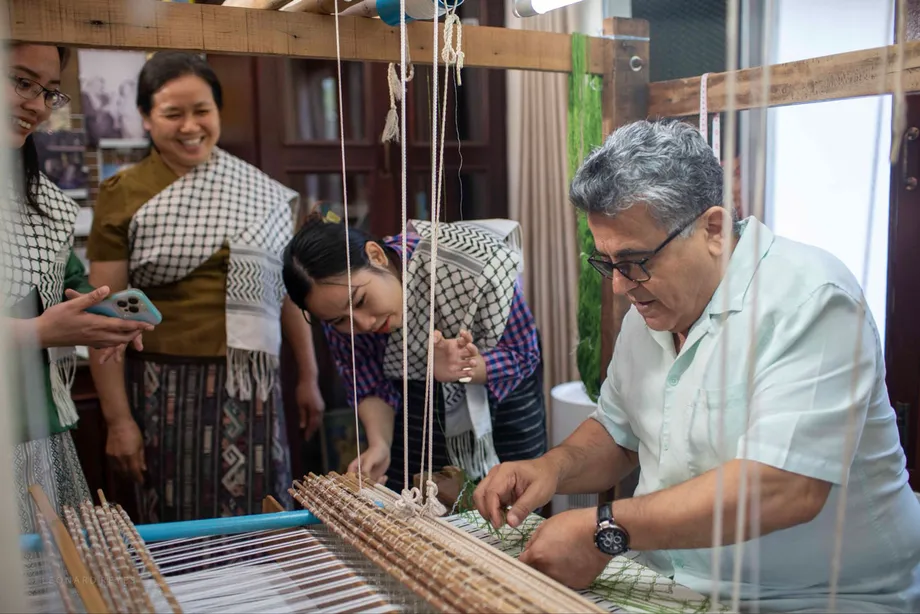
In a Vientiane weaving room, silk threads bring together two traditions shaped by endurance. A small group of Lao weavers is making Palestinian keffiyehs by hand, combining the familiar fishnet motif with the naga, a serpent symbol rooted in Lao culture. Each piece can take more than a month to finish.
Contents
The project, called The Silk Keffiyeh, began in December 2024. Its founders, Souvixada Somsacksy and her godmother, master weaver Bouakham Phengmixay, known as Mae, hope to support Palestinians while building a worker-led livelihood for Lao textile makers. The work also gives younger people a chance to learn a craft that has become less common as factory employment has drawn weavers away from traditional production.
The keffiyeh is a square scarf associated with Palestinian identity and heritage. Its fishnet pattern is commonly linked to Palestinian ties to the sea and coastal life. In the Lao silk version, that pattern interlocks with the naga, a mythic serpent that holds a prominent place in Lao cultural traditions.
Somsacksy describes the naga as a protector in traditional stories. In one account, it wrapped itself around Lao people during past Siamese conquests and shared weaving knowledge with them. The pairing makes the scarf more than a reproduction: it places symbols from two cultures in a single textile, while keeping each tradition visible.
How is each scarf made?
The keffiyehs are woven from traditional Lao silk, a process that calls for time and practiced skill. The team produces them by hand, and a single scarf often takes over a month to complete. That slow pace reflects the complexity of the work and the founders’ aim to preserve weaving as a skilled occupation rather than reduce it to a factory-made commodity.
Mae brings decades of experience to the project. Before joining the residency, she spent more than 30 years working in a textile factory. She is now passing her knowledge to younger generations, including through a full-time residency where participants can learn traditional Lao textile weaving.
The residency is part of a broader effort to create a sustainable career for experienced weavers. Somsacksy has said the long-term goal is for Mae to teach weaving as paid, ongoing work, and for other lifetime weavers to have similar opportunities. The project has faced financial difficulties, but recently hired another full-time weaver, Maiphon Vivongxay, known as Pa Mai, who also worked in a textile factory.
Alongside the residency, the group holds weekly activities, including tatreez embroidery circles. Tatreez is a Palestinian embroidery tradition in which patterns and motifs can carry cultural meaning and reflect regional styles. By bringing Lao and Palestinian designs together in these gatherings, the project creates a place for cultural exchange as well as textile training.
What does the project mean for Lao weavers?
For Mae and Pa Mai, the initiative offers a route from factory work toward a small, independent practice. Factory employment can provide regular wages, but it may leave little space to pass on individual techniques or maintain slower traditional methods. A worker-led project gives the weavers more influence over how the work is taught and made, though its reliance on sales and donations also makes financial stability difficult.
Pa Mai’s own experience connects the project to a difficult chapter in Laos’ history. She grew up during the US war in Laos and learned traditional silk weaving while living through air raids. Her story links the everyday act of learning a craft with the consequences of conflict that continue to affect communities across the country.
Between 1964 and 1973, the United States carried out more than 580,000 bombing missions over Laos, dropping over two million tonnes of ordnance. The scale of the bombing left the country with a vast legacy of unexploded ordnance, including cluster munitions. These weapons release smaller bomblets across an area, and some fail to detonate on impact, remaining dangerous long after fighting stops.
More than 30 percent of the cluster munitions dropped on Laos are estimated to remain unexploded. They have killed or injured people decades after the war ended in 1975, with children among those at greatest risk. The continuing danger shapes daily life in affected areas, where a field, path or piece of metal can conceal a deadly device.
Why has the Palestine connection struck a chord?
The keffiyeh project raises awareness of Palestine among Lao audiences while drawing attention to Laos itself. Somsacksy sees the textile as a way to make the histories of both peoples more recognizable, especially to people unfamiliar with Laos’ wartime experience or its continuing struggle with unexploded ordnance.
She has drawn a parallel between Lao resilience after years of bombing and Palestinian perseverance amid displacement and violence. The comparison is an expression of solidarity, not a claim that the two histories are identical. Each has its own causes, political context and human cost. The shared language of protection and persistence gives the project a way to connect them without erasing those differences.
The humanitarian toll in Gaza has been especially severe for children. UNICEF estimates cited in the project’s account say more than 64,000 children have been killed or injured there since October 2023. Such figures describe a broad toll across a population, while the scarf provides a personal and material point of connection for the people making and wearing it.
In May 2026, Palestinian ambassador to Laos, Vietnam and Cambodia Saadi Salama visited the residency after hearing about the project through word of mouth. Somsacksy said the ambassador was deeply moved and encouraged the team to continue. She recalled that his response gave her confidence at a time when keeping the initiative financially viable remained a challenge.
Craft as livelihood and public memory
The Silk Keffiyeh is working on two closely linked goals: sustaining traditional Lao weaving and raising support for Palestine. The first depends on paying skilled makers and passing techniques to new learners. The second depends on keeping the project visible and building understanding beyond the workshop.
That combination gives the scarf a role beyond clothing. Each piece carries labor that can be traced to individual weavers, along with motifs that refer to Lao and Palestinian cultural histories. The process also gives participants a setting to discuss those histories through making, rather than treating cultural exchange as an abstract idea.
Somsacksy has described the project as a way to humanize the experiences of people whose lives are shaped by conflict and dehumanization. For her, Laos’ survival through years of bombing offers a message of solidarity with Palestinians. The work does not resolve the financial pressures facing the weavers, nor the dangers that unexploded ordnance still poses in Laos. It does create a practical space where craft, income, teaching and political concern meet.
What to Know
- The Silk Keffiyeh began in Vientiane in December 2024.
- Each hand-woven Lao silk keffiyeh can take more than a month to complete.
- The designs combine a Palestinian fishnet pattern with the Lao naga symbol.
- Founders Souvixada Somsacksy and Bouakham Phengmixay aim to support Palestine and create sustainable work for Lao weavers.
- The project runs a weaving residency and weekly tatreez embroidery activities.
- Laos continues to face serious risks from unexploded ordnance left by the 1964-1973 bombing campaign.