
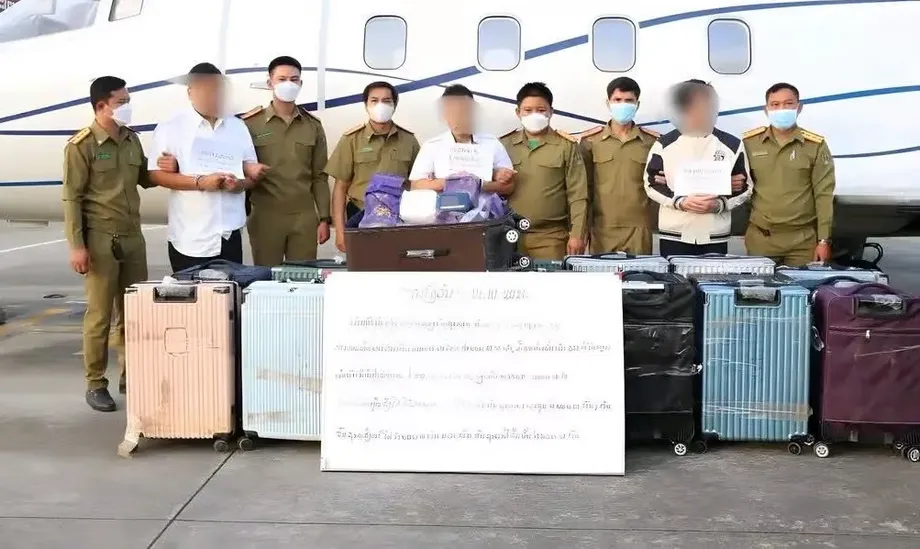
Airport seizure draws investigations across three countries
A Learjet identified as N73GP, 500 packs of suspected crystal methamphetamine and 13 people detained at Luang Prabang International Airport are at the center of an investigation stretching from Laos to Malaysia and the Philippines. The October 1, 2026 seizure involved 521 kilograms of suspected drugs, according to the detailed account of the operation attributed to provincial police in Laos.
Contents
- Airport seizure draws investigations across three countries
- What police found inside the luggage
- A tip preceded the charter booking
- The charter allegedly listed vape products
- An arrested Filipino and a client being sought
- Malaysia examines the aircraft company's role
- Why the Philippine destination remains unconfirmed
- A separate seizure in Thailand widens the inquiry
- Officials respond to changing transport methods
- What investigators still need to establish
- Key Points
The Philippine Drug Enforcement Agency (PDEA) confirmed on Sunday that a Filipino citizen had been arrested in connection with the incident. Authorities have not established whether that person acted as a drug courier, whether the Filipino who allegedly booked the aircraft is the same individual, or whether the shipment was actually destined for the Philippines.
The aircraft had arrived from Malaysia. Malaysian investigators said it departed without cargo and that luggage was loaded after it reached Laos, a distinction that separates the aircraft's departure point from the alleged origin of the drugs.
The Philippine National Police (PNP) is seeking flight records and coordinating with Malaysian and Laotian authorities. Its position remains cautious: a reported Filipino connection and an alleged Manila destination do not yet establish where the cargo was intended to go.
PDEA spokesperson Joseph Frederick Calulut confirmed the arrest while explaining that the person's alleged role remained unresolved.
as to the information if he’s a drug courier that is still to be verified.
The agency said it had initial information about the Filipino but could not release those details. It was still awaiting complete reports from foreign counterparts. The distinction matters because confirmation of an arrest is not confirmation of participation in trafficking, and detention alone does not establish guilt.
What police found inside the luggage
The detailed account attributed to Luang Prabang provincial police describes 23 suitcases moved from two vehicles, passed through an X-ray machine and loaded onto the aircraft by airport staff. Officers subsequently inspected the luggage and found blue bags bearing a golden fish symbol.
Twenty-one suitcases reportedly contained 500 packs of white crystalline material with a combined weight of 521 kilograms. The remaining two held ordinary personal belongings reported to weigh about 180 kilograms. Those belongings were separate from the stated drug weight.
The case is widely described as involving suspected shabu, the term commonly used in the Philippines for crystal methamphetamine. The account attributed to Lao police identifies the substance as crystal methamphetamine, but Philippine officials have not disclosed a final laboratory report.
One report gives the amount as 21 kilograms, conflicting with the original account and the repeated 521 kilogram figure. The detailed seizure account also gives 521 kilograms and separately identifies 21 suitcases containing the substance. The reason for the conflicting weight has not been established.
Authorities seized the Learjet and a white Nissan pickup truck as evidence. Although officers reportedly observed two vehicles delivering the luggage, the detailed account specifically identifies only one confiscated vehicle.
A tip preceded the charter booking
The reported sequence begins before the Filipino allegedly booked the aircraft. Provincial police received information about a suspected trafficking operation on September 21, while Malaysian investigators place the charter booking on September 23.
The principal dates and movements described in the investigation are:
- September 21: Police in Luang Prabang reportedly received a tip about suspected drug trafficking using a private aircraft arriving from Malaysia.
- September 23: A Filipino allegedly booked the aircraft for US$49,500, reported as approximately P3.1 million.
- October 1: Authorities intercepted the luggage at Luang Prabang International Airport, seized the aircraft and detained 13 people.
- October 9: Malaysian investigators described the search for the charter client and arrests connected to the aircraft company.
Accounts differ on the timing at the airport. Malaysian investigators described an arrival at about 11:30 a.m., followed by two vehicles bringing 23 bags at about 1:30 p.m. The provincial police account instead gives 1:30 p.m. as the aircraft's scheduled arrival time. A scheduled arrival and an actual arrival are different records, and the precise sequence still needs reconciliation.
The charter allegedly listed vape products
Comm. Datuk Hussein Omar Khan, director of Malaysia's Bukit Aman Narcotics Crime Investigation Department, said a Filipino believed to be connected to a syndicate booked the flight. Investigators said the booking described the intended cargo as vape products rather than narcotics.
Hussein described what the flight manifest initially stated:
The flight manifest initially stated that the aircraft was chartered to transport goods described as ‘vape’ products from Laos to Manila,
A manifest records information about passengers or cargo. It can help investigators establish what was declared, but it does not by itself prove what was actually loaded or where a flight ultimately would have gone.
The account of an empty departure from Sultan Abdul Aziz Shah International Airport in Subang, followed by loading in Laos, also differs from descriptions suggesting the drugs were carried from Malaysia. Hussein said the drugs were believed to have been produced in Laos, not Malaysia. That remains an investigative assessment rather than a publicly disclosed forensic finding.
Malaysian police are also examining whether there was any attempt to bring drugs into Malaysia. The aircraft's arrival from that country does not, on its own, establish that Malaysian territory was intended as a destination for the cargo.
An arrested Filipino and a client being sought
The accounts leave unresolved whether the Filipino whose arrest PDEA confirmed is the same person Malaysian police were trying to locate. Hussein said information had been shared with PDEA to trace a Filipino charter client believed to be in the Philippines.
Those descriptions should not be merged into a single established identity. A person detained in Laos and a client believed to be elsewhere could be different people. No public identification or complete passenger record has been disclosed to resolve the issue.
The detailed Lao seizure account lists 13 detainees: a pilot, a copilot, a foreign tourist, three company employees and seven airport employees. Three were women. Other reports describe Malaysian, Singaporean and Filipino nationals among those detained, without providing a complete breakdown of nationality by role.
PDEA also said the nationality of another suspect remained unverified. Separately, PNP spokesperson Col. Allen Rae Co said police had not yet received official information confirming the reported Filipino arrest and were checking the passenger's nationality. PDEA's confirmation and the PNP's account of its own records reflect different levels of information held by the two agencies.
Malaysia examines the aircraft company's role
The Malaysian inquiry extends beyond the passenger and the cargo. An October 9 account described the arrest of the owner of the company operating the aircraft and three other people. Hussein said the company owned two planes and rented private jets to clients.
Three people were arrested at Sultan Abdul Aziz Shah International Airport for further investigation. Hussein said those arrested were between 30 and 40 years old and had no previous police records. These Malaysian arrests were described separately from the 13 detentions in Laos; the accounts do not explain any overlap between the groups.
Investigators were examining whether the aircraft's owner knew of its alleged misuse. A lawyer for the company said it had never authorized the transport of narcotics or contraband. That position does not resolve what happened, but it makes the owner's knowledge a separate issue from the presence of suspected drugs aboard the plane.
The Laos flight was described as the eighth booking out of nine received. No comparable details about the other bookings were disclosed, and the booking number alone does not establish that any earlier flight involved illegal cargo.
Why the Philippine destination remains unconfirmed
The strongest reported basis for a Manila destination is Hussein's description of the initial manifest. Philippine police, however, said they had not received documents establishing that the drugs were intended for Manila and had yet to examine the passenger manifest and flight plan.
Co, the PNP spokesperson, explained at a briefing at Camp Crame in Quezon City why investigators needed those records:
It is not enough to simply claim that the plane was headed here. We need to establish whether it actually flew from Malaysia to Laos and whether it had a flight plan indicating that it was en route here (in the Philippines). That is what we will be checking and verifying,
A flight plan sets out an intended aircraft movement. Investigators can compare it with the charter booking, passenger and cargo records, and actual movements to assess whether the claimed route is supported.
The inquiry must also distinguish between a final destination and a transit point. Drugs could be intended for delivery in the Philippines or for transfer there before moving elsewhere. PDEA said neither possibility had been confirmed.
Co said the presence of a Filipino aboard the aircraft would help the investigation but would not establish the cargo's destination. Police were also checking whether other Filipinos were involved and whether the seizure could be connected to shipments previously monitored by Philippine authorities.
A separate seizure in Thailand widens the inquiry
Philippine police are also checking reports of a separate interception in the Gulf of Thailand. That case reportedly involved more than a ton of crystal methamphetamine aboard a boat, valued at 1.2 billion baht, or approximately P2.2 billion.
The reported Thai quantity was larger than the 521 kilograms seized in Laos. The two cases also involved different transport methods, a boat in Thailand and a private aircraft in Laos. Neither the size of the loads nor the alleged Philippine destinations establishes that the same group organized both shipments.
The Thai case was reported on October 8, but that reporting date should not be treated as the seizure date. Philippine authorities had not confirmed that either shipment was intended for the Philippines.
Co said the police Drug Enforcement Group, local police and PDEA were coordinating with foreign counterparts to establish the details of the separate incidents. No confirmed operational connection between them was disclosed.
Officials respond to changing transport methods
Hussein linked the examination of private aviation to changes in suspected trafficking methods after tighter security at Kuala Lumpur International Airport. He said police had previously detected indications of syndicates using Ipoh Airport before turning to private jets.
That assessment explains why Malaysian investigators are examining the charter business and its client, rather than treating the incident solely as a luggage seizure. It does not establish that private aviation generally is being used for trafficking or that the aircraft company knowingly participated.
PNP chief Police Gen. Jose Melencio Nartatez said police were monitoring transport methods and sharing information with regional counterparts. He described the purpose of that work:
We are intensifying our intelligence monitoring and information sharing with regional counterparts to deny opportunities for illegal drugs syndicates either to operate in the Philippines or to make our country a transshipment point for illegal drugs,
Vice President Sara Duterte thanked Laos and Thailand for their action against trafficking and pledged stronger law enforcement and cooperation with partners in the Association of Southeast Asian Nations (ASEAN). In a statement, she addressed the country's alleged association with the incidents:
We recognize the concerns surrounding the Philippines’ role in regional drug trafficking and express my deep regret that our country has become associated with this problem,
Her response expressed concern about the alleged Philippine connection. It did not supply evidence resolving the destination of either shipment.
What investigators still need to establish
The next substantive developments depend on the complete reports requested from Laos and Malaysia, together with the aircraft's flight plan, manifests and charter records. No date for releasing those documents, announcing charges or holding a court hearing was disclosed.
Unresolved issues include the identity and role of the arrested Filipino, whether that person was also the charter client, the knowledge of the aircraft operator, and the intended destination of the cargo. The conflicting descriptions of the airport timing and drug weight also require clarification.
PDEA said it was pursuing the classification of drug groups as terrorist groups. No named organization, legal filing, decision or timetable accompanied that statement, so it should not be understood as an existing designation in this case.
The seizure establishes the basis for a substantial investigation involving an aircraft, luggage, airport personnel and a charter transaction. The Philippine connection remains narrower: PDEA has confirmed a Filipino arrest, while the person's alleged trafficking role and the shipment's destination are still being verified.
Key Points
- Authorities in Laos reportedly seized 521 kilograms of suspected methamphetamine at Luang Prabang International Airport on October 1, 2026.
- The detailed seizure account describes 500 packs in 21 suitcases, with two additional suitcases containing personal belongings.
- Thirteen people were detained in Laos, and a Learjet registered as N73GP was seized.
- PDEA confirmed a Filipino arrest but said the person's possible role as a drug courier remained unverified.
- Malaysian investigators were seeking a Filipino charter client and examining the aircraft company's role.
- Philippine police had not confirmed that Manila or the Philippines was the intended destination.
- A separate boat seizure in Thailand was also under review, with no confirmed connection to the Laos case.