
A training centre with a wider strategic shadow
A new China-backed air force training centre in Laos is officially intended to help Lao pilots build their skills. Its location, runway and reported aircraft deployments have prompted a broader question: could the facility also become a lasting foothold for China’s military in mainland Southeast Asia?
Contents
The China-Laos Joint Support and Training Center and the China-Laos Friendship Aviation Academy opened at Ban Keun Airport, about 50 kilometres north of Vientiane, on September 29. China’s Ministry of National Defense said the facilities would be jointly maintained and operated, and would help Laos strengthen air force training. The ministry said the centre was “not directed against any third party” and would support regional peace and stability.
The announcement did not specify how many Chinese personnel would use the site, what aircraft or equipment would be assigned there, or what access the People’s Liberation Army (PLA) would receive. Those unknowns matter: a jointly run training school is different from a base where foreign forces have exclusive or long-term operational access.
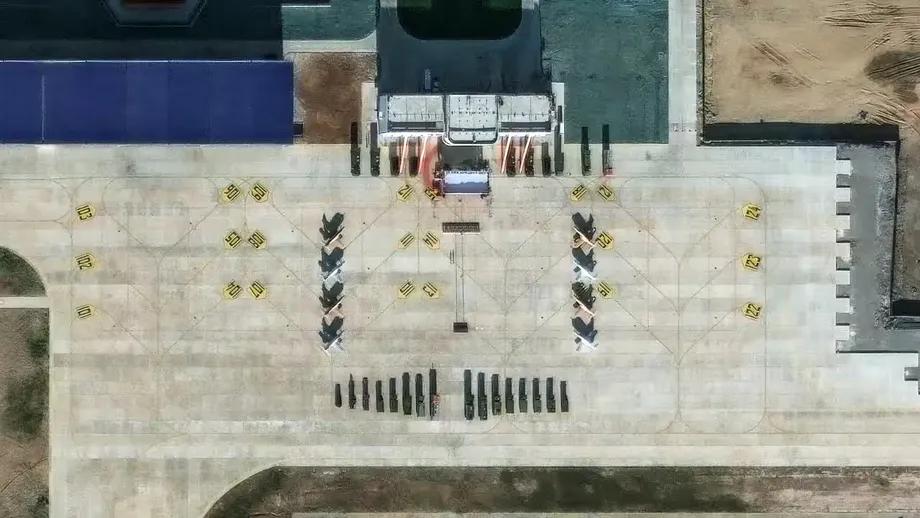
Commercial satellite images reviewed by news organizations showed a newly paved runway roughly 2,000 metres long, a parallel taxiway, aircraft parking areas, a control tower and new buildings. Images taken around the opening showed eight aircraft identified by analysts as Chinese-made Hongdu JL-8s, also known as K-8s, alongside military vehicles. The aircraft type is used for training and can also carry light weapons.
What is known about Ban Keun?
Ban Keun is an airfield in Vientiane Province, close to the China-Laos Railway corridor and within reach of Laos’ capital. Construction on the expanded airfield was reported to have begun in late 2025. The runway and supporting infrastructure mark a substantial change from the smaller, earlier airstrip at the site.
Laos has a small air force, with a fleet that includes transport helicopters and trainer aircraft. Available assessments differ on the exact number and condition of its K-8s and other training planes, but analysts broadly describe the service as limited in size and reliant on foreign partners for training. A dedicated academy could address that capacity gap by providing instruction for pilots and, potentially, maintenance and other flight personnel.
China has not published details about the academy’s curriculum or whether Chinese aircraft will remain at Ban Keun after training activities. The visible K-8s therefore do not by themselves establish who owns or operates each aircraft, or how long they will stay. The distinction will be easier to judge through patterns of use, personnel rotations and the balance of Lao and Chinese control.
The site has an older military history. During the Vietnam War era, the airfield was known as Lima Site 44 and formed part of a network of airstrips used in covert US operations in Laos. Air America, an airline secretly owned by the Central Intelligence Agency, used the site to support operations that included transporting Hmong forces and supplies. Its reuse for a military aviation facility gives Ban Keun added historical weight, though the current project is being established by Laos and China under a different political and legal setting.
Why Vietnam is watching closely
Vietnam’s concern is rooted in both geography and history. Laos shares a long western border with Vietnam, and Hanoi has maintained close political and military ties with Vientiane since the communist movements of the 1960s and 1970s. Vietnam has traditionally viewed Laos and Cambodia as strategically important neighbours along its western flank.
At the same time, China and Vietnam are rivals over competing claims in the South China Sea, where disputes have periodically heightened tensions. A deeper Chinese military presence in Laos could, in a crisis, give Beijing more access to routes and facilities near Vietnam. Analysts have warned that a permanent presence might complicate Vietnamese defence planning or increase China’s ability to monitor activity in the region. Those are possibilities, not demonstrated capabilities of the facility as it currently stands.
Vietnam has not officially commented on Ban Keun’s opening. Its silence does not establish approval or opposition, but the development is likely to be assessed alongside China’s other regional security ties, including its involvement at Cambodia’s Ream Naval Base.
Laos, for its part, has long sought to balance relations with China, Vietnam, Thailand and Russia. The country’s foreign policy has formally followed a non-aligned approach since 1986. A joint facility with China may deepen defence cooperation without necessarily signalling that Vientiane has abandoned that policy. How much operational access each side receives will help clarify the arrangement.
Part of a growing, but limited, overseas network
Ban Keun is being discussed alongside two other China-linked overseas military sites. China opened its first official overseas military base in Djibouti in 2017, where it supports operations including anti-piracy missions. In Cambodia, a China-funded expansion of Ream Naval Base was inaugurated in 2025. Phnom Penh says the facility remains open to friendly foreign navies, while some foreign officials have expressed concern that China could gain preferential or exclusive access.
The comparison is useful, but the sites are not interchangeable. Djibouti is a logistics base near major maritime routes. Ream is a naval facility on the Gulf of Thailand. Ban Keun is an air-focused training and support centre in a landlocked country. Singapore-based security scholar Collin Koh has described the Lao facility as potentially resembling the Djibouti model more than Ream, and said it could be considered China’s first full-fledged overseas military base in Southeast Asia. That is an assessment of its possible role, not an official designation agreed by both governments.
The phrase “joint support and training centre” also leaves room for different levels of military access. China’s announced arrangement may remain focused on training, or it could develop to include more advisers, aircraft, supplies or other support. In military terms, a logistics presence can help forces operate more easily without necessarily providing the equipment and defences needed to launch major combat missions.
China’s defence ministry has used similar language about cooperation and the absence of a third-party target for its facilities in Laos and Cambodia. Analysts say the incremental development of such sites could allow Beijing to expand its overseas military presence over time while initially presenting each project as a limited bilateral arrangement.
What the runway can, and cannot, do
A runway of about 2,000 metres can support some military aircraft, including the trainer and light attack aircraft identified at Ban Keun. A longer runway could allow a wider range of aircraft to operate, depending on aircraft weight, elevation, weather and other airfield facilities. Reports about possible future extensions have led analysts to watch for construction that could signal plans for larger aircraft.
Some observers have speculated that an extended runway could eventually support transport planes, aerial refuelling aircraft or surveillance platforms. Those uses would require more than pavement: fuel storage, maintenance facilities, secure communications, trained crews and appropriate ground support would also be needed. There is no public evidence that Ban Keun currently has the full infrastructure required for sustained operations by larger aircraft.
Geography sets further limits. Laos is landlocked and surrounded by other states, so aircraft operating from Ban Keun would depend on access to airspace beyond Laos for many missions. China also has much larger, better-equipped air bases within its own territory. Singapore-based analyst Collin Koh has cautioned that the site’s immediate operational value for projecting Chinese military power is constrained by these factors.
Other analysts see potential value in the facility as a support point for joint exercises, training visits or limited logistics. It could also contribute to China’s military relationships with Laos and give Beijing more familiarity with regional air routes. These functions can have diplomatic and strategic value even if the site cannot independently support major combat operations.
Economic ties provide the backdrop
China’s defence cooperation with Laos has grown alongside deepening economic links. The China-Laos Railway, which opened in 2021, has improved transport connections between the countries and strengthened Laos’ integration with southern China. Chinese investment and financing have also become prominent across the Lao economy.
That relationship gives Ban Keun a practical connection to Chinese infrastructure and an important political context. China’s Ministry of National Defense has described the facility as the product of “mutual respect and equal consultation.” Some analysts, however, point to Laos’ reliance on Chinese finance and investment as a factor that could give Beijing influence. Laos’ public debt is high, and China is its largest bilateral creditor, according to research cited in recent reporting.
Economic dependence does not automatically translate into military control. Laos retains the formal authority to decide whether and how foreign forces may use its territory. The key questions are whether China gains exclusive access, how long Chinese personnel and aircraft remain, and whether the Lao military retains effective oversight of operations.
China’s military cooperation with Laos has also included higher-level discussions. In June, Lao President Thongloun Sisoulith met Chinese President Xi Jinping in Beijing, where the two leaders agreed to strengthen defence cooperation. Xi proposed a “3+3” dialogue involving foreign affairs, defence and public security officials, a format intended to deepen security and law enforcement coordination. A joint military exercise called Peace Train 2026 focused on humanitarian assistance and military medical services.
What to watch next
For governments assessing whether Ban Keun remains a training centre or takes on a wider role, the most revealing indicators will be practical rather than rhetorical. Analysts have pointed to the duration and frequency of aircraft deployments, the number and duties of Chinese personnel, and whether Beijing receives exclusive access to any part of the facility.
Construction can provide further clues. Air defences, large fuel or ammunition storage areas, expanded maintenance facilities and surveillance equipment could support functions beyond pilot training. None of those indicators alone would prove that the site is a permanent Chinese base, but together with sustained deployments they would point to a more substantial military role.
For now, the facility’s importance is both physical and political. Ban Keun gives Laos a new training complex and gives China a closer defence relationship with a strategically located partner. Its future operational significance remains uncertain, constrained by the site’s current infrastructure and Laos’ landlocked geography.
The Bottom Line
- China and Laos opened a joint aviation training and support centre at Ban Keun Airport on September 29.
- The runway is about 2,000 metres long, and satellite images showed eight aircraft identified by analysts as K-8 trainer and light attack jets.
- The governments have not disclosed Chinese personnel numbers, aircraft arrangements or the terms of PLA access.
- Vietnam is likely to monitor the site because of its ties with Laos and its disputes with China in the South China Sea.
- Ban Keun could grow into a more substantial support site, but its current military reach is limited by infrastructure and Laos’ landlocked position.