
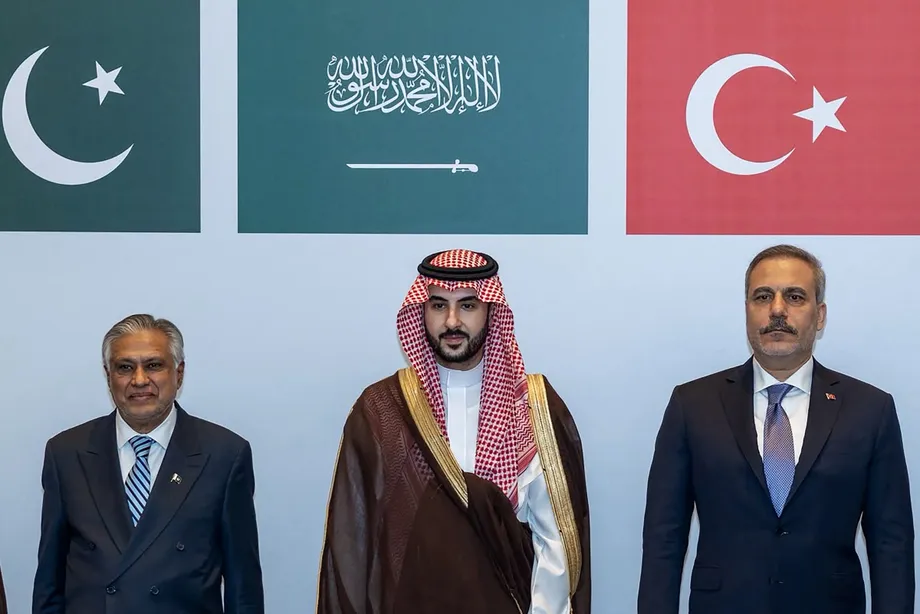
A defence agreement moves from paper to action
Saudi Arabia, Pakistan and Türkiye have agreed to begin implementing their Makkah Joint Defence Agreement, committing to the rapid deployment of agreed military forces and capabilities to the kingdom. The decision followed an emergency meeting in Riyadh on October 5, as Saudi Arabia faced renewed attacks attributed to Yemen’s Houthi movement and fighting intensified across parts of Yemen.
Contents
- A defence agreement moves from paper to action
- What did the Riyadh meeting decide?
- Does rapid deployment mean troops will fight in Yemen?
- Why has the Yemen conflict intensified?
- Why are Pakistan and Türkiye moving cautiously?
- Can the pact replace US security ties?
- What comes next for the alliance?
- Key Points
The announcement marks the pact’s first practical activation since it was signed on August 7, 2026. The agreement treats an armed attack on one member as an attack on all three. Its wording resembles the collective defence principle in NATO’s founding treaty, though the Makkah pact is a separate agreement with its own participants, legal procedures and military arrangements.
The countries said they would carry out the commitments under approved arrangements and in accordance with each party’s national legislation. They did not publish details about the size, timing or precise mission of any deployment. Pakistan’s Defence Minister Khawaja Asif said Pakistani and Turkish forces were playing supportive roles, while Saudi forces were conducting combat operations. He said Pakistan was involved in reconnaissance, the gathering of information used to assess threats and guide military decisions.
The distinction matters. A promise to provide forces and capabilities does not, by itself, establish that foreign troops will fight inside Yemen. The public statements point to a stronger regional defence posture, while leaving the operational details undisclosed.
What did the Riyadh meeting decide?
The Strategic Political and Defence Committee reviewed earlier political and military consultations and approved recommendations to put the collective defence commitments into practice. The three governments said the measures would improve readiness, military coordination and their ability to respond to threats. They also condemned attempted attacks on Makkah and Madinah, along with attacks targeting Saudi cities and civilian and economic facilities.
Saudi Defence Minister Khalid bin Salman described the decision as activation of collective deterrence measures. Deterrence means seeking to discourage an adversary from further attacks by making clear that the potential response could be costly. It can involve combat forces, but also air defence, intelligence, surveillance, training and other forms of support.
The committee appointed retired Pakistani Lieutenant General Nauman Mahmood as the alliance’s first secretary general for a three year term. The appointment is a step toward a permanent administrative structure, after Pakistan’s defence minister said the meeting formalised the alliance’s organisational arrangements. A standing secretariat could help coordinate consultations and planning, although the three governments have not released a detailed command structure or set out how decisions to respond would be made.
Pakistan and Türkiye praised the readiness and professionalism of Saudi forces. Pakistan’s Foreign Office said the three members viewed each country’s security as part of their shared security. That political commitment is clear in the public language. The exact military obligations remain less clear, in part because the full text of the pact and its operational procedures have not been made public.
Does rapid deployment mean troops will fight in Yemen?
Not necessarily. Asif said Pakistani and Turkish forces had a presence in the theatre, but that Saudi troops were carrying out combat operations. He described the other countries’ roles as supportive and said Pakistan was conducting reconnaissance. Pakistan has maintained a long standing military presence in Saudi Arabia under earlier bilateral arrangements, so reports of Pakistani personnel in the kingdom do not by themselves show that new combat units have entered the Yemen conflict.
Türkiye’s role faces an additional legal constraint. The country’s parliament had not ratified the Makkah agreement when the pact was activated, according to reports published after the Riyadh meeting. Türkiye’s constitution sets rules for deploying troops abroad, and the details of the agreement would matter in determining what action is legally permitted. Turkish officials have said preparations to submit the pact for parliamentary approval were underway.
Foreign Minister Hakan Fidan has described the agreement as defensive, saying it does not authorise Türkiye to send troops into another country to carry out attacks. He said Turkish officials were considering possible contributions such as air defence, electronic warfare and technical support, while also discussing a peaceful resolution. Defence equipment and expertise can be supplied without committing large numbers of Turkish soldiers to combat. Some systems can also be operated by Saudi personnel after training.
Pakistan’s government has likewise stressed the pact’s defensive purpose. Officials have rejected reports claiming Pakistani aircraft were being used to attack the Houthis, and the information ministry described claims of a deployment of tens of thousands of Pakistani troops as speculative. Asif has said the agreement does not bar direct involvement if a member faces a threat, but his earlier account of the current roles described support rather than combat by Pakistani and Turkish forces. Those statements describe possible obligations and present activity, which are not the same thing.
Why has the Yemen conflict intensified?
The pact’s activation came amid a renewed offensive by forces aligned with Yemen’s internationally recognised government, which is backed by Saudi Arabia. The forces said they had retaken the Red Sea port city of Mocha and moved toward areas near the Bab al Mandeb Strait. Saudi Arabia’s coalition has said its aircraft provided support. The strait is a narrow passage linking the Red Sea with the Gulf of Aden and the Indian Ocean, making it a key route for commercial shipping.
The Houthis, who control Yemen’s capital and parts of the country, claimed attacks on Saudi sites including Riyadh’s airport and an oil refinery in Rabigh. Saudi authorities did not confirm some of those claims. Saudi aviation officials separately reported attacks targeting airports in Jizan and Najran that caused minor injuries and limited damage. The opposing sides have also traded claims about strikes and territorial gains in Yemen, so individual battlefield reports should be treated with care when they have not been independently verified.
Attacks near Saudi population centres, energy facilities and shipping routes raise concerns beyond the immediate front lines. Disruption around Bab al Mandeb could affect vessels travelling between the Indian Ocean, the Red Sea and the Suez Canal. Threats to oil infrastructure can also unsettle energy markets, even when actual damage is limited. Riyadh has therefore treated the conflict as both a territorial security issue and a risk to economic activity.
The Houthis are backed by Iran, while Saudi Arabia supports the Yemeni government. That alignment raises the risk that a wider foreign military role could draw in more regional actors. Analysts have warned that foreign troops operating inside Yemen could strengthen the Houthis’ narrative of resistance to outside intervention and encourage recruitment. It could also increase pressure on Pakistan and Türkiye to take positions in the broader Iran conflict.
Why are Pakistan and Türkiye moving cautiously?
Pakistan faces a difficult balance. It has close ties with Saudi Arabia and a long history of military cooperation there, but it also shares a border with Iran and has political and economic interests in avoiding a sharp deterioration in relations with Tehran. A direct role in combat against the Houthis could be read by Iran as participation against its regional interests. It could also weaken Pakistan’s ability to present itself as a mediator in efforts to reduce tensions involving Iran.
Türkiye has its own reasons to limit involvement. It is a NATO member with a substantial military and defence industry, but that status does not mean NATO would automatically take part in an operation under the Makkah pact. Türkiye would make its own decisions under its laws and agreements. Its officials have stressed both support for Saudi Arabia’s defence and the need for dialogue. A large ground operation in Yemen would carry greater political and military risks than supplying defensive equipment, advice or intelligence.
The three countries’ combined military size is considerable, but headline totals do not show how quickly forces can be deployed or whether they can operate together effectively. Coordination requires compatible communications, shared planning, clear command arrangements and agreement on the mission. An official familiar with the situation has cautioned that military interoperability during an active war can be difficult. The pact’s new secretary general and committee structure may help with coordination, but they do not settle those practical questions overnight.
Can the pact replace US security ties?
The Makkah agreement reflects Saudi Arabia’s effort to broaden its security partnerships, but it does not appear to replace the kingdom’s relationship with the United States. Reports have said Washington declined requests for direct strikes on the Houthis, while providing intelligence support. US officials have also publicly described defence ties with Saudi Arabia as strong. The difference between intelligence assistance and direct military action illustrates that close partnerships do not guarantee that one country will join every operation requested by another.
Saudi security cooperation with the United States includes capabilities and relationships that the new three country pact has not shown it can match, including extensive intelligence links, advanced air defence and a long record of joint military coordination. The Makkah agreement may add another layer of support, especially through regional partnerships and existing Saudi ties with Pakistan and Türkiye. It is too early to know how much military capacity the alliance can provide in a sustained crisis.
The agreement also serves a political purpose: it signals that an attack on Saudi Arabia could prompt a response from partners beyond the kingdom. Whether that warning changes the Houthis’ calculations will depend on what capabilities are actually supplied and how the members respond if attacks continue. The governments have declared a commitment to collective defence, while retaining room to act under domestic law and to define their contributions.
What comes next for the alliance?
The immediate test is likely to be practical rather than symbolic. The members will need to decide what forces and equipment are agreed, where they will be based, what missions they will perform and how information will be shared. Türkiye’s parliamentary process is one factor, while Pakistan has not disclosed its deployment details. Public statements so far indicate support for Saudi defence, but do not establish that either country has joined Saudi combat operations in Yemen.
Diplomacy remains part of the picture. Fidan has said the Riyadh discussions included ways to resolve the conflict peacefully. Military support and diplomatic engagement can proceed at the same time, but the balance will be delicate: a more visible foreign role might reassure Saudi Arabia while also increasing the risk of escalation with Iran or strengthening the Houthis’ position inside Yemen.
The Makkah pact has now moved beyond a declaration of principle. Its first activation has produced a committee decision, a secretary general and a pledge of rapid support. The scale and limits of that support, and whether the new structure can coordinate action under pressure, remain the central unanswered operational questions.
Key Points
- Saudi Arabia, Pakistan and Türkiye agreed on October 5 to implement their Makkah defence commitments.
- The pact treats an armed attack on one member as an attack on all three.
- Pakistan’s defence minister described Pakistani and Turkish roles as supportive, with Saudi forces conducting combat operations.
- Türkiye’s parliament had not ratified the pact at the time of the announcement, leaving legal and operational questions open.
- Retired Pakistani Lieutenant General Nauman Mahmood was appointed the alliance’s first secretary general for three years.
- The agreement adds a regional defence framework but has not been shown to replace Saudi Arabia’s security relationship with the United States.