

Confidence in AI outpaces workplace readiness
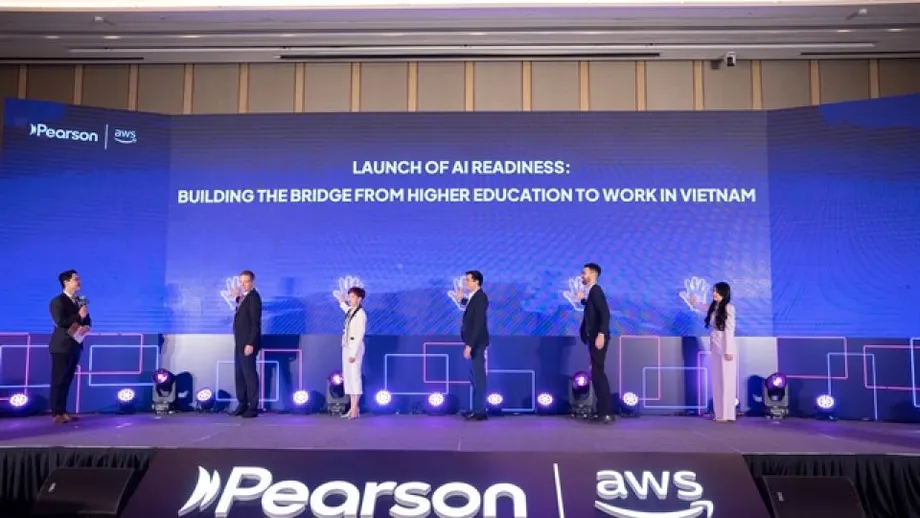
Vietnamese universities are investing heavily in artificial intelligence, and students are more confident than their peers in other surveyed markets about working with AI. Yet employers see a gap between that confidence and graduates’ ability to apply AI effectively on the job, according to a Pearson and Amazon Web Services (AWS) study.
Contents
The Vietnam survey found that 96 per cent of higher education leaders said their institutions were investing in AI. More than 52 per cent of students rated their readiness to work in an AI enabled environment at 8 to 10 out of 10, the highest level of confidence among the six markets studied. By contrast, just 15 per cent of Vietnamese employers rated recent graduates as excellent across eight capabilities needed in AI integrated workplaces.
The study surveyed 402 people in Vietnam: 301 students, 50 university leaders and faculty members, and 51 employers and business leaders. The broader research covered Vietnam, Brazil, Malaysia, Saudi Arabia, the United Kingdom and the United States. Its findings point to a challenge beyond access to AI tools: graduates need to show that they can use them with judgment, verify their results and apply them to practical tasks.
That gap matters as AI changes work and entry level jobs. A student who can prompt a chatbot may still struggle to decide whether its answer is accurate, identify missing evidence or explain how an AI assisted recommendation serves a business need. Those steps require technical familiarity alongside critical thinking, communication and subject knowledge.
Investment is moving quickly, but not evenly
The report classifies Vietnam as a “High-Velocity Strategist,” a market that treats AI as a strategic priority and invests substantially in it. Nine in ten university leaders surveyed said workplace changes driven by AI were happening “extremely fast” or “very fast.” That was 23 percentage points above the global average of 67 per cent. All surveyed academic leaders expected the pace to increase over the next two years.
Investment does not guarantee that institutions can keep up with every development. Only 28 per cent of the Vietnamese institutions surveyed said they were keeping pace with all AI developments. The report points to investments in areas including faculty development, computing infrastructure, technical capacity, curricula and AI systems for institutional operations, while noting that readiness depends on how those resources translate into learning and practice.
The survey also found that 84 per cent of higher education leaders regularly engaged with employers to understand market needs. That is a substantial starting point, though regular contact does not necessarily mean employers help design courses or assess students’ work. The next step is to make those partnerships more practical and sustained.
Students’ self ratings provide useful evidence of confidence, not a direct measure of workplace performance. Employers, meanwhile, judge graduates against tasks and expectations they encounter at work. The gap between those perspectives suggests that courses and assessments need to give students more chances to demonstrate applied skill, not just familiarity with tools.
What employers say graduates are missing
Vietnamese employers identified several problems with graduates’ AI use. Forty three per cent cited poor habits, including excessive trust in AI outputs and weak verification or fact checking. Thirty seven per cent pointed to limited practical experience, while 35 per cent cited over reliance on AI tools. These responses may overlap, but together they show why access alone is an incomplete measure of readiness.
Only 8 per cent of employers rated graduates as excellent at critically evaluating AI outputs. That skill involves checking claims against reliable evidence, recognizing uncertainty and bias, and knowing when a task requires human expertise rather than an automated answer. It is particularly important when AI produces fluent text that may still contain errors.
Across eight areas, employers assessed technical knowledge, adaptability, effective use of AI tools, creativity, applying academic knowledge to practical work, continuous learning, communication and collaboration, and critical evaluation of AI outputs. The overall figure of 15 per cent rated excellent represents the average across those capabilities; it does not mean that every employer gave the same assessment in each area.
The issue also extends beyond Vietnam. Globally, 53 per cent of employers in the Pearson and AWS research said they had difficulty finding recent graduates with AI skills that met workplace requirements. In the overall study, only 14 per cent of learners said they had reached a high level of proficiency in applying AI tools to a professional workflow. Taken together, the findings describe a transition problem: learning to use a tool does not automatically prepare someone to use it reliably in a job.
Four capabilities define an AI ready graduate
The report describes AI readiness as a combination of four connected capabilities. Functional AI proficiency means knowing how to use relevant tools for a task. Critical human skills include judgment, adaptability, communication, collaboration and problem solving. Ethical stewardship means using AI responsibly and considering privacy, bias and potential harm. Strategic intelligence involves understanding where AI can add value and where it may not be suitable.
The capabilities work together. A graduate preparing a business proposal with AI, for example, should be able to frame the task, select an appropriate tool, check claims and sources, identify limitations, and explain the reasoning behind the final recommendations. The human user remains responsible for the work even when a system has helped produce it.
This approach also changes how AI should be taught. A course focused mainly on operating popular tools can become outdated as tools change. Teaching students how to assess outputs, adapt their approach and connect AI to subject knowledge is more durable. It helps learners transfer their skills to unfamiliar systems and new workplace tasks.
The report’s wider AI Readiness Friction Framework describes six barriers that can compound across the education to work transition: pace, connection, capability, governance, experience and skills. Pace refers to workplace change outstripping curriculum updates. Connection concerns weak feedback between employers and educators. Capability includes uneven faculty preparation. Governance covers practical rules for responsible use. Experience is the shortage of structured opportunities to practise. Skills describes the mismatch between what graduates demonstrate and what jobs require.
Turn employer contact into shared practice
Universities and employers can address the experience gap by designing assessments around realistic work. Instead of asking students only to describe an AI tool, an assignment might require them to use AI to draft a proposal, verify its claims, identify weaknesses and defend their recommendations. That makes the process visible and gives instructors a way to assess judgment as well as the final product.
Employers can contribute live challenges, internships and feedback on curriculum. They can also help faculty understand how AI is used in business settings by providing opportunities to observe or work alongside teams. These partnerships can give students practice with the constraints that classroom exercises may miss, such as incomplete information, deadlines and the need to communicate findings to colleagues.
For universities, the report recommends shorter curriculum review cycles, flexible learning models and stackable credentials, which let learners build recognized qualifications in smaller stages. It also calls for faculty development focused on applied teaching and for credit bearing opportunities to practise AI in realistic settings. The aim is to bring AI use into core learning rather than limit it to optional demonstrations or stand alone introductions.
Students can make their skills easier to assess by building a portfolio of AI assisted projects. A portfolio can show the task, how AI was used, what the student checked or changed, and what the final work achieved. That evidence can help employers understand a candidate’s practical ability beyond a degree or a general claim of AI fluency.
The report also discusses a forced choice between hypothetical candidates, one with strong AI skills but no degree and another with a degree but limited AI experience. Employers gave the degree holder an advantage of just four percentage points. The result suggests that credentials still matter, but employers may place considerable weight on evidence of applied ability.
Responsibility extends beyond campuses and employers
Clear governance is another part of readiness. Students and staff need practical guidance on which tools may be used, what information should not be entered into them, how AI generated work should be disclosed, and who is accountable for checking it. Without clear rules, people may use unapproved tools or handle sensitive information carelessly, carrying risks from education into the workplace.
Regulators can support the transition by clarifying policy and enabling relevant digital skills certifications to be incorporated into university programmes. The report’s recommendations also call for education providers and employers to agree on clearer learning outcomes and assessment standards, so graduates have a more consistent way to demonstrate their capabilities.
Pearson and AWS executives have framed the response around translating engagement with AI into workplace capability. The research was developed with independent research firm PSB Insights and includes survey responses from more than 2,700 learners, education leaders and employers across the six markets, as well as interviews with higher education leaders. Its frameworks are intended to help institutions identify which points in their own education to work pathway need attention.
For Vietnam, the central finding is not that universities have failed to invest or that students lack interest. Investment is widespread, student confidence is high and most surveyed institutions already engage with employers. The harder task is connecting those strengths to repeated practice, sound evaluation and work that resembles the decisions graduates will face after leaving university.
The Bottom Line
- 96 per cent of surveyed Vietnamese higher education leaders said their institutions were investing in AI.
- More than 52 per cent of students rated their readiness for AI integrated work at 8 to 10 out of 10.
- Only 15 per cent of employers rated recent graduates as excellent across eight workplace AI capabilities.
- Employers cited poor verification habits, limited practical experience and over reliance on AI tools.
- The report calls for employer designed assessments, applied practice, faculty development and clearer AI governance.