
Managing risk in an increasingly crowded sea
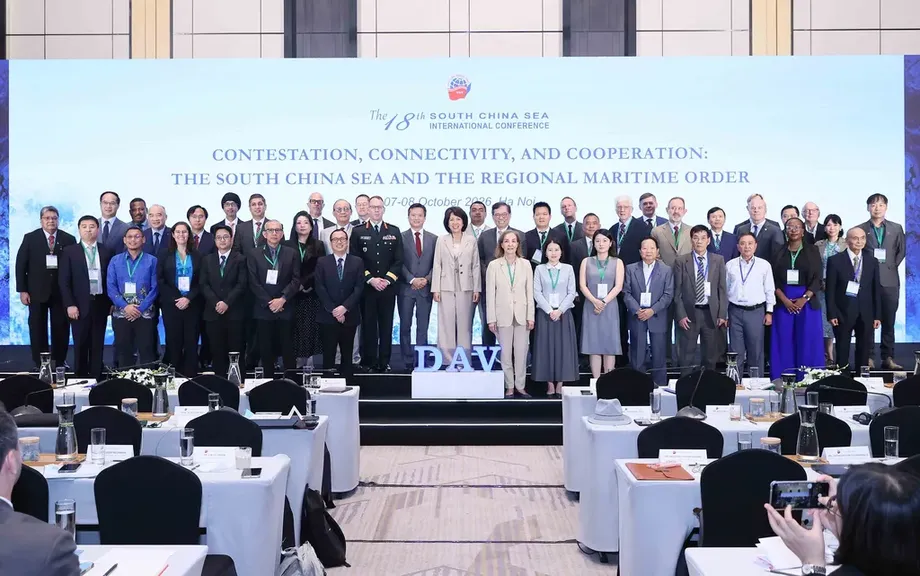
As more ships, coast guard vessels, fishing fleets, research craft and uncrewed systems operate in the South China Sea, a small encounter can leave crews little time to judge another vessel’s intentions. At the 18th South China Sea International Conference in Hà Nội, officials and experts said communication, transparency, restraint and respect for international law are essential to keeping such encounters from escalating into crises.
Contents
The two-day conference, held on October 7 and 8 under the theme “Contestation, Connectivity, and Cooperation: The South China Sea and the Regional Maritime Order,” brought together nearly 50 speakers and about 300 delegates from more than 30 countries and territories, according to conference reports. Policymakers, diplomats, military representatives and scholars discussed how to manage disputes while protecting the sea routes and infrastructure on which regional economies depend.
The South China Sea, known in Việt Nam as the East Sea, links the Pacific and Indian oceans. Its shipping lanes carry goods and energy, and its waters support the livelihoods of millions. The conference’s central concern was that strategic competition is taking place alongside rapid technological change and growing pressure on marine resources, narrowing the time available to prevent misunderstanding from becoming a confrontation.
Dr. Nguyễn Hùng Sơn, president of the Diplomatic Academy of Việt Nam, described the sea as a shared concern involving peace, stability, international law and the wider global commons, not simply a collection of territorial disputes. He warned that deeper connectivity can spread disruption from one location to distant economies. A problem at sea can affect shipping costs, energy supplies and livelihoods, while damage to digital infrastructure can interrupt connections well beyond the immediate area.
Participants also considered how climate change, pollution and pressure on fisheries compound security concerns. Automation and artificial intelligence are changing ports and maritime operations, while undersea cables carry essential data between countries. Competition, connectivity and cooperation, the conference theme’s three elements, therefore intersect in practical ways: states may disagree over jurisdiction while sharing an interest in reliable transport, communications and healthy marine ecosystems.
The conference opened discussions on strategic change, maritime force modernisation, unmanned systems, energy security and cybersecurity. Delegates also examined risks to ports, navigation systems, maritime data platforms and undersea cables. Later sessions were scheduled to address the law of the sea, ASEAN mechanisms, the Code of Conduct negotiations, biodiversity beyond national jurisdiction and resilience for ports and coastal communities.
Why communication needs to come before a crisis
Vietnamese Deputy Foreign Minister Nguyễn Thị Hoàng Vân said governments should not assume that long-running disputes can be settled immediately. Many risks, she argued, can still be managed through direct communication, transparency and practical confidence-building measures. The distinction matters: confidence-building does not resolve competing claims, but it can make an encounter more predictable and reduce the chances that an accident or mistaken assessment triggers a wider crisis.
Canada’s Lieutenant-General Derek A. Macaulay, the senior military representative to the Indo-Pacific, made a similar point about timing. Close encounters can develop quickly, with crews having only a brief window to interpret movements and choose a response. He said communication channels must already be in place before tensions rise, because they cannot be improvised in the middle of an emergency.
The conference discussions included proposals to expand incident-prevention arrangements, improve hotlines and share information about activity at sea. Some experts suggested developing a Code for Unplanned Encounters at Sea, or CUES, for coast guard forces. Existing naval guidance of this kind is intended to provide common procedures when vessels meet unexpectedly. Extending comparable practices to coast guards could address the fact that many encounters involve law-enforcement ships rather than navies.
Maritime domain awareness, often shortened to MDA, is another part of prevention. It means gathering and sharing a sufficiently accurate picture of what is happening at sea, including vessel movements and possible hazards. Better awareness can help authorities distinguish an accident from a deliberate act and coordinate search and rescue or law-enforcement responses. Yet conference participants noted that information sharing can be limited by differences in policy, trust, resources and willingness to disclose sensitive data.
Australia’s Deputy Secretary of Foreign Affairs and Trade Michelle Chan said timely, two-way information sharing can reduce uncertainty and help governments make decisions that lower the risk of escalation. Transparency, in this sense, serves as preventive security. It does not require states to agree on every dispute; it can help them understand events accurately enough to respond with restraint.
UNCLOS as the shared legal reference
Speakers repeatedly pointed to the 1982 United Nations Convention on the Law of the Sea, or UNCLOS, as the broad legal framework governing activities at sea. The convention sets out maritime zones and the rights and duties states have within them, as well as rules concerning navigation and the use of ocean resources. In a region where countries contest sovereignty and jurisdiction, a common legal reference can support predictability even when political disagreements remain unresolved.
Vân said rights must be accompanied by responsibilities and that rules matter when they shape actual conduct. She also backed implementation of the ASEAN–China Declaration on the Conduct of Parties in the East Sea and negotiations toward an effective, substantive Code of Conduct, or COC. The declaration is a political commitment to manage conduct; the proposed COC is intended to establish more detailed expectations for parties in the disputed waters.
Philippine Undersecretary of Foreign Affairs Leo M. Herrera-Lim said UNCLOS and the 2016 South China Sea arbitration award should guide regional conduct. The award, issued by an arbitral tribunal constituted under UNCLOS, addressed legal questions raised by the Philippines. The Philippines regards it as final and binding, a position also affirmed by Australia at the conference. China rejects the tribunal’s jurisdiction and the award. The disagreement over the ruling underscores why legal commitments and practical channels for managing incidents remain central to regional diplomacy.
Swedish Foreign Ministry legal adviser Martin Ratcovich Leopardi described UNCLOS as a framework that increases predictability and stability across maritime regions. Its value, he said, extends beyond the South China Sea: shared legal rules can provide smaller and medium-sized states a basis for asserting their positions and cooperating with others. A common starting point does not remove political differences, but it gives states a way to discuss rights and responsibilities in terms that are not based solely on relative power.
Conference participants cautioned against placing the entire burden of crisis management on a single instrument such as the COC. They argued for complementary measures, including bilateral hotlines, coast guard arrangements, ASEAN-led dialogue and operational procedures. Negotiations on a code can take time; practical safeguards can address immediate risks while those talks continue.
Connectivity depends on resilient infrastructure
Maritime security was discussed as a network-wide concern rather than an issue confined to the South China Sea. Shipping routes connect with other strategic passages, including the Strait of Malacca and the Strait of Hormuz. A disruption at one chokepoint can force vessels to change course, increase insurance and transport costs, and place pressure on energy supplies. Effects can spread to food, fertiliser, manufacturing and other sectors that rely on predictable shipping.
The same networked risk applies to infrastructure below the water. Submarine cables carry the overwhelming majority of international data traffic, while offshore energy facilities and ports support trade and power systems. Damage to a cable can disrupt communications across borders, even if the physical fault occurs far from the communities affected. Conference discussions called for stronger monitoring, clear responsibilities for protection, varied cable routes and the ability to repair damaged systems quickly.
Philippine officials urged a coordinated approach linking maritime security with transport, telecommunications, energy, cybersecurity, disaster management and diplomacy. The conference also considered how governments and companies can work together, since much of the infrastructure is built or operated by private firms. Mapping vulnerable assets, improving early warning and keeping spare components available were among the measures discussed.
Experts also proposed broader steps to strengthen supply chains and transport resilience: diversify energy sources and shipping routes, maintain reserves, reinforce infrastructure and prepare response plans before a crisis. These measures cannot prevent every disruption, but they can reduce the extent to which a single incident affects an entire network.
Vân set out four priorities for Việt Nam: uphold UNCLOS and peaceful dispute settlement, protect vital maritime routes, strengthen critical infrastructure and manage risk while expanding cooperation. She linked those priorities to Việt Nam’s stated aim of developing a sustainable and resilient maritime economy, including through modern infrastructure, marine science and environmental protection.
Cooperation can advance even amid disputes
Speakers identified areas where governments can make practical progress despite unresolved claims. Search and rescue, the safety of fishers, disaster response, marine science, fisheries management, environmental protection, information sharing and training were all raised as fields of common interest. Such cooperation can produce direct benefits for people working at sea while building habits of contact between agencies.
Herrera-Lim pointed to cooperation between the Philippines and Việt Nam, including a joint working group on maritime and ocean concerns, a 2024 memorandum on incident prevention and management, coast guard engagement and humanitarian assistance to sailors and fishers in distress. Hotlines, reciprocal port visits, officer exchanges and scientific and environmental work were cited as practical steps that translate diplomatic commitments into routine contacts.
Delegates also discussed existing cooperation on fisheries in the Gulf of Tonkin between Việt Nam and China as an example of combining law, policy and technology. The conference’s closing discussions stressed that cooperation can grow incrementally: individual initiatives can develop into durable procedures, shared standards and stronger institutional capacity.
Technology may support that work through monitoring, search and rescue and improved management of marine resources. Participants also warned that new systems need to operate consistently with international law and should rely on transparent processes, trustworthy data and respect for national data interests. Strengthening existing arrangements was presented as a priority alongside any proposals for new mechanisms.
ASEAN’s role and the limits of regional mechanisms
ASEAN-led institutions provide a forum for Southeast Asian states, dialogue partners and major powers to meet. Chan said these institutions can build habits of dialogue and reinforce expectations of responsible conduct. Australia also cited its Southeast Asia Maritime Partnerships programme as support for regional maritime security capacity and ocean awareness.
Conference discussions called for ASEAN to play a more active role in confidence-building, information sharing and setting regional expectations, while coordinating with bilateral, multilateral and smaller-group arrangements. The ASEAN Regional Forum and the ASEAN Defence Ministers’ Meeting-Plus were among the mechanisms identified as part of the wider architecture. A more inclusive maritime order, participants argued, should give smaller and medium-sized states a voice and avoid fragmenting cooperation into disconnected or exclusive groupings.
There are limits to what institutions can achieve. ASEAN members and external partners do not hold identical positions, and negotiations over the COC involve difficult questions about obligations, scope and consistency with international law. Participants also recognised that strategic competition among major powers is likely to persist. They called on influential states to exercise restraint and avoid coercive actions that could alter conditions at sea.
The conference’s closing message, delivered by Diplomatic Academy president Nguyễn Hùng Sơn, was that regional peace does not depend solely on quickly settling every dispute. States also need rules that make conduct more predictable, systems that can withstand disruption and practical cooperation that continues even when disagreements remain.
What to Know
- The 18th South China Sea International Conference took place in Hà Nội on October 7 and 8, with about 300 delegates and nearly 50 speakers.
- Participants urged governments to maintain communication channels, share timely information and exercise restraint to reduce the risk of maritime incidents escalating.
- UNCLOS was presented as the common legal framework for maritime conduct, alongside calls to advance ASEAN–China Code of Conduct negotiations.
- Delegates highlighted risks to shipping routes, ports, offshore energy facilities and submarine cables, and called for stronger resilience and crisis preparation.
- Search and rescue, coast guard cooperation, marine science, fisheries management and environmental protection were among the practical areas identified for regional cooperation.