
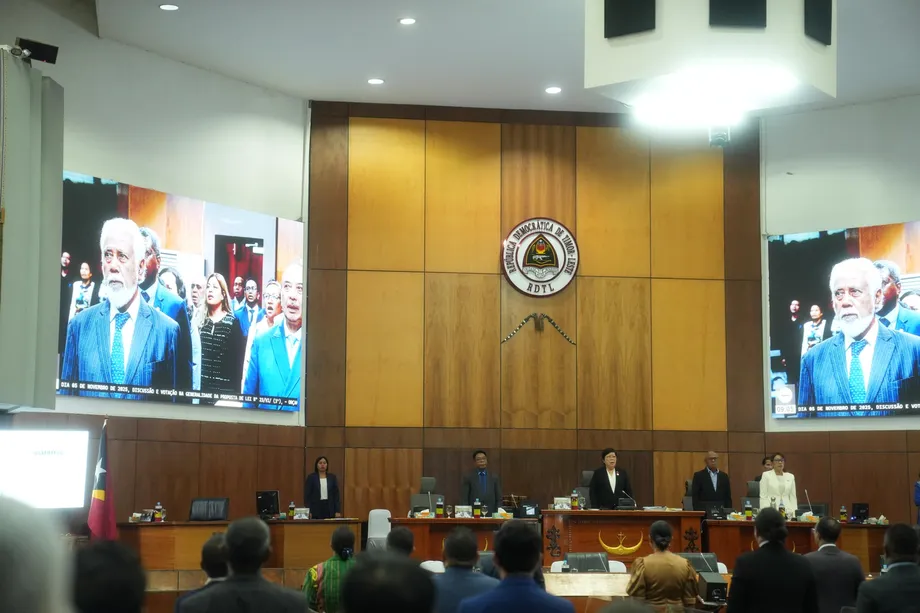
Parliament Receives Spending Plan After Cabinet Approval
Timor-Leste submitted its proposed US$2,568,500,000 General State Budget for 2027 to the National Parliament on October 1, 2026, a day after the Council of Ministers approved it. The proposal combines substantial funding for petroleum and mineral resources with spending on education, health, electricity, social support and municipal development.
Contents
- Parliament Receives Spending Plan After Cabinet Approval
- A New Framework Separates Existing Costs From New Priorities
- Why the Headline Allocations Cannot Simply Be Added
- Petroleum Spending Leads the New Policy Package
- Education, Health and Household Support Remain Major Commitments
- Electricity and Public Works Support Basic Services
- Municipal Funding Extends the Budget Beyond Central Agencies
- Elections, ASEAN Commitments and Security Receive Extra Funding
- Savings and Revenue Reform Face a Delivery Test
- Key Points
The government's budget submission statement sets out three main building blocks: approximately US$1.99 billion in forward estimates, US$197.3 million in adjustments to base expenditure and US$380.5 million for government policy priorities. It projects growth of 4.6% in the economy outside the petroleum sector in 2027, alongside average annual inflation of 1.8%.
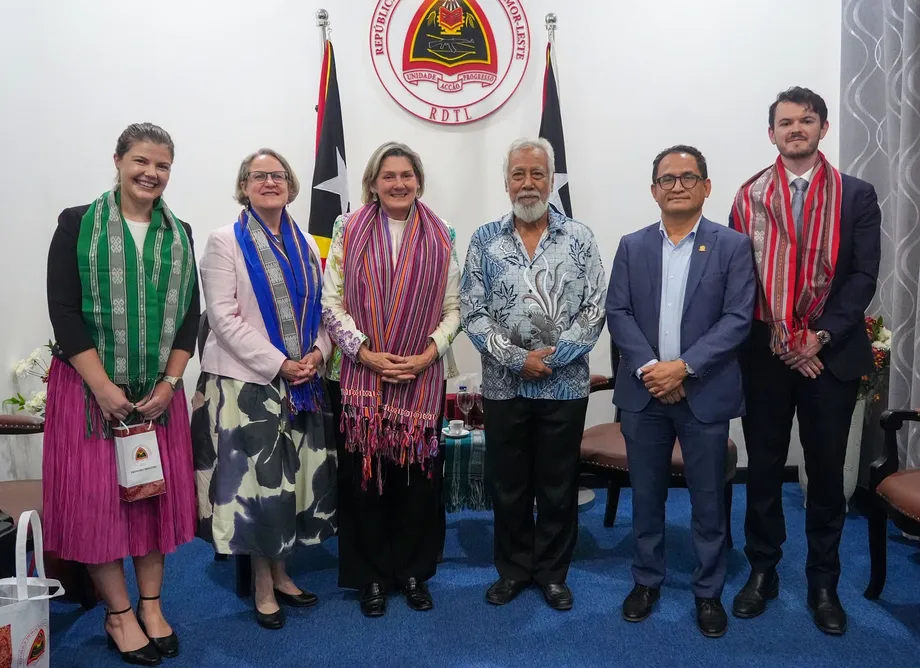
Finance Minister Santina José Rodrigues F. Viegas Cardoso presented the proposal, accompanied at the parliamentary submission by Vice-Minister for Parliamentary Affairs Aderito Hugo da Costa and Secretary of State for Social Communication Expedito Loro Dias Ximenes. Parliamentary analysis and debate now follow. Cabinet approval and formal submission do not constitute final parliamentary authorization to spend.
The immediate sequence is:
- September 30, 2026: The Council of Ministers approved the draft 2027 budget.
- October 1, 2026: The government formally submitted the proposal to the National Parliament.
- Next stage: Parliament examines and debates the proposal under the applicable legal framework and parliamentary procedures. No hearing or voting dates were announced in the submission statement.
A New Framework Separates Existing Costs From New Priorities
The proposal follows the Programme of the 9th Constitutional Government and the Strategic Development Plan for 2011 to 2030. Its stated theme is "Strengthening Resilience through Transformation: Diversifying the Economy for a Sustainable Future".
The new budget framework distinguishes the expected cost of continuing existing policies from adjustments to those costs and new government priorities. Forward estimates are projections of what existing services and commitments will cost in future years. Separating them from new initiatives makes it easier to identify which spending decisions maintain current services and which introduce a change.
Cardoso described the connection between priorities, resources and results in the official submission statement. Translated from Tetum, she said:
The 2027 General State Budget strengthens the link between government priorities, available resources and the results we want to achieve. This new budget framework promotes greater discipline, transparency and efficiency, while continuing to strengthen essential services and strategic investment for Timor-Leste's future.
Planning estimates cover 2027 to 2031, but spending authorization remains annual under Law No. 3/2025 of April 23, on the Framework for the General State Budget and Public Financial Management. Projections for later years therefore support planning rather than automatically authorize expenditure through 2031.
The distinction matters for parliamentary scrutiny. Legislators can examine the cost of maintaining services separately from proposed policy changes, then assess whether the new allocations match the government's stated objectives. The submission does not, however, provide detailed performance measures for each initiative.
Why the Headline Allocations Cannot Simply Be Added
The proposal identifies US$2.487 billion for the Central Government, US$56.1 million for the Oe-Cusse Ambeno Special Administrative Region, known as RAEOA, and US$186.55 million for Social Security. Its headline figure of US$2.5685 billion is described as the consolidated total for the administrative public sector.
Those three institutional amounts add up to US$2.72965 billion, or US$161.15 million more than the consolidated figure. Consolidation generally removes transfers between bodies within the same reporting perimeter so that the same money is not counted twice. However, the published summary does not provide a reconciliation showing how that difference arises.
The distinction is a reason to read the figures carefully, rather than treat them as separate amounts that all sit on top of the headline budget. Functional spending totals, ministry budgets, transfers and additional policy allocations also describe different aspects of expenditure and may overlap.
For example, education and health figures cover spending classified by its purpose across the Central Administration and RAEOA. They are not necessarily identical to the budgets of individual ministries. The same caution applies when comparing territorial investment with the Public Works allocation.
Petroleum Spending Leads the New Policy Package
Development of petroleum and mineral resources receives an additional US$244.8 million for policy priorities approved for 2027. Separately, the Ministry of Petroleum and Mineral Resources is reported to have a total allocation of approximately US$291 million. The additional policy funding and the ministry total should not be added together without the detailed budget tables.
The US$244.8 million allocation is equivalent to about 64.3% of the US$380.5 million government policy priorities envelope. That comparison shows the scale of petroleum and mineral development within the proposed new priorities, even though the government's broader theme is economic diversification.
Initial funding for niche tourism priorities is US$8.8 million, while fisheries receives US$6 million. Together, those allocations amount to US$14.8 million. The additional petroleum and mineral allocation is about 16.5 times that combined figure.
These are comparisons of the named allocations, not complete sector spending totals. The tourism and fisheries funding is intended to support preparation of interventions and capacity building, so it should not be read as the full cost of developing either industry. The budget summary does not identify the individual projects, delivery schedules or expected returns behind these allocations.
The proposal therefore pursues diversification alongside a much larger commitment to petroleum and minerals. Whether that balance produces jobs and a broader productive economy will depend on the projects funded and their execution, neither of which can be assessed fully from the announced totals.
Education, Health and Household Support Remain Major Commitments
The official submission identifies US$756.6 million for human capital and public services within existing policies. This grouping supports education, health, social protection, skills development and other essential services.
More specifically, education receives US$194.2 million and health US$182.6 million under the functional classification of expenditure for the Central Administration and RAEOA. Their combined US$376.8 million is equivalent to approximately 14.7% of the consolidated budget. These amounts should not be added to the broader human capital grouping as if they were separate commitments.
The draft also provides US$156.2 million for recognition and support of veterans, combatants and martyrs of the national liberation struggle. Another US$11.7 million supports mothers and children, primarily through Bolsa da Mae, the Mother's Allowance programme.
School meals receive US$24.7 million through local authorities, covering primary and preschool education. That places municipal delivery alongside central spending in the government's support for children and households.
The figures establish proposed funding levels, but the summary does not specify beneficiary numbers, payment rates, changes in eligibility or targets for expanding access to health and education. Without those details, it is not possible to calculate how much support individual families will receive or whether service coverage will increase.
Electricity and Public Works Support Basic Services
A transfer of US$127.4 million to the public electricity enterprise EDTL, E.P., is intended to maintain electricity supply. It also supports expansion of generation capacity in Oe-Cusse Ambeno and the solar power station at Atauro.
This allocation combines continuity of an essential service with investment in generation capacity. The budget summary does not divide the transfer between operating support and individual projects, or give capacity figures and completion dates for the generation works.
The official submission puts infrastructure and basic services at US$414.6 million, supporting rural infrastructure, connectivity and access to services. Separately, the Ministry of Public Works is reported to receive US$251 million.
Ximenes said Public Works spending would prioritize infrastructure rehabilitation for preparations for the ASEAN presidency in 2029 and for presidential, local authority and parliamentary elections. That identifies purposes for the proposed expenditure, but it does not establish a detailed construction programme or election timetable.
The Public Works ministry allocation and the broader infrastructure grouping are different ways of describing expenditure. They cannot safely be treated as two entirely separate funding packages without checking which projects and services each includes.
Municipal Funding Extends the Budget Beyond Central Agencies
The government identifies US$171.6 million for 13 municipalities and RAEOA. It also announces approximately US$277.9 million for territorial capital investment across 1,643 projects, including projects managed by the Ministry of Public Works.
Capital investment refers to spending on assets such as buildings and infrastructure rather than routine operating costs. The large number of territorial projects makes project selection, procurement and completion important measures of whether the allocation turns into usable public assets.
The draft includes an additional US$17.3 million to strengthen fiscal equity and administration below the national level. Its stated purpose is to support decentralization and delivery of public services throughout the country.
These commitments connect municipal funding, territorial investment and locally delivered services such as school meals. They do not establish how much each municipality will receive. The published summary provides no allocation formula, individual project list or breakdown of the US$277.9 million by territory.
That missing detail limits comparisons between areas. The total number of projects alone cannot show whether funding matches local needs, how many projects are new or continuing, or when residents can expect completed works.
Elections, ASEAN Commitments and Security Receive Extra Funding
The proposed budget includes an additional US$27.5 million for election related needs and commitments associated with ASEAN. It also provides an additional US$13.6 million for public order and security.
The election and ASEAN allocation groups several obligations together. The summary does not show how much is assigned to each purpose, while the Public Works priorities indicate that some related preparations also involve infrastructure expenditure.
Preparation for the ASEAN presidency in 2029 gives part of the 2027 spending a purpose extending beyond the budget year. It does not mean that the US$27.5 million is wholly intended for that presidency, since the allocation also covers election needs and other ASEAN commitments.
The same distinction applies to security funding. An additional allocation identifies a proposed increase for policy priorities, but without a detailed agency and programme breakdown it does not show precisely which activities will receive the money.
Savings and Revenue Reform Face a Delivery Test
The government projects US$53.6 million in savings from reducing spending inefficiencies across 62 organizations. It also expects US$51.6 million in savings from reorienting the Infrastructure Fund in 2027. If the two amounts are separate and fully realized, they would total US$105.2 million, equivalent to about 4.1% of the consolidated budget.
These are projected savings, not confirmed results. The summary does not identify the measures for each organization, the projects affected by changes to the Infrastructure Fund or how progress will be measured during the year.
An additional US$5 million is proposed for strengthening the domestic revenue system. That is expenditure intended to improve revenue collection, not a forecast that revenue itself will rise by US$5 million. The submission does not quantify the additional receipts expected from the measure.
The economic forecasts also need to be read as projections. Growth of 4.6% outside petroleum describes expected expansion in that part of the economy, not total growth including petroleum. Average inflation of 1.8% describes the expected change in prices, not a guarantee that all household costs will rise at that rate.
Parliament's examination will now determine whether the proposal proceeds unchanged or is amended. The next concrete information needed includes the legislative timetable, detailed funding reconciliation, project allocations and the financing plan, including any petroleum fund withdrawals or borrowing. The announced summary does not settle those questions.
Key Points
- The Council of Ministers approved the US$2.5685 billion draft budget on September 30, 2026, and submitted it to Parliament on October 1.
- The framework separates continuing expenditure, base adjustments and US$380.5 million in government policy priorities.
- Additional petroleum and mineral funding of US$244.8 million is equivalent to about 64.3% of the policy priorities envelope.
- Education and health allocations total US$376.8 million, while EDTL is allocated a US$127.4 million transfer.
- Territorial capital investment is approximately US$277.9 million across 1,643 projects.
- The government projects 4.6% growth outside petroleum and 1.8% average inflation in 2027.
- Parliamentary approval, a detailed reconciliation of budget totals and the financing breakdown remain outstanding.