
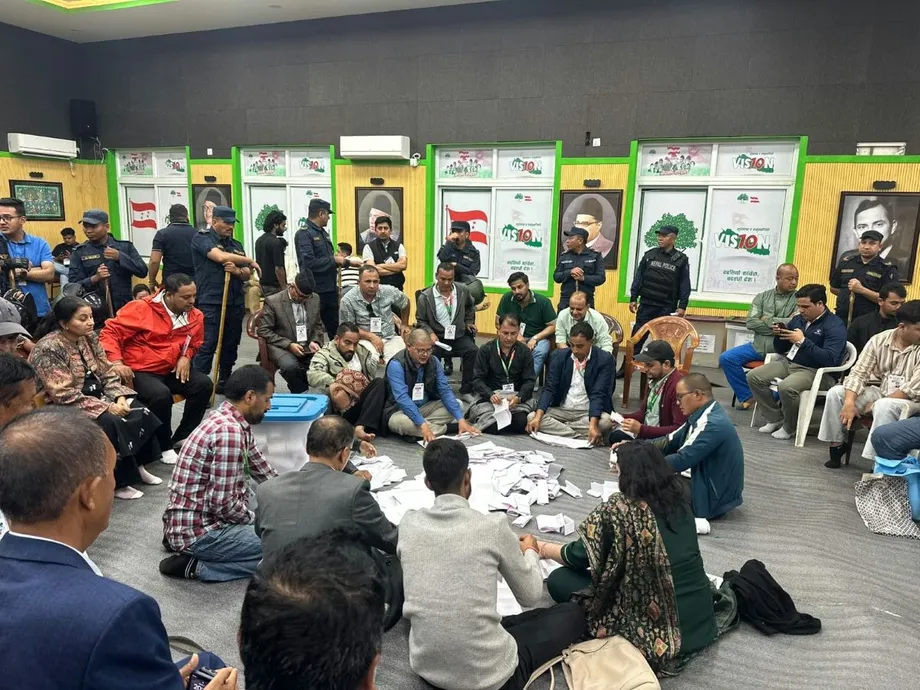
A decisive presidential result, with other contests still open
Gagan Kumar Thapa has won the Nepali Congress presidency with 6,584 votes at the party's 15th General Convention, defeating Shyam Krishna Khadgi, who received 375. The result gives Thapa a commanding mandate from voting delegates, while counting for other leadership positions continues at the party's central office in Sanepa, Lalitpur.
Contents
- A decisive presidential result, with other contests still open
- What the presidential numbers show
- How the count moved from Kathmandu to Sanepa
- Bhandari builds a lead for an open vice president seat
- Other vice president positions take shape
- Nine candidates seek two joint general secretary positions
- Withdrawals leave a second task for Thapa
- An expanded leadership, with limits on appointments
- Key Points
The presidential count began late Friday night at Kathmandu's National Assembly Hall and finished Saturday morning. Mahesh Gautam, a member of the convention's media centre, confirmed Khadgi's tally. The election committee put participation at 7,039 voters out of 7,317 convention delegates and reported 54 invalid ballots.
Those figures leave a small but unresolved accounting gap. The votes attributed to the two presidential candidates total 6,959. Adding the 54 invalid ballots produces 7,013, which is 26 fewer than the reported number of ballots cast. No explanation for that difference has been reported.
Beyond the presidency, the developing results point to a leadership team assembled through both contested elections and uncontested selections. Chandra Kant Bhandari held a substantial lead in the open vice president contest, while Bishwaprakash Sharma and Pushpa Bhusal had already secured separate vice president positions without opposition.
Thapa's immediate task is therefore broader than celebrating his victory. He has promised to include defeated candidates and leaders who stayed outside the election process, while several politicians who withdrew their candidacies say they did so at his request. The remaining counts and subsequent appointments will determine how that commitment translates into positions within the party.
What the presidential numbers show
On the reported delegate and turnout figures, approximately 96.2 percent of eligible representatives voted. The difference between the registered delegate total and participation was 278. Thapa's margin over Khadgi was 6,209 votes, and his share of the votes explicitly assigned to the two candidates was approximately 94.6 percent.
That percentage uses 6,959 candidate votes as its denominator, rather than all 7,039 reported ballots cast. The distinction matters because the published totals do not fully reconcile. The discrepancy does not put the reported victory margin in doubt, but a complete election accounting would need to explain the remaining 26 ballots.
Reports also differ on the size of the convention electorate. The presidential account, citing the election committee, identifies 7,317 delegates and 7,039 voters. A later account of the vice president count describes 7,039 as the total number of representatives. These figures should not be treated as interchangeable without clarification.
One account describes Thapa's victory as a return to the presidency, while the presidential result announcement simply says he was elected. No dates or details of an earlier presidential term are given. The result established by the reported tally is his victory in the 15th General Convention contest.
How the count moved from Kathmandu to Sanepa
The presidential ballots were counted at the National Assembly Hall, where voting had taken place. Ballot boxes for the other party positions were then taken to the central office in Sanepa. Counting for those posts was scheduled to begin Saturday afternoon, after a 1 pm meeting with candidates for vice president and general secretary.
Later updates describe counting extending into Sunday evening, when ballots for open joint general secretary positions, the women's joint general secretary position and open women's central committee seats were being examined at six counting locations within the central office.
- Ashoj 18: The convention began, according to the account of candidacy withdrawals.
- Ashoj 23: Thapa spoke at the National Assembly Hall on voting day about including defeated candidates and leaders outside the process.
- Friday night to Saturday morning: The presidential count began and concluded.
- Saturday: Other leadership counts were scheduled to start after the 1 pm candidate meeting in Sanepa.
- Sunday evening: Counting began for several joint general secretary and women's central committee contests at six locations.
The presidential announcement carries an October 10 dateline, while other accounts use dates from Nepal's calendar and references to weekdays. No year is specified, so the calendar references cannot be aligned confidently into a single dated chronology. The reported sequence nevertheless distinguishes the completed presidential count from the continuing contests.
Bhandari builds a lead for an open vice president seat
Seven candidates competed for two open vice president positions. At the first reported checkpoint, after 1,179 ballots had been counted, Chandra Kant Bhandari led with 623 votes. Madhu Acharya followed with 343, ahead of Govinda Bhattarai on 291 and Surendra Raj Pandey on 289.
The remaining candidates at that stage were Deepak Giri with 242 votes, Dhanraj Gurung with 211 and Chandra Mohan Yadav with 126. Acharya's lead over Bhattarai was 52 votes, while only two votes separated Bhattarai and Pandey. Those gaps made the contest for the second position much closer than Bhandari's lead suggested.
A later update, after 6,000 ballots had been counted, put Bhandari on 3,106 votes and described his election as assured. His tally represented approximately 51.8 percent of the ballots counted at that point, compared with about 52.8 percent at the earlier checkpoint.
These are successive counting updates, not conflicting results. However, the later account does not give revised totals for the other six candidates or a final declaration for both open seats. It supports the picture of a strong Bhandari performance without establishing who secured the second position.
Other vice president positions take shape
Two of the five vice president positions were settled without a contested vote. Bishwaprakash Sharma became senior vice president, a newly created position, and Pushpa Bhusal secured the women's vice president seat. Both were described as outgoing vice presidents.
The inclusive vice president contest remained competitive in the early count. Binod Kumar Chaudhary led with 347 votes, followed by Jeevan Pariyar with 287. Farmullah Mansur had 164, Sita Gurung 151 and Ranjit Karn 98. Chaudhary's reported advantage over Pariyar was 60 votes.
The open, women's, senior and inclusive categories represent different routes into the party leadership rather than one combined contest. Together, the two open positions and the three separate positions account for the five vice presidents described in the expanded leadership structure.
No final result for the inclusive position is given in the counting updates. Sharma and Bhusal's uncontested selections can therefore be distinguished from Chaudhary's provisional lead and Bhandari's position during the unfinished open count.
Nine candidates seek two joint general secretary positions
The open joint general secretary race offers another measure of how the leadership below Thapa is developing. Nine candidates competed for two places. After 584 ballots had been counted, Ramhari Khatiwada led with 289 votes, followed by Dilli Ram Subedi with 187 and Ajay Babu Shiwakoti with 174.
Khatiwada was 102 votes ahead of Subedi at that checkpoint. The gap between Subedi and Shiwakoti was much narrower, at 13 votes, making the second position particularly uncertain during the early count.
The other reported totals were Devendra Raj Kandel with 109 votes, Bikash Koirala with 105, Rajiv Dhungana with 80, Ramesh Prasad Dhamala with 77, Amrit Kumar Aryal with 32 and Bimal Raj Chhetri with 21. The candidate registration and counting accounts render Kandel's surname differently, but both place him in the same nine candidate contest.
For the women's joint general secretary position, Nanumaiya Bastola and Pratima Gautam were competing for one seat. No vote totals for that race were given. Separately, 36 candidates sought 15 open women's central committee positions. That amounts to 2.4 candidates per available seat, with 21 candidates unable to secure a place through that particular election.
These counts remain separate from the presidential result. A decisive vote for Thapa does not establish the winners of the contests for his colleagues, and the early totals do not provide a final picture of the central leadership.
Withdrawals leave a second task for Thapa
Several prominent politicians withdrew after entering contests. Kishor Singh Rathaur withdrew from the presidential race. Devraj Chalise and Minendra Rijal withdrew from the open vice president contest, while Laxmi Pariyar withdrew from the Dalit joint general secretary race.
Other leaders announced plans to compete but did not register. They included Min Bishwakarma, who had considered a general secretary or joint general secretary position; Gyanendra Bahadur Karki, who had prepared to seek a vice president position; and Ishwari Neupane, who had announced an intended joint general secretary candidacy.
Chalise and Rijal said they withdrew at Thapa's request. Pariyar also attributed her withdrawal to his request, while Neupane publicly said she would not contest a position following his appeal. Those decisions reduced the number of candidates in particular races but left the question of their subsequent responsibilities unresolved.
Chalise, described as the outgoing committee's spokesperson and a withdrawn vice president candidate, said Thapa had asked for his cooperation and promised an appropriate role later. His account, translated from Nepali, was:
He said, 'I am in difficulty now, please help me, and later I will arrange an appropriate role for you.' I accepted the president's request.
A separate account suggested Chalise had been promised joint general secretary and spokesperson responsibilities. Chalise himself said no position had been fixed. That distinction matters: an expectation of a future role is not the same as a confirmed appointment.
An expanded leadership, with limits on appointments
The party's leadership structure is described as having expanded from 14 to 25 office holders, an increase of 11 positions, or approximately 78.6 percent. The reported structure consists of the president, five vice presidents, three general secretaries, 15 joint general secretaries and a treasurer.
Under the party statute as described in the reports, the president can nominate four joint general secretaries and one treasurer. The other leadership positions must be filled through the convention. Thapa is also reported to have authority to nominate 61 central committee members.
That creates an important distinction between membership of the central committee and appointment to a particular senior office. A nominated committee seat can bring a leader into the party's governing body, but it does not itself make that person a vice president or general secretary. No appointment list has been announced.
Thapa addressed inclusion at the National Assembly Hall on voting day, saying that leaders outside the process and those defeated in the elections should still have roles. His remarks, translated from Nepali, included:
Some colleagues may be brought back into the central committee, some may be given other responsibilities, but we will take everyone along.
He also said the party would try to address discontent among leaders who remained within Congress, while distinguishing that situation from an individual's decision to establish another party. His commitment covers a wider group than the candidates who withdrew.
The decisions still outstanding are concrete: final results for contested leadership and committee positions, clarification of the presidential ballot discrepancy, and the allocation of nominated posts. No deadline for completing all counts or announcing those appointments has been given.
Key Points
- Gagan Kumar Thapa won the presidency with 6,584 votes against Shyam Krishna Khadgi's 375.
- The election committee reported 7,039 voters among 7,317 delegates, but candidate totals plus invalid ballots leave 26 ballots unexplained.
- Chandra Kant Bhandari had 3,106 votes after 6,000 ballots in the open vice president count; final totals for both seats were not given.
- Bishwaprakash Sharma and Pushpa Bhusal secured separate vice president positions without opposition.
- Ramhari Khatiwada led the early open joint general secretary count, with Dilli Ram Subedi and Ajay Babu Shiwakoti close behind for the second position.
- Thapa has promised roles for defeated candidates and leaders outside the election process, but no appointment list or completion deadline has been announced.