
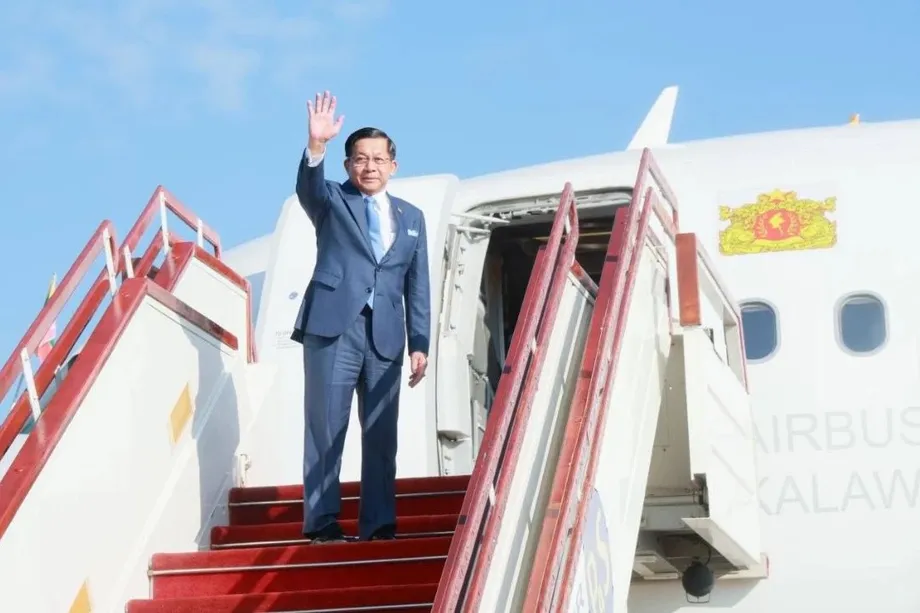
Returns and recognition converge in Putrajaya
Malaysia has repatriated 10,493 Myanmar nationals so far this year, Prime Minister Anwar Ibrahim said on Oct. 8, as his government hosted military leader Min Aung Hlaing and promised to work toward Myanmar's fuller participation in the Association of Southeast Asian Nations (ASEAN). The talks combined a plan to return 5,000 immigration detainees with a diplomatic opening for a leader still excluded from the regional bloc's highest level meetings.
Contents
- Returns and recognition converge in Putrajaya
- What the leaders discussed
- The return figures describe different groups
- Safety assurances face demands for scrutiny
- The Rohingya citizenship condition
- ASEAN engagement without a change in its rules
- Domestic politics and diplomatic gains
- Migrants and resistance groups oppose the visit
- What remains unresolved after the talks
- Key Points
The first group under the detention return plan, 1,476 people, left Malaysia's Lumut Naval Base aboard three Myanmar Navy vessels on Sept. 29. Their departure preceded the Oct. 7 and 8 visit, during which Min Aung Hlaing met Anwar in Putrajaya and addressed Malaysian business leaders. Rights groups warned that people sent back could face persecution, forced military conscription or other abuses.
Anwar presented direct negotiations as a way to secure safe returns and resolve a growing domestic dispute over refugees. Critics saw a different exchange: Malaysia obtaining cooperation on deportations while Myanmar's military leadership gained public acceptance without demonstrating progress on ASEAN's peace plan.
The visit also exposed a practical limit to the negotiations. Anwar wants Myanmar to accept Rohingya refugees, but Min Aung Hlaing said his administration would accept only people confirmed as Myanmar citizens. That condition could exclude most Rohingya, who have been denied citizenship by successive Myanmar governments.
What the leaders discussed
Min Aung Hlaing received an official welcome at the Perdana Putra Complex before a private meeting with Anwar lasting about half an hour. Senior ministers and officials from both countries then joined wider discussions. The visit also included a business dialogue at which the Myanmar leader urged Malaysian companies to invest in his country.
In a public statement after the meeting, Anwar described the central issue as the situation of Myanmar refugees in Malaysia and the possibility of their voluntary, safe and dignified return, regardless of ethnicity. The Malaysian prime minister explained why he had chosen direct engagement:
I believe direct dialogue and negotiations with President Aung Hlaing and Myanmar's leadership are essential to securing a lasting resolution.
Anwar also welcomed Myanmar's stated efforts at reforms and policy adjustments, while saying Malaysia continued to have concerns about conditions there. His support for Myanmar's eventual place in the ASEAN community extended the discussion beyond immigration enforcement to the military leadership's regional standing.
The return figures describe different groups
The 5,000 people covered by the bilateral detention plan are not the same as the total returned from Malaysia since January. Anwar initially told parliament that approximately 10,000 Myanmar nationals had been repatriated through air and sea transport, including flights arranged by authorities in Naypyidaw. On Oct. 8, he gave the more precise figure of 10,493.
Myanmar's military authorities had previously said they had received about 8,000 returnees from Malaysia since January. That differs from Malaysia's figure by roughly 2,500 people. The timing and coverage of the two counts have not been reconciled publicly, so the difference cannot be treated as proof that either count is wrong.
Malaysia's Home Ministry said more than 10,000 Myanmar nationals were held in immigration detention centres at the end of August. The announced plan for 5,000 therefore covers fewer than half of that detained population, if the figures refer to comparable groups. The Sept. 29 departure accounted for about 29.5 percent of the plan, leaving 3,524 people if the target remains unchanged.
These detention and return figures should also be kept separate from refugee registration totals. Figures attributed to the United Nations High Commissioner for Refugees (UNHCR) put the number of Myanmar refugees and asylum seekers in Malaysia at approximately 190,000. Around 126,000 Rohingya asylum seekers are registered with the agency in Kuala Lumpur. Neither figure establishes how many registered people are detained or included in the return programme.
Safety assurances face demands for scrutiny
Anwar told parliament that Malaysia had required explicit diplomatic commitments that Myanmar would receive its citizens and treat them fairly, without abuse, coercion or human rights violations. Malaysian authorities have described the returns as voluntary. The Foreign Ministry framed the negotiations around returns conducted with safety and dignity.
Rights organisations disputed whether those assurances adequately protect people returning to a country in civil war. Fortify Rights and Human Rights Watch called for UNHCR to receive immediate access to immigration detention centres before further returns take place. Their demand targets a central uncertainty: whether each detainee can make a genuinely free and informed decision.
UNHCR is the UN refugee agency, distinct from the Office of the UN High Commissioner for Human Rights. Access by refugee protection staff could help identify people seeking asylum and assess the dangers they face. A government promise of fair treatment does not, by itself, establish the safety of every person selected for return.
The warnings concern persecution, coercion and military recruitment. They describe risks rather than confirmed outcomes for all 1,476 people sent back in September. No public account of their subsequent treatment, or a timetable for independent monitoring, was identified in the statements surrounding the visit.
The Rohingya citizenship condition
Anwar said no Rohingya were included in the recent repatriation. That provides a specific assurance about the September departure, but does not settle whether Rohingya refugees or asylum seekers could be included in later returns. His broader position is that Myanmar should accept responsibility for its nationals, including Rohingya.
Min Aung Hlaing's citizenship requirement leaves a gap between that objective and what Myanmar has offered. Many Rohingya lack recognition as citizens because of policies imposed by successive governments. Requiring proof of citizenship can therefore prevent return even when a person originated from Myanmar.
The distinction matters for both protection and policy. Exclusion from the immediate programme could spare Rohingya a return that rights groups consider dangerous. It could also mean the diplomatic initiative fails to resolve the situation of the population at the centre of much of Malaysia's domestic refugee debate.
Large numbers of Rohingya sought refuge abroad after the Myanmar military's 2017 campaign drove more than 740,000 people from Rakhine State into Bangladesh. Malaysian officials have described refugee hosting as a financial burden and security concern. Those positions do not establish that return is safe, nor do they remove the citizenship barrier announced in Putrajaya.
ASEAN engagement without a change in its rules
Malaysia was the fifth ASEAN member to host Min Aung Hlaing since he assumed the presidency in April, following visits to Thailand, Cambodia, Vietnam and Laos. It was the first country in maritime Southeast Asia to do so. The sequence gives the visit significance beyond a single bilateral immigration agreement.
ASEAN has excluded senior military representatives from its highest level meetings since 2021 because of the failure to implement its Five Point Consensus. Min Aung Hlaing agreed to that framework in April 2021, after the military coup of Feb. 1 that removed the elected administration led by Aung San Suu Kyi.
The consensus calls for an immediate end to violence, dialogue among all parties, mediation by a special envoy, humanitarian assistance through ASEAN's coordinating centre and a visit by the envoy to meet all parties. These are conditions for a political process, rather than a requirement simply to maintain contact with the authorities in Naypyidaw.
Malaysia says hosting Min Aung Hlaing does not amount to recognition of the government backed by the military. Its Foreign Ministry described the visit as consistent with the consensus and with an ASEAN decision to continue constructive and principled engagement. Philippine Foreign Minister Teresa Lazaro has said the consensus remains ASEAN's preferred roadmap. No collective decision restoring senior military leaders to ASEAN summits was announced during the visit.
Domestic politics and diplomatic gains
Hunter Marston, director of the Southeast Asia Program at the Lowy Institute, linked Malaysia's outreach partly to electoral losses suffered by Anwar's coalition in Johor and Negeri Sembilan in July and August. He argued that those results increased pressure on Anwar to respond to public opposition to hosting Rohingya.
Debbie Stothard, founder of ALTSEAN-Burma, also interpreted the return initiative as an attempt to gain electoral support amid hostility toward migrants. These are assessments of political motivation, not established explanations from Anwar. The prime minister's stated case is that Malaysia cannot host refugees indefinitely and needs an authority with whom to negotiate.
For Min Aung Hlaing, the benefits extend beyond accepting returnees. A formal welcome, meetings with senior officials and contact with business leaders can build acceptance and economic relationships even while ASEAN's collective restrictions remain in place.
Marston described the diplomatic effect of the visit:
That increasingly divides ASEAN,
His concern was that separate national initiatives could weaken collective pressure and put countries maintaining a firmer position, including the Philippines, Singapore and Indonesia, in a difficult position. He also saw the outreach as part of Myanmar's effort to restore trade and regional connectivity.
Migrants and resistance groups oppose the visit
The Myanmar Affairs Alliance, a coalition representing Myanmar migrant workers in Malaysia, called for a nationwide work stoppage on Oct. 7. In an Oct. 5 statement, it appealed to employers to understand the circumstances facing workers and argued that hosting Min Aung Hlaing would bring Malaysia no political or economic benefit. The call for action does not establish how many workers participated.
Soe Min Thein, a spokesperson for the alliance, said the interests of people affected by the talks should take priority over relations between leaders:
Dialogue between those who hold power does not necessarily serve the interests of the people. What matters most is the voice and will of the public,
The Steering Council for the Emergence of a Federal Democratic Union, a resistance coalition formed on March 30, asked Malaysia not to legitimize Min Aung Hlaing. Its objection concerns the political authority conveyed by receiving a military leader who seized power, rather than only the terms of repatriation.
The Burmese Rohingya Organization UK also opposed the welcome. It cited an international arrest warrant issued by an Argentine federal court alleging genocide and crimes against humanity against Rohingya between 2012 and 2017, and urged Malaysia to arrest Min Aung Hlaing. The group's demand does not establish what legal action Malaysian authorities could or would take on that warrant.
What remains unresolved after the talks
The immediate unresolved issues are practical: who will be included in the remaining returns, how consent will be assessed, whether UNHCR will receive detention access, and how treatment after arrival will be checked. No firm date for the next departure or completion of the 5,000 person programme was announced in the accounts of the talks.
Moe Thuzar, senior fellow and coordinator of the Myanmar Studies Programme at the ISEAS-Yusof Ishak Institute, supported keeping communication channels open while warning that dialogue must be assessed against compliance and accountability. She also urged continued engagement with other Myanmar stakeholders, including the National Unity Government, the main opposition organisation that regards itself as the legitimate government.
Myanmar specialist U Win Min likewise warned that deeper engagement with the military leadership was concerning, while distinguishing those contacts from ASEAN's unchanged collective restrictions. That distinction is essential: bilateral access has expanded, but full regional reintegration has not been agreed.
The sequence shows how the return programme and diplomatic opening developed:
- February 2021: The military seized power and removed Myanmar's elected administration.
- April 2021: Min Aung Hlaing agreed to ASEAN's Five Point Consensus.
- End of August: Malaysia reported holding more than 10,000 Myanmar nationals in immigration detention.
- Sept. 29: Three Myanmar Navy vessels departed Lumut with 1,476 returnees.
- Oct. 5: The Myanmar Affairs Alliance issued its appeal opposing the visit.
- Oct. 7 and 8: Min Aung Hlaing visited Malaysia for political and business discussions.
- Oct. 8: Anwar announced 10,493 returns so far that year and pledged support for closer ASEAN ties.
The next measure of the initiative is therefore not another diplomatic welcome alone. It is whether Malaysia can demonstrate safe, voluntary returns and whether expanded contact produces progress on the peace commitments ASEAN already adopted.
Key Points
- Malaysia says it has returned 10,493 Myanmar nationals so far this year.
- A separate detention programme covers 5,000 people; 1,476 departed by sea on Sept. 29.
- Anwar hosted Min Aung Hlaing on Oct. 7 and 8 and supported Myanmar's eventual fuller participation in ASEAN.
- Rights groups want UNHCR access to detainees before further returns.
- Anwar said no Rohingya were in the recent departure; Myanmar's citizenship condition could exclude most Rohingya from future acceptance.
- ASEAN's restrictions on senior military participation remain unchanged.
- No firm deadline for the remaining returns or independent monitoring arrangements was announced.