
Greater Sunrise negotiations move toward government approval
Timor-Leste and Australia have reached agreement at the technical level on three documents governing the Greater Sunrise petroleum project, moving negotiations toward domestic approval while leaving the development concept and construction timetable for later stages.
Contents
- Greater Sunrise negotiations move toward government approval
- What the three documents will govern
- The treaty sets the approval responsibilities
- Revenue shares depend on the pipeline destination
- How negotiations reached this stage
- Development planning remains a separate decision
- A wider agenda for resources cooperation
- What remains to be approved and announced
- Key Points
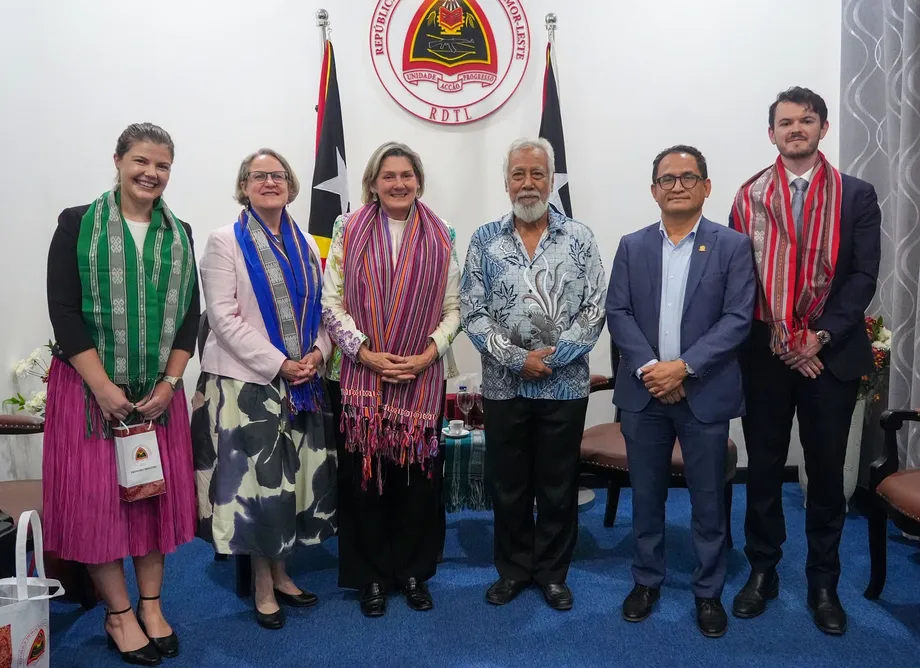
At a meeting at the Government Palace in Dili on 25 September 2026, Prime Minister Kay Rala Xanana Gusmão and Minister of Petroleum and Mineral Resources Francisco da Costa Monteiro received an update from Australia's Special Envoy for the Greater Sunrise Project, Katrina Cooper. Australian Ambassador to Timor-Leste Caitlin Wilson also attended.
Monteiro said the latest negotiations in Canberra had produced technical agreement on the Petroleum Mining Code, the Production Sharing Contract and the Fiscal Regime. Together, these instruments address the rules for petroleum activity, the relationship between the authorities and the contractor, and the taxes applying to the project.
The documents will now enter each country's approval process. In Timor-Leste, they will go to the Council of Ministers and then the National Parliament. Australia will follow its government procedures. The evaluation and approval process is expected to take about three months, placing the anticipated completion around December 2026 if that estimate holds.
This is a legal and contractual milestone, not an announcement that construction can begin. Monteiro said the focus next year would shift to the approved single development concept and detailed design, with future construction in view. Operational documents for subsequent project phases also remain under preparation.
What the three documents will govern
The Petroleum Mining Code establishes the legal and regulatory framework for exploration and development in the Greater Sunrise Special Regime Area. It provides the rules under which petroleum activities can take place within an area jointly governed through arrangements agreed by the two countries.
The Production Sharing Contract sets out the contractual relationship and production sharing between the responsible public authority and the contracting parties. A production sharing contract determines how petroleum production is allocated under the contract. It is distinct from the treaty rules dividing upstream revenue between Australia and Timor-Leste.
The Fiscal Regime specifies taxation and other fiscal obligations for activities in the area. Its importance extends beyond stating tax rates: the maritime treaty requires it to specify how the two countries' taxation laws apply to the contractor.
The three documents therefore perform different functions within the same project framework. Agreement on regulatory rules does not, by itself, settle contractual terms or taxation. September's announcement is broader than the progress reported in March because it brings all three instruments to the stage of internal approval.
The treaty sets the approval responsibilities
The maritime boundaries treaty between Australia and Timor-Leste establishes the Greater Sunrise Special Regime in Article 7 and sets out its operation in Annex B. The stated objective is the joint development, exploitation and management of petroleum in the Greater Sunrise fields for the benefit of both countries.
The treaty gives the Governance Board responsibility for approving the final Petroleum Mining Code, its regulations and subsequent amendments. The Designated Authority is responsible for entering into the Greater Sunrise Production Sharing Contract, subject to Governance Board approval.
Those responsibilities matter when interpreting the latest announcement. Technical agreement among negotiating teams, approval through national institutions and decisions by the treaty's governance bodies are distinct steps. The September update describes the domestic approval process but does not give separate dates for each Governance Board decision.
Annex B also provides for an Interim Petroleum Mining Code to govern development, exploitation and exports until the final code is approved. It says the Governance Board should seek to approve and issue the final code within six months of the treaty entering into force or, if that is not achieved, as soon as possible afterward. That wording establishes a target while expressly allowing for later completion.
Revenue shares depend on the pipeline destination
The treaty already defines how Australia and Timor-Leste will divide upstream revenue under two pipeline options. If Greater Sunrise is developed through a pipeline to Timor-Leste, Timor-Leste receives 70% and Australia 30%. If the pipeline goes to Australia, the shares become 80% for Timor-Leste and 20% for Australia.
Timor-Leste's treaty share is therefore 10 percentage points higher under the Australian pipeline option. Australia's share is 10 percentage points lower. These figures concern a defined category of petroleum revenue, not every economic benefit associated with the development.
Annex B limits upstream revenue to first tranche petroleum, profit petroleum and applicable taxation. First tranche petroleum and profit petroleum are categories used to allocate petroleum under production sharing arrangements. The treaty also limits the taxation included in upstream revenue to specified petroleum activities and installations before the valuation point, the reference point used to value petroleum under the arrangements.
For other activities related to development and exploitation in the Special Regime Area, Timor-Leste's taxation law applies unless the treaty provides otherwise. The Fiscal Regime must translate these treaty provisions into agreed tax arrangements for the project.
Timor-Leste continues to support processing Greater Sunrise oil and gas onshore in its own territory to secure domestic economic benefits. The revenue percentages alone cannot establish which option would deliver the larger total benefit to the country. The September announcement gives no cost estimates or projections of processing income, employment or other domestic activity with which to make that comparison.
How negotiations reached this stage
The September agreement follows a sequence of ministerial commitments and technical negotiations. The progression shows that work on the regulatory code advanced before the full package of contractual and fiscal documents reached the same stage.
- 29 October 2024: Australian Resources and Northern Australia Minister Madeleine King and Monteiro met at the International Mining and Resources Conference in Sydney and supported continued negotiations on the three instruments.
- February 2026: The Petroleum Mining Code was reported as finalized, according to the progress update issued in March.
- 15 March 2026: A Dili update said the Fiscal Regime and Production Sharing Contract were expected to be concluded during 2026. A further meeting in Canberra was planned for July.
- 25 September 2026: Monteiro announced technical agreement on all three documents following the latest Canberra negotiations, with internal approvals expected to take about three months.
- 2027: The minister expects attention to turn to the approved single development concept and detailed design.
The March description of the mining code as finalized and September's announcement of agreement on the full package are not necessarily contradictory. The earlier account identified completion of one instrument; the later account addressed all three and their submission for approval. Neither announcement, on its own, establishes that every formal approval required by the treaty has been completed.
Development planning remains a separate decision
In March, Monteiro said the Sunrise Joint Venture was expected to submit a development concept plan once the Fiscal Regime and Production Sharing Contract were finalized. The treaty defines a development concept as the basic terms on which the Greater Sunrise fields are to be developed.
That makes the concept a separate step from agreeing the project's legal framework. The documents establish the rules and obligations governing development, while the concept sets out the basic approach to carrying it out.
The September update points to work on an approved single concept and detailed design next year. It does not name a selected pipeline destination, describe an approved processing arrangement or identify a date for construction to start. Timor-Leste's support for processing in its own territory should therefore be distinguished from a confirmed project decision.
The three governments and commercial parties involved in the negotiations must also continue preparing operational documents for later phases. The latest announcement signals progress toward development, but it provides no firm timetable for first production.
A wider agenda for resources cooperation
Greater Sunrise was part of a broader resources discussion before the latest agreement. In their October 2024 joint statement, published by the Australian resources minister's office, King and Monteiro supported continued talks with the Sunrise Joint Venture on the mining code, fiscal arrangements and production sharing contracts.
The ministers also stated their position on the project's economic basis:
The Ministers continued their commitment to the mutually beneficial and commercially viable development of the Greater Sunrise project.
The statement discussed the contribution of Timor-Leste's minerals and mining sector to economic development and diversification. Australia expressed support for activities intended to strengthen the national economy, broaden revenue sources and promote private industry development. Officials were tasked with identifying future areas of collaboration in minerals and mining.
The ministers also committed to working on legal and regulatory frameworks allowing carbon dioxide to move between the countries for storage in reservoirs beneath the sea. That is a distinct strand of bilateral cooperation. The statement does not establish that a particular carbon storage arrangement has been approved as part of Greater Sunrise.
What remains to be approved and announced
The immediate next step is the internal assessment of the three agreed instruments. Timor-Leste has identified the Council of Ministers and National Parliament as the institutions through which its approvals will proceed. The announcement gives no parliamentary sitting date or separate Australian decision deadline.
The estimated three months is therefore a working timetable, not a confirmed completion date. Subsequent announcements will need to establish whether domestic approvals have been obtained and how the relevant treaty governance decisions have been completed.
Beyond those approvals, the development concept, detailed design and remaining operational documents will determine how the project advances toward construction. The September agreement narrows the outstanding legal negotiations, while leaving the practical development choices and construction schedule to later decisions.
Key Points
- Technical agreement has been reached on the Petroleum Mining Code, Production Sharing Contract and Fiscal Regime.
- Domestic evaluation and approval are expected to take about three months from September 2026.
- The treaty assigns approval roles to the Governance Board and contractual responsibilities to the Designated Authority.
- Timor-Leste receives 70% of upstream revenue with a pipeline to its territory, or 80% with a pipeline to Australia.
- Timor-Leste continues to support domestic processing, but the September announcement does not identify a selected pipeline destination.
- Development concept and detailed design work are expected to become the focus in 2027; no construction or production date has been announced.