
How chemistry learned to favor one mirror image
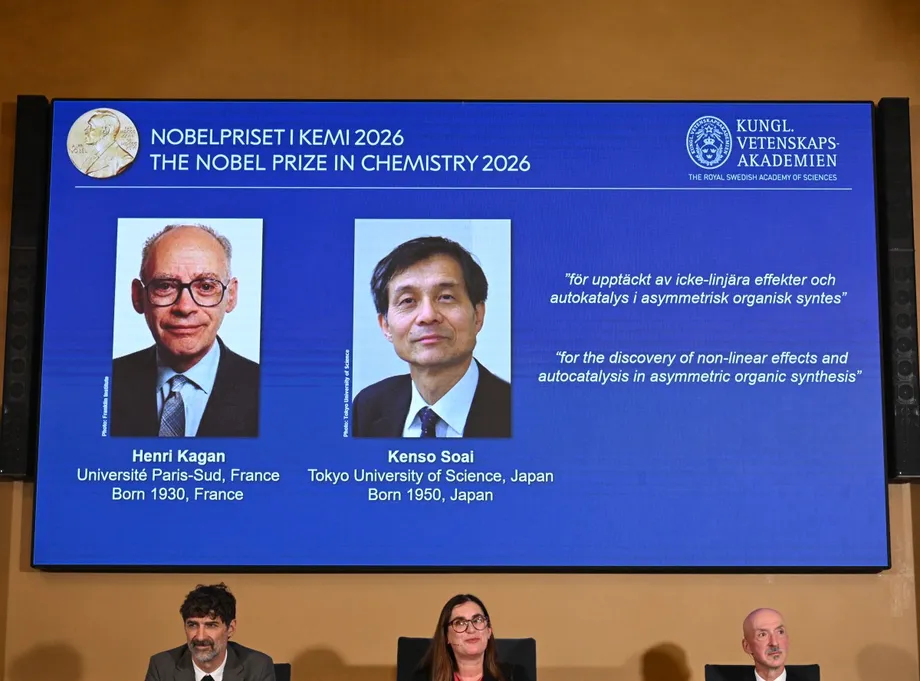
Japanese chemist Kenso Soai and French chemist Henri B. Kagan have won the 2026 Nobel Prize in Chemistry for discoveries showing how chemical reactions can favor one of two mirror image forms of a molecule. Their work addresses a long standing puzzle about life’s chemistry: why many essential biological molecules are found overwhelmingly in just one of their two possible forms.
Contents
The Royal Swedish Academy of Sciences announced the award in Stockholm on Wednesday. It cited the pair’s “discovery of non-linear effects and autocatalysis in asymmetric organic synthesis.” The 12 million Swedish kronor prize will be divided equally between the laureates, with the award ceremony scheduled for Stockholm on December 10, the anniversary of Alfred Nobel’s death.
Soai, a professor emeritus at Tokyo University of Science, learned of the prize while shopping near his home. Speaking by phone to the Nobel committee, he called the news one of the most exciting days of his life and said he was glad to share the honor with Kagan, a professor emeritus at the former Université Paris-Sud. At a later university press conference, Soai thanked his students and colleagues, saying their help had been essential to his work.
The award recognizes basic research with practical value for chemists who make medicines, materials, fragrances and other compounds. It also highlights a laboratory reaction that offers a way to investigate how life’s characteristic molecular handedness might have arisen, although researchers caution that the reaction itself is not considered a direct model of chemistry on early Earth.
What does molecular handedness mean?
Some molecules exist in two forms that have the same atoms connected in the same order but are arranged as mirror images. Like a left and right hand, the pair cannot be placed on top of each other so that every part matches. Chemists call this property chirality and call the two forms enantiomers.
The distinction can matter greatly in living systems. Proteins are built almost entirely from L amino acids, while the sugars in DNA and RNA have the opposite D configuration. A molecule’s two forms can interact differently with the body because biological structures, including proteins, are themselves chiral. One form of a drug may have a desired effect, while its mirror image may have a weaker or different effect, or unwanted side effects.
That makes chirality a practical concern in drug development, not just an abstract feature of molecular geometry. It also gives scientists a striking question about life’s origins. Many ordinary reactions that create chiral molecules produce roughly equal amounts of each mirror image. How, then, did life come to rely so strongly on one form of many biological building blocks?
The puzzle has a long history. In the 19th century, Louis Pasteur separated two forms of tartaric acid crystals and found that their solutions turned polarized light in opposite directions. His experiments helped establish that some molecules have mirror image forms. Later work showed that bacteria could consume one form of tartaric acid while leaving its mirror image untouched, pointing to the unusual selectivity of living chemistry.
How did Kagan change the picture?
A key theoretical idea came in 1953, when physicist Charles Frank described how a reaction that makes its own chiral catalyst could reinforce a small initial imbalance. A catalyst speeds a reaction without being consumed. If the reaction produces more of the catalyst that favors one mirror image, that catalyst could, in turn, help make still more of the same form.
For decades, this proposal remained difficult to realize in a laboratory. Kagan’s work supplied an important part of the answer. In 1986, he and colleagues showed that the relationship between the handedness of a catalyst and the handedness of its products was not always a simple one to one relationship. A modest excess of one catalyst form could lead to a much larger excess of one product form.
This is called a non-linear effect. The term describes a result that does not rise in direct proportion to the initial imbalance. In some reactions, catalyst molecules can pair up in different combinations. If a mixed pair of opposite handedness reacts less effectively than pairs of the same handedness, the reaction can favor one product more strongly than the catalyst mixture alone would suggest.
Kagan’s finding mattered to synthetic chemists because it showed that highly one sided products could sometimes be made without starting with an equally pure catalyst. It also gave researchers a way to think about how a small bias in a chemical system could grow. His work helped turn a mathematical possibility into a question that chemists could test through experiments.
What made the Soai reaction a breakthrough?
Soai pursued a further possibility: a reaction product that acts as a catalyst for making more of itself. This process is autocatalysis. When the product is chiral and preferentially produces more of its own mirror image form, the reaction can amplify a small imbalance through a feedback loop.
Soai and his colleagues reported an early autocatalytic reaction in 1990. In 1995, they published a related reaction that became the landmark Soai reaction: a chiral product catalyzed its own formation in a way that could increase the predominance of one enantiomer. In 2003, the team reported a version that amplified a very small initial imbalance to produce material that was 99.75 percent one enantiomer.
The result demonstrated in the laboratory that a reaction could move toward near one sidedness without relying on an external chiral molecule to dictate which form should dominate. Heiner Linke, chair of the Nobel Committee for Chemistry, said Kagan and Soai had provided “a solution to a chemical mystery that is over a century old: how homochirality can emerge spontaneously.” Homochirality means that a system uses predominantly one of two possible molecular forms.
The reaction is often discussed in connection with the origin of life, but that connection needs qualification. The Soai reaction shows how chemical feedback can magnify a small imbalance. Researchers have pointed out that it requires particular reagents and conditions, including conditions incompatible with water, making it unlikely to have occurred exactly as designed on prebiotic Earth. Its importance lies partly in demonstrating a principle that researchers can compare with other possible routes to molecular asymmetry.
Why the work matters beyond origins research
Controlling molecular handedness is central to making many drugs and other useful chemicals. A reaction that selectively creates one enantiomer can reduce the need to separate a mixture afterward and can help manufacturers make compounds with more predictable properties. The Nobel recognized discoveries that have shaped how chemists understand and design such reactions.
The history of medicine has underlined the stakes. Thalidomide, prescribed in the early 1960s to treat morning sickness, was associated with severe birth defects. Research later drew attention to differences between the biological effects of its mirror image forms. The example is often cited to explain why chemists study chirality, though the biological behavior of thalidomide is more complicated than a simple division in which one form is harmful and the other safe.
Other familiar molecules also show how mirror images can have different properties. The two forms of carvone, for example, are associated with mint and caraway scents. The same principle can influence how medicines, pesticides and other compounds interact with biological targets. A molecule’s structure, including its handedness, helps determine what it does.
Kagan and Soai’s work also sits within a broader development of asymmetric synthesis, the practice of steering reactions toward a chosen enantiomer. The 2001 chemistry Nobel recognized William Knowles, Ryoji Noyori and Barry Sharpless for advances in asymmetric catalysis. Kagan and Soai addressed a related but distinct question: how imbalances can be amplified, including through a product that catalyzes its own formation.
A basic science prize with a Japanese connection
Soai was born in Hiroshima Prefecture in 1950, studied at the University of Tokyo and earned a doctorate in science. After research appointments in Japan and at the University of North Carolina, he became a professor at Tokyo University of Science. He received Japan’s Medal with Purple Ribbon in 2012 and is now a professor emeritus.
At the award day press conference, Soai described research as a process of continuing experiments without knowing whether the intended result would appear. He said he had not dwelled on the difficulties because discovering new experimental facts brought joy and wonder. He also credited the university’s research environment and the students who worked with him.
The award is the third consecutive year in which a person or organization from Japan has received a Nobel Prize, following Japanese recipients in 2024 and 2025. Soai is also among a long line of Japanese chemists recognized for work in organic chemistry, a field concerned with carbon containing compounds that include proteins, sugars and many medicines.
What remains open in the science?
The prize does not settle how life’s one sided chemistry began. It recognizes experimental and conceptual advances that show how a chemical imbalance can be strengthened, while leaving open which processes operated in nature before life emerged. Researchers continue to investigate alternative mechanisms, including effects involving crystals, surfaces and physical conditions that may favor one form over another.
That distinction is part of the value of the work. The Soai reaction offers a powerful example of asymmetric autocatalysis, while Kagan’s non-linear effects help explain how catalyst mixtures can produce unexpectedly strong preferences. Together, the discoveries give chemists tools for studying molecular handedness in both practical synthesis and questions about life’s origins.
Soai said he hopes the recognition will bring more attention to organic synthesis and help research continue. The Nobel Prize celebrates a chain of work that began with a century old puzzle and produced a striking laboratory demonstration: under the right conditions, chemistry can favor one mirror image and reinforce that choice.
Key Points
- Kenso Soai and Henri B. Kagan won the 2026 Nobel Prize in Chemistry.
- The award recognizes non-linear effects and autocatalysis in asymmetric organic synthesis.
- Kagan showed in 1986 that a small catalyst imbalance can produce a larger imbalance in reaction products.
- Soai’s reaction demonstrated how a chiral product can catalyze the production of more of its own form.
- The findings inform chemical synthesis and offer a model for studying, but do not resolve, how life’s molecular handedness began.