
Two stellar nurseries inside an ancient explosion
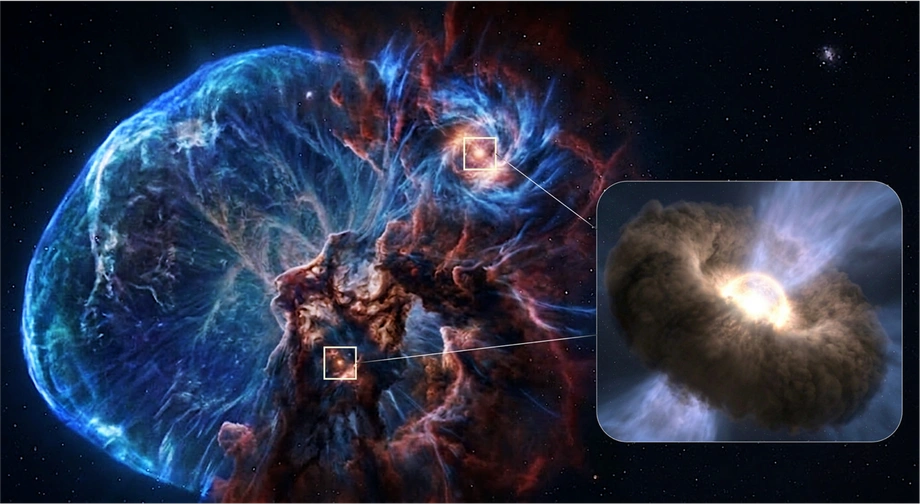
Astronomers have detected two compact nurseries of newborn stars inside RX J1713.7-3946, the expanding remnant of a stellar explosion about 1,600 years ago. One nursery contains complex organic molecules with up to nine atoms, yet its measured chemical proportions resemble those found around young stars in more ordinary environments.
Contents
- Two stellar nurseries inside an ancient explosion
- What ALMA observed
- Why a hot core can still be extremely cold
- A varied inventory, not evidence of biology
- The strongest comparison comes from molecular ratios
- A violent setting with uneven exposure
- Two possible reasons the chemistry persisted
- Why this matters for the Sun's birthplace
- The timeline and the next observations
- Key Points
The discovery, made with the Atacama Large Millimeter/submillimeter Array (ALMA), is the first reported detection of hot molecular cores inside a supernova remnant. These cores are dense pockets of warm gas surrounding stars that are still forming. Finding them in a region exposed to powerful radiation and shock waves gives astronomers a new way to investigate whether the ingredients of future planetary systems can withstand a nearby stellar explosion.
The remnant lies roughly 3,600 light years away. Both cores, designated HC1 and HC2, are associated with protostars more massive than the Sun. The detailed chemical analysis focused on HC1, where the team found molecules containing carbon, oxygen, nitrogen, sulfur and silicon.
Gifu University announced the results on July 9, 2026. Its research announcement gives July 1, 2026, as the publication date in The Astrophysical Journal. The study was conducted by Takashi Shimonishi, an associate professor at Niigata University; Hidetoshi Sano, an associate professor at Gifu University; Kenji Furuya, a researcher at RIKEN; and Yoko Oya, a lecturer at Kyoto University.
The central finding is about chemical survival, not the detection of life. Organic molecules can contribute to chemistry relevant to living systems, but their presence alone does not establish that biological processes have occurred.
What ALMA observed
The team observed the region during ALMA Cycle 11, in December 2024 and January 2025. Earlier radio observations had identified the two locations as likely sites of star formation, including evidence of gas jets extending in opposite directions from embedded objects.
ALMA resolved a compact source at each location. The telescope combines signals from 66 dish antennas in the Atacama Desert of northern Chile, at an altitude of about 5,000 meters. For these observations, its angular resolution was approximately 0.5 arcseconds, allowing the researchers to distinguish small concentrations of molecular gas.
The team's research paper identifies both objects as Class I protostars of intermediate mass. Class I describes an early stage in which a developing star remains surrounded by substantial material. Neither object is a finished star like the present Sun.
Both cores lie inside the remnant's shell as traced by X ray emission. That location establishes their association with the supernova environment, but it does not mean every part of each core has experienced the same radiation or shock exposure.
Why a hot core can still be extremely cold
HC1 contains molecular gas with an estimated density of about 10 million molecules per cubic centimeter, a temperature of at least 100 kelvin, and a compact emitting region smaller than 500 astronomical units. One astronomical unit is the average distance between Earth and the Sun.
A temperature of 100 kelvin is about minus 173 degrees Celsius. That is cold by everyday standards, but warm compared with the molecular clouds from which stars form. The ALMA institutional explanation describes those clouds as having temperatures below minus 260 degrees Celsius.
The temperature difference matters chemically. Molecules can form and accumulate as ice on the surfaces of dust grains in cold clouds. As a newborn star warms its surroundings, those ices can pass directly into gas through sublimation, making their molecules accessible to radio observations. A hot core therefore reveals part of the chemical inventory held in material around a developing star.
A varied inventory, not evidence of biology
The detected molecules include methanol, ethanol, methyl formate, dimethyl ether and formamide. The university announcement also reports water. Together, the detections show that the gas contains a range of chemical species rather than just one surviving organic compound.
In astronomy, a complex organic molecule is generally defined as an organic molecule containing at least six atoms. Some molecules detected in HC1 contain as many as nine. The word complex describes their molecular structure under that astronomical definition, not a demonstrated biological role.
The presence of these compounds is relevant because organic material can become part of the matter from which planetary systems develop. It does not show that planets have already formed around these protostars, that the material will necessarily reach a planet, or that any living organism exists there.
Shimonishi, who led the study at Niigata University, described the broader significance of the discovery:
"The environments capable of harboring complex organic molecules – potential building blocks of prebiotic chemistry – may be more diverse than previously recognized," said Shimonishi.
The strongest comparison comes from molecular ratios
Detecting organic molecules in HC1 was only part of the result. The researchers also compared the proportions of selected molecules with measurements from hot cores and hot corinos in more typical regions of star formation. Hot corinos are warm molecular regions associated with relatively low mass protostars, including stars closer to the Sun in mass.
For HC1, the study examined methyl formate, dimethyl ether and acetaldehyde relative to methanol. It also measured a form of methanol containing deuterium, a heavier isotope of hydrogen, relative to ordinary methanol. Other comparisons included carbonyl sulfide relative to methanol and ethyl cyanide relative to methyl cyanide.
The paper reports that these column density ratios are indistinguishable from those measured in the comparison environments. Column density measures how much material lies along the viewing direction. Using ratios helps compare chemical mixtures rather than simply comparing how much gas each object contains.
This is more precise than saying HC1 is chemically identical to an ordinary stellar nursery. The selected ratios show no detectable difference in these measurements. They do not establish that every molecule, every physical condition or the complete chemical history is the same.
A violent setting with uneven exposure
RX J1713.7-3946 is a young supernova remnant. The ALMA research announcement associates its explosion with an event recorded in Chinese historical documents about 1,600 years ago. It describes an environment containing intense cosmic rays, strong X ray and gamma ray emission, and shock waves traveling at thousands of kilometers per second.
Cosmic rays are energetic particles. Along with radiation and shocks, they can alter molecular gas and its chemistry. Such conditions create competing possibilities: molecules may be broken apart, while some reactions may also be stimulated. The new observations show that a rich molecular mixture exists in this setting, but do not isolate every process responsible for it.
HC1's position is especially relevant. Although it lies inside the shell, the research paper places it near the outer edge. A report describing both objects as deep within the shell is less specific than the paper's location for HC1. Being inside the boundary is not equivalent to having spent the entire lifetime of the remnant under its harshest conditions.
Two possible reasons the chemistry persisted
The researchers propose two explanations for HC1's apparently ordinary molecular ratios. The first is limited exposure time. Its surroundings may only recently have begun experiencing the supernova environment, leaving insufficient time for energetic particles and radiation to produce a measurable chemical change.
The second involves magnetic fields strengthened by the supernova's effects on surrounding gas. Such fields could restrict the penetration of cosmic rays into the dense core, reducing one route through which the molecules might be damaged.
These explanations are possibilities, not confirmed mechanisms. The observations do not establish which one dominates, whether both contribute, or how the molecular mixture will change as exposure continues. The remnant's age of approximately 1,600 years cannot be treated as the measured exposure time of HC1.
That distinction limits the survival claim. The study demonstrates chemical richness in a nursery located within a recent supernova remnant. It does not prove that every detected molecule endured the original blast unchanged or that similar cores will retain their chemistry indefinitely.
Why this matters for the Sun's birthplace
The solar connection comes from radioactive isotope evidence discussed in the ALMA announcement. Analyses of material from the early Solar System suggest that its formation may have occurred in an environment influenced by supernova explosions. That makes protostellar cores near remnants useful objects for investigating a possible setting for the Sun's birth.
The discovery supplies an observed example of organic molecular richness in such a setting. Previously, the absence of a detected hot core in a region affected by a recent supernova left a gap between the proposed environment and direct measurements of warm molecular chemistry.
HC1 and HC2 are not exact copies of the young Sun. Their protostars have intermediate masses, and the detailed chemical comparisons center on HC1. The useful connection is narrower: material around a forming star can remain chemically varied within a supernova environment, at least under the conditions measured here.
The timeline and the next observations
The observations and publication followed this sequence:
- About 1,600 years ago: the explosion that created RX J1713.7-3946 occurred, with the ALMA announcement linking it to Chinese historical records.
- December 2024 and January 2025: ALMA observed the two sites during Cycle 11.
- July 1, 2026: the study appeared in The Astrophysical Journal, according to Gifu University.
- July 9, 2026: Gifu University issued its research announcement.
The ALMA announcement also identifies The Astrophysical Journal as the publishing journal, but leaves its publication date as an unfilled placeholder. Gifu University supplies the specific date. Both official announcements identify the same paper and DOI, 10.3847/1538-4357/ae6fba.
The team plans further ALMA observations. The institutional announcement also points to broader radio observations of molecular gas and infrared observations of dust and ice as ways to investigate these environments. No specific observing date or deadline for new results has been announced.
The next measurements need to establish whether HC1 is representative or unusual, how much shielding its surroundings provide, and whether other nurseries show similar chemical proportions. Observations of more objects would help distinguish a general pattern from a result dependent on one core's position and recent history.
Key Points
- ALMA detected two hot molecular cores, HC1 and HC2, inside the supernova remnant RX J1713.7-3946.
- The remnant is about 1,600 years old and roughly 3,600 light years away.
- HC1 contains complex organic molecules with up to nine atoms and gas at least 100 kelvin in temperature.
- Selected molecular ratios in HC1 match those measured in more typical regions of star formation.
- Recent exposure and magnetic shielding are proposed explanations, not confirmed causes.
- The findings inform studies of possible Solar System birth environments but do not constitute evidence of life.
- Further observations are planned, with no specific date announced.