
A map of where ancient Martian chemistry could begin
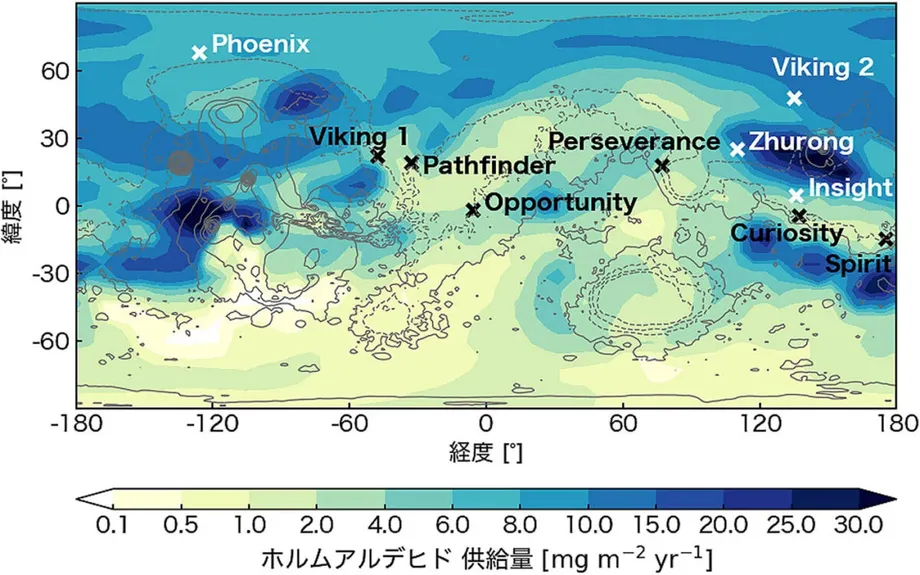
Rain on ancient Mars may have delivered a chemical ingredient for life's building blocks in amounts that varied roughly 100 times from one region to another, according to simulations of the planet around 3.8 billion to 3.6 billion years ago. The estimated global average was about 5 milligrams of formaldehyde per square meter each year, while areas around the Tharsis and Elysium mountains reached about 50 milligrams.
Contents
- A map of where ancient Martian chemistry could begin
- Why formaldehyde matters to the search for life's origins
- How the researchers connected chemistry and climate
- Water helped make the molecule and carry it down
- Mountains and northern waters received more
- Why a nearby basin could be a better chemical gathering place
- How rover measurements could test the map
- What the study leaves unresolved
- Key Points
The research identifies a possible connection between atmospheric chemistry, rainfall and places where organic molecules could have accumulated. It does not establish that life existed on Mars, or that the predicted quantities of formaldehyde survive today. Instead, it offers a geographical prediction that researchers could compare with measurements of ancient rocks.
The team included scientists from Tohoku University, the Earth-Life Science Institute and the Institute of Science Tokyo. Tohoku University's research announcement, dated October 1, 2026, identifies the study as Global distribution of atmospheric formaldehyde deposition correlated with water vapor on a warm early Mars, published in The Planetary Science Journal on September 30, 2026. It lists the paper's DOI as 10.3847/PSJ/ae9942.
Why formaldehyde matters to the search for life's origins
Formaldehyde, written chemically as H2CO, is strongly irritating and toxic. Its relevance to this research comes from a different property: in water, it can participate in reactions that lead toward sugars, amino acids and other organic compounds associated with life.
That makes it a possible starting ingredient for prebiotic chemistry, meaning chemistry that occurs before life exists. Detecting or predicting such an ingredient is not the same as finding a living organism. Organic molecules can form through chemical processes without biology.
Earlier research had already indicated that formaldehyde could form in the atmosphere of warm ancient Mars. The new question was where it would reach the surface, and in what amounts. An atmosphere capable of making a useful molecule does not necessarily deliver that molecule evenly to lakes, rivers or other places where further reactions might occur.
How the researchers connected chemistry and climate
The team combined a photochemical model with a global climate model. Photochemistry describes reactions driven by light, in this case including ultraviolet radiation that changes molecules in the Martian atmosphere. The climate model calculated atmospheric circulation, temperature, water vapor, clouds and precipitation across the planet.
The researchers first calculated formaldehyde production under different combinations of surface temperature, water vapor, atmospheric pressure and ultraviolet intensity. They organized those results into a reference table, which the climate model could use to estimate chemical production under conditions in different regions.
This approach moved beyond earlier calculations that represented the atmosphere through a single vertical dimension and a planetary average. Those calculations could explore whether formaldehyde formation was possible, but could not capture the geographical differences in humidity and rain needed to map delivery to the ground.
The simulations assumed a warm environment during the period about 3.8 billion to 3.6 billion years ago. Geological and mineral evidence suggests that Mars experienced episodes when liquid water could exist at the surface. The model examines what chemical delivery could have looked like under those conditions; it does not demonstrate that the entire planet stayed warm and wet throughout that interval.
Water helped make the molecule and carry it down
Water vapor mattered at two stages. First, ultraviolet light broke apart water molecules, releasing reactive hydrogen involved in the atmospheric reactions that produced formaldehyde. Regions with more atmospheric moisture therefore had conditions favorable to making the molecule.
Second, rain dissolved formaldehyde and transported it to the surface. Moisture influenced both the production of the chemical and its delivery, helping explain why the predicted distribution was so uneven.
This distinction is central to the findings. A location's supply depended on more than the amount of formaldehyde produced above it. Rainfall also controlled how effectively the atmosphere transferred that chemical into surface water. The resulting map connects the Martian water cycle to the places where ingredients for further organic chemistry could have arrived.
Mountains and northern waters received more
The simulations predicted relatively high delivery over the assumed northern ocean and in the Hellas basin. Average delivery in the northern hemisphere exceeded that in the southern hemisphere by several times, although the findings described here do not give a precise ratio.
Mountain terrain produced another pattern. Around Tharsis and Elysium, air rising along slopes promoted precipitation, creating local areas of high formaldehyde delivery. This is a terrain effect: when moist air rises, cooling can encourage cloud formation and rain.
The maximum estimate of about 50 milligrams per square meter per year was approximately ten times the global average of 5 milligrams. That comparison is different from the roughly 100 times variation reported across regions. The first compares the highest delivery with the planetary average; the second describes the wider geographical range. Neither figure measures the amount of formaldehyde now present in Martian soil.
The results also caution against treating an entire hemisphere as chemically uniform. Although the north received more on average, the Hellas basin was another area of relatively high supply. Local water availability and terrain mattered alongside the broader contrast between north and south.
Why a nearby basin could be a better chemical gathering place
The places receiving the most rain were not necessarily the same places where formaldehyde became most concentrated. The researchers identify basins near wet regions as promising settings because water could transport material into them and then evaporate.
Delivery and concentration describe different things. Delivery is the amount arriving at the surface over a given area and time. Concentration is how much of a substance is present relative to the water containing it. A large input into abundant water can remain dilute, while water loss through evaporation can concentrate material that remains.
In the proposed scenario, rainfall supplied formaldehyde to a wet region, rivers or other flows gathered it into a basin, and evaporation increased its concentration. Such a setting could have supported reactions leading to more complex organic molecules.
This remains a possibility rather than a demonstrated chemical history for a particular basin. The map estimates atmospheric supply. Establishing what happened after delivery requires understanding transport, reactions, destruction and preservation at the surface.
How rover measurements could test the map
One proposed test is to compare ancient layers of rock in regions predicted to have received different amounts of formaldehyde. Researchers could examine both the abundance of organic compounds and their carbon isotope patterns. Isotopes are forms of the same element with different numbers of neutrons, and their relative amounts can help investigate chemical origins.
Earlier work by the team suggested that carbon isotope characteristics associated with atmospheric formaldehyde could help explain organic material detected during Mars exploration. The new geographical predictions offer another way to investigate that possible connection, rather than relying on chemical composition alone.
Shungo Koyama, a researcher and study author, described how the predicted distribution could be compared with rover observations:
By comparing our map with findings from rovers, we can begin to test whether places that received more H₂CO were also more favorable for early life-related chemistry," said Dr. Koyama. "If future observations confirm this relationship, our map could help identify promising targets for future Mars missions.
A correspondence between predicted delivery and preserved organic chemistry would support the proposed atmospheric contribution. It would not, by itself, establish a biological origin. The researchers would still need to account for what happened to those compounds during their long history in Martian rocks.
What the study leaves unresolved
The principal uncertainty is the gap between modeled delivery billions of years ago and material that can be measured today. The estimates do not show how much formaldehyde accumulated permanently, how much reacted into other compounds, or how much was destroyed. They also do not establish that conditions suitable for the origin of life developed at any particular location.
The team plans to develop models that directly connect atmospheric chemistry and climate in three dimensions. This would extend the current method, which uses chemical calculations organized in a reference table within a global climate simulation.
Experiments on the breakdown and preservation of organic material are also planned. These could help connect predicted ancient inputs with the chemical traces that exploration might find. No date is given for those results, and the research does not announce a selected landing site or a scheduled mission to test the map.
The chronology separates the ancient environment being modeled from the modern publication:
- About 3.8 billion to 3.6 billion years ago: the period represented by the warm Mars simulations.
- September 30, 2026: the study's publication date listed by Tohoku University.
- October 1, 2026: the date of the university's research announcement.
The study's contribution is a testable geographical picture of chemical supply. Rather than identifying where life existed, it points to places where atmospheric ingredients may have arrived in greater quantities and where water could have gathered them for further reactions.
Key Points
- Modeled formaldehyde delivery varied roughly 100 times between regions on ancient Mars.
- The global average was about 5 milligrams per square meter annually, with local maxima near 50 milligrams around Tharsis and Elysium.
- Water vapor supported atmospheric production, while rainfall carried formaldehyde to the surface.
- Basins near wet regions may have collected and concentrated the chemical through water flow and evaporation.
- Comparisons of ancient organic compounds and carbon isotopes could test the predicted distribution.
- The findings concern possible chemistry before life, not evidence that Mars hosted life or measurements of formaldehyde remaining today.