
Four patients, two to four years of safety monitoring
Four men with severe cervical spinal cord injuries showed no tumor formation or adverse events attributed to transplanted neural progenitor cells during two to four years of follow up in a Japanese clinical study. Each patient received 2 million cells made from induced pluripotent stem cells, or iPSCs, injected into the damaged spinal cord. Two later improved from the most severe category of spinal cord impairment to categories indicating some recovery of movement below the injury.
Contents
- Four patients, two to four years of safety monitoring
- Who received the transplant?
- How the cells were prepared and delivered
- What the safety monitoring found
- Imaging remained free of signs of abnormal growth
- What changed in movement and daily independence?
- How recovery compared with the registry group
- What remains unproven
- The publication timeline and next steps
- Key Points
The findings, published July 21, 2026, in the Nature Medicine study, provide evidence that the procedure can be performed with an acceptable safety profile in a small, carefully selected group. They do not establish that the cells caused the improvements. The trial had four participants, no randomly assigned comparison group and no direct demonstration that the transplanted cells survived or became functioning parts of the spinal cord.
Keio University Hospital and Murayama Medical Center conducted the research in patients treated during the subacute period, the weeks shortly after injury. The study was the first clinical transplantation of iPSC derived neural stem/progenitor cells into an injured human spinal cord. Its main objective was safety, with neurological recovery assessed as an exploratory outcome.
The distinction matters: avoiding abnormal cell growth is a necessary step toward a potential treatment, while proving that a transplant restores function requires further testing. The results support continued clinical evaluation rather than a conclusion that an effective therapy is ready for routine use.
Who received the transplant?
Seven people underwent screening between December 2021 and November 2023, and four met the criteria for transplantation. All four were men, aged 26 to 66, with injuries at cervical levels C4 to C6, in the neck. Each had American Spinal Injury Association Impairment Scale grade A, known as AIS A, confirmed again on the day of transplantation.
AIS A means that testing detects no sensory or motor function in the lowest sacral segments used to classify a spinal cord injury. It describes a clinically complete injury, not necessarily a spinal cord that has been physically severed. The registered protocol excluded injuries involving complete transection or multiple damaged sites.
The protocol allowed a wider range of injuries, from C3/C4 in the neck to T10 in the chest region, and permitted both men and women aged 18 or older. The actual participants therefore represented a narrower group than the eligibility criteria. Findings from these four men cannot establish safety or benefit across all spinal cord injuries.
Patients also needed neurological stability and the ability to undergo surgery, immunosuppression and repeated assessments. Active infection, major organ dysfunction and severe respiratory problems were among the reasons for exclusion. After spinal stabilization at acute care hospitals, candidates were transferred to Keio University Hospital for evaluation.
How the cells were prepared and delivered
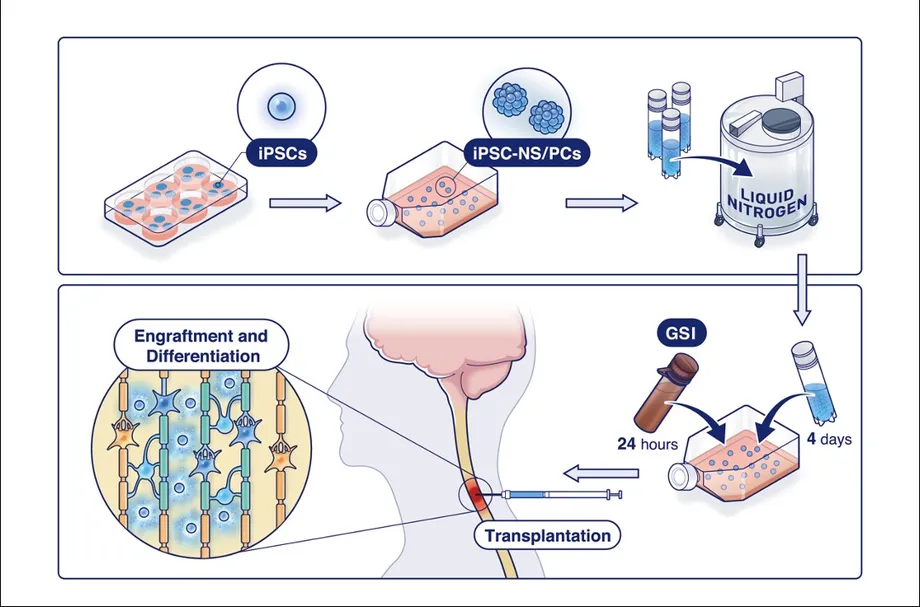
Induced pluripotent stem cells are adult cells reprogrammed into a state from which they can produce many types of cells. The transplant used neural progenitor cells, which have a more restricted capacity to develop into nerve cells and supporting cells called glia. The proposed approach is to introduce cells that might help repair damaged neural tissue, rather than transplant undifferentiated iPSCs.
The starting cell line, YZWJs513, came from umbilical cord blood donated by a healthy person and was established by Kyoto University's Center for iPS Cell Research and Application under Good Manufacturing Practice conditions. Osaka National Hospital produced the neural progenitor cells, which met predefined quality standards before use.
The product was frozen for storage and shipment to Keio. Four days before transplantation, the cells were thawed and cultured. They also received a 24 hour treatment with a gamma secretase inhibitor to suppress Notch signaling, a pathway involved in regulating cell development. The culture fluid and inhibitor were removed before the cells were suspended in artificial cerebrospinal fluid.
Each participant received one injection of 2 million cells into the center of the spinal cord lesion. Standard rehabilitation continued under Japan's national health insurance system. Because transplantation occurred alongside rehabilitation and natural recovery, subsequent changes in function cannot be assigned to the cells alone.
What the safety monitoring found
All four participants completed the initial 52 week study. Researchers recorded 84 adverse events, counting repeated occurrences separately. That total is important context for the headline finding: the study did not report an absence of medical problems. Instead, it found no adverse events attributed to the transplanted cells.
One event met the definition of a serious adverse event: a transient blood potassium measurement of 6 milliequivalents per liter. The participant had no symptoms, the finding resolved spontaneously, and researchers considered it most consistent with a blood sampling artifact rather than a genuine clinical abnormality.
Two moderate events were attributed to the operation: increased upper airway secretions and leakage of cerebrospinal fluid. Another 22 mild or moderate events were considered related to tacrolimus, the drug used to suppress immune responses against the donor cells. Low magnesium levels and urinary tract infections occurred in all four participants. Urinary infections are common after spinal cord injury, but a contribution from tacrolimus could not be excluded.
Tacrolimus began the day before transplantation, continued for six months and was discontinued by month nine. The findings therefore cover both the period of immune suppression and a longer period after it ended, when delayed problems might have emerged.
Imaging remained free of signs of abnormal growth
One major concern with therapies originating from pluripotent stem cells is that unwanted cells could multiply abnormally or form tumors. Researchers used repeated magnetic resonance imaging, or MRI, and a whole body PET scan at week 24 to look for suspicious changes. PET measures uptake of a radioactive tracer and can help identify areas of unusual metabolic activity.
During the first year, neither MRI nor PET showed evidence suggesting abnormal cell proliferation in the spinal cord. Later imaging also showed no signs of tumors or other abnormalities attributed to the graft. Some patients developed changes consistent with chronic myelomalacia, meaning damaged or softened spinal cord tissue, which researchers considered compatible with the natural course of the original injury.
Follow up lasted four years for the first patient, three years for the second, two and a half years for the third and two years for the fourth. No delayed serious adverse events or progressive neurological deterioration were identified. These observations support safety over the periods studied, but four patients are too few to rule out uncommon complications.
What changed in movement and daily independence?
All four patients improved on assessments of motor function and independence during the initial study period. The International Standards for Neurological Classification of Spinal Cord Injury motor score, which ranges from 0 to 100, measures muscle function. The median improvement from baseline to the reported week 52 assessment was 13 points, with individual gains ranging from 10 to 40.
Motor scores rose most rapidly during the first 12 weeks after transplantation, followed by slower gains in most participants through the first year. Sensory testing using light touch and pinprick also improved. These measurements describe observed recovery, but do not explain its cause.
Two participants changed AIS category: one from A to C and another from A to D. Both categories indicate a motor incomplete injury, with voluntary movement below the injury level. Grade D requires a greater proportion of the assessed muscles below that level to have enough strength to move against gravity. An AIS improvement alone does not establish a particular ability, such as independent walking.
Scores on the Spinal Cord Independence Measure III, which assesses daily activities, also rose in all participants. Beyond the first year, motor function and AIS categories remained largely stable. Modest later decreases in independence scores in two participants reflected changes in bladder management chosen for convenience, rather than neurological deterioration.
How recovery compared with the registry group
To put the changes in context, the researchers used the Japan Single Center Study for Spinal Cord Injury Database at the Spinal Injuries Center in Fukuoka. From 986 patients hospitalized between 2013 and 2024, they identified 52 who met the trial's eligibility criteria. This was a historical comparison, not a control group enrolled alongside the transplant recipients.
In the registry analysis using patients with measurements available at each assessment, median motor score gains were 5 points at week 24 and 7 points at week 52. The corresponding transplant group gains were 7 and 13 points. At week 52, the transplant group's median improvement was therefore 6 points greater than the registry figure.
Missing follow up measurements changed the registry estimates. An analysis that carried each patient's last recorded result forward produced median gains of 4 points at both assessments. This method retains patients without later measurements but assumes their last measured status remained unchanged.
Two of four transplant recipients, or 50%, reached AIS C or higher. In the registry, that outcome occurred in 3 of 25 patients with available week 52 assessments, or 12%, and in 8 of 52 patients, or 15.4%, using the carried forward analysis. The differences are encouraging, but each transplant recipient accounts for 25 percentage points. Small numbers, missing registry data and differences in patient selection prevent a reliable conclusion that transplantation outperformed standard care.
What remains unproven
The study was open, meaning patients and clinicians knew the treatment had been given, and everyone enrolled received it. Without random assignment to a contemporary comparison group, the effects of transplantation cannot be separated confidently from spontaneous recovery, rehabilitation or other aspects of care. The authors explicitly state that the improvements cannot be attributed to the transplant.
The researchers also could not directly demonstrate graft survival, development into different neural cell types or functional connections with the patients' existing nerve circuits. Stable imaging and the absence of deterioration after tacrolimus ended are compatible with graft persistence, but they are not proof that the cells survived or contributed to recovery.
Immune testing found no clear relationship between donor matching and neurological outcomes. Two patients shared donor variants at all six major human leukocyte antigen locations examined, while the other two had very limited matching. No signs of rejection were identified, but four observations cannot determine how much matching future recipients will need.
Pain and muscle stiffness were also monitored. All participants reported some pain, but none developed persistent pain rated 5 or higher on the numerical scale used, and symptoms were manageable with oral medication. Three had mild ankle spasticity at week 52, with no more severe spasticity or need for invasive treatment. Later assessments found no consistent increase in neuropathic pain.
The publication timeline and next steps
The work was led by Hideyuki Okano, director and professor of the Keio University Regenerative Medicine Research Center, and Masaya Nakamura, professor and chair of Keio's Department of Orthopaedic Surgery. Keio's July 27 statement brings together the initial clinical results and subsequent safety observations, and supports further development of the approach.
The UMIN trial record, identifier UMIN000035074, specified transplantation 14 to 28 days after injury, adverse events through one year as the primary outcome and effectiveness as a secondary outcome. It lists recruitment as completed. Its administrative dates and publication status need to be distinguished from the later paper:
- December 1, 2020: study information was publicly disclosed in the registry.
- December 2021 to November 2023: seven candidates were screened and four enrolled.
- November 30, 2024: the registry lists the last follow up date.
- September 18, 2025: the registry lists analysis as concluded.
- July 21, 2026: the combined findings were published online in Nature Medicine.
- July 27, 2026: Keio published its statement on the results.
The registry version last modified in October 2025 still labels the results unpublished and contains no outcome results. It therefore does not reflect the July 2026 publication or the full duration of follow up reported in the paper. The paper also lists registrations UMIN000050104 and jRCTa031190228.
No date for a new trial, regulatory decision or routine clinical availability is announced in these documents. The next scientific task is to test benefit more reliably in additional patients while continuing to monitor delayed safety problems and finding ways to assess whether the graft survives and functions.
Key Points
- Four men with complete cervical spinal cord injuries each received 2 million iPSC derived neural progenitor cells.
- No tumors or adverse events attributed to the transplanted cells were identified during two to four years of follow up.
- The study recorded 84 adverse events, including problems associated with surgery and immune suppression.
- Median motor score improvement reached 13 points at week 52, and two patients improved from AIS A to C or D.
- Recovery figures exceeded historical registry comparisons, but the study cannot establish that transplantation caused the gains.
- Graft survival and function were not directly demonstrated, and further clinical testing is needed.