
Lower dementia odds associated with fewer risk factors, even with one APOE ε4 copy
A study of 9,605 Japanese adults aged 65 or older found that a more favorable health and lifestyle risk profile was associated with lower odds of dementia among people carrying one copy of APOE ε4, a major genetic risk factor for Alzheimer's disease. The same association appeared in people with no ε4 copies, but was not demonstrated among the 87 participants carrying two.
Contents
- Lower dementia odds associated with fewer risk factors, even with one APOE ε4 copy
- What the genetic comparison actually showed
- Seven factors formed the risk score
- The association was weaker with one ε4 copy
- Why the two copy result is not a verdict on prevention
- Brain scans supported part of the pattern
- Blood markers told a more selective story
- Eight communities used a common assessment process
- Publication dates differ, and causal evidence is still needed
- Key Points
The differences were substantial. Compared with people in the same genetic group who had higher risk scores, those with lower scores had 65% lower adjusted odds of existing dementia among people without ε4, and 40% lower odds among those with one copy. These are differences in odds, not proof that changing habits would reduce an individual's future dementia risk by those percentages.
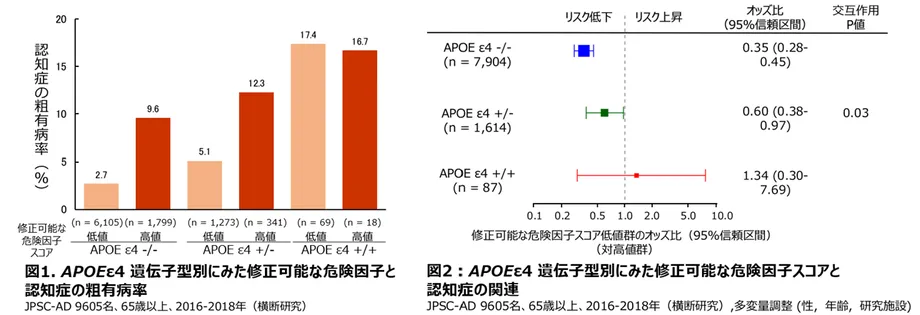
For people with two ε4 copies, dementia prevalence was similar across the two risk categories: 17.4% in the lower score group and 16.7% in the higher score group. That finding requires caution because this genetic subgroup was small and its statistical estimates were imprecise.
Kyushu University's research announcement, dated June 5, 2026, presents the findings as evidence that managing modifiable factors may help people with some inherited susceptibility. The study itself, however, examined dementia and risk factors at the same point in time. It did not test a prevention program or establish that a favorable profile caused better outcomes.
What the genetic comparison actually showed
APOE is a gene involved in lipid metabolism. Its ε4 variant is associated with Alzheimer's disease, but carrying it is not equivalent to having a dementia diagnosis. People normally inherit one APOE copy from each parent. A person with one ε4 copy is described as a heterozygote; someone with two is a homozygote.
The study included 7,904 people without ε4, 1,614 with one copy and 87 with two. The last group represented about 0.9% of participants, calculated from 87 out of 9,605. Distinguishing these groups matters because combining everyone with ε4 into a single category would conceal the different patterns observed.
In the published study, adjusted dementia odds were 2.30 times those of people without ε4 for participants with one copy, and 11.04 times for those with two. The corresponding 95% confidence intervals were 1.76 to 2.97 and 5.33 to 21.68. Those intervals indicate the uncertainty surrounding each estimate, with much greater uncertainty in the smaller group.
There were 337 dementia cases among participants without ε4, 107 among those with one copy and 15 among those with two. Calculated from those counts, the unadjusted proportions were approximately 4.3%, 6.6% and 17.2%. These observed proportions and the adjusted odds ratios describe different aspects of the results and should not be treated as interchangeable.
Seven factors formed the risk score
The researchers used a weighted score developed for assessing dementia risk in Japanese adults. It covered education, hypertension, diabetes, low body weight, stroke history, current smoking and physical inactivity. A score of zero to two points was classified as low; three or more points was classified as high.
The scoring system assigned different weights rather than simply counting how many factors a person had:
- Nine or fewer years of formal education: one point.
- Hypertension: one point.
- Diabetes: two points.
- Body mass index below 18.5: one point.
- History of stroke: two points.
- Current smoking: one point.
- Sedentariness: two points.
This structure means, for example, that diabetes combined with hypertension would reach the higher score category. Hypertension alone would not. The score therefore measures a particular weighted combination of factors, not a general judgment about how healthy someone is.
The term modifiable also needs qualification. Smoking, activity and management of medical conditions can potentially change, but years of formal education and an existing stroke history cannot simply be reversed in later life. The analysis did not identify which individual change would provide the greatest benefit or show that reducing a person's numerical score would prevent dementia.
The association was weaker with one ε4 copy
Among people without ε4, unadjusted dementia prevalence was 2.7% in the lower score group and 9.6% in the higher score group. Among people with one copy, the corresponding figures were 5.1% and 12.3%. Both comparisons pointed in the same direction, though their size differed after statistical adjustment.
After adjustment for age, sex and research site, the odds ratio comparing lower with higher scores was 0.35 among people without ε4, with a 95% confidence interval of 0.28 to 0.45. Among those with one copy, it was 0.60, with an interval of 0.38 to 0.97. An odds ratio below one indicates lower odds in the group being compared.
The researchers also found that adjusted dementia odds among people with one ε4 copy and a lower score were comparable to those among people without ε4 and a higher score. This comparison supports a central message of the study: genetic susceptibility and clinical risk profiles both matter. It does not establish that favorable habits erase inherited risk.
A statistical test assessing whether the association differed according to the number of ε4 copies produced a p value of 0.03. That supports a difference between genetic groups under the researchers' model, but does not establish why that difference exists or how it would respond to treatment.
Why the two copy result is not a verdict on prevention
For participants with two ε4 copies, the adjusted odds ratio comparing lower with higher scores was 1.34. Its 95% confidence interval extended from 0.30 to 7.69, spanning possibilities ranging from substantially lower to substantially higher odds. The study therefore found no clear association in this group, rather than proving that modifiable factors have no effect.
Only 18 people with two copies had a higher score, compared with 69 who had a lower score. With 15 dementia cases across the entire genetic subgroup, there was limited information for estimating differences between those categories. This is especially relevant when interpreting the apparently similar prevalence percentages.
Among participants who already had dementia, the median reported age at onset was 82.0 years for those without ε4, 79.7 for those with one copy and 71.1 for those with two. The onset ages were obtained from participants or informants and, when available, checked against medical information. They describe these existing cases, not the expected onset age for every person with a given genotype.
The authors call for studies that follow people over time and prevention trials separated by genotype, including research on intervention timing among people with two copies. The present analysis cannot determine whether changes earlier in life would produce different results.
Brain scans supported part of the pattern
Magnetic resonance imaging data were available for 8,793 participants. In people without ε4 and those with one copy, lower risk scores were associated with larger hippocampal and gray matter volumes and smaller volumes of white matter lesions. The hippocampus is involved in memory, while gray matter contains many of the brain's nerve cell bodies.
White matter lesions are abnormalities visible on scans in tissue that carries connections between brain regions. The researchers adjusted brain volumes for estimated head size and accounted for age, sex and research site in the comparisons. They found no clear difference in amygdala volume between score groups.
Among participants with two ε4 copies, no statistically significant difference between lower and higher scores was found for any of the measured brain volumes. However, formal tests did not show a significant interaction between genotype and score category for these imaging measures. The scan findings therefore should not be presented as independent statistical confirmation of every aspect of the dementia interaction.
Across participants of different ages, associations between older age and smaller hippocampal, amygdala and gray matter volumes were stronger in the group with two copies. These were comparisons between people assessed at baseline, not repeated scans documenting how each person's brain changed over time.
Blood markers told a more selective story
The blood analysis involved 1,502 participants from Hisayama in Fukuoka Prefecture, rather than all eight study communities. Samples were collected in 2017 and 2018, stored frozen, and tested in 2023. This distinction separates the date of blood collection from the later laboratory analysis.
The researchers measured the ratio of two amyloid beta proteins, Aβ42 and Aβ40; phosphorylated tau at position 181, called p-tau181; and neurofilament light chain, or NfL. Amyloid and tau measurements provide information related to Alzheimer's biology, while NfL is a marker associated with nerve cell injury.
With increasing numbers of ε4 copies, the amyloid ratio was lower and p-tau181 levels were higher in both risk score categories. Within each genetic group, however, neither marker differed significantly between lower and higher score categories.
NfL showed a different pattern. Levels were higher in the higher score group among people without ε4 and those with one copy, but not among those with two. Taken together, the results suggest that the score's associations with dementia and brain structure were not mirrored by every biological measurement. They do not establish a mechanism or prove that managing the score's components changes amyloid or tau processes.
Eight communities used a common assessment process
The analysis came from the Japan Prospective Studies Collaboration for Aging and Dementia, known as JPSC-AD. Baseline examinations took place between 2016 and 2018 in Hirosaki, Yahaba, Nakajima in Nanao, Tokyo's Arakawa ward, Ama, Nakayama in Iyo, Hisayama and Arao. Of 11,408 participants aged 65 or older, 9,605 were included in the dementia analysis after exclusions.
Dementia assessment followed a standardized process across the sites. Trained staff first conducted cognitive screening. Participants suspected of having dementia then underwent evaluation by psychiatrists or neurologists. Diagnoses were independently reviewed by specialists from participating institutions other than the institution making the initial diagnosis.
The collaboration included Kyushu University professor Toshiharu Ninomiya, researcher Masaya Kumamoto and RIKEN deputy center director Yukihide Momozawa, alongside researchers from other participating institutions. Tohoku University's research release identifies Yasuyuki Taki, a professor at its Institute of Development, Aging and Cancer, as a participating researcher.
The universities report support from the Japan Agency for Medical Research and Development's dementia research program and a collaborative research relationship with Suntory Holdings. JPSC-AD continues to follow dementia, cardiovascular disease and deaths, but this paper reports a baseline analysis rather than results of that continuing follow up.
Publication dates differ, and causal evidence is still needed
The official records give different publication dates for the same paper, which appears in Alzheimer's & Dementia: Diagnosis, Assessment & Disease Monitoring, volume 18, issue 2, as article e70371, with DOI 10.1002/dad2.70371. The chronology separates data collection and testing from publication:
- 2016 to 2018: baseline examinations across the eight communities.
- 2017 to 2018: collection of the Hisayama blood samples used in the biomarker analysis.
- 2023: laboratory testing of those frozen blood samples.
- April 1, 2026: publication date listed in Kyushu University's publication record.
- May 21, 2026: date shown in the journal record hosted by PubMed Central, which also records acceptance on April 26.
- May 22, 2026: publication date stated by Kyushu and Tohoku universities.
- June 5, 2026: university announcements of the findings.
The records do not explain these discrepancies. They identify the same article, but the April 1 listing precedes the acceptance date recorded with the paper.
Ninomiya, a professor in Kyushu University's Department of Epidemiology and Public Health, offered a cautious interpretation. His statement, translated from Japanese, said:
Even when carrying the APOE ε4 genotype, heterozygous carriers may be able to reduce dementia risk by reviewing their lifestyle.
The word "may" is essential. Because health factors and dementia were assessed together, the analysis cannot establish which came first. Dementia itself can affect activity and body weight, for example. The results support further investigation of prevention by genotype, not a promise of protection or a conclusion that people with two copies cannot benefit. No date for a prevention trial or the next follow up results was announced.
Key Points
- The analysis included 9,605 Japanese adults aged 65 or older from eight communities.
- Lower risk scores were associated with lower dementia odds among people with zero or one APOE ε4 copy.
- People with two copies had 11.04 times the adjusted dementia odds of those without ε4.
- The two copy subgroup contained only 87 people, making comparisons within it uncertain.
- Brain scans supported associations with more favorable structure in the zero and one copy groups; blood marker findings varied.
- The study assessed existing dementia and cannot prove that changing risk factors prevents future disease.