
When one adult child becomes the whole care team
Most mornings and evenings, a 59-year-old woman in Chiba visits her parents’ nearby apartment to prepare meals and check what they need. Her mother, in her late 80s, uses a wheelchair after a cerebral hemorrhage. Her father, around 90, also needs care. The woman stays overnight three or four times a week, while holding down a job as a care manager and raising a son in his mid-20s.
Contents
- When one adult child becomes the whole care team
- Why more people may be affected
- Care services help, but families still carry much of the work
- The costs are emotional, physical and financial
- Peer groups offer a place to speak plainly
- Moving into residential care can be a responsible choice
- Making care sustainable for both generations
- Key Points
Her parents receive home visits from care workers and attend adult day care through Japan’s long-term care insurance system. Those services help, yet they do not cover every daily need. Her sister lives in Osaka, too far away to provide regular help. The daughter keeps a journal of meals, bathroom visits and other changes for care workers, and says writing also helps her organize her own feelings.
“I’m healthy enough to take care of my parents now, but I wonder how long I can keep living like this,” she said. Even with professional knowledge, she finds decisions about her own parents emotionally demanding. She has told colleagues about her situation and arranges short breaks from work when a doctor visits her mother at home. Her aim, she said, is to help her parents live peacefully without giving up her work or her own time.
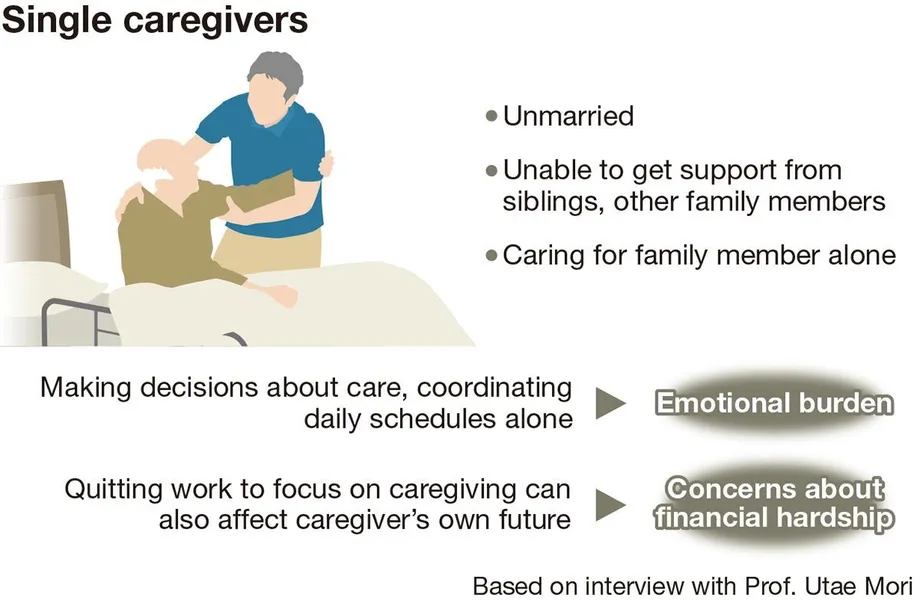
This arrangement is often called “single caregiving”: an unmarried adult child taking primary or sole responsibility for an aging parent. The phrase describes the concentration of care on one person, not necessarily a complete absence of public services or relatives. As Japan’s population ages, family sizes shrink and more people remain unmarried, the number of adults facing this kind of responsibility is expected to grow.
Why more people may be affected
Japan already has one of the world’s oldest populations. Government population estimates put the number of residents aged 65 and over at 36.18 million in 2023, or 29% of the population. People aged 75 and over numbered 19.57 million, or 15.7%. That older age group is especially relevant to care demand: in fiscal 2020, 23.4% of people aged 75 and over covered by the long-term care insurance system were certified as requiring long-term care, compared with 3% of those aged 65 and over.
Projections from Japan’s National Institute of Population and Social Security Research indicate that the share of residents aged 65 and over could reach 34.8% in 2040 and 38.7% in 2070. The population aged 75 and over is projected to make up 19.7% in 2040 and 25.1% in 2070. Even if the number of older people eventually falls, their share of the total population is expected to remain high, sustaining demand for support.
At the same time, the pool of potential family caregivers is changing. In 2020, 28.3% of Japanese men and 17.9% of women were unmarried at age 50. The institute projects those shares will rise by 2040, to 30.4% for men and 22.3% for women. A person may be unmarried, divorced, or have siblings who live far away or are unable to help. In each case, practical responsibility can gather around the relative who is closest or most available.
Household patterns also point to fewer relatives living together. A review of Japan’s 2022 National Survey on Living Conditions found that three-generation households among households with a care recipient fell from 32.5% in 2001 to 10.9% in 2022. Over the same period, single-person households in this group rose from 15.7% to 30.7%. Smaller households can mean fewer people at home to share tasks, even when relatives remain involved from a distance.
Care services help, but families still carry much of the work
Japan’s long-term care insurance system, established in 2000, helps eligible people access services such as home care, day services and residential facilities. Care needs are assessed, and the resulting plan can combine different forms of support. The system can reduce the load on relatives, but it does not eliminate the need for family members to coordinate appointments, track changes, provide meals or respond when plans fall short.
Family members remain central to care. In the 2022 National Survey on Living Conditions, 56.4% of primary caregivers were family members, while public care service providers accounted for 15.7%. The term “primary caregiver” identifies the person regarded as chiefly responsible; it does not capture every hour of help from other relatives, professionals or neighbors. Still, the figures show how much care continues to depend on households.
Public services also face staffing constraints. Japan had about 2.15 million care workers in 2021. Ministry estimates put the number needed at about 2.43 million in 2025 and 2.8 million in 2040. In 2022, the job-to-applicant ratio for care workers was 3.71, compared with 1.16 across all occupations. A 2021 survey found that 63% of care providers said they had some degree of staffing shortage. These pressures make it difficult to assume that professional services can replace family care entirely.
That does not mean families should be expected to fill every gap. Care is often a mix of formal services and informal help from relatives, friends, neighbors and volunteers. The challenge for policy is to make that mix workable without leaving one family member to absorb the time, cost and emotional strain alone.
The costs are emotional, physical and financial
A 2022 survey of 324 unmarried people caring for family members, conducted by Utae Mori, a social security studies professor at Osaka University of Economics, found that 58.3% were concerned about emotional exhaustion. More than half also cited their own health or illness, at 51.5%, and living expenses, at 50.6%. Among respondents who had quit or changed jobs, 24.5% said the physical and emotional demands were too great to continue working.
These concerns can reinforce one another. Time spent on care can limit paid work, while reduced income makes it harder to pay for help or plan for the caregiver’s own later life. Exhaustion can also make it more difficult to manage schedules, communicate with service providers and notice changes in a parent’s condition. Caregivers may be managing their own health and aging at the same time.
Mori has warned that a person and those around them can come to treat caregiving as simply their responsibility. That expectation may make it harder to recognize when the burden has become unsustainable or to ask for help. The Chiba woman’s experience illustrates that professional knowledge does not remove the emotional pressure of deciding what is best for a parent.
Mori advises caregivers to consult a care professional and use available services to create physical and emotional breathing room. She also argues that communities need to make it easier for people to speak openly about what they are experiencing. Recognition matters because isolation can hide a problem until work, health or the parent’s safety is already at risk.
Peer groups offer a place to speak plainly
In Nagasaki, a group focused on single caregiving holds gatherings at a cafe every two months. Participants talk about the strain of caring for someone who is also a close family member, and about uncertainty over their own lives once the caregiving ends. For some, hearing others describe similar pressures brings relief from the belief that they are facing the situation alone.
The group’s organizer, 50-year-old Maki Mori, experienced solo care herself. In her early 30s, she cared for her father while helping her grandmother with daily life. She left her job and became isolated from her community before finding the group and attending its meetings.
Mori says everyday conversation does not always leave room to discuss the difficulty of carrying care responsibilities alone. She hopes that speaking openly at the gatherings can ease some of that burden. Peer support cannot provide home visits or replace professional care, but it can give caregivers a place to compare experiences, discuss practical worries and recognize when they need additional help.
Moving into residential care can be a responsible choice
Home care is not always the safest or most sustainable arrangement. In Tokyo’s Shinagawa Ward, an unmarried man in his early 60s had cared for his mother, around 90 and living with dementia, while continuing to work. His brother lived nearby but did not take part in her care.
After his mother contracted influenza, she spent about a month in hospital and lost strength in her legs. The family faced a practical safety concern: she lived in a fourth-floor apartment and might no longer be able to climb the stairs. After consulting her care manager, her son arranged for rehabilitation at a geriatric health services facility, followed by a move to a group home. These facilities provide a residential setting for small groups of people with dementia, with support adapted to their daily needs.
His mother moved into the group home in April and now lives there peacefully, according to her son, who visits each weekend. After a decade of caring for her at home, he said the constant worry had become mentally exhausting. He is glad he made the move when he did. Choosing residential care can reflect a careful assessment of safety and well-being, rather than a lack of devotion.
Care managers and local authorities can help families understand what services are available and how a person’s needs might be met. Japan’s health ministry recommends contacting the municipal office responsible for long-term care insurance or a local comprehensive community support center. These centers can connect older residents and families with care planning, health and welfare resources, and advice on possible next steps.
Making care sustainable for both generations
Japan’s aging population and shortage of care workers mean families are likely to remain part of the care system. Yet a model that depends on one adult child quietly filling every gap is fragile. It can threaten the caregiver’s income and health while making care itself dependent on a person who may eventually be unable to continue.
Support starts with treating the caregiver’s needs as part of the care plan. Regular professional services, clear communication with employers, contact with local support centers and opportunities to talk with peers can help. Residential care may also be appropriate as an older person’s physical or cognitive needs change. These options do not have to be viewed as signs of failure; they are ways to match care to changing circumstances.
Longer-term planning must also account for the workforce needed to provide services and the social supports that allow families to contribute without bearing the full cost alone. When caregivers can ask for help early, decisions can be made before exhaustion or a medical crisis narrows the choices.
Key Points
- Single caregiving places much of an aging parent’s care on one unmarried adult child.
- Japan’s older population is growing as household sizes shrink and the share of people unmarried at age 50 is projected to rise.
- More than half of primary caregivers in the 2022 national survey were family members.
- Unmarried caregivers report concerns about emotional exhaustion, their own health and living costs.
- Care managers, municipal long-term care offices, community support centers, peer groups and residential facilities can help families share or adjust care.