
Robots are changing how China grows and harvests food
From machines that pollinate flowers to driverless harvesters moving across vast grain fields, intelligent equipment is reshaping agriculture in China. The tools are beginning to address long-standing pressures on farmers: labor shortages, rising costs, the need for reliable yields and the challenge of producing food amid extreme weather.
Contents
The technology ranges from specialized robots for breeding and tea picking to drones that spray crops, systems that guide irrigation and platforms that collect field data. Some machines are designed for large commercial farms, while lighter equipment targets smaller holdings and steep terrain. Together, they point to a shift from isolated automation toward farming systems in which sensors, positioning technology, artificial intelligence and machinery work in coordination.
That shift is also linked to national priorities. China feeds nearly one-fifth of the world's population with less than 9 percent of its arable land, and food security has become more difficult to manage amid geopolitical uncertainty and increasingly frequent extreme weather. The country reported grain output above 700 million tonnes in both 2024 and 2025, while per capita grain availability exceeded 500 kilograms, according to figures cited by Chinese authorities.
China's modernization plans set further targets for technology-led production. The national smart agriculture action plan aims for more than 30 percent of agricultural production to be information-driven by the end of 2026, rising above 32 percent by the end of 2028. A 2026-2030 modernization plan calls for science and technology to contribute 67 percent to agricultural development.
What can robots do beyond driving tractors?
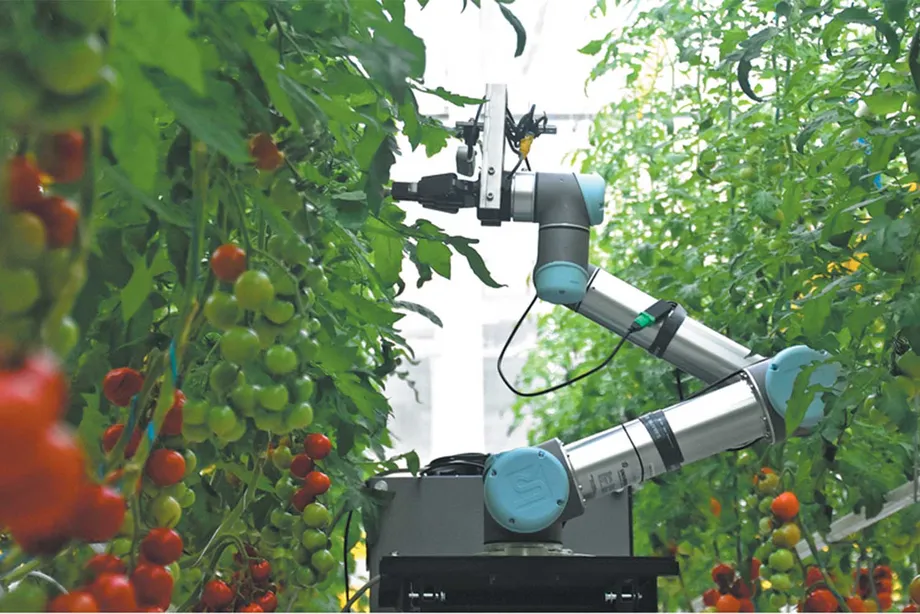
Some of the most targeted systems work on tasks that are difficult to mechanize with conventional equipment. GEAIR, described as the world's first intelligent breeding robot, uses deep-learning technology to identify flowers and carry out cross-pollination. Cross-pollination transfers pollen between plants to create hybrids with selected traits. In tomato breeding, the system is reported to shorten a breeding cycle from five years to one and reduce labor costs by more than 25 percent. In soybean breeding, it cuts manual pollination time by 76.2 percent.
That kind of automation can speed up the development of crop varieties, though the results depend on the plants, breeding process and conditions in which the system is used. It also illustrates how AI in agriculture often means a focused tool: software identifies a flower or crop feature, and a mechanical system performs a precise action.
A separate machine is being developed for corn breeding. It automates detasseling, the removal of a plant's male flowers, as well as topping. These steps help breeders control which plants pollinate others. Doing the work accurately at scale can reduce manual labor and equipment costs, while supporting more consistent breeding trials.
In controlled plant factories, a machine cow phenotyping robot gathers standardized information about crops, including plant height and structure. Phenotyping means measuring observable traits. The robot navigates preset routes, avoids obstacles and uses image recognition to collect data continuously. Compared with manual measurements, the approach can reduce delays and subjective differences between observers. Combined with controlled growing conditions, it helps researchers advance generations of crops more quickly.
Can machines pick delicate crops?
Tea picking is a demanding test for agricultural robotics. Premium tea depends on selecting tender buds without damaging surrounding leaves and branches, often across plantations with uneven ground. A humanoid tea-picking machine developed for plantations in Zhejiang, Anhui, Fujian, Sichuan and Guizhou combines machine vision with a mechanism modeled on the motions of a human hand.
Its system locates suitable shoots, then pinches, lifts, stores and releases them. The current design is intended for flat and gently sloping land. Developers expect future models to use lighter frames and multiple robotic arms, which could expand the amount of ground covered. The technology is still bounded by the conditions it can handle: dense foliage, changing light and steep slopes can all complicate recognition and movement.
Similar challenges appear in orchards, where branches, fruit and terrain vary from row to row. In Beijing's Pinggu District, weather stations at the Xiying Future Orchard monitor local conditions, while machines and drones assist with tasks from furrowing to watering, fertilizing and spraying. The district produces nearly half of Beijing's fruit output value, but officials cite labor shortages and limits to large-scale cultivation as concerns for the industry's long-term growth.
Yu Yongqiang, director of Pinggu's fruit services center, said the broad use of smart equipment is becoming necessary for the orchard industry. In Guangxi, mango grower Huang Xianjun said agricultural drones helped reduce overall costs by 30 percent while producing more consistent yields on his 1,300-mu orchard, an area of about 86.7 hectares. Results vary by farm, crop and equipment, but these examples show why growers are weighing automation as a practical business decision.
How do drones and irrigation systems fit together?
Agricultural drones can spray crop-protection products, spread fertilizer or seed, and move materials. The DJI Agras T100S combines spraying, spreading and lifting functions for use in field crops, orchards, forests and aquaculture. Its equipment includes LiDAR, a laser-based system for measuring distance and mapping surroundings, along with millimeter-wave radar and cameras to help it operate in complex terrain. The T55 is a lighter model designed for one-person operation and smaller or scattered plots, including orchards and mountainous farmland.
These systems are part of a much larger fleet. China's agricultural drone count exceeded 300,000, while the overall mechanization rate for plowing, sowing and harvesting reached 76.7 percent in 2025, according to ministry figures. Drones are also used outside China for crop protection, fertilizer delivery and aquaculture feeding, including in the United States, Mexico, Brazil and Thailand.
Positioning technology helps coordinate machines and reduce overlap. China's BeiDou Navigation Satellite System provides location data for agricultural equipment. By the end of 2023, about 2.2 million agricultural machines nationwide had BeiDou terminals, enabling functions such as guided routes and assisted driving.
Water management is another piece of the system. Center-pivot sprinklers move in a circle, so they can leave the corners of square or irregular fields dry. A smart corner irrigation attachment extends an adjustable arm to water those otherwise missed areas, then retracts as the machine moves. BeiDou positioning, route algorithms and maps created using drones help tailor water and fertilizer application to crop moisture and growth conditions. Farmers can adjust the speed and water volume remotely by smartphone. The system has been deployed in Henan and Inner Mongolia.
The value of linking these tools lies in making decisions with more local information. Sensors and field maps can help estimate soil moisture, temperature and crop condition, while drones can collect data on growth or maturity. That information can guide irrigation, pest management and harvest timing. It does not remove uncertainty from farming, but it can replace some guesswork with measurements taken across more of a field than a person could check by hand.
Where is automation expanding at scale?
Heilongjiang, a major grain-producing province in northeast China, offers a view of large-scale deployment. At a demonstration farm near Harbin and Jiamusi, international journalists observed driverless harvesters following planned routes, drones patrolling overhead and digital platforms displaying field conditions. At a local tractor manufacturer, visitors tried a diesel-electric hybrid tractor equipped with BeiDou navigation and assisted driving.
Autonomous harvesting requires more than a vehicle that can steer itself. Sensors and navigation systems must keep equipment on course, while software helps it respond to obstacles and changing field conditions. The same technologies can support sowing and other operations. Their usefulness depends on accurate maps, reliable positioning and equipment suited to the land.
That last condition matters in a country with wide differences in terrain and crop types. New equipment is being developed for hilly and mountainous fields, where large machines may be impractical. Tractors designed for slopes of 6 to 15 degrees are being promoted in provinces including Gansu, Chongqing and Sichuan. Mountain-adapted corn seeders are entering wider use in southwest and northwest China.
For the autumn season, authorities have also reported faster deployment of high-capacity combine harvesters and crop-protection drones able to carry payloads of up to 85 kilograms. Hybrid tractors rated at 200 to 300 horsepower and fully electric tractors rated at 25 to 75 horsepower have entered production. Hybrid rice harvesters and six-row cotton pickers with baling capability are expected to complete design work before mass production.
Who can afford the transition?
Cost and scale will shape how quickly the machinery spreads. Large farms and service providers may be able to keep expensive equipment in regular use, while smallholders may struggle to justify buying machines that are needed only for a short season. Government support is intended to narrow that gap. China's 2026 agricultural support policy list prioritizes subsidies for high-performance seeders, intelligent rice transplanters, advanced combines and machinery suited to hilly areas. It also supports professional services that allow smallholding farmers to hire equipment rather than own it.
That business model is changing who uses the technology. Justin Gong, co-founder of agritech company XAG, said growers accounted for 79 percent of the company's customers in 2025, compared with about half in 2021. Some farmers use equipment on their own land and provide services to others, creating a source of income that can spread costs across more hectares.
China's machinery industry is growing alongside domestic adoption. The country exported $9.305 billion in agricultural machinery and parts in the first half of 2025, a 26.5 percent increase from the same period a year earlier. XAG says it has exported products and services to 70 countries and regions. These sales suggest that Chinese manufacturers are competing internationally, although the fit of any machine depends on local crops, regulations, farm sizes and service networks.
Energy use is another area of change. Hybrid and electric equipment could reduce fuel consumption and operating costs, depending on the task and access to charging or maintenance. The economics are not uniform: a machine that works well on a large, flat farm may be too costly or difficult to operate on small, steep plots. Building reliable systems for varied geography remains a central technical and commercial challenge.
What remains difficult to automate?
Farming is less standardized than many factory processes. Soil, weather, crop varieties and field layouts change across short distances. A robot trained to recognize flowers or fruit in one setting may perform less reliably under different light or foliage. Machines must also withstand dust, rain, mud and long working days, while farmers need repairs and technical support during narrow planting and harvest windows.
Automation also depends on usable data. Smart machinery can collect measurements, but those figures need to be accurate and connected to decisions farmers can act on. BeiDou positioning, weather stations, drone maps and image recognition each provide part of the picture. Better coordination can make irrigation or spraying more precise, while poor data or weak connectivity can reduce the benefit.
For now, the most persuasive gains come from specific tasks: reducing repeated manual pollination, measuring plants consistently, applying inputs more precisely and helping machinery operate over larger areas. Broad claims about fully automated farms should be treated cautiously. The systems described here demonstrate a growing technical range, while their commercial value will depend on whether they deliver dependable savings under local conditions.
The Bottom Line
- Chinese farms are adopting robots, drones, smart irrigation and navigation systems for breeding, crop care and harvesting.
- GEAIR is reported to shorten tomato breeding from five years to one and reduce manual soybean pollination time by 76.2 percent.
- China's agricultural drone fleet exceeded 300,000, and crop plowing, sowing and harvesting mechanization reached 76.7 percent in 2025.
- Policy plans target wider use of digital agriculture, while subsidies support advanced machinery and equipment for difficult terrain.
- Labor savings and more precise field management are driving adoption, but cost, terrain, data quality and maintenance remain constraints.