
Mine blast puts Seoul’s response under scrutiny
Three South Korean soldiers were injured by explosions in the Demilitarized Zone (DMZ) on Sept. 21. Two were seriously hurt, including soldiers who suffered critical ankle injuries. A joint investigation by South Korea’s military and the U.S.-led United Nations Command later concluded that North Korean antipersonnel mines, deliberately buried south of the Military Demarcation Line (MDL), caused the blasts.
Contents
The finding prompted a mine clearing operation, calls for an apology from Pyongyang and a debate in Seoul over whether the government’s response was firm enough. At parliamentary audits, Defense Minister Kang Shin-chul defended the operation and said the military would maintain control of its activities near the boundary. Unification Minister Chung Dong-young stressed that investigators had not reached a final conclusion about North Korea’s intent to injure South Korean troops.
That distinction has become central to the dispute. Investigators concluded that the mines were deliberately placed, but officials have been more cautious about saying they were planted specifically to cause casualties. The government must also weigh its response against the risk of a further military clash in an area where the border is difficult to identify on the ground.
South Korea’s military said tests of residue and fragments found trinitrotoluene, or TNT, and synthetic resin consistent with North Korean plastic mines. Investigators also found an unexploded mine near the blast site. The command estimated the mines had been placed about 12 months earlier. GPS measurements located the blast sites and another mine roughly 10 meters south of the MDL.
The blast happened as South Korean troops were clearing a path for a joint inspection with the UNC. The planned inspection followed changes in the terrain that raised suspicions of mine laying. The military said its operation on Oct. 5 detonated mines confirmed to be south of the line. It was the first South Korean mine removal mission of this kind inside the DMZ buffer zone.
Why is the boundary so hard to police?
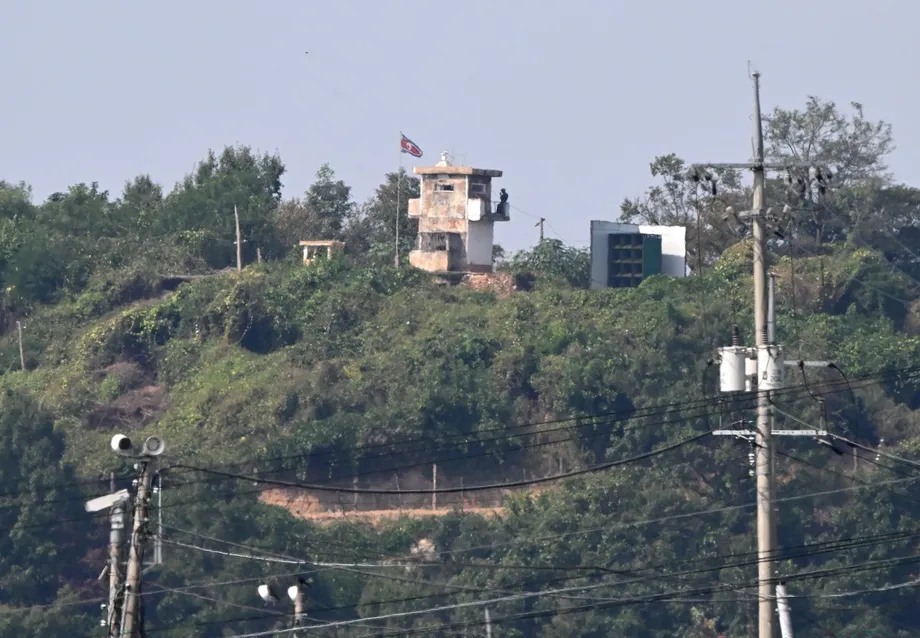
The DMZ is a roughly four kilometer wide buffer zone created by the 1953 armistice that halted fighting in the Korean War. The MDL runs through its center and serves as the effective land boundary between the two Koreas. The armistice prohibits hostile acts in the zone and restricts crossings of the line without authorization through the military armistice system.
Yet the boundary is not easy to see. More than 1,200 markers were installed along the MDL after the armistice, but only about 200 are said to remain intact. South Korea’s Defense Ministry has also acknowledged that its coordinate references and those used by the UNC differ across roughly 60 percent of the boundary. Weather, terrain and deteriorating markers make it harder for troops working near the line to know exactly where it lies.
That uncertainty is politically sensitive. South Korean officials say North Korean troops have repeatedly crossed south of the MDL during border fortification work. Under Seoul’s rules of engagement, South Korean forces fire warning shots when troops cross the line. North Korea, meanwhile, has warned that it would respond forcefully if South Korean personnel entered what it considers its territory.
The UNC has a formal role in the armistice system and oversees the border area. South Korea says it will work with the command to investigate reported crossings, establish whether the armistice was violated and notify Pyongyang while seeking corrective action. Unification Minister Chung has proposed talks to clarify the line, but North Korea has rejected dialogue on the issue.
What did the military say about its response?
At a parliamentary audit, Kang said the military was responding firmly to repeated crossings and would retain operational control in the area. He also told lawmakers that there may be several other places south of the MDL where North Korean mines were planted. Asked whether hundreds could remain, he said the military believed that was possible.
“We plan to conduct joint investigations with the UNC, clearly establish the facts and then continue taking necessary measures,” Kang said.
South Korea’s Joint Chiefs of Staff chairman, Gen. Jin Yong-sung, described the blast as a provocation, saying he had never thought otherwise after one of his soldiers was seriously injured. He also said he had not focused on the fact that the word “provocation” was absent from an earlier military announcement. Jin called the mine clearing operation significant, saying it removed a threat to troops and demonstrated the military’s resolve. He said additional response measures would remain under review.
The military has described the Oct. 5 operation as a response to the casualties and said it may continue clearing mines if North Korea does not remove them. The operation was coordinated with the UNC, with advance notification intended to reduce the risk of an accidental clash. South Korean officials have also said they are examining ways to improve surveillance and reduce blind spots along the frontier.
Pyongyang denies responsibility. North Korea’s Foreign Ministry called Seoul’s findings fabricated and warned of “immediate and powerful counteraction” if South Korean forces crossed even a small distance into territory it claims. The statement also rejected talks about the boundary, framing its border work as an exercise of sovereignty.
Why is Seoul balancing pressure with dialogue?
The mine dispute tests President Lee Jae-myung’s effort to lower tensions with the North. His administration has pursued a less confrontational approach, including suspending border loudspeaker broadcasts and pledging to restore a 2018 inter-Korean military agreement. Unification officials say they will continue seeking dialogue and peaceful solutions even as the military and diplomatic services respond to the mine findings.
Chung called the blast an “unfortunate accident” during the audit, drawing criticism from People Power Party lawmaker Park Chung-kwon, a North Korean defector. Park objected to the wording and called the mine clearing operation “idiotic,” arguing that North Korea should remove mines it had planted. Chung replied that the military had acted to protect personnel. He said the government had not made a final determination about whether North Korea intended to cause the injuries.
Foreign Minister Cho Hyun said the government was reviewing diplomatic options with the National Security Council while trying to prevent unnecessary escalation. The possibilities under consideration include raising the issue at the United Nations, sending a letter to the Security Council or choosing a response outside that body. Cho said the government was also considering measures tied to North Korea’s cyber activity, though officials have not established that such steps would be a direct response to the mine incident.
The experience of 2015 offers a comparison, though officials say the circumstances are different. That year, wooden box mines attributed to North Korea seriously injured two South Korean soldiers. Seoul resumed loudspeaker broadcasts, and the two sides exchanged artillery fire before senior officials reached an agreement that included a North Korean expression of regret. Today, the South has removed its border loudspeakers, while Pyongyang has denied responsibility and rejected talks.
South Korean officials have said a range of military options is being studied, from continued mine clearing to displays of conventional military capability. Loudspeaker broadcasts have not been identified as an immediate step. The government’s challenge is to make clear that it will protect its troops and contest armistice violations without triggering a cycle of retaliation that leaves less room for communication.
Border fortification adds to the risk
The mines are part of a broader North Korean border construction effort. Since 2024, North Korean troops have reinforced fences, planted mines and built anti tank barriers along sections of the MDL. The campaign followed leader Kim Jong-un’s declaration that the two Koreas should be treated as hostile states rather than partners working toward reunification.
South Korea’s military has reported increased North Korean activity near the boundary and dozens of crossings south of the MDL since the fortification work began. It has said thousands of North Korean personnel may be involved in clearing land and building defenses, particularly along the eastern front. North Korea says the work is for border security and has warned against interference.
The combination of poorly marked coordinates, construction close to the line and live mines creates risks beyond any single incident. A troop movement that one side considers routine can be interpreted by the other as a violation. A warning shot or retaliatory action could then escalate quickly, even if neither side initially intended a wider confrontation.
At the audit, lawmakers also raised questions about other military readiness concerns. Reform Party lawmaker Cheon Ha-ram wore recording smart glasses during a Defense Ministry hearing and said he had entered the compound in a Chinese made BYD electric vehicle equipped with cameras and cellular connectivity. Kang acknowledged there were no specific rules barring such vehicles from military sites and said protections should be strengthened.
Lawmakers also questioned whether South Korea has enough specialists for its planned nuclear powered submarine program. Kang said the military currently has hundreds of relevant personnel, while thousands would be needed, and said training and education would be prepared. The ministry also said it would pursue an assessment of the future Combined Forces Command as part of planning for the eventual transfer of wartime operational control from the United States to South Korea.
Key Points
- A joint South Korean and UNC investigation concluded that North Korean mines planted south of the MDL caused the Sept. 21 explosions.
- Three South Korean soldiers were injured, two seriously.
- South Korean troops detonated mines near the blast site in the military’s first such operation inside the DMZ buffer zone.
- Seoul says more mines may remain south of the boundary and is seeking further joint investigations.
- North Korea denies responsibility, rejects talks and warns of a forceful response to any South Korean border intrusion.
- South Korea is weighing military and diplomatic measures while its unification officials continue to call for dialogue.